Fought The
p. 76 · Read in the full issue
When The Americans Fought The Battle Of Malolo
By. Capt. S. B. Brown
When the battles of Guadalcanal, and the Pacific campaign in general, were still in the planning stage, Nadi Bay in Fiji, close by the present international airport, was an anchorage and base for those of the big ships of the United States Pacific Fleet that had survived the holocaust of Pearl Harbour.
ris often assumed that this was the first appearance of the United States Navy in an aggressive role in those waters.
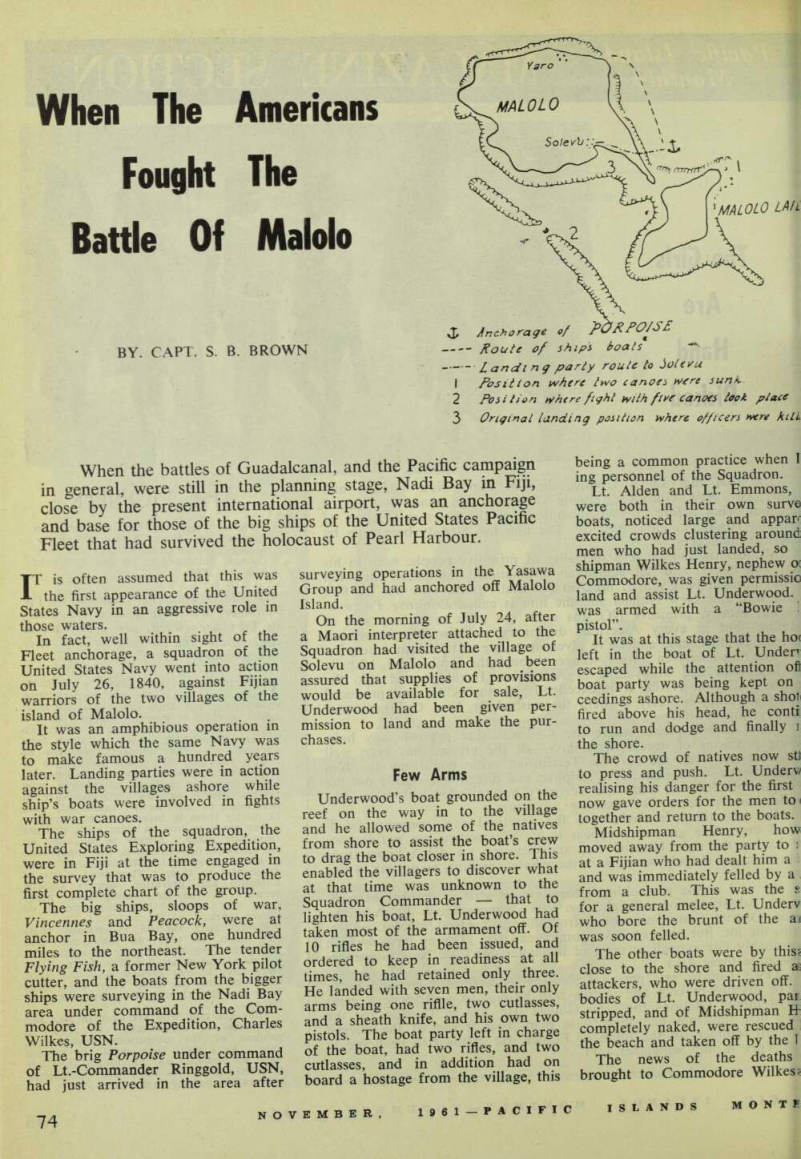
In fact, well within sight of the Fleet anchorage, a squadron of the United States Navy went into action on July 26, 1840, against Fijian warriors of the two villages of the island of Malolo.
It was an amphibious operation m the style which the same Navy was to make famous a hundred years later. Landing parties were in action against the villages ashore while ship’s boats were involved in fights with war canoes.
The ships of the squadron, the United States Exploring Expedition, were in Fiji at the time engaged in the survey that was to produce the first complete chart of the group.
The big ships, sloops of war, Vincennes and Peacock, were at anchor in Bua Bay, one hundred miles to the northeast. The tender Flying Fish, a former New York pilot cutter, and the boats from the bigger ships were surveying in the Nadi Bay area under command of the Com modore of the Expedition, Charles Wilkes, USN.
The brig Porpoise under command of Lt.-Commander Ringgold, USN, had just arrived in the area after
surveying operations in the Yasawa Group and had anchored off Malolo Island.
On the morning of July 24, after a Maori interpreter attached to the Squadron had visited the village of Solevu on Malolo and had been assured that supplies of provisions would be available for sale, Lt.
Underwood had been given per mission to land and make the pur chases.
Few Arms Underwood’s boat grounded on the reef on the way in to the village and he allowed some of the natives from shore to assist the boat’s crew to drag the boat closer in shore. This enabled the villagers to discover what at that time was unknown to the Squadron Commander that to lighten his boat, Lt. Underwood had taken most of the armament off. Of 10 rifles he had been issued, and ordered to keep in readiness at all times, he had retained only three.
He landed with seven men, their only arms being one riffle, two cutlasses, and a sheath knife, and his own two pistols. The boat party left in charge of the boat, had two rifles, and two cutlasses, and in addition had on board a hostage from the village, this
being a common practice when I ing personnel of the Squadron.
Lt. Alden and Lt. Emmons, were both in their own surv© boats, noticed large and appar excited crowds clustering around men who had just landed, so shipman Wilkes Henry, nephew oc Commodore, was given permissio land and assist Lt. Underwood, was armed with a “Bowie pistol”.
It was at this stage that the hot left in the boat of Lt. Unden escaped while the attention ofl boat party was being kept on ceedings ashore. Although a shot fired above his head, he conti to run and dodge and finally i the shore.
The crowd of natives now stl to press and push. Lt. Undervv realising his danger for the first now gave orders for the men to< together and return to the boats.
Midshipman Henry, how moved away from the party to : at a Fijian who had dealt him a and was immediately felled by a from a club. This was the s for a general melee, Lt. Underv who bore the brunt of the ai was soon felled.
The other boats were by this? close to the shore and fired as attackers, who were driven off. bodies of Lt. Underwood, par stripped, and of Midshipman K completely naked, were rescued the beach and taken off by the 1 The news of the deaths brought to Commodore Wilkes*