Magazine Section
p. 75 · Read in the full issue
Pacific Islands Monthly
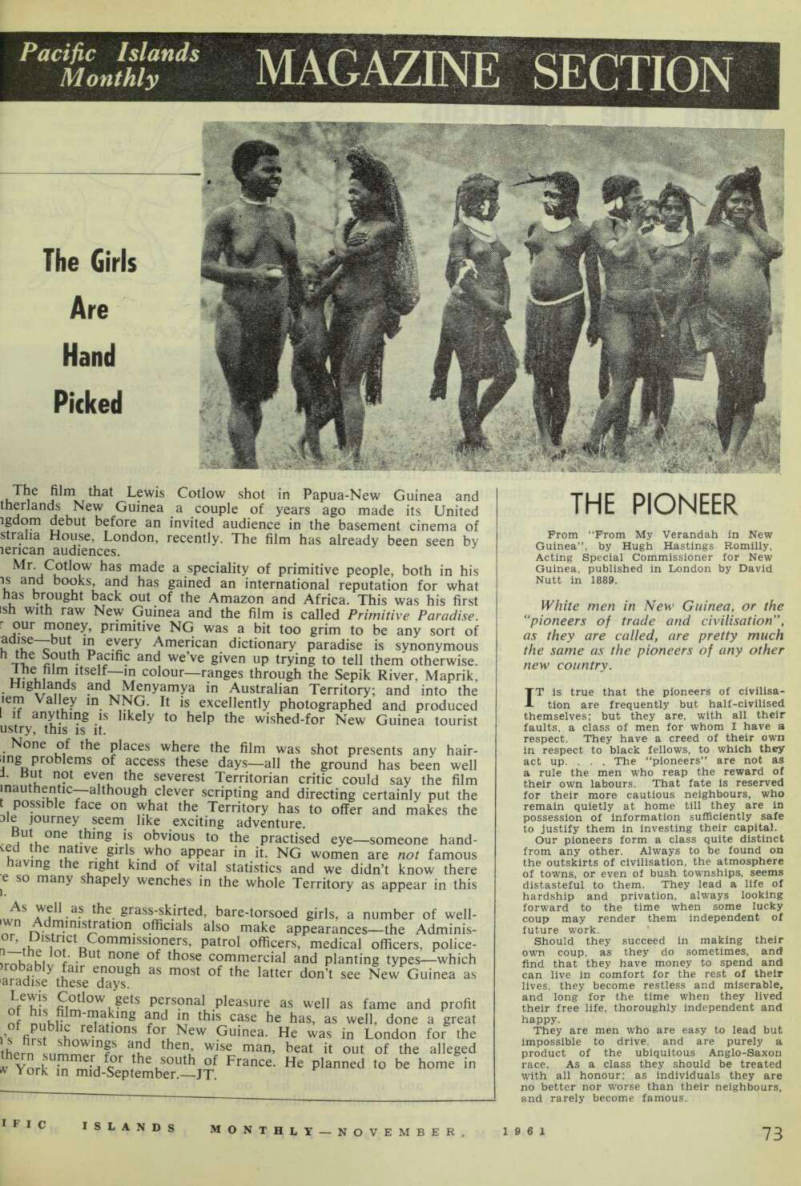
The Girls Are Hand Picked
The him that Lewis Cotlow shot in Papua-New Guinea and therlands New Guinea a couple of years ago made its United igdom debut before an invited audience in the basement cinema of stralia House, London, recently. The film has already been seen by lencan audiences.
Mr. Cotlow has made a speciality of primitive people, both in his is and books, and has gained an international reputation for what has brought back out of the Amazon and Africa. This was his first ish with raw New Guinea and the film is called Primitive Paradise. r Ur n ? one y’ PHhdtive NG was a bit too grim to be any sort of ka o Ut u e -^ ery American dictionary paradise is synonymous h tS C «? Ut • 1 • and weVe given U P trying to them otherwise, ine mm itself—in colour—ranges through the Sepik River, Maprik, Highlands and Menyamya in Australian Territory; and into the Jem Valley in NNG. It is excellently photographed and produced if anything is likely to help the wished-for New Guinea tourist ustry, this is it.
None of the places where the film was shot presents any hair ing problems of access these days—all the ground has been well H! 1 5 >t ev , e ? the severest Territorian critic could say the film inauthentic— although clever scripting and directing certainly put the t possible face on what the Territory has to offer and makes the Die journey seem like exciting adventure. , u f, one thing is obvious to the practised eye—someone hand e native girls who appear in it. NG women are not famous having the right kind of vital statistics and we didn’t know there e so many shapely wenches in the whole Territory as appear in this * s ell . a ? the bare-torsoed girls, a number of well ministration officials also make appearances—the Adminis or, f District Commissioners, patrol officers, medical officers, police- JrnhQki f • n ° n u of those comm ercial and planting types—which aradtl these dTys 8 “ ° f 866 Guinea as n/u;! Gotlow S ets Personal pleasure as well as fame and profit of < nd x 1? this case he has > as well > done a g reat i’s f fir.t b lL re - atl ° nS , for , New Guinea - He was in London for the thern Lmm f S then ,l wise man > beat [t out of the sieged ■V York in m id4%,temb S e°r U _JT Fra " Ce ' He Pla " ned ‘° be h ° me
White men in New Guinea, or the
“pioneers of trade and civilisation”,
as they are called, are pretty much the same as the pioneers of any other new country.
IT is true that the pioneers of civilisa tion are frequently but half-civilised themselves: but they are, with all their faults, a class of men for whom I have a respect. They have a creed of their own in respect to black fellows, to which they act up. . . . The “pioneers” are not as a rule the men who reap the reward of their own labours. That fate is reserved for their more cautious neighbours, who remain quietly at home till they are in possession of information sufficiently safe to justify them in investing their capital.
Our pioneers form a class quite distinct from any other. Always to be found on the outskirts of civilisation, the atmosphere of towns, or even of bush townships, seems distasteful to them. They lead a life of hardship and privation, always looking forward to the time when some lucky coup may render them independent of future work.
Should they succeed in making their own coup, as they do sometimes, and find that they have money to spend and can live in comfort for the rest of their lives, they become restless and miserable, and long for the time when they lived their free life, thoroughly independent and happy.
They are men who are easy to lead but impossible to drive, and are purely a product of the übiquitous Anglo-Saxon race. As a class they should be treated with all honour; as individuals they are no better nor worse than their neighbours, and rarely become famous.
The Pioneer
From “From My Verandah in New Guinea”, by Hugh Hastings Romilly, Acting Special Commissioner for New Guinea, published in London by David Nutt in 1889.