They "Exacted Retribution"
pp. 77-99 · Read in the full issue
ne when he was just completing a t of observations that virtually ided the work in that area.
He states in his narrative that he cided immediately to exact retri ition. Meanwhile, he proceeded to ganise the burial of the two officers.
He chose a small sandy island off ida Point, the island of Kadavu tilai, and after interring the two dies purposely left no stone to irk the spot, rather obscuring foot irks and covering the area with ives so that the bodies should not dug up and eaten.
He named the island Henry Island, and the small group of which it is a part, he named the Underwood Islands, He then issued orders for the attack on the island. Only men on the sick list were to be left on board Porpoise to man the guns and thus prevent any natives escaping across the reef to Malolo Lailai. During the ensuing action the brig was only required to fire once, when two natives attempted to cross the reef.
The landing party of 70 officers and men in three divisions were under the command of Lt.-Commander Ringgold. The Squadron Com mander took charge of the tender and boats. The tender grounded on a coral patch when getting under way and took no further part in the action that followed.
The plan of the attack is best seen from the diagram. The land ing parties were to land and destroy the village of Solevu and then to march across the island and cut off the defenders of Yaro village while it was under attack from the boats on the seaward side. All canoes met during the action were to be sunk or destroyed on the beach and in addition it was planned to destroy all gardens and crops.
Fully Armed
All the men were fully armed and the parties were equipped with ship’s rockets, which had already proved useful in starting fires and in im pressing the Fijians, who had christened them “Fiery spirits”.
Main resistance occurred at Solevu where men from Yaro had also gone to assist in the defence. Their fort, a strong palisade of coconut logs overlaid with wickerwork with a wide moat outside had already, in the past, withstood attacks from other Fijian war parties.
The defence, at first, appeared impervious to attack with bullets, and a strong fire by muskets and bows and arrows was kept up. Eventually a rocket was successfully launched and started a fire within the stockade and the defenders commenced mak ing their escape through a gate that was not under attack.
Eventually they were driven out and the stockade and all the houses were destroyed by fire. Soon after the party had landed two canoes were sighted off the east point of (Continued on p. 97)
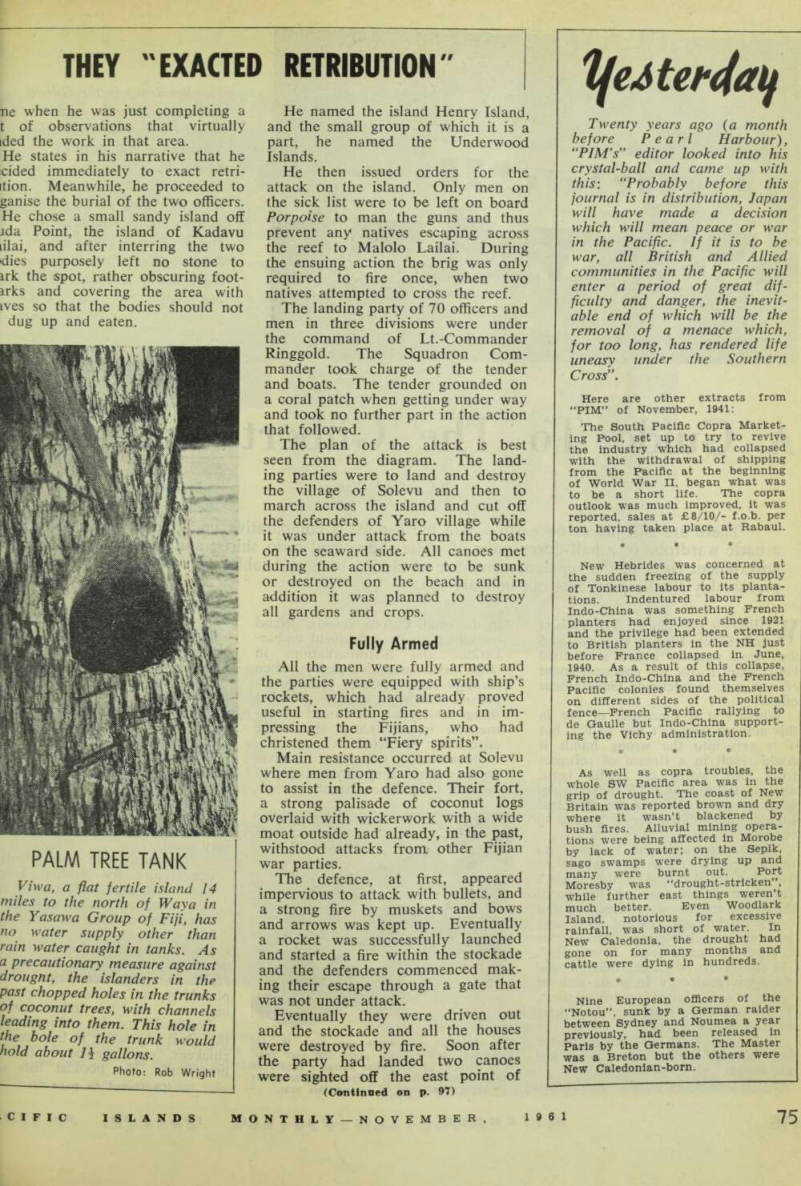
Palm Tree Tank
Viwa, a flat fertile island 14 miles to the north of Waya in the Yasawa Group of Fiji, has no water supply other than rain water caught in tanks. As a precautionary measure against drougnt, the islanders in the past chopped holes in the trunks of coconut trees, with channels leading into them. This hole in the bole of the trunk would hold about 1½ gallons.
Photo: Rob Wright
They were attacked by the nd sunk and their occupants nt aboard the brig, ommander Ringgold, after ing all the gardens and id root crops, marched his ross the island for the attack ) but arrived to find the village in flames. The boat party ;t with slight resistance, and n easy landing—the shore reef quite narrow at this place. canoes which were found I had also been destroyed, e meantime, Lt. Emmons had i search of five canoes which jen sighted earlier, and his :rew had pulled almost com around the island before sight canoes. The canoes made no to escape, but closed together, their sails, and advanced to the boat. Their crews fought ichind a breastwork designed ect them from the shot. what is described in the idore’s narrative as a “short rce engagement” one canoe 1, one was sunk and three were d. Lt. Emmons returned to >rpoise at midnight with his •rizes. day a peace overture was >y a woman, but this was re by Wilkes who knew enough Fijians’ customs to realise that peace would never be recog as a defeat. Eventually the •s came and begged forgiveness ■rendered themselves to Wilkes, mded one of the earliest US mgagements in the Pacific, iously Wilkes had destroyed llages on Vanua Levu, one of