Territories TALK-TALK
pp. 37-39 · Read in the full issue
With Tolala
It would seem that P-NG is being subjected to a gentle wculation of tourism propaganda, according to the local news apers up there. And goodness knows it's about time they ealised the potentialities (wonderful word!) which have lain 'ormant these many years and require only the studied tech ique of an expert PRO to extract a few millions of money rom the pockets of tourist-hungry folk from far and wide.
i I have already pointed out in rthese columns, tourist money is money and is not the same old id note circulating locally. Ergo: something to be fostered to the ;st extent. NG German times, when the i “tourism” was unknown, there ; two popular “health resorts” in colony: One at Toma on the elle Peninsula, the other at slberg, back from Finsch Haven the mainland. Both were well onised by Europeans recovering i fever or other ailments, he Toma resort, started by the ' Guinea Compagnie and situated the heights above Varzin planta in the Kokopo area, was sub ;ed by the German Government there one could obtain fresh milk meat and cool breezes, luxuries ;h were hard to come by in those » of no refrigerators, little ice and ! weeks between steamers, ut now—with the vast regions of Highlands settled—there are un possibilities available. So here’s d luck to the promoters. And t tourism become an important or in adding to Territorial revenue lout, if possible, having too bad influence upon the native people.
Fimely
ognition
t was good to read about the imony at Lae (and why not by?) on August 6 when the two 3’s were named “Leahy Brothers” 1 “Mustar” by the owners of the lective names. And the South ■ific Post graciously gave due ignition to the work of these neers when, in an editorial, it )te: There seems to be a growing bareness in the Territory of the teed to give these pioneers the ullest credit for their efforts. t takes time for this “awareness” be realised and the deeds of
pioneers recognised; sometimes —too often—not until they are dead. And who wants to wait until he’s dead before knowing his works have been appreciated?
It is a good sign, as the editorial indicates, that the B4’s and the Behinds are coming closer together.
It shows a trend for “togetherness”, as important a factor amongst the non-native people as tribal “cohesion” should be such an important aim amongst the natives.
Time tempers the envies and jealousies of the present plodders for the deeds of the pioneers and brings their actions into proper perspective.
But what we must ensure in this present day is that the record is according to fact and not embellished with their fictional romance or in correct data. Due care must be given to the spelling of proper names lest the errors of the present be handed down to future generations.
In this respect, for instance, in the captions beneath the photos of the Leahy Brothers in the same issue as the editorial above mentioned, appears the name of lan Grabowsky, the so capable pioneer general manager of Guinea Airways, but it is spelt in correctly. And incorrect spelling of proper names is too often perpetrated —and not only in New Guinea.
Where is That Rendezvous?
A couple of months ago 1 men tioned having been on a pub crawl in Sydney in search of old New Guinea faces. I repeated the search in late August—but without much success.
To be sure I met up with Arthur Browning in what is somewhat naively called the Sportsman’s Bar in the Hotel Australia, elbowed by pale faced youths, dressed in stove-pipe trousers and pointed shoes, together with various members of the PMG’s Department. (Over)
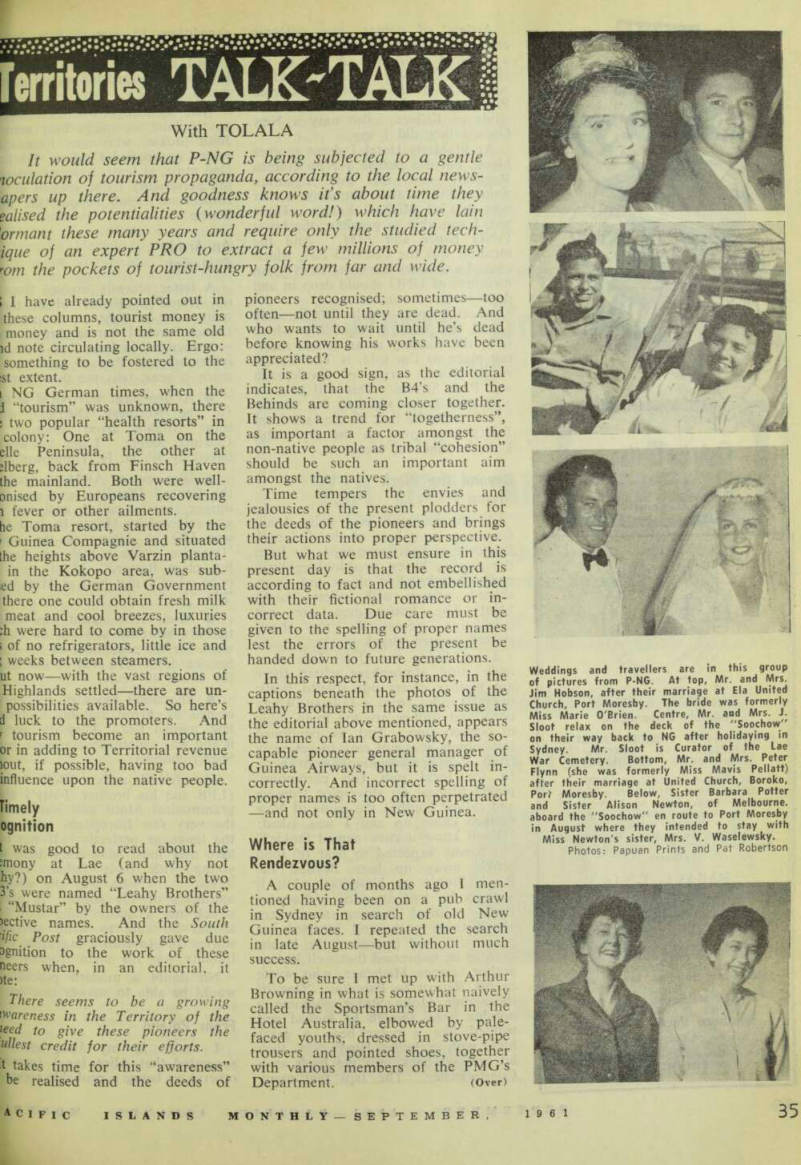
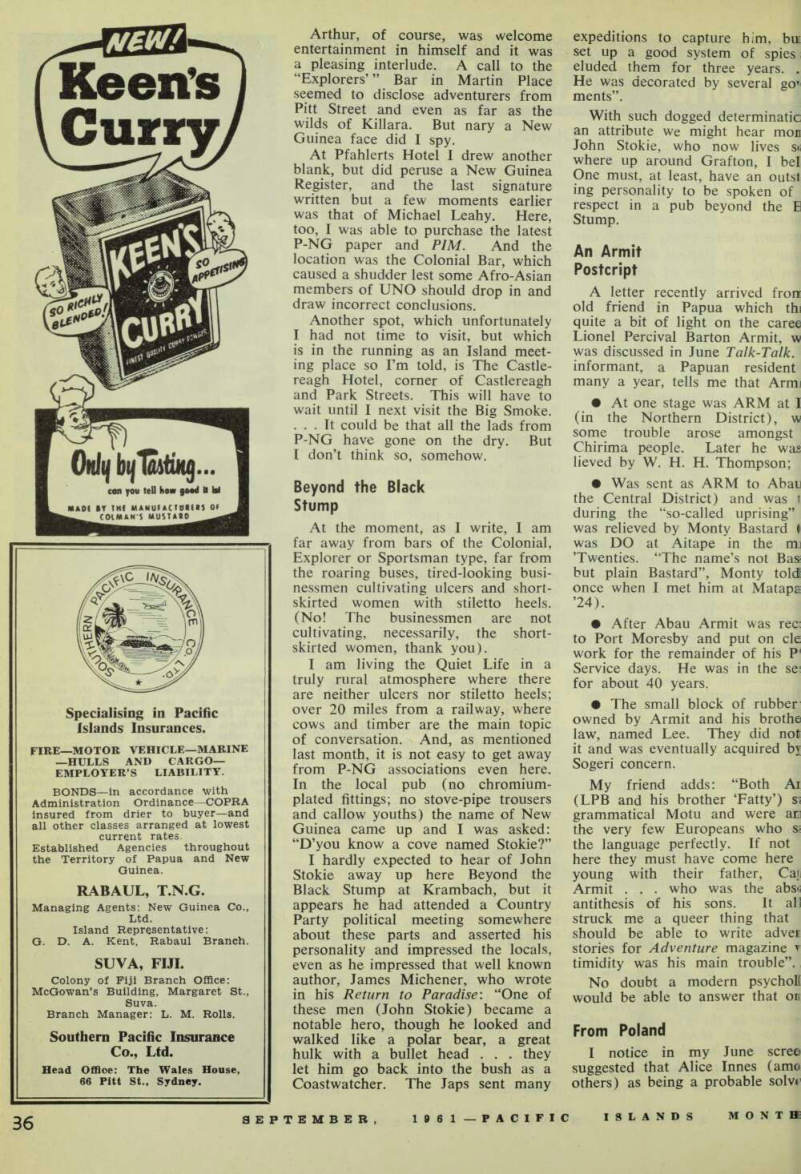
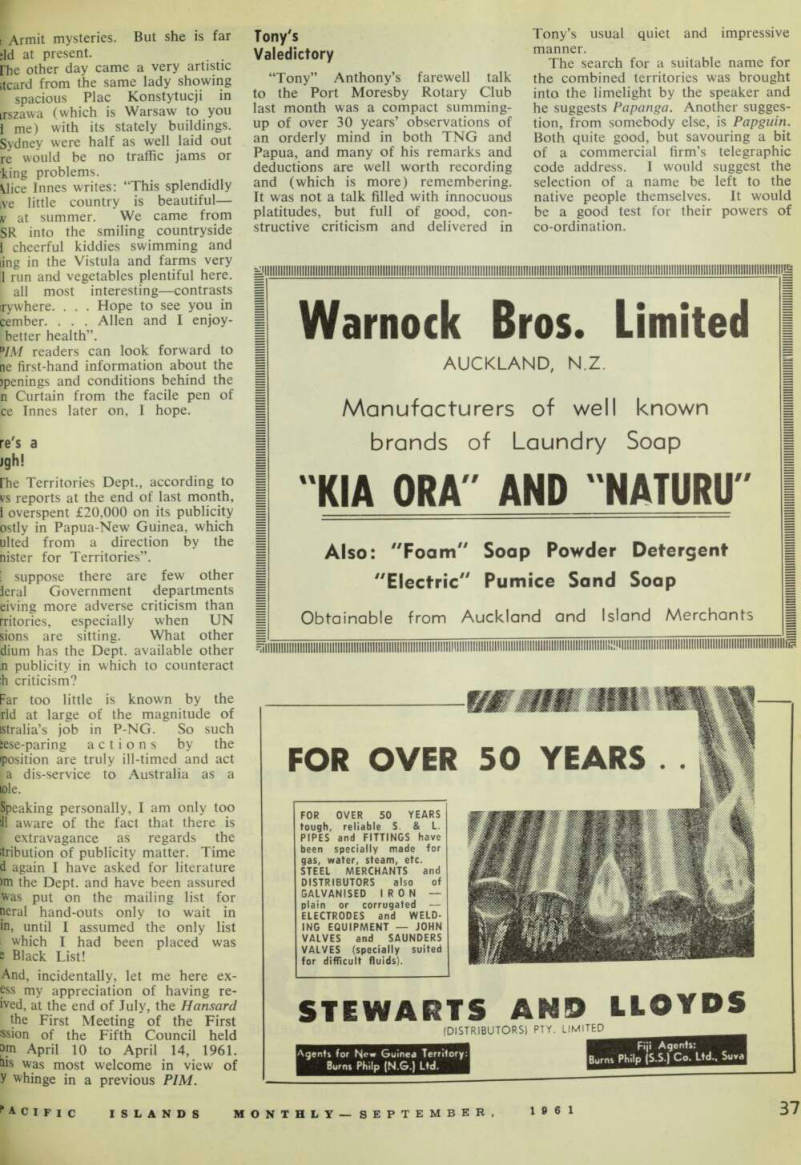
Weddings and travellers are in this group of pictures from P-NG. At top, Mr. and Mrs.
Jim Hobson, after their marriage at Ela United Church, Port Moresby. The bride was formerly Miss Marie O'Brien. Centre, Mr. and Mrs. J.
Sloot relax on the deck of the "Soochow" on their way back to NG after holidaying in Sydney. Mr. Sloot is Curator of the Lae War Cemetery. Bottom, Mr. and Mrs. Peter Flynn (she was formerly Miss Mavis Pellatt) after their marriage at United Church, Boroko, Pori- Moresby. Below, Sister Barbara Potter and Sister Alison Newton, of Melbourne, aboard the "Soochow" en route to Port Moresby in August where they intended to stay with Miss Newton's sister, Mrs. V. Waselewsky.
Photos: Papuan Prints and Pat Robertson
Arthur, of course, was welcome entertainment in himself and it was a pleasing interlude. A call to the “Explorers’ ” Bar in Martin Place seemed to disclose adventurers from Pitt Street and even as far as the wilds of Killara. But nary a New Guinea face did I spy.
At Pfahlerts Hotel I drew another blank, but did peruse a New Guinea Register, and the last signature written but a few moments earlier was that of Michael Leahy. Here, too, I was able to purchase the latest P-NG paper and PIM. And the location was the Colonial Bar, which caused a shudder lest some Afro-Asian members of UNO should drop in and draw incorrect conclusions.
Another spot, which unfortunately I had not time to visit, but which is in the running as an Island meet ing place so I’m told, is The Castle reagh Hotel, comer of Castlereagh and Park Streets. This will have to wait until I next visit the Big Smoke. ... It could be that all the lads from P-NG have gone on the dry. But I don’t think so, somehow.
Beyond the Black
Stump
At the moment, as I write, I am far away from bars of the Colonial, Explorer or Sportsman type, far from the roaring buses, tired-looking busi nessmen cultivating ulcers and short skirted women with stiletto heels. (No! The businessmen are not cultivating, necessarily, the short skirted women, thank you).
I am living the Quiet Life in a truly rural atmosphere where there are neither ulcers nor stiletto heels; over 20 miles from a railway, where cows and timber are the main topic of conversation. And, as mentioned last month, it is not easy to get away from P-NG associations even here.
In the local pub (no chromium plated fittings; no stove-pipe trousers and callow youths) the name of New Guinea came up and I was asked: “D’you know a cove named Stokie?”
I hardly expected to hear of John Stokie away up here Beyond the Black Stump at Krambach, but it appears he had attended a Country Party political meeting somewhere about these parts and asserted his personality and impressed the locals, even as he impressed that well known author, James Michener, who wrote in his Return to Paradise : “One of these men (John Stokie) became a notable hero, though he looked and walked like a polar bear, a great hulk with a bullet head . . . they let him go back into the bush as a Coastwatcher. The Japs sent many
expeditions to capture him, buc set up a good system of spies; eluded them for three years. .
He was decorated by several go T < ments”.
With such dogged determinate an attribute we might hear mon John Stokie, who now lives S(< where up around Grafton, I be!
One must, at least, have an outst ing personality to be spoken of respect in a pub beyond the E Stump.
An Armit
Postcript
A letter recently arrived front old friend in Papua which thi quite a bit of light on the caree Lionel Percival Barton Armit, w was discussed in June Talk-Talk. informant, a Papuan resident many a year, tells me that Armi • At one stage was ARM at I (in the Northern District), w some trouble arose amongst Chirima people. Later he was lieved by W. H. H. Thompson; • Was sent as ARM to Abau the Central District) and was 1 during the “so-called uprising” was relieved by Monty Bastard 0 was DO at Aitape in the rm ’Twenties. “The name’s not Bas but plain Bastard”, Monty told! once when I met him at Matapas ’24). • After Abau Armit was rec: to Port Moresby and put on cle work for the remainder of his P' Service days. He was in the se; for about 40 years. • The small block of rubber' owned by Armit and his broth© law, named Lee. They did not it and was eventually acquired bv Sogeri concern.
My friend adds: “Both Ai. (LPB and his brother ‘Fatty’) si grammatical Motu and were am the very few Europeans who si the language perfectly. If not here they must have come here young with their father, Cap Armit . . . who was the abs*« antithesis of his sons. It all struck me a queer thing that should be able to write advei stories for Adventure magazine v timidity was his main trouble”..
No doubt a modern psycholl would be able to answer that on From Poland I notice in my June scree suggested that Alice Innes (amo others) as being a probable solw
i Armit mysteries. But she is far ;ld at present.
Fhe other day came a very artistic itcard from the same lady showing spacious Plac Konstytucji in irszawa (which is Warsaw to you i me) with its stately buildings.
Sydney were half as well laid out re would be no traffic jams or king problems.
Mice Innes writes: “This splendidly ve little country is beautiful— vat summer. We came from SR into the smiling countryside I cheerful kiddies swimming and ling in the Vistula and farms very II run and vegetables plentiful here. [ all most interesting—contrasts irywhere. . . . Hope to see you in cember. . . . Allen and I enjoy i better health”. ?IM readers can look forward to ne first-hand information about the jpenings and conditions behind the n Curtain from the facile pen of ce Innes later on, I hope. re's a
jgh!
fhe Territories Dept., according to vs reports at the end of last month, 1 overspent £20,000 on its publicity ostly in Papua-New Guinea, which ulted from a direction by the nister for Territories”. [ suppose there are few other leral Government departments eiving more adverse criticism than rritories, especially when UN sions are sitting. What other dium has the Dept, available other n publicity in which to counteract h criticism?
Far too little is known by the rid at large of the magnitude of Btralia’s job in P-NG. So such actions by the •position are truly ill-timed and act a dis-service to Australia as a lole.
Speaking personally, I am only too ill aware of the fact that there is [ extravagance as regards the itribution of publicity matter. Time d again I have asked for literature )m the Dept, and have been assured was put on the mailing list for oeral hand-outs only to wait in in, until I assumed the only list i which I had been placed was b Black List!
And, incidentally, let me here ex ess my appreciation of having re ived, at the end of July, the Hansard the First Meeting of the First ssion of the Fifth Council held om April 10 to April 14, 1961. ais was most welcome in view of y whinge in a previous PIM.
Tony's
Valedictory
“Tony” Anthony’s farewell talk to the Port Moresby Rotary Club last month was a compact summing up of over 30 years’ observations of an orderly mind in both TNG and Papua, and many of his remarks and deductions are well worth recording and (which is more) remembering.
It was not a talk filled with innocuous platitudes, but full of good, con structive criticism and delivered in
Tony’s usual quiet and impressive manner.
The search for a suitable name for the combined territories was brought into the limelight by the speaker and he suggests Papanga. Another sugges tion, from somebody else, is Papguin.
Both quite good, but savouring a bit of a commercial firm’s telegraphic code address. I would suggest the selection of a name be left to the native people themselves. It would be a good test for their powers of co-ordination.