How Will Samoa React
pp. 33-35 · Read in the full issue
To Independence ?
How nationalistic will the West Samoans become after independence next January? After 15 years in the Territory, West Samoa’s Chief Judge C. C. Marsack thinks it’s still an open question. But he can give some clues as to the possible trends of Samoan thought.
[E does it in a nicely-timed book, I Samoan Medley, which was jased in August, and is recom nded to South Pacific readers who nt to learn something authoritative >ut the people who next January I become independent. West Samoa I be the first territory in the Pacific mds to have passed through a iod of colonial rule and gained full lependence.
Mr. Marsack, a New Zealander who tained his law degree in Auckland 1914, was appointed Chief Judge West Samoa in 1947, after a long reer in New Zealand as a barrister, icitor and later magistrate.
Extracts from Samoan Medley, ten out of their context, might give 5 impression that he is unduly itical of some aspects of Samoan fe, but readers of the book will be ft with no doubts that Judge Irsack is firmly on the side of the ■loans, whom he obviously under tads and for whom he has a great ting and respect. Thus the book is i important and intelligent piece of iblic relations for West Samoa, and r ailable at a time when it will do the ost good.
On the matter of nationalism, Judge farsack points out that Samoans we no violent racial antagonisms, it if other countries are to taken 1 a guide, an outbreak of “intensely itional feeling” might well be ex ited after January.
The professed aim of Samoan oliticians is to get rid of European ifluences as far as possible and to istore the Samoan way of life.
'Crtainly every effort will be put
forward to make the country as self contained as possible—restricting to the bare minimum the importation from abroad of public servants and employees of private firms.
Nevertheless, he says, the pre liminary phases of the approach to independence have been moving along “rather more smoothly than had been generally expected” and there was promise that the change-over might not cause any violent disruption in the life of the country. He does not
feel that the fundamental Samoan hospitality towards the stranger will alter to the extent that visitors will be made unwelcome.
Judge Marsack seems to think that what it will all add up to is that it will be a long time before the Samoan casts aside his customs in favour of the modern way of life.
“They have a real pride in the past.
The present feeling among Samoans is that the matai system at least is not to be disturbed,” he says.
Judge Marsack gives a word of warning: There is a very definite move towards making Samoan the official language after independence, and if this is done the country will find itself in great difficulties. The Samoan language is not able to express many ideas and conceptions, and not only would Samoans find it impossible to express the wishes of the Legislative Assembly in legisla tive matters but they would find “the outside world has no intention what ever of learning Samoan”. (Over)
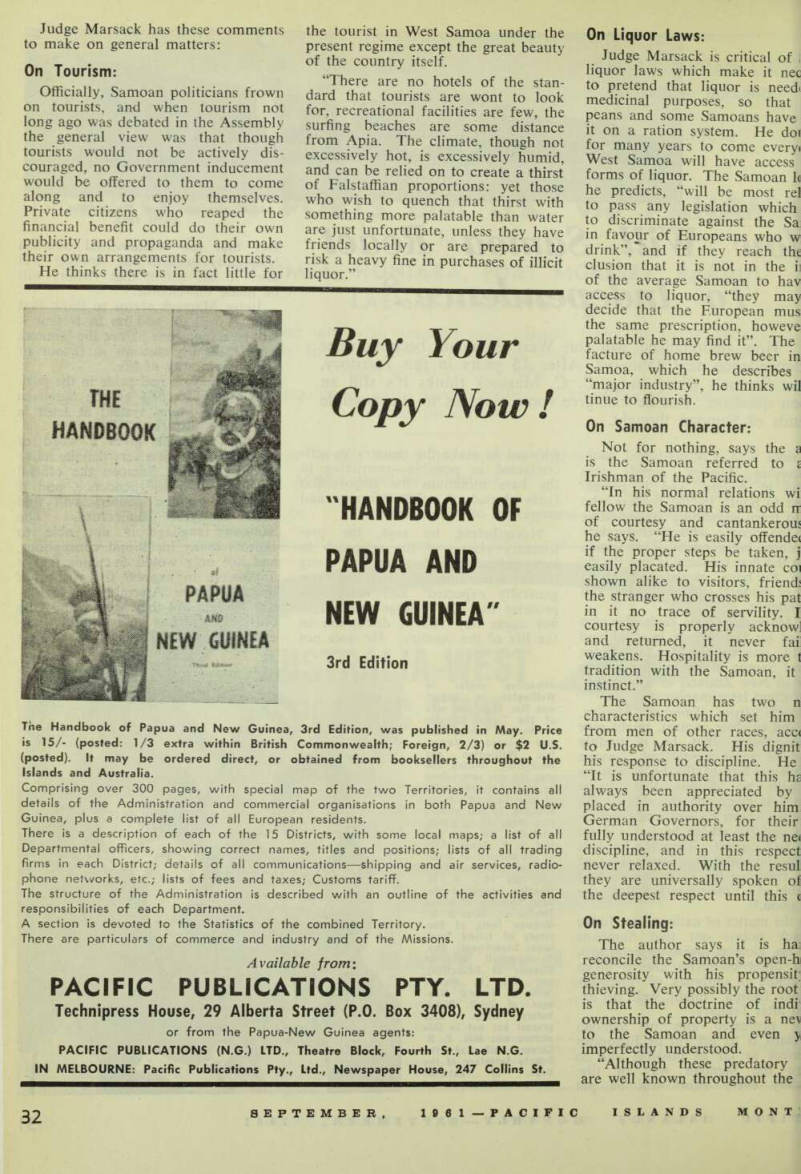
Attractive visitor to Wellington in August was Mrs. Mata'afa, wife of the Prime Minister of Western Samoa, who was educated at Master ton, Wellington and Auckland. During her stay she was entertained by Mrs. Holyoake, wife of New Zealand's Prime Minister. In this picture Mrs. Mata'afa is sitting with Mrs. Holyoake and Mrs. J. R. Hanan (wife of the Minister of Maori Affairs). Standing (from left) are Mrs. D. M.
Wheeler (sister of Mr.
Gotz, Minister of Island Territories), Mrs. J. M.
McEwen (wife of Sec retary of Island Terri tories Department), Mrs.
A. Campbell (wife of Director of Education), and Mrs. R. Walker (wife of General Man ager of Fruit Distri butors Ltd.). Also present but not in this picture was Mrs. F. H.
Corner, wife of the Deputy Secretary of the Dept. of External Affairs.
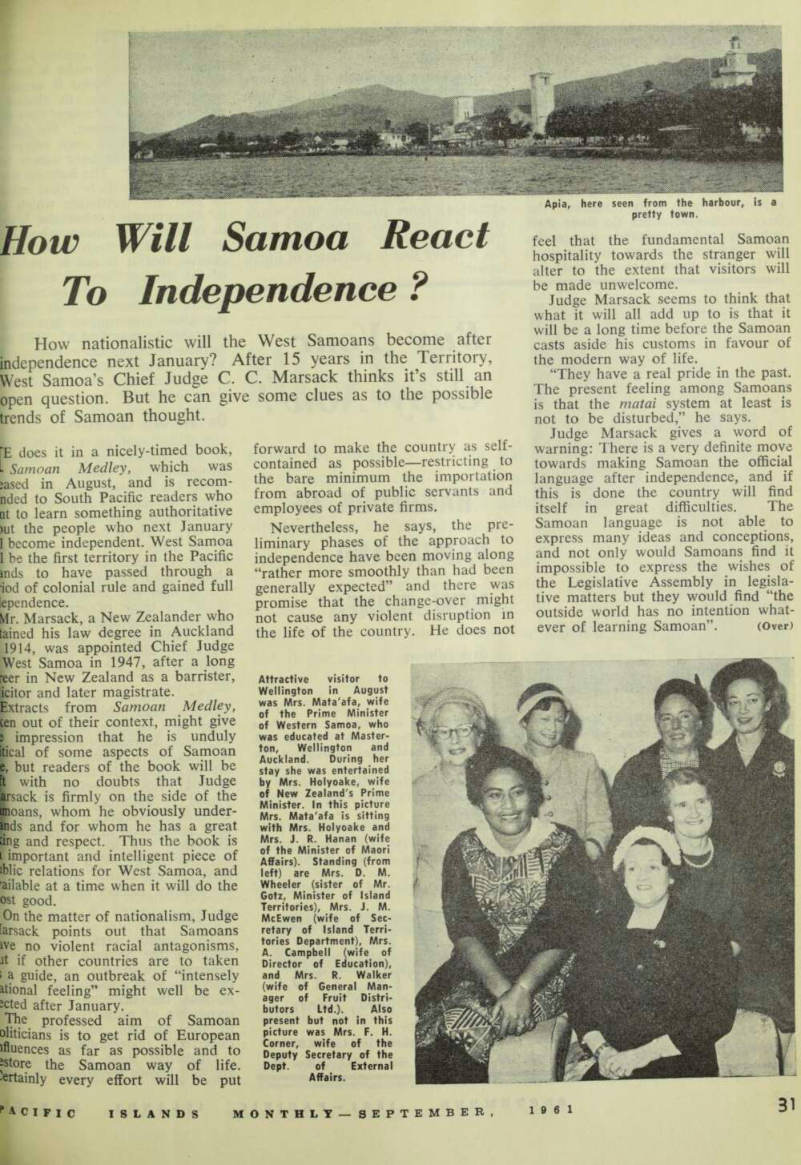
Apia, here seen from the harbour, is a pretty town.
Judge Marsack has these comments to make on general matters: On Tourism: „„ . „ . . , Omcially, Samoan politicians frown on tourists, and when tourism not long ago was debated in the Assembly the general view was that though tourists would not be actively discouraged, no Government inducement would be offered to them to come along and to enjoy themselves.
Private citizens who reaped the financial benefit could do their own publicity and propaganda and make their own arrangements for tourists.
He thinks there is in fact little for
the tourist in West Samoa under the present regime except the great beauty of the country itself. , There are no hotels of the stan dard that tourists are wont to look f or , recreational facilities are few, the surfing beaches are some distance from Apia. The climate, though not excessively hot, is excessively humid and can be relied on to create a thirst of Falstaffian proportions: yet those who wish to quench that thirst with something more palatable than water are just unfortunate, unless they have friends locally or are prepared to risk a heavy fine in purchases of illicit liquor.”
On Liquor Laws: Judge Marsack is critical of i liquor laws which make it neo to pretend that liquor is needi' medicinal purposes, so that peans and some Samoans have it on a ration system. He doi for many years to come every* West Samoa will have access forms of liquor. The Samoan le he predicts, “will be most re! to pass any legislation which to discriminate against the Sa: in favour of Europeans who w drink”, and if they reach the elusion that it is not in the ii of the average Samoan to hav access to liquor, “they may decide that the European mus; the same prescription, howeve: palatable he may find it”. The facture of home brew beer ini Samoa, which he describes “major industry”, he thinks wil tinue to flourish.
On Samoan Character: Not for nothing, says the a is the Samoan referred to £ Irishman of the Pacific.
“In his normal relations wi fellow the Samoan is an odd ir of courtesy and cantankerous he says. “He is easily offendec if the proper steps be taken, j easily placated. His innate coi shown alike to visitors, friend; the stranger who crosses his pat in it no trace of servility. I courtesy is properly acknowl and returned, it never far weakens. Hospitality is more t tradition with the Samoan, it instinct.”
The Samoan has two n characteristics which set him from men of other races, acc« to Judge Marsack. His dignit his response to discipline. He “It is unfortunate that this h£ always been appreciated by placed in authority over him German Governors, for their fully understood at least the ne* discipline, and in this respect never relaxed. With the resulJ they are universally spoken of the deepest respect until this c
On Stealing:
The author says it is ha: reconcile the Samoan’s open-hi generosity with his propensit; thieving. Very possibly the root is that the doctrine of indi ownership of property is a nev to the Samoan and even y imperfectly understood.
“Although these predatory are well known throughout the
the political leaders are apt to i little sensitive if the subject is ly discussed, especially with le from overseas. When serious I of theft before the High Court becoming increasingly numerous, High Commissioner made a dcast address over the local radio >n 2AP calling attention to the r is in the matter of instilling nples of honesty into the mem of the their respective families, politicians were horrified. They i convinced that much interest attracted in Europe and America ill Samoan radio broadcasts, and ■esult in this case would inevitably most damaging blow to Samoa’s tation in the capitals of the Great ons. The matter was even made bject of debate in the Legislative mbly,”
Chastity and Sex: enerally speaking, says Judge sack, chastity is not, in Samoa, :ed among the more deserving les, and no girl married or not, any reluctance in admitting that has already “had a husband”, ise the local euphemistic phrase, he author illustrates: “There is on ird in the files of the Education •t. an application form filled in I Samoan girl seeking a post with department. To the question “sex” answer was, “Once, at Falelatai”. r et despite the matter-of-fact hide adopted by Samoans on ual matters, cases of rape and anpted rape are numerous, much re so in proportion to the popula- I than in any country of which ge Marsack has seen the criminal istics. He says he cannot explain nd once again the Samoan justifies reputation of being completely Predictable. He says that, neverthe criminal assaults against white wen, “the class of sexual crime rch I am informed is common N &w Guinea and elsewhere in the is happily almost unknown West Samoa.
1 Missionaries::
Judge Marsack gives the missions for their work in West Samoa
but is also very critical of some developments He says a big portion of the acts of violence, disturbances and assaults “so rife in Samoa” arises out of rivalry between the different religious “v: y s ‘, , He says the Samoans are charged substantial sums for the privilege of embracing the white man s religion.
There were more churches in West Samoa in proportion to the population, probably, than anywhere else in the world, and the building of new ones “may well be considered a national hobby”.
In the education of the young, says Judge Marsack, the work of the
missions is unanimously favourable, Mission-trained children are normally ‘he best behaved and best-educated children, at least in the junior grades, Q n p o ||tics: , * . ..
One of Judge Marsack’s concluding remarks in Samoan Medley is that as a mem ber G f the judiciary he is not SU p pose( j to know anything about politics. But nevertheless he does not understan d just why “it should cons i dered necessary to have a p ar iiament of 48 representatives to manage t he political affairs of fewer t j ian ioo,ooo primitive people”, Others have wondered, too. (samoan medley. Published by Robt.
Hale Ltd. Australian price. 22/6.)
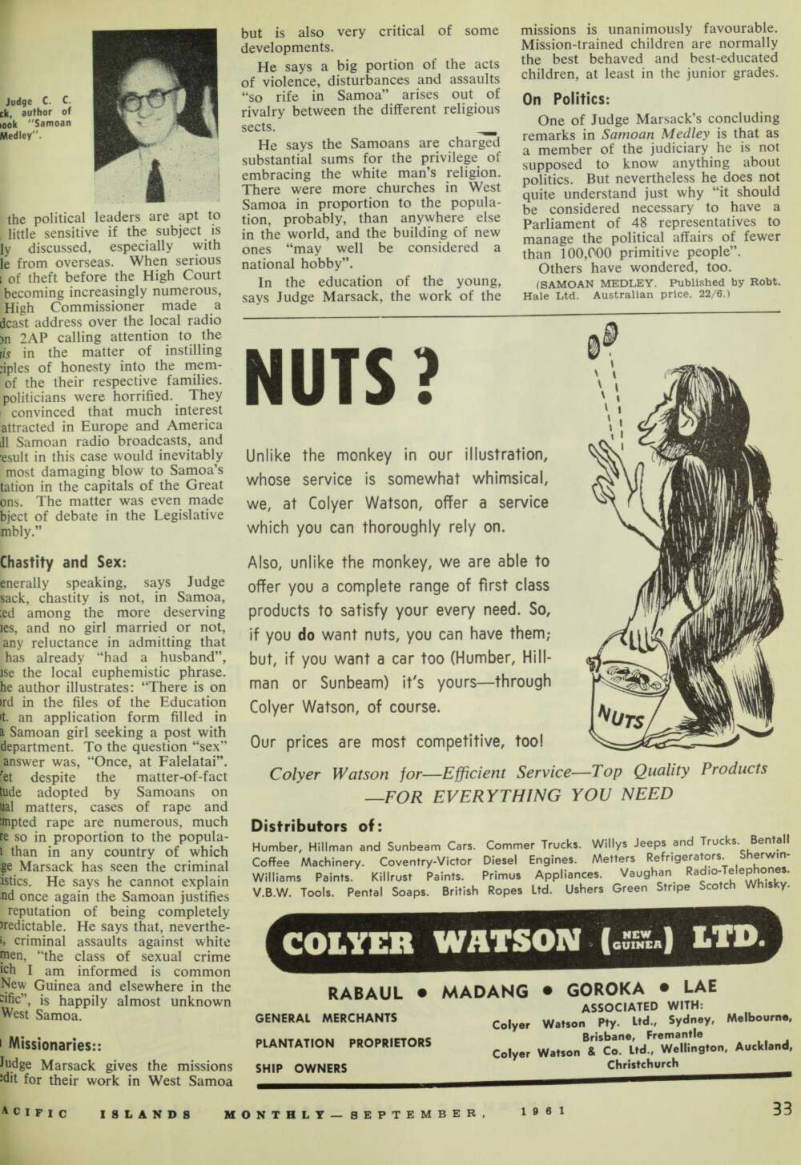
Judge C. C. ck, author of look 'Samoan Medley".