Closer Together
pp. 41-44 · Read in the full issue


Pacific Churches Move Closer Together
From Rev. L. D. Fullerton, in Suva A vital new era in the work of the Christian Missions in ■ Pacific has just opened up with the announcement of the of Pastor Vavae Toma as the first full-time secre y in the Pacific for the International Missionary Council.
pASTOR TOMA, of the Samoan A Church (London Missionary Society) will work through his regular contacts with Pacific churches and with overseas conferences to act as a strong bridge between the Paci fic Church and the outside world.
This big new task is a direct result of the recommendations of the Samoa Conference, and is proof enough that that first conference of Pacific churches really was a land mark in the history of the Pacific Church. And this is merely the be
ginning.
At this moment there are also dis cussions going on to put into motion another important recommendation of that conference—establishment of an £85,000 Central Theological College, here in Suva. The College will serve the South Pacific (as does the Central Medical School in Suva) by providing a higher academic level of training to meet Pacific Church requirements.
The Samoa Conference brought together 74 people, made up of 57 delegates from all over the Pacific (35 of them were Pacific Islanders) plus experts and observers from the International Missionary Council (which organised the conference), the World Council of Churches, the East Asia Christian Conference and overseas mission boards.
This brought together, conse , quently, Church leaders from the
Pacific Islands, Burma, Indonesia* England, Switzerland, America* Hawaii, Australia and New As the conference proceeded delegates became increasingly deter mined to find machinery that would carry on the work of the conference and help the churches in the Pacific to think, plan and act together.
“It is amazing that it has taken us so long to find each other,” delegates said, in effect. “We must now stay together.”
An idea of how important is the work yet to be done by the Pacific Church can be gauged by the fact that, although accurate figures are difficult to obtain, it appears that one third of the population in the Pacific is still non-Christian. The majority of these non-Christian people are not Asians but Pacific Islanders (in Papua-New Guinea, the Solomons, the New Hebrides, Micronesia), who are in the process of accepting the Christian faith.
Young Population
Also, the Pacific is predominantly a young population. In general, 45 per cent, of the Pacific peoples are under 15 years of age. This is the mark of vigorous growing Islands societies with a future.
The Samoa Conference took these and other facts into consideration and at the end took two steps: • It appointed a Continuation Committee “to carry forward the studies and discussions begun at this conference, and to consult with the churches regarding the development of co-operation among them.”
The chairman of the Continua tion Committee is the Rev. Setareki Tuilovoni of Fiji. The members are: Rev. A. G. Horwell (New Hebrides), Rev. L. Alafurai (British Solomons), Rev. M. A. Ledoux (New Cale donia), Mr. Stahl Mileng (New Guinea), and Mrs. Fetaui Mataafa (West Samoa).
Unforunately, the chairman,
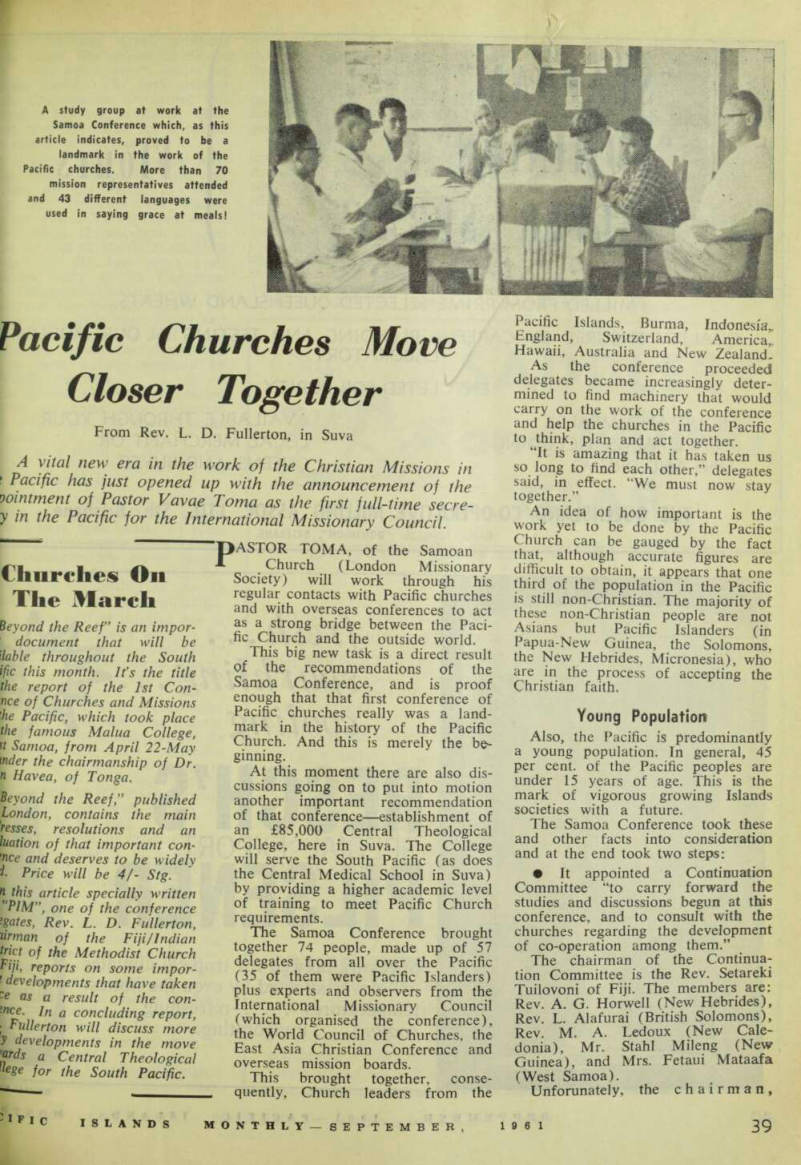
A study group at work at the Samoa Conference which, as this article indicates, proved to be a landmark in the work of the Pacific churches. More than 70 mission representatives attended and 43 different languages were used in saying grace at meals!
ireki Tuilovoni, shortly proceeds the Union Theological Seminary, v York, for a year’s course of nsive studies. The next meeting the Continuation Committee will held in Noumea in March, 1962. las been appointed for a period t exceeding five years”, i It asked the International Mis ary Council to appoint a regional etary for the Pacific to “be a ig link” between the Pacific •ches. Pastor Vavae Toma was a iral choice. He has been a mem of the staff of Malua Theological ege (he did two years post dated study at the Congrega il College in Auckland). He was Jtary of the Samoan Church be his new appointment. He proved e an exceedingly able local organ for the Samoa Conference, and be most warmly accepted by Pacific churches. lat Samoa Conference focussed ition on some very important is which call for further study action. irtly as a result of my own ex :nces at that conference I am convinced that: There is tremendous leadership dial amongst our Pacific Islands le. I have been nearly 20 years 'iji and my appreciation of my 5c colleagues has grown greatly the years, but I was much im ;ed with the quality of the 35 ds delegates to the conference.
A great deal of thinking has to lone in the Church about a lot
ontemporary issues—particularly
influence of rapid social change, iage and family life and the
stian ministry.
: many points during conference tes one could not help feeling: I Church just hasn’t thought its through this issue.” Criticism made by Islands delegates, in ersation and in debate, that the rch is tied to the chiefly system, .to the traditional pattern of ; ty, tied to the past. ie Church has to become much 5 flexible, and it is a healthy that this kind of constructive :,sm is now being so vigorously The pattern of church life in Pacific is distinctive. The Paci *s s till “a homeland of the r ch”, to use a phrase of the Rev. s-Reudi Weber, of the World ncil of Churches. There is prob no other part of the world where [ch and society are still so :ly mter-related. The Pacific rc “ has its own contribution to e to the world.
The Pacific is passing through a 1 social revolution. Reports made
to the Samoa Conference suggest that the rate of change is greater than all of us have generally realised.
“The Coconut Curtain has been raised and life will never be the same again,” the Rev. Bernard Thoro good, of the Cooks, observed.
The conference saw a touch of irony in the fact that the Rev. Itubwa Amram, of Nauru, who was to have addressed the conference on the effects of rapid social change in the Pacific, was prevented from attend ing by a strike in Nauru. Rapid social change had caught up with him, and “he gave a very good ad dress by not being here,” one delegate commented.
Undoubtedly the influence of
towns, industry, press, radio and films reaches into all corners of the Pacific—producing confusion and a “new paganism”. For instance, tourism now comes in for some vigorous criticism. Conference dele gates from Tahiti won a sympathetic hearing when they expressed their fear that large scale tourist develop ment would have a demoralising in fluence on Tahiti.
One delegate from New Guinea protested against “people using Paci fic peoples as objects for observa tions”. “We are human beings,” he said. “We don’t want tourists staring: at us.”
The conference resolved to ask the International Missionary Council fo
nominate some specialist (possibly an American) to make a thorough en quiry into the influence of the tourist industry on Tahiti and similar situa tions in the Pacific area.
The possibility of a South Pacific University—a matter which has been discussed by others from time to time —also got an airing at the Samoa Conference and it is unlikely that the Church is finished with the matter.
All educational questions pro duced vigorous discussion, and when this matter of the university came up, delegates were about evenly divided for and against a university at this time.
But later, the conference recorded its conviction “that higher education should be available within our Islands environment” and urged the “Governments in the Pacific, through the South Pacific Commission, to consider the establishment of a South Pacific University.”
The Samoa Conference took four years of planning, but there is no doubt the future results are going to be worth it.
West Samoa was to hold a Terri tory wide census on September 25, the seventh—and the last under NZ administration.