Indonesia’S Eggs Are Now
pp. 71-75 · Read in the full issue
Scrambled
From a Hollandia Correspondent As predicted, April saw the Did war over possession of West ew Guinea heating up. Presi
snt Soekarno visited Washing
>n for talks with President
ennedy; and Indonesia’s Army
hief of Staff, General Abdul asution, visited Canberra for Iks with Australian Prime finister Menzies. It all added id to the fire. lndonesians reiterated the ■ foundation of their claim to West ew Guinea—the influences that the iltans of the Indies had in that part the world 300 or 400 years ago. ley agreed their claim was not a ?al one, but political and historic, it they were always quick to add at they made no claim to the irtuguese half of Timor, the Aus dian half of NG or the British half Borneo, no matter what Indonesian Itans may have been doing in the e-European past.
Those who appear now to be turn l a more favourable eye on Indo
nesia’s claim are, in any event, blind to another event of April—the first step towards the independence of NNG. Independence may sound ridiculous in connection with NNG, but as a famous politician once said, scrambled eggs are almost impossible to unscramble.
Scrambled Eggs
Indonesia’s eggs in West NG appear to have been impossibly scrambled by the setting up of the New Guinea Council, and whatever motives might be attributed to the Dutch for doing this, it is going to be very difficult for nations who have pinned their faith in an anti-colonial policy to fly in the face of the result.
The Dutch in NNG have deliber ately inculcated the idea of self-de termination—just as the Australians arc deliberately planting the same seeds in their part of NG. The simple act of inaugurating the Council has given point to this Dutch policy and anyone doubting how the NNG natives are taking it, should read some of the statements made at the inaugural meeting in April.
Mr. N. Jouwe, an elected member from Hollandia, made the point that the political development of the Terri tory was “well in advance” of its economic and cultural development.
Papuans hoped that the Nether
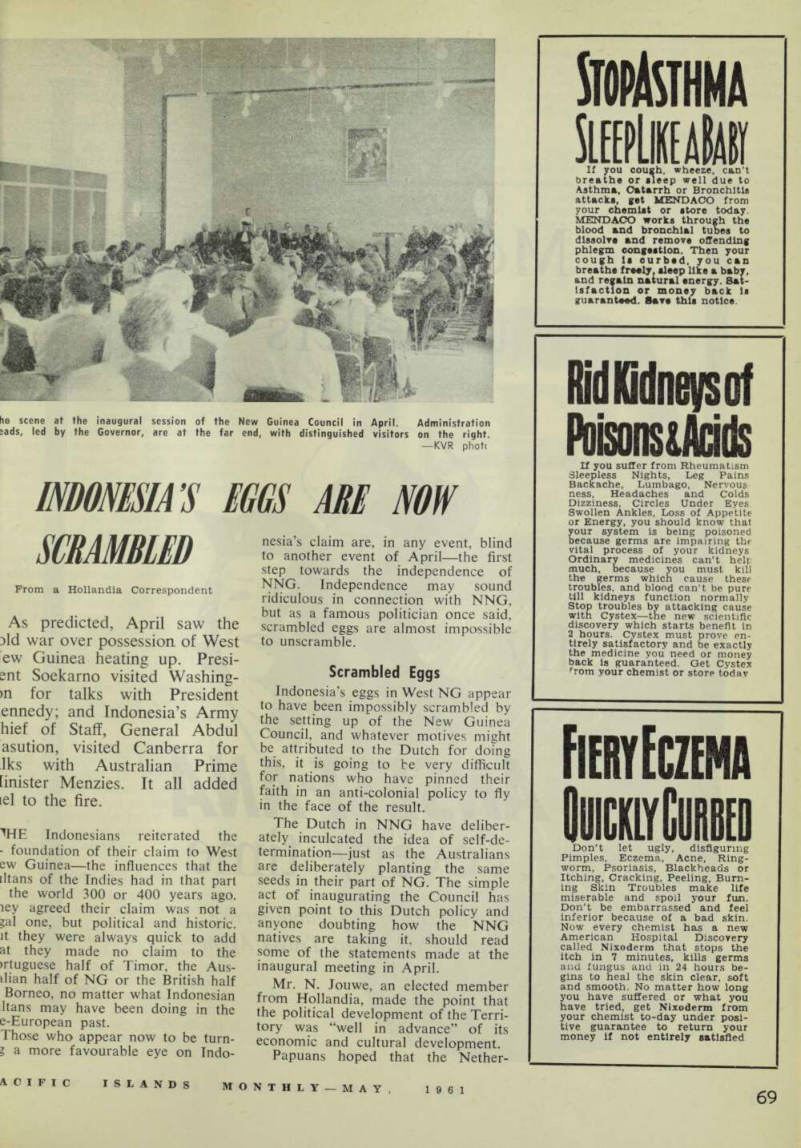
[?]e scene at the inaugural session of the New Guinea Council in April. Administration [?]eads, led by the Governor, are at the far end, with distinguished visitors on the right. —KVR photo
nds Government would devote its ne to building up these other needs.
He added: “We should stimulate e investment of foreign capital lere necessary, by giving guarantees.
"Higher Education"
“We must also keep pressing the avernment to enable talented chil en to receive higher education at s expense of the Government. It is cessary right now to enable as many puans as possible to receive :ondary education, not only in NNG t also in the Netherlands. Other se there might be a dangerous gap ?arating the political advance from anomic, educative and cultural Ids.
“This situation might also carry the nger of the inhabitants of this Terri •y being compelled to take up in national begging, and we Papuans ve been able to look around us and : how dangerous this can be.
“Certain international political arters regard the presence of the itch as a continuation of colonial n. We Papuans now possess proof sitive that this is not the case, and : are pleased that other countries 5 today in a position to satisfy ;mselves of this fact.
“Therefore we Papuans feel dis jointed and aggrieved that the lited States, which calls itself the ampion of democracy and the right self-determination, and in which jntry we peoples of the Pacific ye always placed much confidence, not represented on this occasion. i do hope, however, to be in a dtion in the near future to per lally convince also the United ites.” iead between the lines, please. Mr. iwe is not worrying about Indo ►ia—he is concerned with NNG— h nationalism. \nother Papuan member, Mr. rman Womsiwor (who is an pointed member to represent pri e enterprise) warned that material [fare was a subject of high interest 1 would doubtless be of great im tance during the discussions in the w Guinea Council.
"History Not Kind" ‘Nobody will claim that history and ure have been too kind to my >ple and a certain impatience to ch a better standard of living will re to be understood by those who re luckier in this respect,” he said, added that the natural resources NNG, as far as was known, were overwhelming, with the exception the timber industry. Lack of cap , trained manpower, transport and iper roads had meant that the
potential timber riches had not been exploited, and part of the reason for this was the adverse opinions of some countries which made foreign in vestors in NNG hesitant.
But, he said, there were indications that international private business, looking for new ventures, was becom ing more confident about NNG.
Government research might also soon produce results. There was a big rubber planting project, and com munity cocoa plans, which were very favourable. Big scale geological ex plorations would start this year, and other exports, such as nutmeg, copra and even cocoa, were showing a steady progress.
Mr. Womsiwor recommended the government investigate international development programmes, such as the United Nations Special Fund and the many opportunities for receiving extra technical assistance.
An Experiment?
The elected member for Hollandia city, Dr. O. J. de Rijke, a Hollandia lawyer, said some people considered the inauguration of the New Guinea Council too hurried a step, estab lished because of external political factors. They had some reserve over its establishment.
“This would not seem to be com pletely unfounded,” he said, “because
a political development which is not deeply rooted in an economic and cultural soil might prove unable to standi the forces of the wind, and especially of a storm springing up from the west.”
Dr. Rijke said that it was, how ever, only seldom allowed to man to create something great at a pace which would best suit the purpose. It was inevitable that perfection might be forced to give way to utility, and seen in this light there should be appreciation rather than scepticism over the establishment of the Council.
If the experiment should fail the responsibility of Council members would be very heavy, as the failure would encourage those who tried to make the world believe that by estab lishing the Council the Netherlands Government intended a mockery
Colonial Designs
It was, he said, a fact that “noth ing can be undertaken in this terri tory without colonial designs being imputed to it”.
It was true that the Netherlands was little appreciated for its work in NNG. This was due to the fact that Indonesia had advanced its claims to the territory in an increasingly louder voice, based on ever poorer arguments. But that portion of the NNG native population which was conscious of what was going on, was
grateful to the Netherlands for its having been unwilling “to yield to pressure which has gradually become almost unbearable”.
Dr. Rijke added: “First, the solemnly established Netherlands-Indonesian Union was unilaterally denounced. Next all
Dutch interests were confiscated witl out any compensation. Thereupon a Dutch nationals were forced to lea\ Indonesia in a* hurry, the nati\ country of many of them. And final! all diplomatic relations were severe* “These developments altogeth* have cost the Netherlands natic billions of guilders, but neverthele: the Government has quietly pn ceeded on its way.”
There was more to all this tha mere words. There is nationalisi taken seed in NNG, and before lon it will have grown so quickly that an attack on NNG from outside will in mediately be looked upon by th Western world as an attack on a emerging nation.
The Netherlands State Secretar for Home Affairs, Dr. Th. H. Bo in his address to the inaugural Coui cil, said he was aware of the di Acuities of mental development i NNG. It was a fact that the progre; of political as well as economic an technical development proceeded at more rapid pace than the process c human adjustment. However, a fir condition for all development was th will to help oneself.
Independence When?
He continued: “In the light of this essentiall temporary nature of the Netherlanc administration in New Guinea I no 1 formally invite you—as the Nethei lands Government already announce in the autumn of 1960, in the Nethei lands States General—that you nc later than one year from today mak
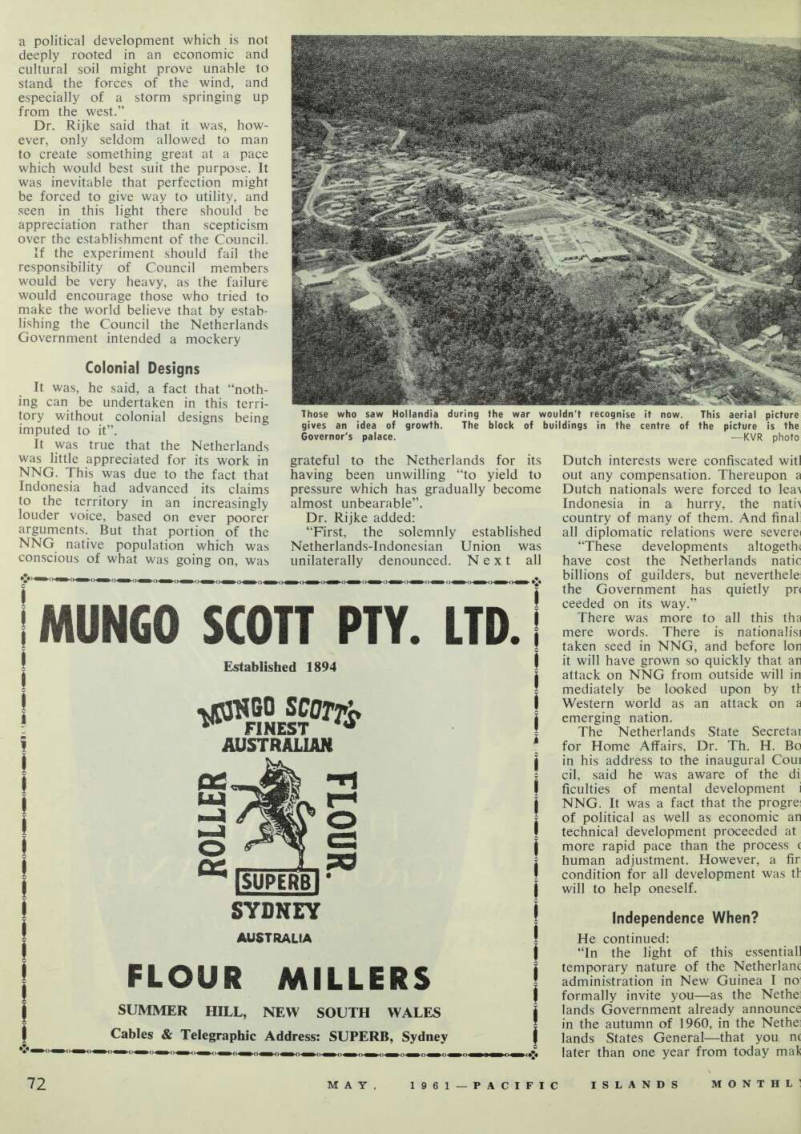
Those who saw Hollandia during the war wouldn't recognise it now. This aerial picture gives an idea of growth. The block of buildings in the centre of the picture is the Governor's palace. — KVR photo
lown to the Government, and dis iss in a way to be determined later, >ur views as to the manner in which id the possible desirability of fixing term within which your right of If-determination is to be realised.
“This should take place against the ickground of the ten-year plan awn up by the Government, show i g the consequences for the onomic, social and cultural build • of your country.”
Dr. Bot said that Netherlands knew would be difficult to receive a de led reply on such a complex matter, t the Government expected to get •tainly a provisional answer—such the question of what were the nimum conditions th e Council nted.
Dr. Bot said the ten-year plan was t meant to be a target date for 1f - determination, but it was sential” to the Netherlands Gov iment that self-determination, in spirit and in the letter of the ited Nations, be achieved at a >rt date.
Constitutional Revision further revision of the Consti on, the main outlines of which aid shortly be presented for the ancil’s consideration, would reflect ie said that “it might be conceived” t in the near future an executive ncil would be instituted, most of 3se members would be natives. )r. Bot said that the Council uld bear in mind that not only mans themselves, plus the Nether ds Government, but also foreign operation was indispensible for G’s future.
If no appropriate measures are 'P in time for the anchoring, in international field, of your future ipendence and co-operation in the place with your natural partners, r future will be uncertain,” he >r. Bot added that the Nether- Is believed it was entitled “to the tinued respect and the active sup : of all nations who really are :erned with the right of self-de u’nation and progress of all sle, not only in speech but also ction.” n April 24 the full session of the ncil came up with its interim 'point—that it wanted the Dutch •emain in NNG until self-deter ation; that meanwhile the Dutch eminent was “no longer free” to ify NNG’s status without prior ent of the Council. It was put -he form of a resolution and
)ted unanimously.