Thousands Live
pp. 67-69 · Read in the full issue

In These Fiji Shanties
By A. J. C. FOSTER, of Lautoka, a former builder.
A Practical Man's Plea for a New Approach To An Urgent Problem
rpHESE are termed low cost housing. But, are they, in truth, low cost? In my opinion, they definitely are not, since they are all, basically, standard houses, with nothing at all revolutionary in constructional details to complicate them. They are built by out side builders at a profit.
In general, all the buildings so far completed are of fair quality, but with minimum finish. Some money has been saved by group ing them to simplify drainage and sewerage. But that is about all.
The £3-per-Week Labourer No effort has been made to put a house within the reach of the £.3-a-week man, the labourer.
This class—in some ways the backbone of the Colony—is today either living in cramped single rooms in town—sometimes two adults and several children to a ten-foot-square room—or appal ling shanties on the edges of the towns.
Others have a little land, often rented at high prices, and have put up huts from odd materials found around dumps. Walls of beaten out oil drums, with thatched roof, are common. No bath room, no water, no toilet except the canefield, no cooking facilities except an open fire. Thousands live under these conditions.
Is it possible to raise good citizens from these dumps?
What has the Government done for these unfortunates? Noth ing! And why? Because no finance is available in Fiji, and there is no action because there is no finance!
No one is concerned with the matter. No one will move until the subject is given so much publicity that the Government will have to do something about it.
Housing of these low-paid men must be first priority. Given sufficient Government interest, the problem can be solved.
I have heard it said these people “don’t want better houses and would not know how to look after them if they had them”.
What nonsense! I watch every day, with increasing interest, the spectacle of cleanly-dressed children emerging from these hovels, on the way to school. They come in neat uniforms from mud and filth. People who can do this want help. It is ridiculous to say they cannot be aided to better living.
One problem is that many of these labourers will not take kindly to housing estates, with partly communal living. Apart from any other consideration, where they have a little land they can grow enough food to lift their standard of living from bare subsistence level, to which they have been forced by appallingly low wages. And, of course, many are on casual or seasonal em
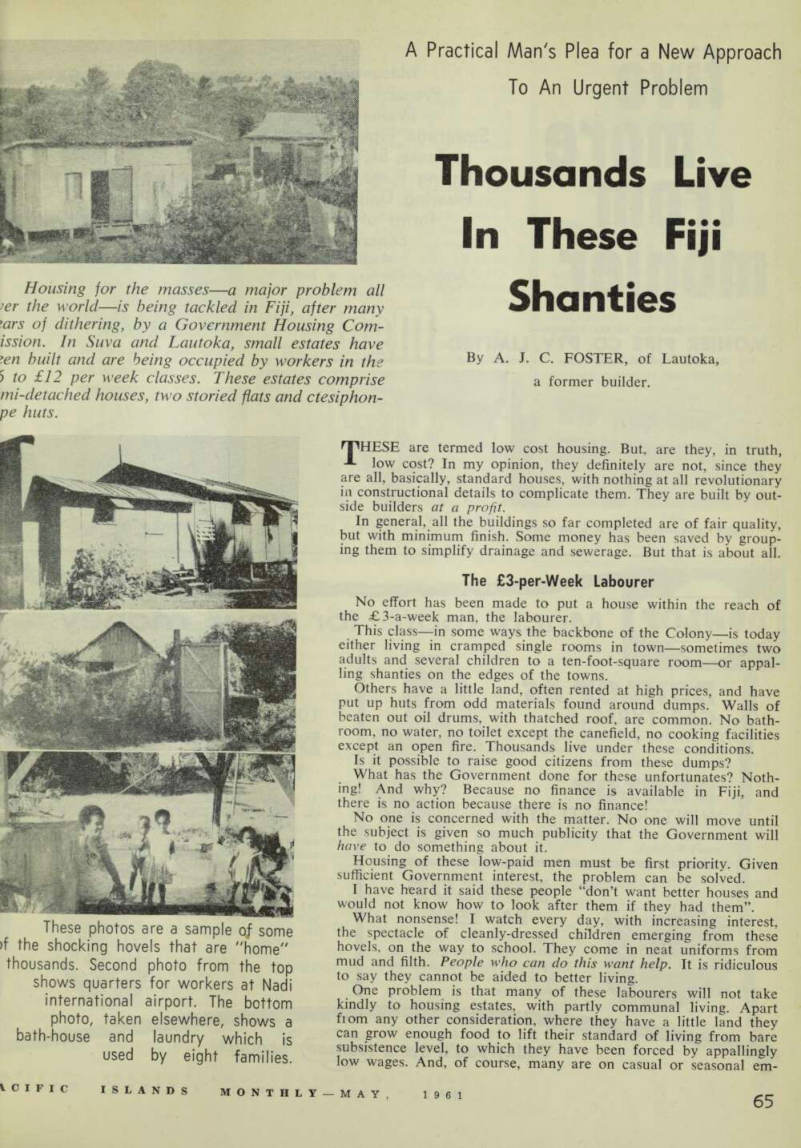
Housing for the masses—a major problem all [?]er the world—is being tackled in Fiji, after many [?]ars of dithering, by a Government Housing Com [?]ission. In Suva and Lautoka, small estates have [?]en built and are being occupied by workers in the [?] to £l2 per week classes. These estates comprise [?]mi-detached houses, two storied flats and ctesiphon [?]pe huts.
These photos are a sample of some of the shocking hovels that are "home" thousands. Second photo from the top shows quarters for workers at Nadi international airport. The bottom photo, taken elsewhere, shows a bath-house and laundry which is used by eight families.
oyment, probably averaging less an £2 weekly during the year.
How to house these under ivileged is a Government-sized task, r any scheme of selling or renting mses to them is faced with the re lyment question. How can they ford it, with such uncertain wages turn?
How It Can Be Done So any housing plan must take ese factors into account: (a) Separate [aiders, which can be built in scat hed localities, (b) A finance plan lich will enable these houses to be iught and rented by persons in the kv-wage, uncertain-income group.
I think that competent and in vested people in Fiji will agree with ; following conditions.
The Government, or possibly the ilonial Development Corporation, even a large group of contractors, jst attack the problem.
Building standards must be scaled wn. A four-inch wall can be re ced to three inch, with added brac l, to reduce timber costs. The same plies to rafters and studs and plates, lere is no need for such high mdards. Glass windows can be minated in favour of shutters. The alth aspect can be provided for by mbining these with fixed plastic ■eens.
A simple-type septic tank can re ice the pit latrine and, where rain iter is not available, use well water, rough a small pump, a tank and a v feet of pipe.
There are endless means of reduc l the cost of houses, not the least ing the remission of import taxes building materials associated with sse schemes.
Local timber, chemically treated, ould be used instead of high-priced inadian Oregon.
Intense investigation should be ide into substitute materials, Hard ard, cheaper by far than Oregon, operly painted when fitted, is more during than weatherboard as a ill-covering. Lightweight concrete nels are possible. A team of earnest m, who should be practical ilders—not law clerks and similar ople—should explore all these pos lilities.
Pre-Fabricate Pre-fabrication by a central organ tion, with continuity of orders, pre ably on a Government-sponsored ancial plan, with profit limited to i lowest practicable margin, could ing down timber houses to half the ices now charged.
Houses of about 300 square feet, timber and wallboard, with iron
roof, sitting on concrete piles, can definitely be pre-fabbed as a “pack age house”, to be sold at £3OO, with a small profit included. This house, with panels of varying sizes, adaptable to variable partitioning, could be de livered to the man at his site, who would then erect it himself. A simple floor plan, which would be changed within limits to suit the occupier, pre sents no difficulties.
I have seen detailed quantity lists for such a house, complete with a 400-gallon tank, outside toilet over a simplified septic tank, kitchen, bath room as an annexe, living-room and two bedrooms. Painted, with all bolts, delivered as a “package” for £355.
Total area, just over 320 square feet, to house two adults and up to six children.
Pre-fabbed houses, preferably done by a non-profit organisation, or one content with a nominal profit, could be rented at reasonable returns, or sold over a 20 to 30 years period, at 5 per cent, interest.
I may be a lone man, crying in the wilderness, about this.
Better housing for the real poor— the £3 a week man—means better citizens; and continuance of the pre sent neglect must lead to trouble.
Now is the time to put such a scheme into action, when Fiji has a large surplus of labour, which could be employed usefully all over the Colony on this most necessary task.
The Finance Angle As for finance necessary: Let me say that from all viewpoints money could be better spent on this project than on many of the non-productive schemes which the Fiji Government has in hand.
I will not believe that there is no money available for a well-thought out housing project of far-reaching proportions, if it can be shown to be even moderately self-supporting. And it can be.
Banks offer about 3 per cent, for loaned money. Surely this scheme could offer 5 per cent.? It only needs the right men in the right places.
I am positive—and I can name other businessmen, who are also pos itive—that such a scheme, with about £2,000,000 to back it, would build about 7,000 houses for a start, and earn the necessary 5 per cent, interest which the financial interests will de mand.
Prove this in Fiji, and another £2,000,000 would be easy to obtain in a year or two.
What about it, Government?
EDITORIAL NOTE —And even if it does not return 5 per cent, it still is worthy of Governmental backing.