They're Trying To Beat
p. 51 · Read in the full issue
A Fool's Paradise
By a Staff Correspondent
The strike of phosphate workers at Ocean Island and Nauru in April turns the spotlight on the future of the South Pacific’s phosphate supplies. And this in turn pinpoints the name of Bellona Island, in the southern Solomons.
THE British Phosphate Commission - is examining the possibility of a ng-term development of Bellona.
Bellona is the most promising ospect of about 100 islands investiited in a three-year survey of the acific made by the Australian Govnment’s Bureau of Mineral Re- »urces, in conjunction with the ritish Overseas Geological Surveys, id the New Zealand Geological Sur- ;y, Impetus for the survey came from le need to find new phosphate sources » replace existing deposits, all of hich have only a limited life.
Geologists have been emphasising ►r years that the Pacific is something f a fool’s phosphate paradise, bemse the present supply of high-grade aosphates cannot last indefinitely.
Ocean Island, producing about 500,000 tons annually, will last less lan 28 years. n .. ... -incz Bellona Deposits in IVoo Nauru, yielding 1,600,000 tons, will ist only another 40 years.
And in the Indian Ocean, Christmas iland (production about 400,000 ms) is expected to be good for only 5 or 50 years, although its reserves ave not yet been fully tested.
The Bellona deposits are among le most recent discovered.
They were found in 1956 by the hief geologist of the British Solomons reological Services, Mr. J. C. Grover, A further investigation was made 'hen the Bureau of Mineral Re-
sources assessed all known and re ported deposits in its three-year sur vey, and the most recent examination was made last November by the British Phosphate Commission m conjunction with the BMR.
Bellona is a raised atoll, six miles long and li miles wide, with 100 ft cliffs around the coast, The phosphate deposits are in the centre of the old lagoon, and were apparently formed in the pleistocene (i C e) age by rainwater running down from seabird droppings on the cliffs and reacting with the limestone, Geologists believe that the ocean currents in the pleistocene era brought phosp h a tes to the surface from the bed of the ocean . This led in turn tQ the f ormat ion of vast quantities of p i an ]<ton, providing food for fish on which myr i ads G f seabirds fed. similar currents feed the birds which in more recent deposits have made the guano deposits on islands off the South American west coast.
The Bellona deposits comprise about 4,500,000 tons of low-grade aluminous phosphate overlying about 700,000 tons of higher grade calcium
phosphate. . .
The British Phosphate Commission is assessing the possibility of pro cessing the Bellona higher grade and some material from Christmas Island to make phosphoric acid, and from that triple-super. This is a fertiliser well known in the United States, but not used so far in Australia and New Zealand.
The deposits are very small pota* toes compared with those being worked on Nauru, Ocean and Christ mas Islands.
But Australia has to face the fact that they are the only known worth while supplements to existing work ings.
And before we found the Nauru- Ocean Island deposits we were glad to work mere 3 ft deposits of sand phosphatised by bird droppings on islands in the Admiralty Group.
Even the higher-grade calcium phosphate at Bellona is of much lower quality than Ocean-Nauru Island phosphates.
If a process were discovered which would enable the aluminous phosphate to be treated economically, Bellona would become much more important.
But even then, the island’s total of around six million tons is a flea bite alongside current consumption.
The best anchorage, off the northern tip of the island, would mean a five-mile land haul from the richest phosphate deposit.
Although deep-sea ships can get close in, the anchorage, as is usual around similar islands, is not good.
But it is sheltered from the pre vailing south-westerlies, and an altern ative is available on the west coast nearby in a change of wind.
Bellona is an island of extreme fertility. This is attributed to the presence of the phosphate.
Geologists investigating the de posits have found roots of coconut palms—normally surface-rooted trees —at depths of 22 ft.
Because of the fertile land, and good fishing, the 500 Bellonese are of exceptional physique..
They are Polynesians, and can trace their royal family back through 22 generations to the time when their ancestors migrated from Polynesia to conquer the original inhabitants of Bellona and nearby Rennell Island.
They have all the natural food they need, but like other advancing peoples of the South Pacific they have a hankering for bicycles, sewing machines and the other trappings of civilisation.
Those who have visited them be lieve they would welcome the work ing of their phosphate deposits to provide them with both employment and cash income from royalties.
Because the islanders have a well defined system of land tenure, negoti ations on mineral rights would be simpler than in less well-organised communities.
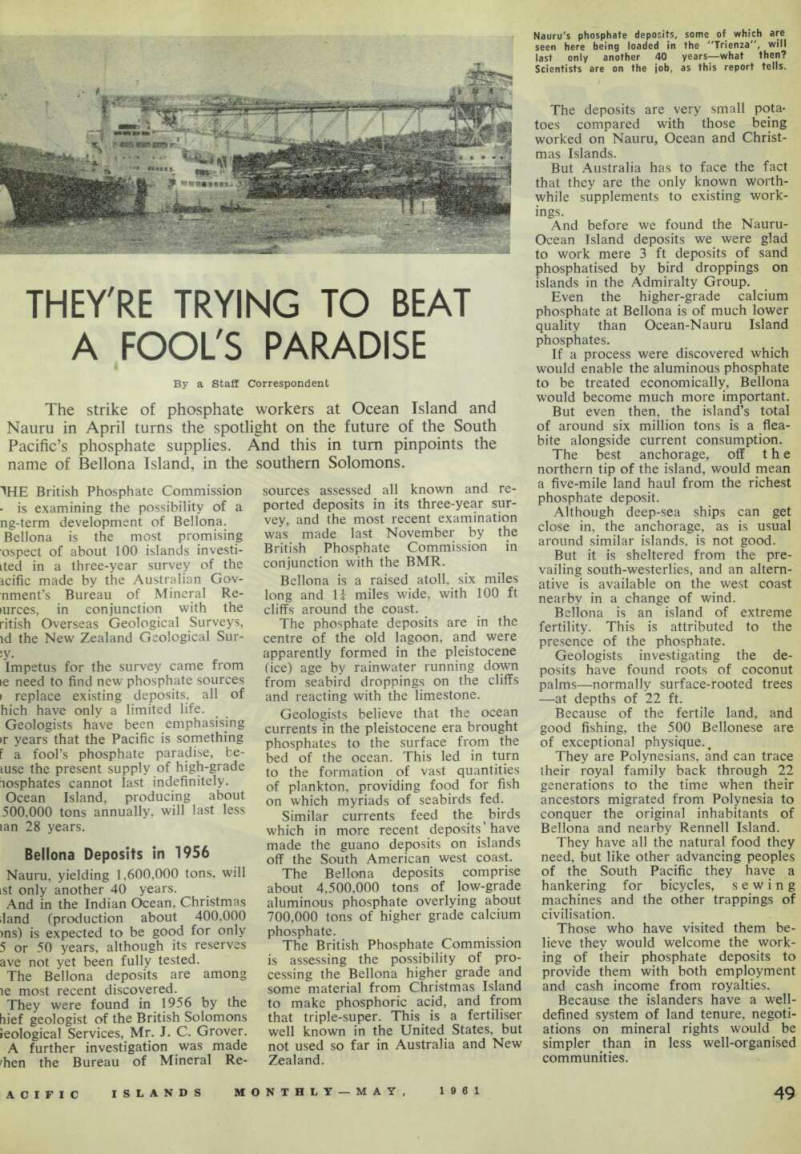
Nauru's phosphate deposits, some of which are seen here being loaded in the "Trienza", will last only another 40 years—what then?
Scientists are on the job, as this report tells.