Territories TALK-TALK
pp. 39-43 · Read in the full issue
With Tolala
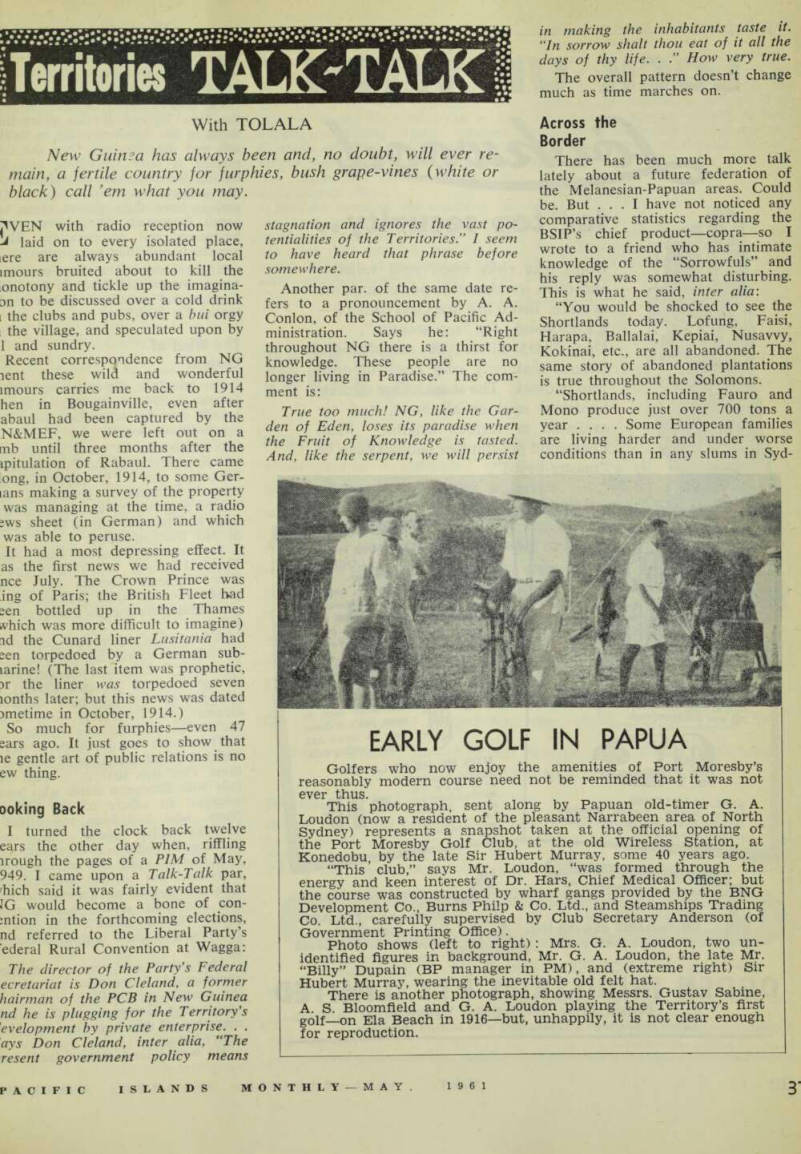
New Guima has always been and, no doubt, will ever re main, a fertile country for furphies, bush grape-vines (white or black ) call ’em what you may.
jWEN with radio reception now J laid on to every isolated place, iere are always abundant local imours bruited about to kill the onotony and tickle up the imagina an to be discussed over a cold drink [ the clubs and pubs, over a bid orgy the village, and speculated upon by 1 and sundry.
Recent correspondence from NG lent these wild and wonderful imours carries me back to 1914 hen in Bougainville, even after abaul had been captured by the N&MEF, we were left out on a mb until three months after the ipitulation of Rabaul. There came ong, in October, 1914, to some Ger lans making a survey of the property was managing at the time, a radio sws sheet (in German) and which was able to peruse.
It had a most depressing effect. It as the first news we had received nee July. The Crown Prince was ing of Paris; the British Fleet bad sen bottled up in the Thames which was more difficult to imagine) id the Cunard liner Lusitania had sen torpedoed by a German sub larine! (The last item was prophetic, ir the liner was torpedoed seven lonths later; but this news was dated imetime in October, 1914.) So much for furphies—even 47 sars ago. It just goes to show that le gentle art of public relations is no ew thing.
ooking Back
I turned the clock back twelve ears the other day when, riffling irough the pages of a PIM of May, 949. I came upon a Talk-Talk par, 'hich said it was fairly evident that 1G would become a bone of con mtion in the forthcoming elections, nd referred to the Liberal Party’s ederal Rural Convention at Wagga: The director of the Party's Federal ecretariat is Don Cleland, a former hairman of the PCB in New Guinea nd he is plugging for the Territory's evelopment by private enterprise. . . ays Don Cleland, inter alia, “The resent government policy means
stagnation and ignores the vast po tentialities of the Territories.” 1 seem to have heard that phrase before somewhere.
Another par. of the same date re fers to a pronouncement by A. A.
Conlon, of the School of Pacific Ad ministration. Says he: “Right throughout NG there is a thirst for knowledge. These people are no longer living in Paradise.” The com ment is: True too much! NG, like the Gar den of Eden, loses its paradise when the Fruit of Knowledge is tasted.
And, like the serpent, we will persist
in making the inhabitants taste it.
“In sorrow shalt thou eat of it all the days of thy life. . ” How very true.
The overall pattern doesn’t change much as time marches on.
Across the Border There has been much more talk lately about a future federation of the Melanesian-Papuan areas. Could be. But ... I have not noticed any comparative statistics regarding the BSIP’s chief product—copra—so I wrote to a friend who has intimate knowledge of the “Sorrowfuls” and his reply was somewhat disturbing.
This is what he said, inter alia: “You would be shocked to see the Shortlands today. Lofung, Faisi, Harapa, Ballalai, Kepiai, Nusavvy, Kokinai, etc., are all abandoned. The same story of abandoned plantations is true throughout the Solomons.
“Shortlands, including Fauro and Mono produce just over 700 tons a year ... Some European families are living harder and under worse conditions than in any slums in Syd
ney. . . . The wealthy natives of the Shortlands are not as well off as they were in your day [1916] in spite of their having abandoned plantations to harvest if they wish.”
He then referred to plantations in the New Ireland district, older than those in the Solomons and in similar soil and deteriorating, “but the little planter is busy replanting and fer tilising his coconuts; ploughing back his money into the country. The natives have their groves clean and copra harvested. They have trucks, businesses and co-operatives. There are roads and they are prosperous”.
There seems to be something wrong somewhere down in the BSIP.
Government apathy? Native indo lence? Or both?
The Wind of
Change
So one-time Co-operative Officer Cooper failed in his application to appeal over his conviction for utter ing seditious words.
Now he has to serve the balance of his sentence in the Port Moresby boob or, as it is euphemistically termed, institute of correction. One can be forgiven for wondering exactly what his “labour” will be in this Land of No Discrimination.
My memory travels back along Time’s Highway to 50 years ago in New Guinea’s German days when preservation of white prestige was so great that there was no European gaol at all!
If and when a European committed an offence warranting incarceration, and not a fine, he was promptly given the good oil to get out. Usually he disappeared by the next outgoing steamer. This invariably worked, and the sacred prestige was upheld!
There were two occasions, however, which I recall that created complica tions. One was that of a local-born lady with European status who horse whipped an officer of the German Navy, who had been too attentive to the lady’s sister. This mis demeanour could not be overlooked.
It was an insult not merely to the individual but to the Imperial uni form so, despite an appeal, the lady lost out and served her sentence under “house arrest”. The natives (supposedly) knew nothing about the incident.
The other one was a bit more complicated. A recruiter had adopted the practice of “pulling recruits” by posing as a Government official, with members of his boatcrew attired as police-boys.
He would land at an island, erect
lag-pole, run up the German ensign ile his “police boys” ceremoniously ;sented arms, and then the re nter would line the inhabitants d tell the chief that the Govern ;nt required so many boys to serve the Police Force. The sturdiest lies on the line would be ordered bout turn, quick march” and put oard.
But the Government caught up th him, and he was given the drum “vamoose”, which he attempted do by way of the British Solo ms.
Unfortunately for him, he was eady known in the Solomons (as matter-of-fact he had been featured Jack London in one of his recent oks) and was promptly turfed out, spite his hazardous trip in a mon >m Buin to Faisi, carrying a bag of vereigns.
He wended his back to Bou inville and Rabaul, where he stood al and received a sentence to be :ved as an honorary Road Master an isolated district. But . . . whilst sre he selected some good planting nd and on his release turned it into flourishing plantation! (He was lied during the Jap occupation.) So much for the old-time preserva m of white prestige. Like bustles d buggies and elastic-sided boots it s gone into the discard.
In these days it is the nearest thing subversion and, in my own private •inion, the need for its extermina >n is being greatly over-emphasised.
But we won’t enter into that argu ent here, except to say that in many stances the natives themselves don’t irticularly want it, but accept it as co-ordinating factor in their own Ivancement in present-day affairs.
There is no greater respecter of ste than the coloured gentleman mself. It’s not a case of colour so uch as caste, culture and custom at are difficulties to integration.
apped Down
For some time now it seems there is existed a certain animus between e Paternal Government at Port loresby and the Town Advisory ouncil at Kokopo.
The former has reacted in the ;ual pompous manner to adverse iticism of its actions (or lack of ;tion) by pulling its rank, “slapping 3wn”, and giving the orthodox meral treatment to recalcitrant •ganisations, whilst the latter, not maturally, take umbrage at the at tude adopted toward them, couched biting officialese, and consider the overnment attitude quite uncalled >r.
Outspoken Chairman Ron Levi pulls no punches when he rises to speak, and more power to him.
There is much talk in the Territory these days about the equality of man and Ron is one who apparently believes it should be carried out in its entirety, including Town Advisory Councils, which should be given their proper regard and respect in the present democratic building-up. He is quite correct. But ...
Because some of the Councils do not keep in step with Bureaucracy in Moresby and/or Canberra it does not mean they should be any the less vocal in airing their opinions. Possibly—probably—were they pre
dominantly native voices they would receive a better hearing.
Is one to assume that this recently vaunted New Deal of Legislation in P-NG is to be selective and only to apply to the indigenous people? Hu man equality applies equally to the non-natives as it does to the natives.
Otherwise there is bound to be trouble.
"Pulling Their
Rank"
Regarding this phrase (which, so far as I remember, was coined by the Yanks in War II) it is rather in teresting to note that the chappies
Iding that power both in Papua d New Guinea for the last forty d years, with only one exception, ve been men with military rank, or least military titles, [n Papua we had Colonel J. H. P. irray (later more commonly 3wn as Judge, and later still as Hubert); following him was the e civilian; Leonard Murray. n New Guinea we start off with lonel Holmes who took over the ony from the Germans and later ame Major-General, followed by lonel Pethebridge (later rose to g.-General and was knighted). fhere was an Acting Administra from October, 1917, to April, 8, Lieut-Colonel Seaforth Mac izie (a Judge), then came Brig.tieral Johnston (later Major icral); followed <jy Brig. General n Griffiths up until 1921 when itary occupation ceased and he : relieved by Brig.-General Evan ;dom.
'om Griffiths had a further term d ’33 to ’34 when he was relieved Brig.-General McNicoll (later ?hted) who was the last in TNG Dre the Japs came in 1942. Sub aent to War II for the amalga ed territories we have had Colonel C Murray and Brigadier D. M. and. urely an impressive array of Top ss and, incidentally, something is usually anathema to the age Australian and before whom average native is prepared to iflect. he question arises: Is this the type of professional man to e at the head of an administra dealing with—on the one hand large population of ex-service , who have put on their “bowler and a primitive people who t someone to understand them their way of life not just a inating figure-head disseminating berra edicts?
□logical
llation here is fancy spelling of local Guinea words going to end? mutilated version of lava-lava lap) has come to stay it seems, >ugh I did notice in a Gov icnt tender advertisement some ago that the correct spelling, lava, was employed. And now ave “houseboi” which is certainly may be called an “integration ”, embracing as it does the Euro
pean and the Pidgin.
I noticed recently that old Ravalien plantation, out Kokopo way, was spelt “Revalion”. Yet this is a purely Tolai word meaning “the beach” (Ra Valien). Is it the idea to lose the derivation of old names altogether?
It does not take much imagination to hear the Rabaul Quiz Kids in a few years’ time being faced with the question: What is the derivation of Revalion?
In a Pidgin newspaper supplement recently I espied the word “Mesa” being used for “Mr.”
Isn’t it about time there was some standardisation of native words in stead of it being left to the vagaries of individual native writers putting into print words according to their own tribal enunciation? This philolo gical confusion I note was commented on, indirectly, in a story about dak and fok in a pidgin supplement in April.
Is this something about which our educators could not care less? Or is it ignorance? And what the “crash” teachers will do with local names is nobody’s business.