An Analysis
pp. 37-38 · Read in the full issue
Of Fiji's Gloom
By a Staff Writer in Fiji
The picture of Fiji, as I see it today, is gloomy. I see unem
ployment, poverty in places, poor
rice crops, inadequate housing,
empty shops in the larger towns,
grim looks on the shopkeepers’
faces, shocking roads, unculti
vated land, unweeded sugarcane.
ADDED to this—an unpleasant factor in my eyes—are ex pressions of hostility or distaste on the faces of both Indians and Fijians —which I never have seen before.
Travelling the country districts, 1 have noticed a feeling of depression prevailing in such towns as Ba, which is at the centre of one of the richest districts in Fiji. The merchants seem pessimistic, they see no future, they are losing interest in the Colony.
Shops are loaded with trashy trifles.
Transistor radios, cheap Japanese goods, cheap Swiss watches. In one row of shop windows in Lautoka this week I counted 118 radios—and 753 watches at prices from £.2/18/upwards. How many of these two articles are on sale in Fiji, if this is the count in only ten shops? These shops are also drapers and general merchants.
In the streets almost all day, close to the hotels, are drunks, reeling around, making a nuisance of them selves. In Suva, some streets are not safe at night from these hooligans.
This problem is extending to Lautoka and other towns.
All this is the direct result of the
failure of development to take care of a rapidly-growing population.
A sorry picture, to look at this Colony today and compare it with the early ’Fifties. Where are we head ing and who is to blame?
Unimaginative Government
Fiji today is what the European population, the European and Indian trading firms, and—most of all—the Government have made of it. It has deteriorated into a loosely-bound community, with few, if any, com mon interests, beyond that of making a profit for the lucky few.
The old example of the “haves” and the “have nots” has never been more evident than it is today. I at tribute the surly looks, the lack of courtesy, the unwillingness to help, to this cause.
To blame the Governmental system entirely is an easy way out. But I think the major blame lies there— although other parties must bear a part of it.
This administration, directed and controlled by the British Colonial Office, has done nothing—nothing discernible, anyway—to bind the races into a prosperous community. (Over)
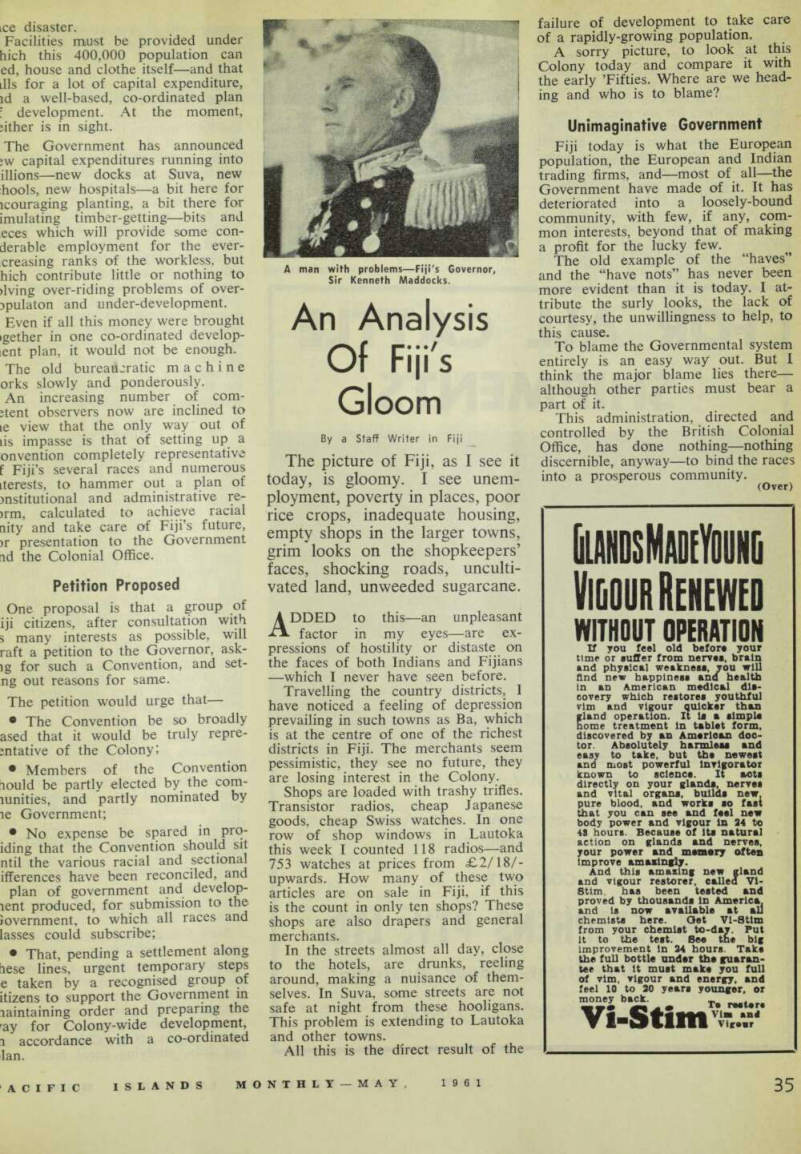
A man with problems—Fiji's Governor, Sir Kenneth Maddocks.
Government has turned a blind eye to the paramount need of this Colony —namely, leadership. The country needs the leadership of capable, energetic, imaginative men, dedicated to the task of making Fiji work, and work together, for the greater benefit of the whole community.
These communities need a man at their head, who is capable of being tough and ruthless, both with racial customs and with vested interests—a man who will cut red tape, go places, and push all the races hard, even to the point of enmity, to achieve his purpose. Perhaps this man is hard to find. Fiji may even need two, or three of this type. Where are they?
Just what is the Government pro gramme? I see in The Fiji Times proposed expenditure of a thousand here and a thousand there, to en courage coffee and cocoa growing, land and soil analysis. A few hundred thousands for roads. Millions for wharves, slipways, technical schools, secondary schools which are all worthy objects, but are they needed now?
Apart from the obvious labour benefits of these schemes, which may take a few thousand fortunates into temporary employment, what is the productive value of those spent millions? How many additional
people will they permanently feed?
It is time that Government recog nised that such amenities are not what Fiji wants. We can get by with the present facilities, even if they are slightly dilapidated.
The Government proposes to tap the loan market this year for part of the cost of the Suva wharf. It will probably secure the money. But how much more useful would this loan be if it were destined for a land develop ment scheme; or low-cost housing for the poor; or for a fishing industry?
Coffee, cocoa, sisal, cotton, cloves, kapok, ginger, tobacco, tumeric, rum, methylated spirits— most are “pos sible” export commodities, but which need the hard cash of sponsorship.
What is being done as part of a co-ordinated plan to bring up our ex ports? Literally nothing! And nothing appears to be intended—except for certain sops to appearances, con cerned with the recommendations of the Burns Commission. A few paltry thousands, where millions are needed!
Blind Eye
The Government should take the old telescope from its half-blind eye and seek some instrument to give a wider vision of the Colony. A sharp focus is needed, not upon pet schemes with little productive value, and fostered by interested parties, but upon the broader plan of making Fiji a prosperous country—a heritage that is there to be enjoyed if only someone will take the lead. And finds money for production, rather than for amenities.
All races should share the call for work; but surely the first lead—and the second lead, too, if necessary— should come from the Government and the European leaders of business in the Colony. Let them make haste!
Education, wharves, hospitals, even secondary roads, could safely be left static, while this flood of money which the Government proposes to spend is turned into channels where it will directly create or foster—by direct subsidy if necessary the primary and secondary industries of the Colony.