Bloomy Outlook
pp. 27-28 · Read in the full issue
Commentary
■ West Samoa
VERY old resident of Western Samoa summarises the present 30k there as he sees it, under the Government system: 'estern Samoa faces a very dif t financial position. r e must earn money from over in order to maintain this gov lental machinery, and the pects for 1961 are poor. ic prices we are getting for cocoa copra are low; copra production ;creasing and there is little cocoa Dme in in the fiKt half of 1961. ar banana exports to New Zea are meeting increasing competi from Fiji and Tonga, while our uction is increasing, dministration will take all the ey we’ve got, and there will be ing for new development.
M agrees that the old resident ntitled to feel gloomy. It is tinly an unhappy state of rs that W. Samoa should be 1 with recession at a time when pendence is almost on her. it all winds of change blow hot cold, and independence is more raising a new flag and throwing hat in the air. 3w Samoa’s new Government les the pressing problems that dready on her will be a measure s fitness. ☆ ☆ ☆
iy Indonesia's Leaders
VIP Treatment
E month’s developments relating d Indonesia have been quaint, or Ling, or revealing. It would not ise for South Pacific dwellers to e them. donesia is sprawled across Aus i’s northwest frontiers, with t 85,000,000 people, saved from ical anarchy by the dictatorship flayboy Soekarno, and from amic collapse by some rich oil and by foreign loans (mostly USA, which has supplied Indo with about 650 million dollars the republic was established 11 ago). the republic collapses, it will be pied by the Communists, and the
South Pacific will have a Red propa ganda centre right on its doorstep— just as USA now has one on its door step, in Cuba.
That explains why President Soekarno, who is one of the cheapest and tawdriest kinds of politicians, got VIP treatment when he set off in April on one of his frequent world tours. Photographs showed him being greeted in Bangkok by Siam’s King; frivolling heartily with playboys—and playgirls, of course—in Hollywood; and being ceremoniously received at the White House by President Kennedy.
Mr. Soekarno, we are told, gets very peeved if he is not accorded the full red-carpet treatment. So, as part of the Cold War process of checking the tireless Red mischief-makers in their southwards thrust Laos, Vietnam, Afghanistan, Persia, Iraq, etc. —he is received as if he were someone of intrinsic worth.
There have been similar happen ings in Australia.
General Nasution head of the In donesian army, has been making a formal visit to Sydney and Canberra, and he also has been given VIP treatment—guards of honour, guest of the Commonwealth at Kirribilli House, formal conferences at the cap ital with the Prime Minister..
Nasution appeared on the national TV—a nice-looking, courteous young man, with good English—and was treated respectfully while he talked the usual platitudinous nonsense about West New Guinea.
Then a curious thing happened.
Nasution was on his way back to Djakarta from a brief visit to New Zealand; and Mr. Menzies, on April 24, postponed a Cabinet meeting in Canberra, to fly to Sydney for another talk with Nasution, Nasution departed that right for Indonesia, with the remark that he was not satisfied with Australia’s attitude on West New Guinea.
Next night, Mr. Menzies made a statement in Parliament to clarify the situation. Its object and its purpose are shown by our report from Can berra, on another page.
Something—no one knows what it was—happened between Nasution’s visit to Canberra on April 18-19, and April 24, to make it desirable that Mr. Menzies should have another talk with Indonesia’s military chief; and this time there was no possibility of
misunderstanding.
By April’s end, the Indonesian news-sheets were screeching at us.
“Do the Australians think that In donesians are second-class people? ' demanded one editor. Australia, said his paper, wanted a promise that In donesia would not use force in New Guinea, while it refused to put pressure on the Dutch to enter into talks on NG, “Such logic”, declared the newspaper, “stabs Indonesia in the back”.
“Australia,” argued another Djakarta writer, “should know what ‘colonialism’ means because Australia herself once suffered under it.”
The picture thus relayed from Djakarta is in many ways a remark able spectacle but the Western statesmen who have the job of guid ing and shaping SEATO find it
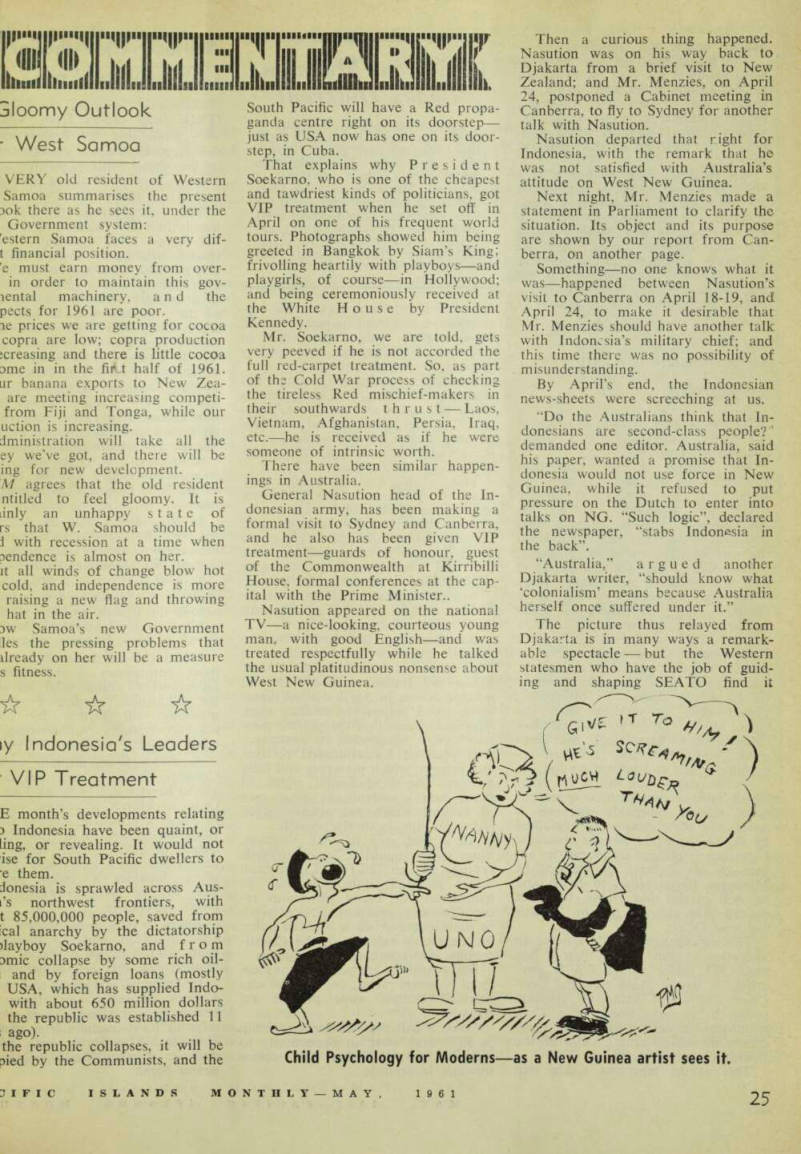
Child Psychology for Moderns—as a New Guinea artist sees it.
neither quaint nor amusing.
The propping-up of Indonesia, so as to maintain the East Indies barrier against Communism, and against the danger that Asians may one day swarm southwards, is one of the un welcome, thankless tasks which now adays we perform in the name of security.
We keep on with it, but it is a hopeless prospect. These Indonesians are incapable of establishing a stable government. At present, trying to keep the eyes of their hungry masses off their domestic woes, they are equipping, with fiery gestures towards New Guinea, a large army; and, for the equipment, they have accepted a .gift of $450,000,000 from Russia. . . ☆ ☆ $
Urgent Call for Fiji
Leadership
DO the citizens of Fiji, of all races, really understand the Colony’s constitutional position?
The debates of the Legislative Council, when in April it virtually re jected the Governor’s plan for in troducing “Ministers” into the administrative system, suggests that Councillors generally had not grasped the real implications of the proposal.
The plan is that selected members of Legco shall—if not already there —become members of Executive Council; and then should be given authority to superintend and, to a degree, direct the activities of certain Government Departments. After a period—vaguely indicated as two oi three years—these “Members” would be given the status of “Ministers”; should then presumably have the right to sit as a body—Executive Council or Cabinet—with the Gov ernor, and advise the Governor re garding policy and administration.
At this stage—and this is the point which most commentators appear to have missed, probably because it never has been adequately explained by the Governor or anyone else—the Governor is obliged to accept the ad vice of his Cabinet or Council of Ministers. If he refuses to do so (and he will retain that right), he must defend his refusal to the British Colonial Office.
This arrangement would require an alteration in the Letters Patent (see page 33) under which Fiji is gov erned. It would mean that the Gov ernor, instead of being an absolute monarch, as now, would be a Con stitutional monarch, like most Gov ernors in self-governing units of the British Commonwealth.
This would represent a big step
forward. It would mean that the rep resentatives of the Fiji people would have a real, authoritative voice in government. At present, they have a voice, but no real authority.
Inevitably, such a Constitutional change will raise in Fiji questions about the status and ability of “Min isters”. Under what method will they go into Legco as representatives of the people? What will be the system of selection or election?
This angle was apparently very much in the minds of the half-dozen able young Fijians who spoke in the debate. They want no “common roll” (through which all other races could be dominated by the Indians), and they will not tolerate any weakening of the authority of the British Crown.
Anyone, knowing the history of the Colony, will be in full sympathy with the Fijians’ viewpoint.
But that does not mean that the present impasse should continue in Fiji. That way lies disaster. Most Fijian and Indian members, in that notable debate in April showed them selves to be reasonable, tolerant men, who understand that the present posi tion cannot be allowed to continue.
A plan of Constitutional revision and reform, which preserves and fully protects the fundamental rights of the Fijians— and of any other race or interest which has acknowledged rights in Fiji—is surely possible.
As a first step in that direction, some move should be made towards setting up an all-Fiji Convention, where sectional difficulties may be hammered out, racial viewpoints re conciled and practical advice given to the Governor, on a basis of unity, for necessary reforms in the Consti tutional and administrative systems.
Early reforms are necessary. Agree ment between racial, commercial and political interest must precede re forms.
What a call there is for leadership in Fiji—and what an opportunity to give the harassed Colony real service through leadership!
A Shot in the Arm For
New Hebrides Education
THE brief report from Vila th month that the British half j the New Hebrides Condominium! to go ahead with plans for a ne Central Teacher Training School (si p. 138) is important news.
The establishment of the schot means that for the first time Britai will have some general, uniforf teacher training in the New Hebride There is no Condominium Educatio Department. Britain has left educ: tion matters virtually in the hanii of the missions, who do remarkab work, but who have been hand capped through lack of trained peop and finance. Also their work in til educational field has not been unifom Things looked brighter in Se? tember, 1959, when a British Educ: tion Officer arranged a conference j all British agencies engaged in educ: tional work. At this conference ear establishment of a training collej was recommended by the delegate as the New Hebrides’ most importai need.
In November, 1960, the first mee ing of the newly formed Britis Education Advisory Committee ei; dorsed this recommendation.
Now that the school is not far cc there is no doubt great enthusiasm among the British missions who har worked so hard and long in the ii terests of New Hebrides education.
Without doubt there would be eve more enthusiasm if the Australia Government would offer to relier the education burden from tH missions still further by offerin teacher training scholarships, an other training facilities in Australii Australia spends millions under tH Colombo Plan for just this kind f aid to her friends in South East Asii Only in March it opened its doo< to the first group of Korean student who will be trained in Australia in variety of fields. Twenty Koreans wr be trained each year—and the fin group includes a young jouraalit who will be given Australian newv paper experience.
Korea is not a participant in tH Colombo Plan, and this training h;i been offered under a special schem inaugurated only last September..
If Australia can afford to help trail Korean journalists—and there is n reason why it shouldn’t—it can alsJ offer to train teachers from the Nes Hebrides. The South Seas are om domain. Charity should begin muo nearer home.