Soviet Ships ‘Siioeld
p. 25 · Read in the full issue
Be Watched’
By a Staff Reporter
Soviet survey ships active in the South Pacific should be “closely watched’’, according to Sir Wilfred Kent Hughes, chairman of the Australian Parliamentary Foreign Affairs Committee. He urged this in April before leaving Australia on a world “fact-finding” tour.
WHAT he thought might be discovered in a “close watch”, he didn’t say, but there is no doubt that the Russians have been increasingly active in the South Pacific in the last year or two, and nobody really knows what they are doing. Some of their activities have certainly been centred on Russian rocket exneriments.
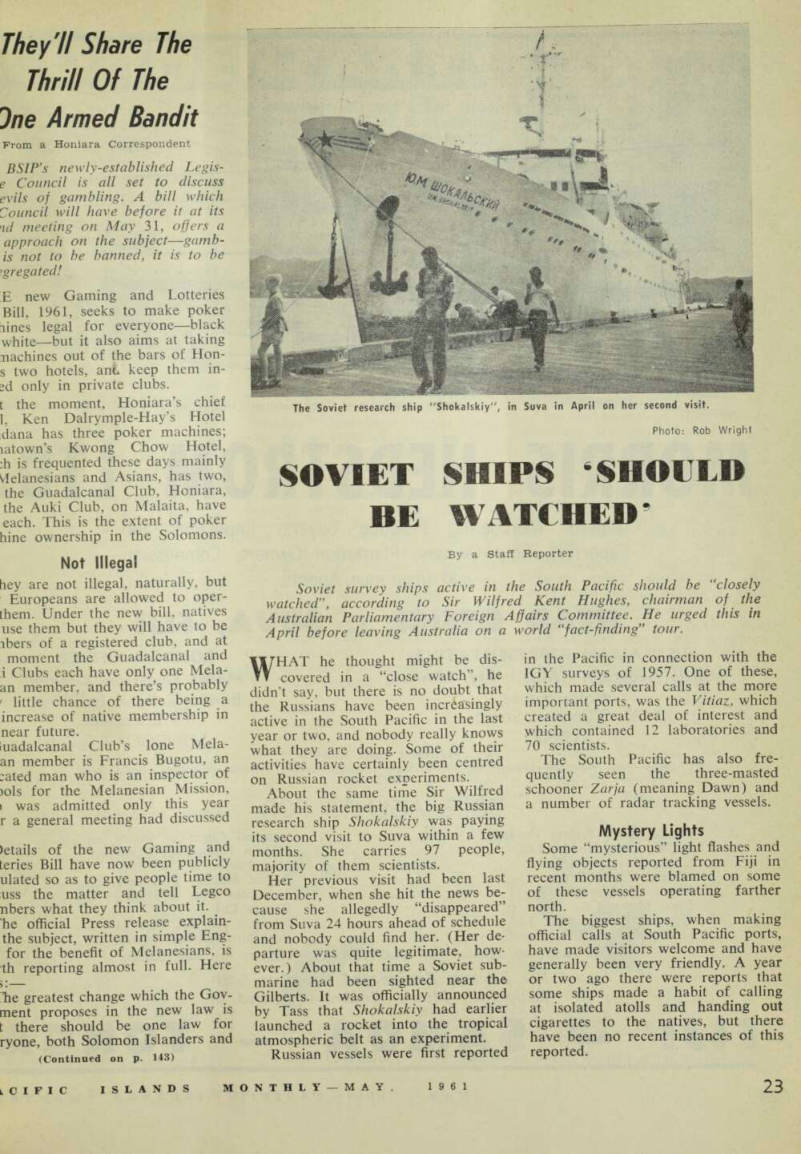
About the same time Sir Wilfred made his statement, the big Russian research ship Shokalskiy was paying its second visit to Suva within a few months. She carries 97 people, majority of them scientists.
Her previous visit had been last December, when she hit the news because she allegedly “disappeared” from Suva 24 hours ahead of schedule and nobody could find her. (Her departure was quite legitimate, however.) About that time a Soviet submarine had been sighted near the Gilberts. It was officially announced by Tass that Shokalskiy had earlier launched a rocket into the tropical atmospheric belt as an experiment.
Russian vessels were first reported
in the Pacific in connection with the IGY surveys of 1957. One of these, which made several calls at the more important ports, was the Vitiaz, which created a great deal of interest and which contained 12 laboratories and 70 scientists. i r The South Pacific has also fre quently seen the three-masted schooner Zarja (meaning Dawn) and a number of radar tracking vessels, . ,
Mystery Lights
Some “mysterious” light flashes and flying objects reported from Fiji m recent months were blamed on some of these vessels operating farther north.
The biggest ships, when making official calls at South Pacific ports, have made visitors welcome and have generally been very friendly. A year or two ago there were reports that some ships made a habit of calling at isolated atolls and handing out cigarettes to the natives, but there have been no recent instances of this
reported.
The Soviet research ship "Shokalskiy", in Suva in April on her second visit.
Photo: Rob Wright