His Chimp Again
pp. 119-143 · Read in the full issue


It's That Man and His Chimp Again
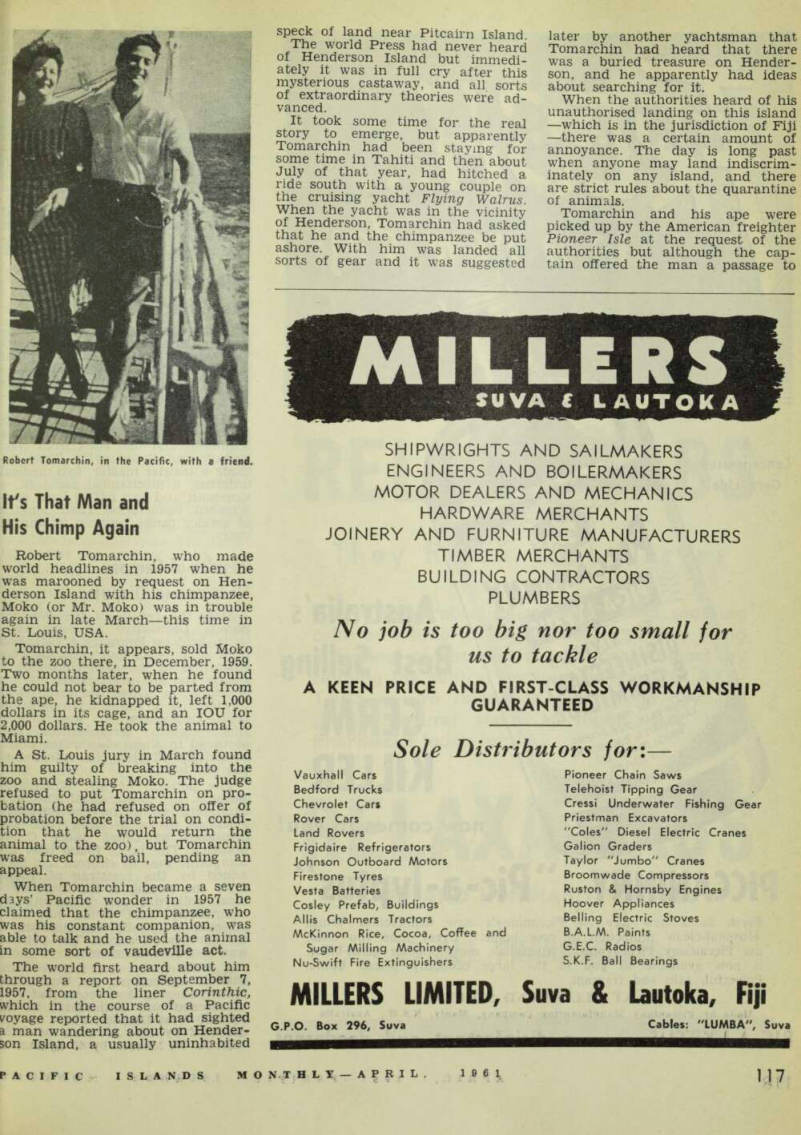
Robert Tomarchin, who made world headlines in 1957 when he was marooned by request on Hen derson Island with his chimpanzee, Moko (or Mr. Moko) was in trouble again in late March—this time in St. Louis, USA.
Tomarchin, it appears, sold Moko to the zoo there, in December, 1959.
Two months later, when he found he could not bear to be parted from the ape, he kidnapped it, left 1,000 dollars in its cage, and an lOU for 2,000 dollars. He took the animal to Miami.
A St. Louis jury in March found him guilty of breaking into the zoo and stealing Moko. The judge refused to put Tomarchin on pro bation (he had refused on oifer of probation before the trial on condi tion that he would return the animal to the zoo), but Tomarchin was freed on bail, pending an appeal.
When Tomarchin became a seven days’ Pacific wonder in 1957 he claimed that the chimpanzee, who was his constant companion, was able to talk and he used the animal in some sort of vaudeville act.
The world first heard about him through a report on September 7, 1957, from the liner Corinthic, which in the course of a Pacific voyage reported that it had sighted a man wandering about on Hender son Island, a usually uninhabited
SP tSS> ( !i«J?Jf c ls near l . P if cairn Island - ™, orld Pr |ss had never heard ol Henderson Island but immedi- .VL was full cry after this mysterious castaway, and all sorts of extraordinary theories were advanced. it tooK some time for the real story to emerge but apparently Tomarchin had been staying for some time in Tahiti and then about July of that year, had hitched a ride south with a young couple on the cruising yacht Flying Walrus.
When j* lo yacht was in the vicinity Henderson,Tom archin had asked that he and the chimpanzee be put ashore. With him was landed all sorts of gear and it was suggested
later by another yachtsman that Tomarchln had heard that there was a buried treasure on Hender son, and he apparently had ideas about searching for it.
When the authorities heard of his unauthorised landing on this island —which is in the jurisdiction of Fiji —there was a certain amount of annoyance. The day is long past when anyone may land indiscrim inately on any island, and there are strict rules about the quarantine of animals.
Tomarchin and his ape were picked up by the American freighter Pioneer Isle at the request of the authorities but although the cap tain offered the man a passage to
Robert Tomarchin, in the Pacific, with a friend.
the United States he refused tc take the chimpanzee. Tomarchir refused to be separated from his pet and both were landed or neighbouring Pitcairn Island.
Finally Tomarchin was persuader to leave Pitcairn Island on the Rangitiki, to—as he put it—“avoir embarrassment between Pitcairr Island and Fiji”. Moko stayed be hind on Pitcairn until Tomarchir made the necessary arrangements to land the animal in the Uniter States.
That was the last we heard oi Mr. Tomarchin or Mr. Moko bul apparently they were reunited suc cessfully at some subsequent date.
250 Years for
The Government
In mid-March the Australian* Gov ernment announced that Loyal Ser vice Awards had been made to eight natives of Papua-New Guinea whc between them had given 250 years of service to the P-NG Administra tion.
Three of the natives are from Papua, three from the New Guinea Mainland and one each from New Britain and Bougainville. They in clude a trawler master, two medical orderlies, a mechanical assistant, a storeman and two native local gov ernment councillors. Their lengths of service range between 26 and 41 years.
Results of Samoan
Elections in Dispute
After the results of the Western Samoa Legislative Assembly elec tions, held on February 4, 1961, had been announced, four petitions were submitted to the Apia High Court, asking for an investigation of the elections in three Samoan elec torates and of the election of Euro pean candidates. It was alleged that certain irregularities had occurred in these electorates which materially affected the outcome of the elections.
The petition of Mr. William F.
Betham, an unsuccessful European candidate, asking for the European elections to be declared void, was dismissed by Chief Judge C. C.
Marsack. The judge found that the complaint that 55 electors had been added by the registrar of voters after the closing of the main elec toral roll, did not constitute an irregularity, and would not have affected materially the outcome of the European elections. The petition was therefore dismissed.
A petition by the former Min ister of Agriculture, Mr. Tualaulelei Mauri, alleging that voters had been threatened and intimidated in the Palauli West District, where he was defeated by Mr. Afoavale Misimoa (Mr. H. W. Moors) by 46 against 42
votes, was also dismissed by the Court, as the evidence in the case was conflicting and contradictory.
A third petition concerning the election in the Faasaleleaga I dis trict of Savaii, where Mr. Magele Ate, as the only candidate nomin ated, was declared elected, succeeded and the election was declared void.
In consequence, a by-election is to be held in this electorate on June 10, 1961.
A fourth petition against the elec tion result in the district of Faleata West had not been heard up to late March.
Madang Natives Want
To Be In It
The three-towns basic wage agree ment for unskilled native workers, which came into effect in Papua- New Guinea earlier this year, is now having repercussions further afield.
The basic wage was for £3 a week and applied to Port Moresby, Lae and Rabaul only. Now Madang native workers want to get into the act.
A native organisation represent ing 450 workers announced in late March that it will negotiate with employers in Madang for the same wage—that is, a rise of about £2/10/- a week.
The chairman of the Native Em ployment Board, Mr. F. C. Caterson, said in Port Moresby on March 22 that Madang employers had agreed to discuss the natives’ claim.
The native organisation calls it self the Madang Workers’ Associa tion and has an executive com mittee of 12, with Stahl Salum as its president. Salum was recently appointed to the Papua-New Guinea Copra Marketing Board as its first native member.
Madang natives at present come under the rural workers’ award which sets a minimum wage of 32/6 per month, plus food, housing, medical care, etc. The natives would, however, prefer to be included in the basic wage that was fixed for the three other big towns—£3 a week without rations or other benefits.
If no agreement can be reached between the Madang employers and the natives, the issue will go before the P-NG Employment Board for settlement.
Housing Loans for
Reputable Rabaul Citizens
The announcement in mid-March of housing loans to low-income ?roup residents of the Rabaul area of New Guinea, was the “first real ray of hope for the Euronesian community”, according to one of its leaders, Mr. Harry Lewerissa.
Most of the Euronesian residents Df Rabaul live in Malaytown, which las come in for a lot of adverse
publicity in recent months. Severa hundreds of people of mixed rac live there, mostly in shacks mad from old war-time scrap.
The scheme, which is availabl to any reputable resident regardles of race, provides for a loan of u to £2,750 when the applicant caj provide £195. The loan may be usei either to build or to buy a hous; and repayments are spread over 2 years with interest at 5%.
Smaller deposits will be accepter in cases where the loan sought i less than the maximum £2,750.
However, there is a trick to it borrowers must have land whid can be mortgaged, and so far a Malaytown is concerned, this i causing concern. A survey of th area has been delayed, and very fe> suitable alternate building block with adequate title are available ii Rabaul.
Judgment in Samoan
Newspaper Suit
Judgment was given in the Apr High Court on March 9 in the libe action brought by one of Wester] Samoa’s weekly newspapers agains the other.
Samoa Newspapers Ltd., pub lishers of Samoana had claime< £2,000 damages from the Samo; Printing and Publishing Compan; Ltd., publishers of Samoa Bulletin and Mr. R. F. Rankin, editor o Samoana had claimed a simila sum.
In his judgment, Chief Judg C. C. Marsack dismissed the sui brought by Samoa Newspapers Ltd. but found in favour of Mr. Rankir and assessed the damages recover able against defendant at £IOC together with disbursements am expenses.
The local newspaper war arose ou of letters signed by a corresponden who called himself “Citizen”, whicl were published in the Samoa Bui letin of December 23, 1960, and Jan uary 6, 1961.
The letters strongly criticised th< action of Mr. Rankin, editor of tin rival newspaper, alleging he had re fused to use the process-block mak ing machinery, owned by Samoana to make a block for an advertise] in the Samoa Bulletin.
In the course of the letters som< uncomplimentary personal thing! were said about Mr. Rankin and i was also alleged that Mr. Rankir and his company had not paid the correct customs duty on the block making machinery when it hac been imported.
Chief Judge Marsack said, in hi! judgment, that he dismissed the suii brought by Samoa Newspaper!
Limited as the statements com plained of did not refer to an in corporated company but only to Mr Rankin as an individual.
The remarks made about Mr
fcankin, however, were clearly de amatory and were not based upon , true statement of fact. The de ence claim of a fair comment herefore failed.
In rendering judgment, the Judge aid he took into consideration the act that the solicitor for the de endant company had tried to settle he matter out of court, but that he plaintiff had rejected all over ares.
cheme for Treating
IC's Low-grade Nickel
The plan of a Canadian in ustrialist, Mr. D. W. Heller, to :eat New Caledonia’s low grade ickel ore at a West Coast plant, as caused a lot of interest in New aledonia. It has also caused some :epticism.
Mr. Heller spent some time in ew Caledonia making a survey of >w-grade (2%) nickel deposits. He len returned to Canada where he ivestigated a new process for re
fining this type of ore. He subsequently announced that he and the mterests he represents will erect, at the West Coast port of Nepoui, a P^ capable of treating 5,000 tons of ore per day. However, there were some “buts” in it. He said that before going into the affair he would need certain guarantees from the New Caledonian Administration. Cost of erecting the treatment plant would be around $25,000,000, and it could be run either by conventional power or from an atomic pile. In addition, the passage through the reef off Nepoui would need to be enlarged to permit the entry of 7,000-ton g hips.
Mr. Heller said that his plans
would give special consideration to the small miner who would be sup plied with mechanical equipment and interest-free loans repayment for which would be made in ore.
Mr. Heller said that his group is willing to invest $5O million in New Caledonia.
Noumea’s reliable newspaper, Bulletin du Commerce calls the scheme “grandiose”—and obviously not without reason. But even if only a part of the plan is realised it would give a boost to New Cale donia’s economy. The island has tremendous reserves of low-grade ore which are useless unless some revolutionary process—such as that claimed by Mr. Heller—can deal with them. (Over)
[?]HE PORT MORESBY SCENE. Port Moresby [?]adio announcer David Cole and Miss Kathie [?]ndre were married quietly in Port Moresby [?] March, and the same evening celebrated [?]ith dinner at the Papua Hotel (top). Lower [?]icture shows Mr. & Mrs. B. Goodsell, at the [?]pening of Burns Philp's new men's mess in [?]ermadec Street, Port Moresby, in March. [?]r. Goodsell is a general-manager of Burns [?]hilp (NG) Ltd. Photo: Papuan Prints.
New Caledonian citizens who ai adopting a policy of wait-and-sei recall another North American min ing venture of some years ago, Thi company, called Calmet, als operated at Nepoui, where it set u a big treatment plant to recove chrome from the sands of the rive flats nearby.
A large amount of money wa spent in equipment, including dredge, but after producing abou 1,000 tons of 52% chrome, it wa found that the whole project wa uneconomic and the compan folded up. The concentration plan was bought by the Nickel Compam
Cooks Want Their
Own Museum, Library
Rarotonga has formed a com mittee to organise the establishmen of a museum and library for th Cook Islands. It will be erected o: Rarotonga.
In early March a first donatio] of £22 was received for the museuri fund, the money collected by th Teacher Trainees’ Association.
Resident Commissioner A. O. Dar is one of the leading exponents o the need for a museum, and is giv ing the scheme every encourage ment.
Getting NG Down
On Canvas
A cartoonist of the London even ing newspaper, The Star, think: that he will live in a New Guinej native village for several month: later this year and draw native in habitants for an exhibition in Lon don.
He is Mr. Fred Joss and he ha; just made a flying visit to th< Territory en route to Hongkong. H( has not chosen the village in whicl he will live yet, but it could hi in the Highlands or in the
Mr. A. O. Dare, who supports moves for a museum for the Cooks. See above.
Trobrlands, off the Milne Bay area of Papua.
He says that he wants to “in troduce the New Guinea villager to the world”.
He said in Port Moresby in mid- March that from the artist’s point of view, New Guinea was com pletely unexploited, and that he wanted to return and get his im pressions down on canvas while the native’s present way of life still exists.
New Caledonia Was
Never Like This
Letters are now reaching New Caledonia from Vietnamese repatri ates who went back to North Viet nam in recent months. Reports of conditions there, according to the letters, are conflicting, the highest praise being that “life is hard”.
The writers obviously might have more to say about the conditions as they find them if it were not for the fact that the letters might be censored.
One letter of instructions from a head of one family to his married daughter still waiting repatriation in New Caledonia, tells her not in any circumstances to bring money with her, but to bring as much merchandise as possible.
This particular man left on the first repatriation voyage, and in order to go gave up a magnificent market garden which he had created out of the wilderness a few miles from Noumea. Before he left he sold it for the equivalent of £A7,500.
The Eastern Queen was due back in Noumea on April 3 to lift about SO Vietnamese who originally came from the New Hebrides. The vessel sailed later to Vila, New Hebrides, where about 450 Vietnamese will embark for Haiphong.
W. Samoa Faces
Sloomy 1961
The economic position of Western Samoa during 1960, according to official figures, deteriorated con siderably, and for the first time for pears the value of imports exceeded :he value of exports by about £40,000.
This was mainly due to the drop n the market prices for main ex ports—cocoa and copra—and a de crease in the production of copra.
At the beginning of 1961 it was •ealised that export values in 1961 vould be decreasing and that there vere no prospects of an appreciable mprovement in these values in .961. The edge of a hurricane, which vas felt in W. Samoa on March 12 lid very appreciable damage to the .961 prospects for the main com nodities, too, and the results will )e felt during the whole of the lurrent year. (Over)
The new cocoa crop which was coming on well, has been practically wiped out by the strong winds and heavy rains, the flowers and young pods being blown off or turned black. There will be hardly any cocoa for export until the end of the current year.
The banana plantations suffered heavily and most of the plants were blown down. Banana exports to New Zealand will probably reach only two-thirds of last year’s exports of 400,000 cases.
As Tonga’s bananas have been more severely affected by hurricane damage, Fiji’s banana growers may benefit from the misfortune of Samoan and Tongan growers which is the reverse of the case of i few years back when Fiji banana production was so badly affected by lurricanes.
It has been suggested that, in )rder to cope with the dangerous ow level of Western Samoa’s over seas funds, the Government may )e forced to introduce import con ;rol.
As the spending power of the Samoan people will be greatly imited in the foreseeable future, mporters will anyhow be compelled o reduce their imports.
The Samoan Government, and >articularly the new Minister of r inance, the Hon. G. F. D. Betham, faced with a particularly dif icult task in preparing the 1961 Judget which is to be submitted to he Legislative Assembly budget ession commencing on April 11.
For years now, the Budget has be ome more and more top heavy and nrealistic for a small country like Vestern Samoa with only 100,000 ihabitants.
The Public Service with a salary ill of about £8.750,000 is particularly nwieldly, and at present requires lore than half of the ordinary evenue of the Samoan Government.
When a similar, but much milder, Bcession was experienced in 1957, ie Government had to resort to ismissal of hundreds of school jachers and other public servants.
It is at present not known what ?medies the Government will sug sst to cope with the unfortunate nancial setback in 1961. It is also reatly regrettable that an economic Jcession should face W. Samoa at time when it is looking forward > Independence on January 1, 1962.
S Scholarship Men
lake an Impression
“The three young men with us at •esent are making a fine im •ession both with faculty and wnsmen. They are laying the oundwork for ready acceptance of ture applicants.”
This was the tribute paid to Fiji’s ■st three scholarship winners to e East-West centre at the Uni rsity of Hawaii, by the Acting
Dean of the International Colleg Mr. Leonard D. Tuthill, in a lett< to Fiji’s Director of Education, M J. G. Rodger, in March.
The three students, who left F; at the end of January, are Mar Tupou, formerly Fiji Visitoi Bureau representative at Nad James Surendra Jagi, student Lelean Memorial School, and Jam Anthony, secretary of the Whol sale and Retail General Worke] Union. (See PIM, Mar., p. 45).
Mr. Rodger had written inquirii how many more of East-West Cent scholarships would be available Fiji, as the scheme came in operation only last October.
In his reply, Mr. Tuthill said only four scholarships were ava: able to the Pacific territories (e: eluding US Trust territories) f 1960-61, and as Fiji had alrea( been awarded three of these, it d not seem likely that the Coloi would be granted the only one le: Next year, however, eight schola ships would be available to the territories, and it was more th; likely that Fiji would be success! in gaining its share of them.
Mr. Tuthill said in all, 250 schola ships would be awarded for 1961and by 1965, the total will ha reached 1,000.
In the hope that Fiji’s allocate will increase annually, Mr. Rodg said consideration was being giv to the selection procedure necessa to cope with the large number prospective students expected apply.
And although it is to be expect that the more populous Asii countries will gain the bulk of t! scholarships, a Suva corresponde says it is good that Fiji is keepu a weather eye on what’s offeru for its part of the world—and th its pioneer students are makii such a good impression.
Bulk Petroleum Products
For Bsip
Work will commence shortly < the erection of the first oil su installation built in the Briti Solomon Islands.
The installation, costing £llO,Ol will be erected by the Shell Co. i its present site in Honiara. T storage capacity will exceed 1,500,0 gallons of petroleum products.
Bulk supplies will come fre Singapore by 18,000-ton tankers, t biggest ever to visit Honiara. Fi will be pumped ashore through submerged pipeline.
Since bulk petrol was introduc by Shell on a small scale in M£ 1960, the price of motor spirit ai distillate has dropped by 7d. p gallon. The present Shell install tion has a bulk storage capacity 75,000 gallons, and stocks are from the company’s Rabaul dep< being transported to Honiara small tankers.
With the commissioning of the 'W installation early in 1962, a rther price reduction can be ex cted. The present bowser price is U per gallon.
While plans are being finalised • Shell’s enlarged installation, the 'Cuum Oil Co. Ltd. has almost npleted the erection of its first >tallation in the BSIP which >0 is like Shell’s in Honiara.
Jnder the supervision of Vacuum’s istruction engineer, Mr. C. V. >rris this installation is expected be completed by the end of April,
months after coLtrnrti™ U £ four MiMorrri sa w tb» f h» T began. isfiPH he ™ as sat “
considering the s?te Tpotat C°raz
was originally a swamp which had to be reclaimed before erection could be started.
When asked about marketing arrangements, Mr. Morris made no SSSSSS’ lTto e theT § ive nO . in ;
VacTTse?virP Tw 0f
V HoT r r[s ser?Thv tT?
statfon* Vi nf XnIT thr fe service nrnrfTf; a Jls f whlc - h market . shell nf d any * n p. rea se in the litToH 1 " service stations must be unmeet.
It is believed that Vacuum will be supplied by the tanker Pacific En terprise, which will draw from Vacuum’s depot at Lae, New Guinea.
PlR's Big Part
To Play
Critics of Papua-New Guinea’s Pacific Island Regiment were probably interested in the mid- March announcement that Australia spent more on her Army units in P-NG than on any other units in the Commonwealth.
This information was given by Major-General R. E. Wade, GOC
Northern Command, who had ji completed a ten-day familiarisati tour of the Territory.
At a press conference in P( Moresby he claimed that he h been “most impressed”, especia by the PIR which he described a “fine body of soldiers with a 1 part to play in this countr future”.
Trobriands Lose
A Powerful Chief
The death has occurred in t Trobriand Islands, east of Papi in March, of Mitakata, chief of t Tabalu clan of about 3,000 peopl He is survived by 13 wives, children and an estimated 40 grar children, plus 9,000 other Trobria Islanders who have all gone ii mourning for him.
The mourning period is expect to last some months as Mitaks was regarded almost as a god. : was about 75 years old and had important place in the Trobria scheme of things for the last years. He was one of the Grou most respected and powerful me:
Bond For Young
NB Native
A 13-year-old New Britain nat: boy was given a 12 months’ go behaviour bond in the Supre] Court at Kandrian in late Man He was found guilty of killing ] five-year-old brother with a fi£ spear.
The Crown alleged that at t time of the brother’s death, be boys had been on their way to mission feast. While they wt crossing a river the younger brotl began to cry because he thought was being left behind. The elc struck him with a fish-spear quieten him, and when the youni boy attempted to swim away ] elder brother had reversed his spe and thrown it. The spear enter the young child’s groin and he di almost instantly.
In a second hearing, the bo step-father, Anuk, the village chi was acquitted on a charge of ha ing attempted to pervert the car of justice. The Crown alleged tt Anuk had tried to bribe witness of the boy’s death not to report t incident.
Chief Justice Mann, who v hearing the case, accepted the c fence’s plea that allegations were conspiracy by certain villagers have Anuk removed from power I cause he was reputed to be sorcerer.
Has NG Got Mau-Mau
Or Just Jitters?
Just how serious is a so-call Mau Mau type cult in New Guin
vas the centre of a controversy in March —with the clergy on one side md Government officials on the >ther.
The clergy said it was serious md something should be done ibout it. The Administration said t wasn’t serious, and that they had tad their eye on it for some time, nyhow.
The cult is called Iniid.
A Roman Catholic missionary, 'ather J. Reischl, of Rabaul, a nest of many years experience in Few Guinea, reported the existence f the cult to the authorities in ebruary (PIM, Mar. 7).
According to Dr. John Gunther,
.ssistant Administrator, the natives
ivolved were “Teddy Boy” types, ho just needed a spanking.
The great mass of the native eople of New Britain resented ;hese fools”, he said.
“They also would bitterly resent ay suggestion that there is real Dposition to the Australian Admin tration, or that white people need • have fears.”
Dr. Gunther was making an Bcial statement on reports of the leged secret native cult whose embers were sworn to kill all hite men.
The cult was reported to be build s' up among the Tolai people of ew Britain and spreading to the bw Guinea mainland.
Dr. Gunther said the Administra- Jn had known “for some time’ at a secret society—one that Junshed back in the German days had been revived.
He ridiculed the idea that any iti-European bias it might have is of significance. He said the re lt of the March 18 elections— len only native candidates who mpaigned for closer native-Euro an co-operation succeeded—gave e lie to that. [ngiat was one of three native 2ret societies which flourished ring the German rule of New linea, Dr. Gunther said.
Ft was banned at the turn of the atury after a planter’s wife and r children were murdered in re lation for desecration of an Ingiat nee ground.
“The Administration is closely watching its activities,” he said “Today there is no fear of Ingiat acting in any way to the detriment of the Australian or Tolai people.
“Any public statements to the contrary are gross exaggerations and looking for sensationalism.”
Dr. Gunther said that Adminis tration officers in Rabaul were actively following all cult rumours.
“We can’t stop these people mak ing fools of themselves until they are a danger to society,” he said.
“When they do this then the law steps in.”
However, two weeks after Dr.
Gunther’s statement at end of March, Fr. Reischl was still con vinced that there was, as he put it, a “secret government of terror”
amongst local Gazelle Peninsula natives.
He said that he believed the majority of natives, while not Iniid adherents, had been intimidated, through fear of sorcery, into aiding the cultists.
Cashier Faces NG
Theft Charge
Basil Seeto Sek Cheong, 32, in March was committed for trial at the next sitting of the Supreme Court in Lae on a charge of steal ing during the past two years £12,057/14/9 from his former em ployers, Burns Philp (N.G.) Ltd., at Lae, for whom he worked as a cashier. Seeto is married with two children.
Dr. John Gunther.
Spear-Fishermen Blamed
For Noumea Fish Shortage
The increase in the numbers of amateurs spear-fishing has been blamed for the scarcity of fish caught in recent years by pro fessional fishermen around the coast of New Caledonia.
In a letter to a Noumea news paper, Mr. Emile Castex stated that a few years ago commercial fisher nen could be certain of filling their vessels locally with enough fish to satisfy Noumea’s demand. Now they ire forced to go a lot farther afield ll u^i.i even en they are not sure yhether they will catch sufficient ish for the demand.
Mr. Castex and a number of other :ommercial fishermen have made a lose study of the situation in the ast three years and their opinion s that around the fishing grounds hat are frequented by spear ishermen, the fish have virtually lisappeared.
Underwater sport of this type fas, of course, virtually invented y the French but even the spear- Lshermen themselves are being fleeted by the scarcity of fish round Noumea these days. People mo take part in the numerous pear-fishing competitions now have \ go much further afield them slves to capture anything worth inle.
Other amateur fishermen who ever did anything more adventur es than dangle a line at various x>ts around Noumea harbour also iport now that they have to sit •nger for fewer fish.
Mr. Castex is particularly critical : the so-called spear-fishing cham tonships which caused huge nounts of fish to be caught and len thrown back into the sea once le spear-fishermen had posed for lotographs in front of the catch.
G Patrol Hazards—
annibalism and Japs
A patrol of 54 days has recently sen completed in the country south 5St of Lake Kutubu, in Papua. It as carried out by Native Affairs srsonnel under the leadership of itrol Officer F. J. Howard.
The first patrol through this so iled Bosavi area was made by the lamson-Champion patrol, in 1936, id Lake Kutubu station was opened 1937.
There have been other subsequent xrols and Mr. Howard was able report at the end of the most sent one that although tribal sputes still occur and there e some cases of cannibalism, Ad mistration influence is growing.
With one exception the patrol is well received in all hamlets d on several occasions the people Id dances to welcome the party, hers had built new rest houses
and police quarters before the patrols arrival, and an abundance of native food was offered for sale to the party.
The one attempt made to influ ence the patrol to leave a hamlet occurred at Ferisa. After camp had been made a villager arrived on the run and announced that Japanese troops had stayed the night at a nearby village and might visit the Ferisa hamlet soon. Mr. Howard comments that this report was probably invented in the expecta tion that on its announcement the patrol would immediately move on.
The informant was advised that the patrol knew there were no Jap anese troops in the Territory, and the people then made no further
effort to induce the patrol to break camp. Mr. Howard said that as no Japanese were ever anywhere near the area during the war, reports of Japanese troops in the country dur ing the war had probably come through from men of the Kikori area who had served with the Forces.
The patrol found that the popula tion had ample supplies of native produce and supplemented this with wild game, cassowary, wild pig and pigeons, which abound in the dis trict. The Bosavi men are par ticularly fine and accurate bowmen.
A full set of arrows for a huntsman consists of six different types, each with its own purpose and used on one particular type of game only.
The Bosavi bows are widely sought ter and are traded far into the iri area of the Southern High ids. Most Bosavi men appear to end at least half of their time inting.
Bosavi houses seen by the patrol ire exceptionally good and of a sign unique to the area. When ilding a house a Bosavi first finds clump of trees with the correct acing to serve as supports. The ies are then cut off sometimes 30 40 feet from the ground and the imps used as uprights. Mr. Howard v some uprights as large as eight it in diameter. The roof is made sago leaves with curved side and i gables so that the shape is lilar to an upturned boat. The iise are communal homes in ich the women of the clan live quarters partitioned from the itral hall, which is occupied by i men.
i Discusses a
iff Distinction
l beneath-the-surface struggle 5 going on in Fiji in early April ween those who wish to accept a tish Government proposition for her rewards for overseas civil pants in Fiji, and those who mgly resist the idea, ondon has pointed out that ian administration needs a lot .killed officials and that Fiji, hav a limited budget, cannot afford pay the high, and increasing iries of all the officials it needs, isequently, a number of import posts remain vacant, ondon therefore has offered to vide the difference between what can pay these officials, and it the officials require before they accept service in Fiji. A system lew rates, representing increased )luments. would apply to all ex riate officials in the Fiji public dee. he Fiji Government, being corn ed —as to the dominant majority \ senior expatriate civil servants enthusiastically in favour of
the plan. It argued that this system of bringing in more skilled and ex perienced officials would greatly assist in the urgent task of develop ing Fiji’s resources, to take care of the rapidly increasing population.
But the high officials ran into
trouble immediately.
It was part of the plan that only officials from overseas should re ceive these additional emoluments.
The increasing number of officials who are rated as “residents” of Fiji would continue to receive only what is called the Fiji rates of pay.
That, of course, was political dynamite and the non-Govern mental persons who learned of the plan told the Governor so, in simple terms. The Fiji Times was outspoken on the subject.
Also, it was manifest injustice.
Why should residents of Fiji be paid less for their services than residents of England or Australia?
Why should a person be penalised because he is a resident of Fiji— always provided, of course, that the service he gives is comparable with the service supplied by the expatri ate?
Everyone agrees that Fiji needs— now, more than ever before —skilled and experienced administrative officers. Since the Colonial Office is in a generous mood, it would be folly not to take advantage of the offer.
So why not accept the offer —on condition that all officials, expatri ate or resident, got the benefit of the higher rates?
The Fiji Government seemed to baulk at that. Probably, it was re luctant to seem to bargain with the Colonial Office.
But it was pointed out, in Suva, that a similar position arose re cently in Kenya; and was solved by an agreement that the higher rates, as provided by the Colonial Office, should be paid to all officials, whether local or exoatriate.
At this moment, the ball is in the air. and none knows where it will fall. It is being very anxiously watched by those overseas officials who are in Fiji merely because they
are serving “a term of duty” there.
However, the belief was current in Suva early in April that the Government ultimately would re commend something similar to the Kenya plan to the Colonial Office.
Suva's Most Celebrated
Gael Escapee Recaptured
An armed party of Suva police captured Sairusi Nabogibogi, who escaped from Lautoka Gaol on May 28, last year.
They took the prisoner in his father’s house at Raiwai, a Suva suburb, in early April.
Acting Senior Superintendent Stan Gullidge, formerly of the South Australian Police Force, led the police party.
Two Fijian policemen smashed a door down and found Sairusi with a group of seven other Fijians drink ing kava.
A .22 calibre rifle was beside Sairusi, but he surrendered quietly.
Seven other Fijians were charged with harbouring a prisoner.
Sairusi at the time of his escape was serving sentences totalling 13 years for crimes which included robbery with violence. \
Does Niue Provide
A Survival Clue?
Niue Islanders might provide the key to the future of mankind in the atomic age. British physicist Sir Ernest Marsden said in Wellington in April, He said research into the ability of the islanders to withstand abnormally high natural radiation on their unique volcanic island—a New Zealand dependency 300 miles
In Sydney
These four young ladies from Fiji were at a re cent Polynesian Asso ciation gathering in Sydney. From left.
Hazel Curtis, Grace Miller, Kiti Cokanasiga and Grace Smith. Hazel is a business secretary, the two Graces and Kiti are nursing.
ast of the Tonga group—might trovide clues to the ability of man ;ind to withstand the horrors of luclear warfare.
Sir Ernest said that at present iologists at Cambridge University rere working on material from Niue sland.
It was hoped this research would nable scientists to find how these eople had been affected by living Dr so many years on an island in arts 20 times more radio-active ban normal.
“We have already discovered this nvironment has evolved a race lore resistant to radio-activity,” ir Ernest said.
“We are on the verge of interest ig new discoveries.”
The work would be linked with le effect of radiation on chromo >mes and genes microscopic articles that determined hereditary ictors.
Sir Ernest said Niue Islanders ad evolved under their prcjsent mditions by a process of survival f the fittest.
Stillbirth had reduced those un ble to withstand the abnormally igh radiations of parts of the iland.
iji Subscribes
0 Gatty Memorial
A small number of Fiji citizens 1 response to an appeal by the iji Times, sent in subscriptions to le Harold Gatty Memorial Fund nd, at the end of March, Fiji imes sent the sum of £34, thus mtributed, to the Secretary of the und, Town Council Office, Camp ell Town, Tasmania. Campbell own is the birthplace of the late Lr. Harold Gatty, and the memorial being erected there. (See PIM, lar., p. 57).
opra Prices
each a New Low
Copra prices reached a new low i March when the average price, i.f. UK/Continent was £Stg.6o/15/er ton.
This has been reflected in adjust lents to prices paid producers in acific Islands—notably in Fiji and le Solomons.
The BSIP Copra Board adjusted its rices down to the tune of £B/10/er ton, making the three grades \5l/10/-, £ASO and £A47/10/-. Fiji rice at the beginning of April was F49/10/- and £F47 for their two grades.
The chairman of the Papua-New •uinea Copra Marketing Board has ;ated in his monthly report to pro acers that he hopes an average of 3tg.61 per ton will be maintained ) that it will not be necessary to ary the tentative P-NG price hich at present is £AS4/10/-, £AS3, ad £AS2/10/- respectively for the
three grades. However, he Indicates that the safety margin is now pretty narrow.
Other points made by the chair man in his report are that “un fortunately for copra producers” they are now on the other end of the swing from where they were several years ago when copra and coconut oil were in very short supply.
Before manufacturing formulae can be altered, long-term produc tion and price potentialities must be considered. Manufacturers are well aware that both soya bean and cotton seed production can be in creased sharply without mu c n trouble, whereas there is no quick means of increasing copra produc tion —“Hence the cagey approach” to any sudden change in manufac turing formulae.
The chairman thinks that it is a good omen for the copra market later this year that 155,000 tons of the current season’s Antarctic whale oil catch has already been sold. The price was £Stg.73/10/- per ton ex ships, to Unilevers, on behalf of Norwegian, Japanese and British Whalers. (Over)
Some Acid Comment
On Fiji Sugar
The Commission of Inquiry into the sugar industry in Fiji ended late in March with some notes of sharp criticism of the CSR Co. by some of the experts advising groups of cane-growers.
Mr. R. s. Kay, a chartered accountant assisting one group, was supported by the chairman (Sir Malcolm Trustram Eve) when he insisted that the company had shown reluctance in answering questions about what became of a sum of £1,380,000 which at one period appeared in the Depreciation Account, and then disappeared with out trace or explanation.
Mr. H. G. Nicholls, a CSR official, submitted in writing a rather com plicated reply which the chairman said was not comprehensible. “It may be an accountant’s answer, but we want a straight answer,” was his summary.
Mr. A. D. Patel also hammered at the mysterious figure; and then argued that the CSR was “cheat ing” the growers in relation to pay ment for molasses. He called for Government, instead of monopoly control, of the sugar industry in Fiji; and he advocated a system under which the growers could pro cess their own cane.
Mr. D. M. N. Macfarlane, repre senting other cane-growers, con demned the “remote control” of the Fiji industry by the CSR. He argued
that the cost of managing the h dustry in Fiji from Australia ws between £300,000 and £400,000 p. annum—“and that is too much ” I declared.
Mr. B. D. Lakshman said that tt figures given to the Commission 1; the CSR showed that the compar could pay bigger wages to mil workers; and if the present “deac lock ’ on wages was not resolved s the next crushing season the resu could be disastrous”
In replying to all this for th CSR, Mr. R. G. Kermode said th company had grave doubts whethe the constitution of a Sugar Boar to control the industry really wa the answer to the problem in Fij The company advocated, instea( improved control and operation c unions and associations, and a mor scrupulous regard for agreement!
Any disadvantages of “remote con trol” were more than outweighed by the benefits the CSR in Fr received from its association wit] the very big sugar industry in Aus tralia.
So far as the demand for highe wages at the mills was concerned the company considered that th present wage structure already wa more than fair and equitable. Th idea of growers processing cane fo themselves was completely im practicable, under present work conditions.
As reported, on p. 20, the Com' mission's sitting ended happily wit! an agreement covering the 196' cane-cutting.
Members of NNG's
New Council
With the announcement ir Hollandia in late March of the names of the 12 appointed members of the New Guinea Raad, NNG was all set to hold the inaugural meet ing on April 4 (see p. 19). The New Guinea Raad has 28 members, 16 elected and 12 appointed.
These were the elected members:
Hollandia, Mr. N. Jouwe;
Hollandia-City, Dr. O. J. De
Rijke; NIMBORAN, Mr. Manasse
Suwae, Schouten Islands, Mr.
M. W. Kaisiepo, Mr. B. Mofu; JAP
En-Waropen, Mr. M. B. Ram
andey, Mr. E. J. Bonay; MANOR WARI, Mr. H. F. W. Gosewich;
Ransiki, Mr. P. Torey; Radja
AMPAT, Mr. Abdulla Arf a n ; SORONG, Mr. A. van Zeeland;
Teminaboean, Mr. A. Onim;
AJAMARU, Mr. Daud Deda; FAK FAK, Mr. N. Tanggahma; MER AUKE, Mr. A. Kendau Gebse; KAIMANA, Mohamad Achmad.
The appointed members are: Mr.
V. Maturbongs, Mr. F. Poana, Mr.
Kiriwaib, Mr. Thontji Mezeth, Mr.
Simon Samkakai, Mr. Dominicus Walab, Mr. Bertus Burwos, Rev. Dr.
F. Kamma. Father Dr. L. J. van de Berg, Mr. Karel Gobai, Mr. Herman Womsiwor (private enterprise), Mrs.
Dorkas Tokoro-Hanasbey (women’s representative).
Mr. J. H. F. Sollewijn Gelpke is Chairman of the first Council.
They Want PIR
Moved Out
The Papua-New Guinea State branch of the Returned Soldiers’
League decided at its congress at Lae, in March, to recommend that the Pacific Islands Regiment training establishment (for native soldiers) 3e moved out of Port Moresby.
Delegates said there were a lot of
indesirable natives living in Port Moresby who had influenced young PIR troops, and this had been shown n recent riots involving the troops.
The congress also decided that it vas unsatisfactory for the Army to 30st its European officers to the PIR for short periods, and that periods should be lengthened or nade permanent.
The congress decided to press for naugura.tion of an all-race volunteer ntizen force in P-NG, and to ask ;he Commonwealth Government to extend citizenship and passports to nixed-blood people born and living n the Territory.
Fhe Council Battle
Dn Norfolk Island
Norfolk Island’s internal politics ook an interesting turn in March ollowing the election to the Nor olk Island Council of Mr. A. Bathie n place of Mr. Leo Nola, whose )ffice was declared vacant because le was absent from three meetings )f the Council.
Mr. Bathie has been one of the nost outspoken critics of the Council, which was elected last year n place of the old Advisory Council.
Ever since the Council took office the community has been split on whether it has been doing a satisfactory job or not.
Mr. Bathie’s first move following his election was to have a special Council meeting called for discussions with the Administrator on Norfolk’s financial problems.
At the next regular Council meeting, on March 14, Mr. Bathie asked the president, Mr. F. J. Needham, for an adjournment on the ground that proper notices of the meeting in accordance with the Ordinance had not been sent out.
The president refused and Mr.
Bathie took the matter to the Chief Magistrate in early April, asking for a ruling that the meeting had
not been properly convened, and for a direction to the Council to set out properly the nature of its busi ness at future meetings.
He won his case, The verdict has aroused a lot of speculation on Norfolk. The fact that one meeting has been ruled improperly convened may mean that earlier meetings were, too.
And if all meetings were im properly convened, Councillor Nola may have been improperly removed from office!
Reported one Norfolk Island cor respondent; “General opinion is that the Gilbert and Sullivan comic opera regularly being performed at Rawson Hall is rapidly developing into a tragedy for Norfolk Island.”
[?]he Australian Minister for Repatriation, Mr. [?]. M. Osborne, with Mrs. Osborne, arrives in ae to attend the RSL State Congress in March.
The Minister later made a P-NG tour.
Photo: "New Guinea Times-Courier".
Tragedy, and Near
Tragedy, in the Air
Two crewmen and a hostes* scrambled from a DCS freighte: minutes before it broke in half anc burned fiercely after an emergence landing in the New Guinea High lands in early April.
Medical equipment worth £10,00( was destroyed in the fire.
The £30,000 aircraft, which burnec for more than 24 hours, has beer written off as a total loss.
The aircraft, owned by Papuar Air Transport, had been chartered by the Administration to take 4,30 C lb of medical equipment to Kun diawa, in the Eastern Highlands.
The pilot, Miles Lewis, 36, said: “We were at about 13,000 feet. 1 smelled something—l don’t know just what it was—and went back to investigate.
“There was smoke or fumes com ing from one of the boxes and the plane was filling quickly.”
Lewis said he headed in a long, shallow dive for nearby Bereina air strip.
Four minutes later he touched down and taxied the smoke-filled aircraft off the main runway.
He and the air hostess, Miss Pat Gollum, 21, jumped to the ground from the emergency escape door.
First Officer Bill Vink, 40, blanketed the smoking boxes with foam from an extinguisher before jumping clear.
Minutes later the roof of the air craft’s fuselage caved in and the plane broke in half.
The aircraft was the second that Papuan Air Transport has lost in the last month.
On March 8, a twin-engined Piaggio and its pilot, Geoffrey Wallace, vanished on a 90-mile flight from Popondetta to Port Moresby.
An intense air and ground search failed to find any trace of the air craft.
However, a patrol did find the re mains of four bodies in a crashed war-time American Mitchell bomber, and some of the identifica tion tags could easily be read.
The Show Crowds
Liked the Coffee
Over a hundredweight of coffee and cocoa beans were souvenired by the public from the Papua-New Guinea display at Sydney’s big Royal Easter Show.
The beans were sampled by the kids who took them home to paste in their “project” books.
Several new panels of enlarged photographs were added to the P-NG stand this year to illustrate the development of coffee and cocoa growing in the Territories, Other murals which attracted the : public’s attention showed the re cent political advances of the New
Guineans, social progress, work of the missions and advancement of women.
Administration officials, assisted by two New Guineans, had a hectic time answering all the queries from the public.
Most questions were intelligent ones, showing the Australian man in the street’s interest in the Terri tory.
Although the overall attendance at the Show dropped this year, P-NG stand officials said they had experienced the biggest crowds yet.
Maybe next year New Guinea coffee growers should get into the sample bag business and really pro mote the interests of New Guinea coffee to the million-odd show visitors!
New Support
For Suva Airport
The plan to establish an airport at Suva Point, on the edge of Suva city, is being vigorously supported by an organisation of Suva citizens.
Dr. K. M. E. Bradfield, a high official in Civil Aviation in Aus tralia, and Mr. A, Reiher, of the Australian Department of Works, were in Fiji at the end of March to report upon the plan.
Suva’s present airport is at Nausori, on a low-lying section of the Rewa Delta; and the 12-miles long road-connection between Suva and Nausori airfield is through a series of growing Indian and Fijian villages. (See PIM, Feb., p. 138).
Seven Out of 10 Natives
Won't Reach Five
The task of bringing help to Papua-New Guinea was so great that it would never ba overtaken until Australians had the partner ship of the indigenous people, the Minister for Territories, Mr. Hasluck, said in Madang on April 7.
Mr. Hasluck was opening the new £662,000 Madang District Hospital.
“In this task,” he said, “people of all races and variety of talents will be required.
“It is not only in this field we will make a triumph where in other parts of the world there has been human tragedy but in others as well we may be able to do suc cessfully what has never been done anywhere else.”
The Director of Public Health, Dr. Roy Scragg, said that now only four per cent, of those who died in the Territory received hospital treatment when they died.
Dr, Scragg said seven out of 10 children never reached the age of five, whereas in Australia 39 chil dren out of 40 lived beyond the age of five.
A woman had one chance in 10 of dying in one of her pregnancies.
He was glad to see a hospital established which would lift the standard of health in the district.
A native, Liwa Kolau, president of Ambenon, the native Local Gov ernment Council, clad in shirt, tie and laplap made a speech in Pidgin in which he thanked the people of Australia for paying “big fella taxes” to pay for the hospital.
The native people would have to pay them back and they could best do that by working hard together with the Administration for the ad vancement of all, he said.
Important New Radio
Telephone Link
A new radio-telephone service, which provides a new and highly efficient telephone link between Suva, Lautoka and Nadi was in
The P-NG stand at this year's Sydney Royal Easter Show.
augurated by the Governor of Fiji late in March.
To perform the opening ceremony, Sir Kenneth Maddocks climbed to South Ridge, a 3,500 ft unroaded peak in the interior of the island of Viti Levu, where a repeater station has been built as one of the important links in this VHF ser vice.
The new telephone link repre sents a great improvement in the telephone services linking the main centres of Fiji. Suva and Lautoka can now call each other quickly and efficiently, where on the old service there were long and exasperating delays.