Pacific Report
pp. 115-117 · Read in the full issue
The month’s round-up of news and pictures of people and events, from PIM correspondents in the South Pacific.
'Won't Carry Ouf
Fiji Burns Report
Latest news suggested that very few of the more important recom mendations of the 1960 Burns Re port on Fiji could be carried out, Dr. R. F. Waters, lecturer in geography at Victoria University, told the Canterbury branch of the New Zealand Geographical Society in March.
If this were so, things would grow worse than they were already, he said.
One of the worst features was the racial tension between the Indians md native Fijians.
This was not visible immediately ;o the tourist at Suva, but there was i cold hatred between the two races md often a hot hatred.
The Indians regarded their cul ture as superior to that of the rijians, and looked down on them, vhile the Fijians resented the jresence of the Indians and were rery jealous of the “paramount josition” in the islands which had >een guaranteed them in the Deed •f Cession and subsequent legisla ion.
The Indians clung to a declara ion in Queen Victoria’s time that heir rights were to be in no way nferior to those of other races.
>aol for Subversion
n Dutch New Guinea
A 38-year-old Indonesian was entenced to four years gaol in the follandia District Court in March 3r having founded a secret sub ersive pro-Indonesian organisation.
The court was told that Willem ohannes Pakashy came to West few Guinea in 1949, and in 1958 mnded an organisation called Fentara Tjendrawasi Tenjagan”
Army of the Heroic Paradise Bird), hich was to prepare for an Indo esian invasion.
To attract natives to the organ ation he sold amulets which made le buyer “invulnerable”.
Pakashy denied pro-Indonesian itentions and said he wanted to ither information about the organ ation for the Dutch authorities.
Two crown witnesses, co-members
of the organisation, Frits Werluken and Rafael Maselkosu, some months ago were gaoled for five years.
The prosecutor, Mr. Frans Jansen, told the court that secret pro-Indo nesian organisations which had been started in 1958 had now been broken up.
They Can't Beat
That There Drum!
Rarotonga, it now turns out, doesn’t altogether condone the time honoured practice of its theatre owners in throwing advertising leaf lets from moving trucks, and of banging drums to attract atten tion.
It made up its mind about this in February at a meeting of the Raro tonga Island Council.
The subject had been raised at
earlier meetings when some coun cil members had said they thought picture drumming was dangerous and should be stopped. The council was told that the Medical Depart ment had complained that the throwing of leaflets from moving trucks exposed children to injury when they ran on the road after them.
The council formed a select com mittee empowered to discuss the matter with authorities and pos sibly draft a by-law to stop the practice.
The February council meeting heard the select committee’s re port.
The report recommended that no by-law be introduced at present to stop the throwing of advertising matter or the banging of drums.
However, the Resident Commis sioner should “officially request” proprietors to stop the practice.
If this didn’t produce results, it was pointed out that offenders could be prosecuted under present regulations. But only as a last re sort should a special by-law be in troduced, said the select committee.
The council adopted the com mittee’s report.
Bird-bander Strikes
One From the Deep South
One of the more rewarding of hobbies—it could be so on many Pacific Islands—is bird-banding, at-
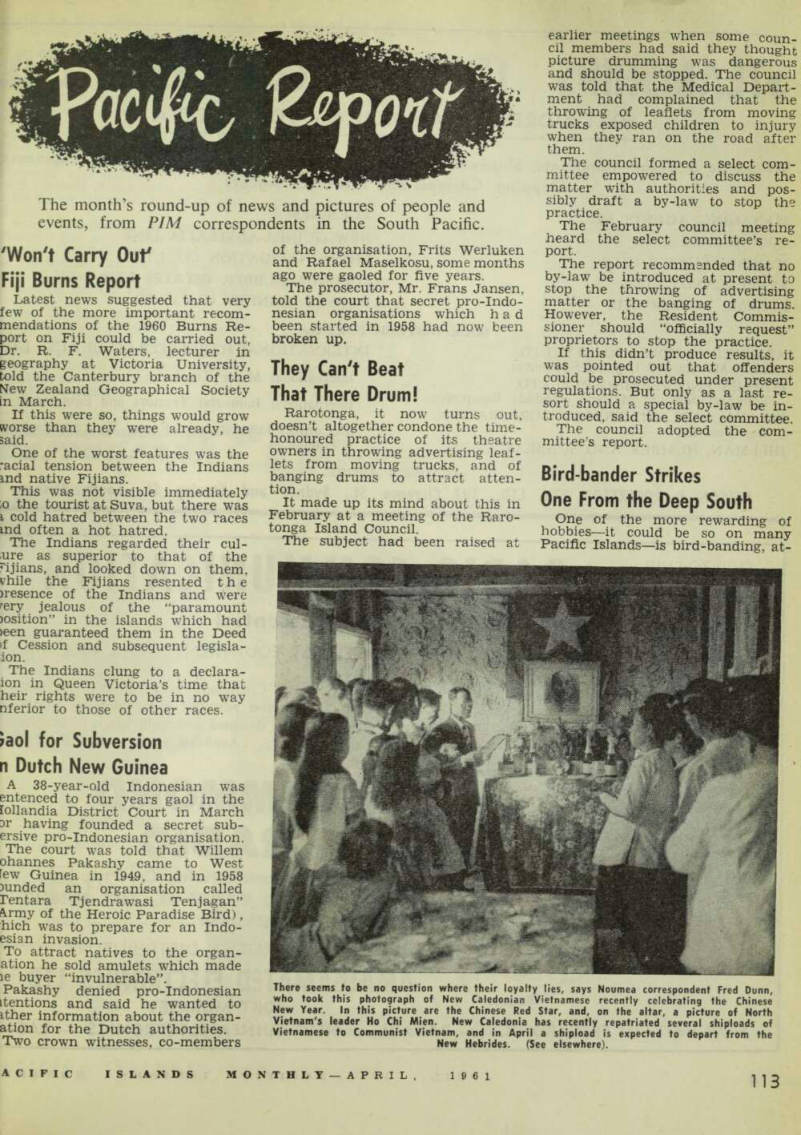
There seems to be no question where their loyalty lies, says Noumea correspondent Fred Dunn, who took this photograph of New Caledonian Vietnamese recently celebrating the Chinese New Year. In this picture are the Chinese Red Star, and, on the altar, a picture of North Vietnam's leader Ho Chi Mien. New Caledonia has recently repatriated several shiploads of Vietnamese to Communist Vietnam, and in April a shipload is expected to depart from the New Hebrides. (See elsewhere).
tachmg a tiny aluminium band with a registered identifying number to the legs of migrattpry birds in the hope that some time, somewhere, someone will recover the band and return it from some distant country.
That bird-banding produces far more results than, for instance, the launching of ocean drift-bottles, is made clear in a report in March from Dr. Stuart Houston, MD of Saskatoon, Canada. It was Dr Houston who banded the common tern recently found dead at Aitutaki Island (as reported in PIM, Mar p. 121).
Over a period of years Dr.
Houston has, as a hobby of scientific interest, banded some 19,700 birds of 143 species and no less than 800odd of those bands have been re turned to the US Fish and Wildlife Service, But of the 350 common terns banded this was only the second from which a band has come back, and—more interesting still—this was the first band from the southern hemisphere. The other tern was caught in Mexico.
Most of Dr. Houston’s birds have not got further than the North American continent or the Carrib bean islands.
Many bands have come back from pintail ducks and little juncos caught in Alaska, or from teal and coots captured in Cuba, Jamaica Cayman Island, and Puerto Rico!
Two teal got as far south as Colombia but did not cross the equator.
Many birds from Alaska and Siberia pass down through the Islands to as far south as New Zea land each year.
Some of these tire on the journey and remain in the Islands instead of moving further south, or north.
Surveyors' lot
An Unhappy One
It’s hard work surveying Norfolk Island, according to government surveyors who are now involved in that task. They say that 70 per cent, of Norfolk is now covered with lantana and other scrub, which
makes survey work “slow and ardu ous”.
The survey going on is to provide a basis for the introduction of the easier Torrens system of land titles in the territory. Norfolk at present operates on the old system of titles, which means deeds have to be checked for at least 40 years back before legal title can be established.
The BSIP Now
Has a Union
The BSIP Government has given its blessing to the formation of a Solomon Islands Workers’ Union which will organise port and plant ation workers in the Protectorate.
The movement started off in Malaita, and rules were drawn up with the help of the BSIP Com missioner of Labour, Mr. A. Pick woad. But it was agreed by the in terested parties that it should be extended.
The union will interest itself in wages and work conditions, and it should be operating in April.