The Month's New Reading
pp. 87-88 · Read in the full issue
With Judy Tudor
Sex That Excites Scientists
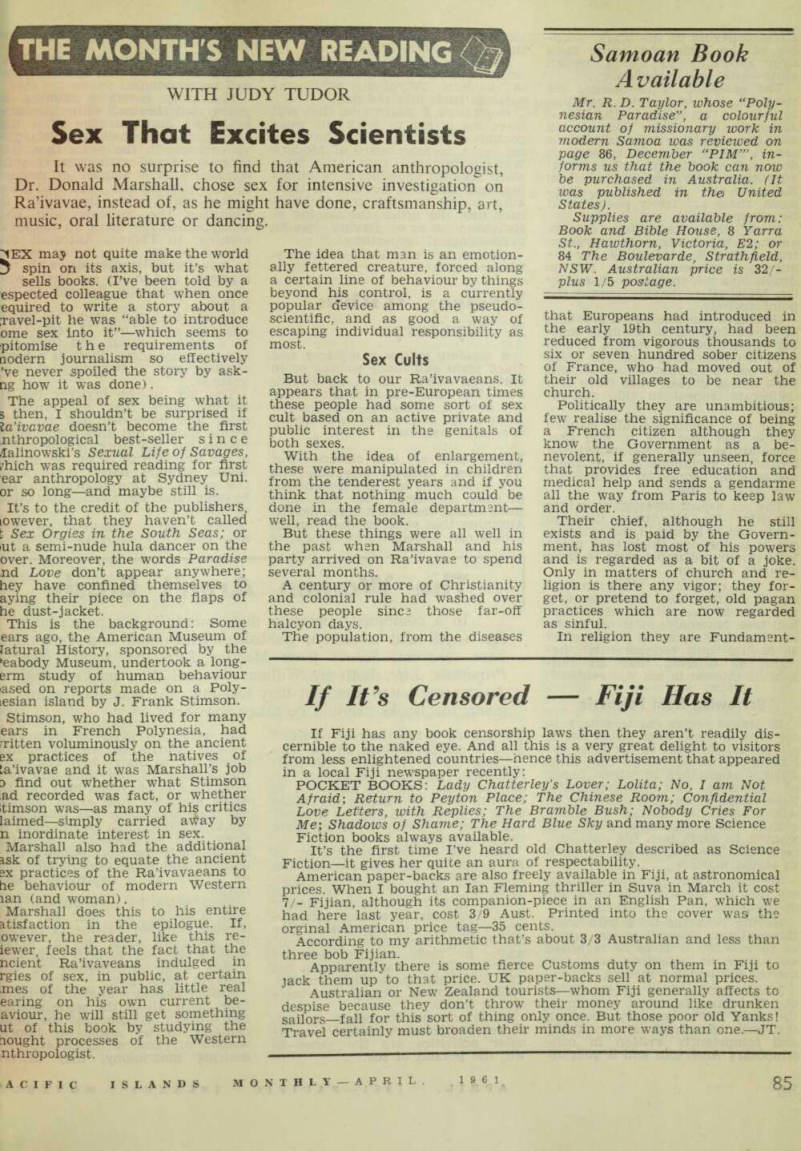
It was no surprise to find that American anthropologist, Dr. Donald Marshall, chose sex for intensive investigation on Ra’ivavae, instead of, as he might have done, craftsmanship, art, music, oral literature or dancing.
JJEX may not quite make the world j spin on its axis, but it’s what sells books. (I’ve been told by a espected colleague that when once equired to write a story about a javel-pit he was “able to introduce ome sex into it” —which seems to pitomise the requirements of modern journalism so effectively ’ve never spoiled the story by ask ng how it was done).
The appeal of sex being what it 3 then, I shouldn’t be surprised if la’ivavae doesn’t become the first nthropological best-seller since Malinowski’s Sexual Life of Savages, /hich was required reading for first ear anthropology at Sydney Uni. or so long—and maybe still is.
It’s to the credit of the publishers, Lowever, that they haven’t called t Sex Orgies in the South Seas; or iut a semi-nude hula dancer on the over. Moreover, the words Paradise nd Love don’t appear anywhere; hey have confined themselves to aying their piece on the flaps of he dust-jacket.
This is the background: Some ears ago, the American Museum of latural History, sponsored by the ‘eabody Museum, undertook a long erm study of human behaviour ased on reports made on a Poly tesian island by J. Frank Stimson.
Stimson, who had lived for many ears in French Polynesia, had written voluminously on the ancient ex practices of the natives of La’ivavae and it was Marshall’s job o find out whether what Stimson ad recorded was fact, or whether itimson was—as many of his critics laimed —simply carried a\£ay by n inordinate interest in sex.
Marshall also had the additional ask of trying to equate the ancient ex practices of the Ra’ivavaeans to he behaviour of modern Western lan (and woman).
Marshall does this to his entire atisfaction in the epilogue. If, owever, the reader, like this re iewer, feels that the fact that the ncient Ra’ivaveans indulged in rgies of sex, in public, at certain mes of the year has little real earing on his own current be aviour, he will still get something ut of this book by studying the bought processes of the Western nthropologist.
The idea that man is an emotion ally fettered creature, forced along a certain line of behaviour by things beyond his control, is a currently popular device among the pseudo scientific, and as good a way of escaping individual responsibility as most.
Sex Cults
But back to our Ra’ivavaeans. It appears that in pre-European times these people had some sort of sex cult based on an active private and public interest in the genitals of both sexes.
With the idea of enlargement, these were manipulated in children from the tenderest years and if you think that nothing much could be done in the female department— well, read the book.
But these things were all well in the past when Marshall and his party arrived on Ra’ivavae to spend several months.
A century or more of Christianity and colonial rule had washed over these people since those far-off halcyon days.
The population, from the diseases
that Europeans had introduced in the early 19th century, had been reduced from vigorous thousands to six or seven hundred sober citizens of France, who had moved out of their old villages to be near the church.
Politically they are unambitious; few realise the significance of being a French citizen although they know the Government as a be nevolent, if generally unseen, force that provides free education and medical help and sends a gendarme all the way from Paris to keep law and order.
Their chief, although he still exists and is paid by the Govern ment, has lost most of his powers and is regarded as a bit of a joke.
Only in matters of church and re ligion is there any vigor; they for get, or pretend to forget, old pagan practices which are now regarded as sinful.
In religion they are Fundamsnt
alists, believing in the literal word ing of the Bible and ruling their lives according to the Christian ethic—with one exception.
The exception is pre-marital sex relations, but even this, according to them, is “according to the Book ’.
Although the Bible does forbid adultery (which the Polynesians always considered a sin, anyway) it does not specifically forbid sexual adventures before marriage, and on Ra’ivavae as elsewhere in Poly nesia, these are freely partaken of by all youngsters.
It is this description of life amongst the modern Ra’ivavaeans that makes it worthwhile, for me anyway—a statement that, I’ve no doubt, lays me open to a charge by Dr. Marshall of having missed the point entirely.
Doubtless the alleged sex practices of the ancient Ra’ivavaeans is excit ing to scientists and certain readers after a cheap thrill—and the blurb that has been issued about this book makes it clear that there is a deliberate appeal to this sort of reader.
But most adults are fully attuned to the fact that sex is, and that there are as many longitudinal and latitudinal variations of it as there are regional recipes for cooking fish —so why the fuss?
The sex aspect investigations into primitive life has been done to death and is boring in the extreme, yet it is the one thing that never fails to stir anthropologists to their greatest agitation.
In this connection, it is interest ing to see that Alan Seabrook, who was one of the party and at first had been Marshall’s alter ego in the investigations, is noted on page 267 as having “quit collaborating”, be cause he believed that an “un healthy interest in sex was evident”.
Borrowing from Polynesia
It always seems extraordinary to me that in these days, when one is almost called upon to apologise for having a white skin, the most diligent researches by whole bands of scientists and anthropologists have failed to unearth one piece of Afro, Asian or Islands primitive culture that Western man has wanted to graft into his own—ex cept one: The Polynesian’s freedom in sexual matters.
To that extent perhaps you can say that Dr. Marshall has made one of his points.
Having read the book with some thoroughness I’m still in two minds as to whether it is to be regarded as a serious scientific work, or merely for popular reading.
Malinowski’s effort on behalf of the Trobriand Islanders, written in the early 1920’s was quite clearly a text-book; Ra’ivavae is attractively and competently written in con temporary American and is guaran
teed not to strain the patience of the most unliterary reader.
In short, it is an interesting account of life on a remote island in modern Polynesia, with ex cursions back into the past.
Excursions, I might add, that still leave me trying to work out what possible significance it can have for me (as a representative of Modern Western Woman) that, at a time when my own ancestors were bound ing over the Skye heather in their kilts, trying to push the McLeods back into the drink, the virgins of Ra’ivavae were having public gynaecological inspections! (RATVAVAE. Published by Doubleday.
US price, $4.95.)
Mystery Within
A Mystery
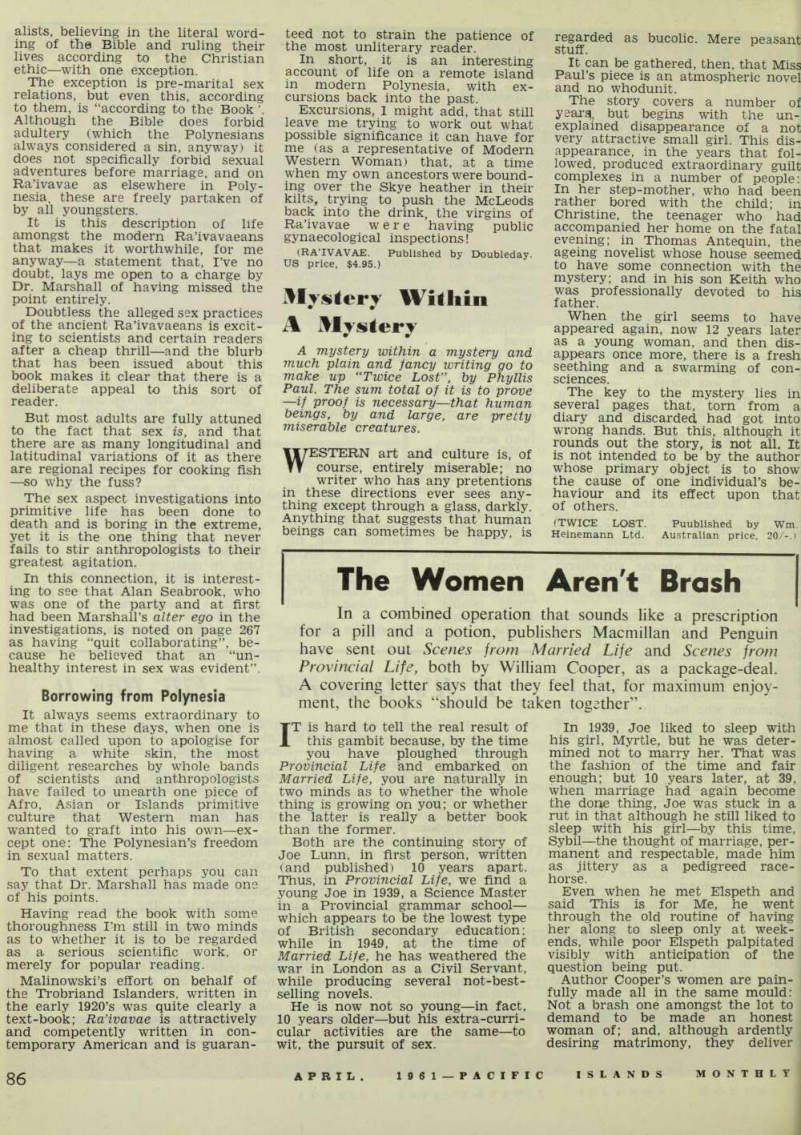
A mystery within a mystery and much plain and fancy writing go to make up “Twice Lost”, by Phyllis Paul. The sum total of it is to prove —if proof is necessary—that human beings, by and large, are pretty miserable creatures.
WESTERN art and culture is, of course, entirely miserable; no writer who has any pretentions in these directions ever sees any thing except through a glass, darkly.
Anything that suggests that human beings can sometimes be happy, is
regarded as bucolic. Mere peasant stuff.
It can be gathered, then, that Miss Paul’s piece is an atmospheric novel and no whodunit.
The story covers a number of but begins with the un explained disappearance of a not very attractive small girl. This dis appearance, in the years that fol lowed, produced extraordinary guilt complexes in a number of people: In her step-mother, who had been rather bored with the child; in Christine, the teenager who had accompanied her home on the fatal evening; in Thomas Antequin, the ageing novelist whose house seemed to have some connection with the mystery; and in his son Keith who was professionally devoted to his father.
When the girl seems to have appeared again, now 12 years later as a young woman, and then dis appears once more, there is a fresh seething and a swarming of con sciences.
The key to the mystery lies in several pages that, torn from a diary and discarded had got into wrong hands. But this, although it rounds out the story, is not all. It is not intended to be by the author whose primary object is to show the cause of one individual’s be haviour and its effect upon that of others. (TWICE LOST. Puublished by Wm.
Heinemann Ltd. Australian price, 20/-.)