The Colourful
pp. 82-97 · Read in the full issue

A Brett Hilder Profile
Harbour Master
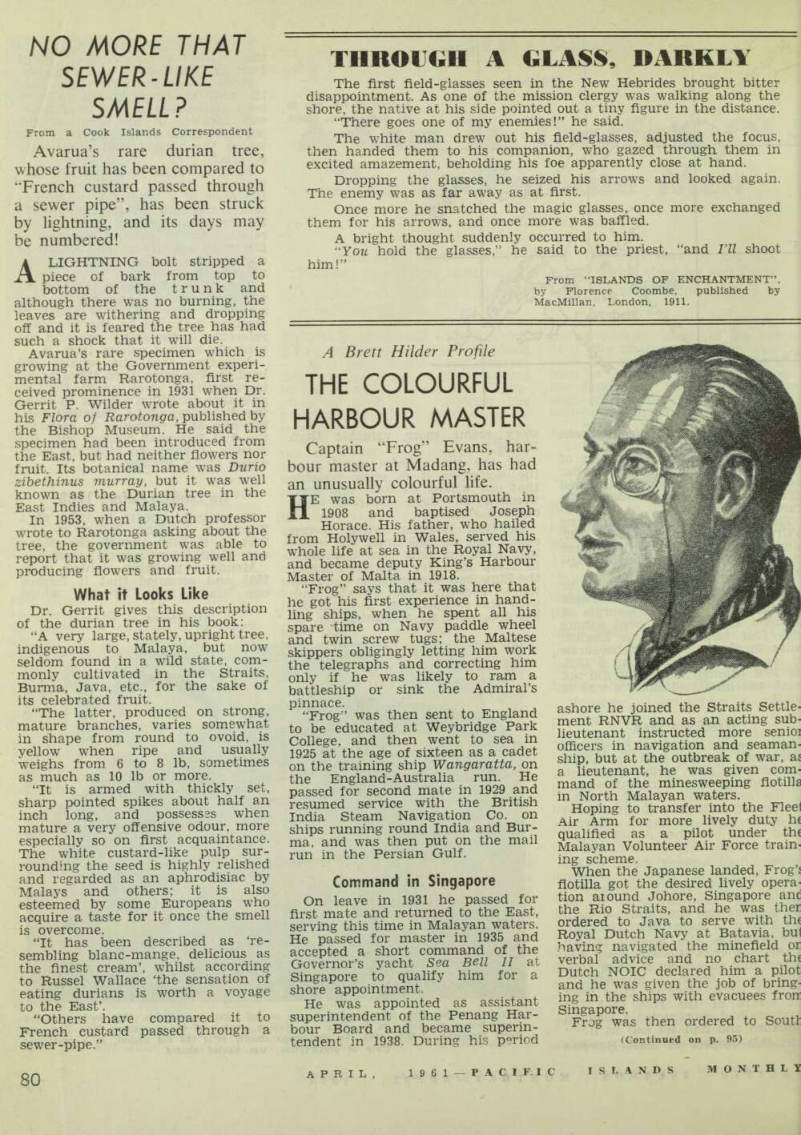
Captain “Frog” Evans, har
bour master at Madang, has had
an unusually colourful life.
HE was born at Portsmouth in 1908 and baptised Joseph Horace. His father, who hailed from Holywell in Wales, served his whole life at sea in the Royal Navy, and became deputy King’s Harbour Master of Malta in 1918.
“Frog” says that it was here that he got his first experience in hand ling ships, when he spent all his spare time on Navy paddle wheel and twin screw tugs; the Maltese skippers obligingly letting him work the telegraphs and correcting him only if he was likely to ram a battleship or sink the Admiral’s pinnace.
“Frog” was then sent to England to be educated at Weybridge Park College, and then went to sea in 1925 at the age of sixteen as a cadet on the training ship Wangaratta, on the England-Australia run. He passed for second mate in 1929 and resumed service with the British India Steam Navigation Co. on ships running round India and Bur ma, and was then put on the mail run in the Persian Gulf.
Command in Singapore
On leave in 1931 he passed for first mate and returned to the East, serving this time in Malayan waters.
He passed for master in 1935 and accepted a short command of the Governor’s yacht Sea Bell II at Singapore to qualify him for a
shore appointment.
He was appointed as assistant superintendent of the Penang Har bour Board and became superin tendent in 1938. During his period
ashore he joined the Straits Settle ment RNVR and as an acting sub lieutenant instructed more senioi officers in navigation and seaman ship, but at the outbreak of war, as a lieutenant, he was given com mand of the minesweeping flotilla in North Malayan waters.
Hoping to transfer into the Fleel Air Arm for more lively duty he qualified as a pilot under the Malayan Volunteer Air Force train ing scheme.
When the Japanese landed, Frog’s flotilla got the desired lively opera tion around Johore, Singapore and the Rio Straits, and he was ther ordered to Java to serve with the Royal Dutch Navy at Batavia, bul having navigated the minefield or verbal advice and no chart the Dutch NOIC declared him a pilot and he was given the job of bring ing in the ships with evacuees frorr Singapore.
Frog was then ordered to South
(Continue# on p. 95)
Java for minesweeping duties, but was caught and bombed whilst in the minefield off Batavia, and his ships, having only surface guns, were damaged.
He describes this as his most amusing and exciting action; he had no room to manoeuvre and gave the order to open fire, and when asked where, he said, “anywhere, just to make a lot of noise, and we won’t know theirs from ours”.
The result was that the attack was from a higher level, but he hates to think where his shells fell and whom he frightened most.
Frog was then caught in the Banka Strait (“Bomb Alley”), the graveyard of so many Allied and Australian ships, but eventually limped into Tjilatjap at four knots, with his remaining ships looking like pepper pots. It was here that his active seafaring days with the Royal Navy ended, as the Dutch sank two of his sweepers as block ships. The only one with any speed made a dash for Australia, but was never heard of again.
Tjilatjap was a trap left open by ihe Japanese: of about 28 ships vhich left, about five got through Dnce out of sight of land. Frog and lis crew got away on the last ship, :he Tuwali, and eventually arrived n Colombo after twice narrowly ;vading capture or sinking by Jap anese naval patrols. They picked up ►urvivors from other sunken ships m this voyage.
From Colombo he went to South Africa, and as the Straits Settle ments unit had been wiped out he oined the South African Air Force.
But at the last minute after ap >ointment to the Johannesburg air tation the Navy indicated that they lad a prior claim on his services, tnd he was sent to Cape Town and >ut in the Sea Transport Service ittached to the Fleet Air Arm.