Pacific Report
pp. 119-142 · Read in the full issue


The month’s round-up of news and pictures of people and events, from PIM correspondents in the South Pacific.
\ Tape-Recorder
\t The Elbow
The tall young American with he quiet Indiana drawl and the ape-recorder merges surprisingly asily into the Fiji village back round.
Usually in the shadow of a )istrict Officer, he is there, but usiness goes on just the same, yhich is just what 24-year-old Jbert Schutz wants.
For Albert, with another Amen an linguist scholar, Floyd Camack, ; devoting 10 months to a study f the Fijian language and its ialects, and it is the everyday peech they want to hear.
Both are in Fiji on National cience Foundation grants admini tered through Cornell University, ’heir choice of Fiji was basically le brainchild of their professor, harles F. Hockett, of Cornell, who as been interested in the Fijian mguage for a good 20 years. In loyd and Albert, both bachelor -ee, he found just the boys for the )b.
Since their arrival last Novem er, both have knuckled down to sarning to speak and understand ijian, but neither claims to be past le “primer stage” as yet.
Suva is their depot, but each eek they drift off in different irections, Floyd to Bau to put up i a bure hospitably provided by atu Niko Komaitai, and Albert, aywhere, north, east or west of uva on Viti Levu.
While Floyd delves into the ructure of Bauan, which, for istorical reasons—and more, be luse the missionaries plumped for —is the common language.
Albert, at Rakiraki, Nadroga, or herever he may roam with his ipe recorder, collects material for is research into the dialects.
They count themselves lucky that ) much work on their subject has sen done in the past 100 years.
“Fijian has been given the best eatment of any Pacific language 7 earlier scholars and missionaries, id we have their excellent ground ork to use as a jumping off 3int,” says Floyd, adding that the
work of Dr. A. Capell, of Sydney University, and Bruce Biggs, of Auckland University, is particularly valuable to them.
But all is not work. While Albert finds it relatively easy to be anonymous by day, he has been getting the full honoured-guest treatment by night in the villages he has visited.
“The immense consideration, co operation and hospitality we have received from the Fijian people is just indescribable,” says Floyd, his Bauan bure now obviously vying for affection with his old Kentucky home.
To try and reciprocate then hosts’ warm welcomes, Floyd and Albert often join in the festivities, Floyd with guitar, and Albert with a recorder which has proved quite a novelty.
Their musical prowess might surprise their professor when he looks in on his two budding PhD’s in June!
"Excellent" Chances
Of Oil in P NG
The experts who took part in two discussion panels on Sydney’s ABC television station in February, were all agreed that the chances of find ing oil in Australia and in Papua are excellent.
They attributed the fact that it has not yet been found in com mercial quantities in either place
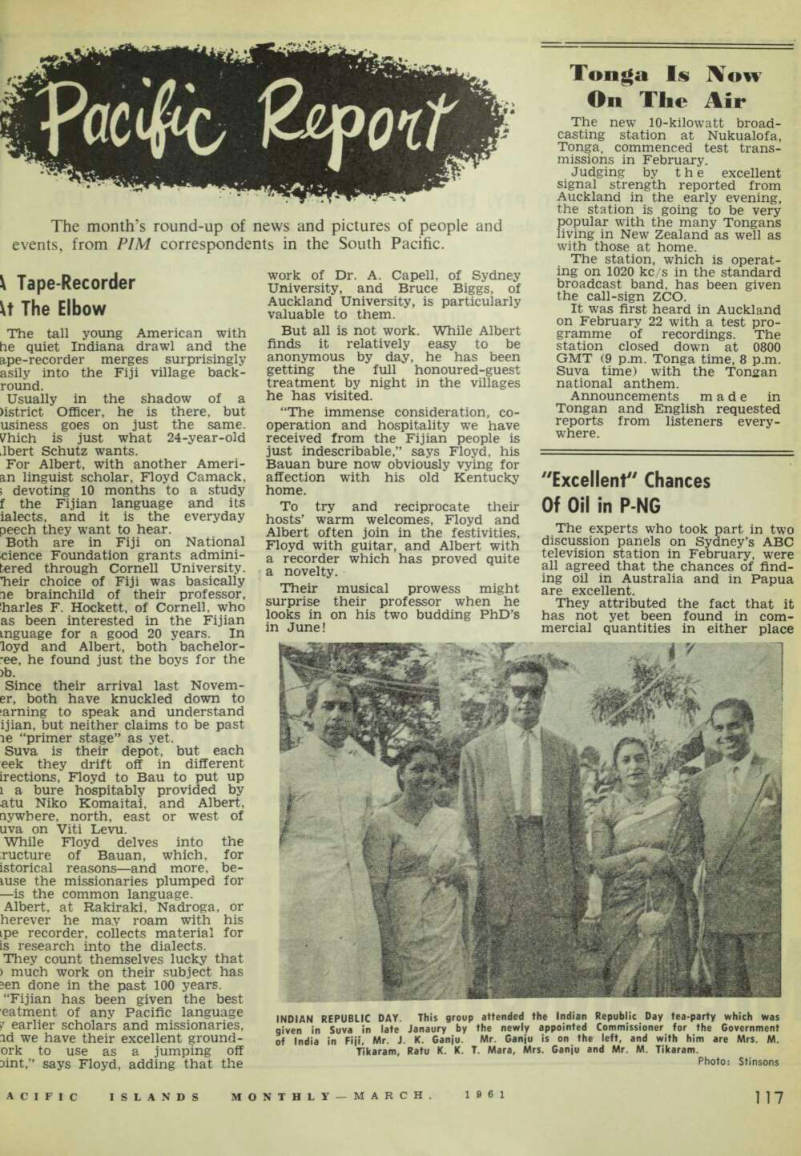
INDIAN REPUBLIC DAY. This group attended the Indian Republic Day tea-party which was given in Suva in late Janaury by the newly appointed Commissioner for the Government of India in Fiji, Mr. J. K. Ganju. Mr. Ganju is on the left, and with him are Mrs. M.
Tikaram, Ratu K. K. T. Mara, Mrs. Ganju and Mr. M. Tikaram.
Photo: Stinsons
ot to the fact that we haven’t been rilling long enough, but to the ict that we haven’t been drilling ften enough.
It was stated that of the 10 drill ig rigs in existence in Australia ad Papua, only four are currently aerating. In overseas countries— ich as Canada —hundreds of new ells were drilled each week.
The experts were of the opinion lat seismic work and geophysical irveys were necessary—but that ice their work had shown that an •ea could be oil-bearing, the only ay to tackle the problem from iere on was by a massive attack trough drilling. Not only should ie rigs in Australia never be lowed to be idle, but there should ; vastly more of them.
An American expert described oil ; the “most übiquitous mineral” all. and said that there was arcely a place on earth where it 'Uldn’t be found. He said the idea at Australia was “too ancient” to i oil-bearing was an old woman’s le and that the sedimentary rocks Texas, where the country was ;avily oil-bearing, were just as icient.
He described how some of the st gas deposits that had been dis vered in Texas as a result of oil filing were piped all over the lited States —even as far as the irth-eastern seaboard—and used r industrial purposes.
It was stated during the session th the last panel of experts—of 10m Mr. G. B. Kater, chairman of 1 Search Ltd., was a member— at one day the huge gas deposits at have been discovered in the ilf District of Papua might be ed in a similar way.
Mr. Kater is firmly of the opinion at his company will eventually id oil in Papua, although he esn’t under-estimate the cost of ing so.
He said that the last well drilled that at lehi—had cost Australian troleum Company £l| million.
He said, however, that if oil were and in this part of Papua, the st of getting it out wouldn’t add eatly to the cost.
Asked whether he thought the litical aspect might have to be nsidered in Papua he said that is did present a problem, although personally believed that Papua -w Guinea would want to link it f with Australia, Nonetheless, he would be in 'ested to know the outcome of e recent talks between President mnedy and Mr. Menzies on the itherlands New Guinea situation. iy change in our approach to was bound to affect Aus ilian New Guinea.
come Tax Is
oubling Them
rhe perplexing peregrinations of
3 Australian income tax return [1 be puzzled over by quite a few ii residents for the first time this
year.
With maybe a few hundred pounds invested in Australian companies they are the incidental victims of the Commonwealth’s latest pre cautionary measure against over seas tax truants—to wit, the With holding Tax legislation, which came into force last July, and thus applies for the first tax year this year.
Amounting as it does to a com pulsory pay-as-you-earn system, to the tune of 6/- in the dividend £, it has come as more than a slight shock to Fiji residents who have to pay it.
The whole thing is probably troubling small investors more than large ones as the latter are likely to have long standing arrangements
for dealing with overseas invest ments and to be paying tax at more than the arbitrary 6/- rate anyway.
What is happening, of course, is that the Australian Taxation De partment is making sure of getting its cut by getting the company that is paying the dividends to make the deductions at their source for in vestors who are not domiciled in Australia. The deductions in respect of Fiji are at an arbitrary rate of 30 per cent.
This is just part of the “usual form” of the Australian Taxation Department. The taxgatherers get the money first, then they are pre pared to listen to taxpayers’ argu ments as to whether or not they should have paid it.
Dividends are not taxed at a igher rate in Australia than any ther kind of income, and the bvious way out, if Fiji residents ?el that 30 per cent is too much, to submit an Australian income ix return—and this is what, in fact, mk managers in Fiji are advising leir clients to do. If the amount lat has been deducted from their ividends is then in excess of what ley would normally pay on that nount of income, refunds will be ade to them.
There is a reciprocal provision in le laws of both Australia and Fiji •oviding that income already taxed . one is not re-taxed in the other. is obligatory on the taxpayer in astralia, as well as the taxpayer in iji, to disclose all sources of all come, at home or overseas, when dging an income tax return.
Perhaps the unkindest cut of all this tax trouble came to a Suva ink manager who had a bundle about 40 Australian tax-returns nt to Suva for the convenience of s clients. He was required by Fiji istoms Department to pay duty on em!
}o Many Eggs
i Their Basket
The Minister for Territories, Mr. asluck, has authorised an inquiry to the affects of alleged Australian :g “dumping” on the Port Moresby arket.
The president of the Papuan :imary Producers’ Association. Mr.
Pikett, said his association had mplained to Canberra that eggs 3re being air-freighted to the from Queensland.
The glut of eggs, he said, had reed some local poultry farmers it of business.
This is an unusual development New Guinea. Usually, people such Australian passionfruit producers id plywood manufacturers com ain to Mr. Hasluck about what iports of NG produce are doing to em.
abaul Airport To Be
iproved
In February work began on the •st stage of remodelling Rabaul’s ikani airport when builders be ,n putting down foundations for e new £35,000 air operations build g.
The building, scheduled for com etion within 26 weeks, is planned incorporate facilities for aeradio, eteorology, flight planning and uipment storage.
ats Off to a
acific Navigator
Sailing ships, steam ships, and otor ships may successively sappear from the oceans, and
man-made methods of aerial travel may change, but, almost forgotten m this age, the migratory birds still wing their way north and south with each successive season over vast stretches of land and ocean, just as they have done for centuries past—though even their routes have changed.
Bird No. 523-60398, banded by the US Fish & Wildlife Service, found floating dead in Aitutaki lagoon, Cook Islands, on November 26 last, was a reminder of these aerial navigators, whose methods of navigation are still incompletely explained.
PI M’s inquiry regarding this particular bird brought a response
in February from the Petuxent Research Refuge at Laurel, Mary land, USA.
The bird in question, a Common Tern, was banded on July 8, 1956, by Dr. Stuart Houston at a mountain lake eight miles east of Imperial, Saskatchewan, Canada, As it was reported to be only recently dead, judging from the condition of the body when found by Roi Marama, a Cook Islands boy, it may be reasonably assumed that this tern had made at least four and possibly five round trip flights from Canada to the Cooks — or at least to Polynesia—in the intervening years, The distance between the two
points by the shortest route i about 5,700 nautical miles.
Longest ocean flight would pre sumably be from the mainland.
United States to the Hawaiia:, Islands, about 2,000 miles, thenc south via the Line Islands and thi Northern Cooks, with the end-of] year months in the Southen Hemisphere and the mid-yeai months in the North—following thi warmer weather.
For a bird which weighs a matte; of ounces this is pretty fair bikini —with no hitches.
Finding a Good Thing
And Sticking To It
Pyrethrum, the basic ingrediem of most insecticides, comes from th< flower of a species of chrysanthe mum—and about 30 strains of thi plant with high pyrethrum conten have been bred at Aiyura, P-NG’i high-level agricultural station ir the Eastern Highlands.
Such has been the success a' Aiyura that a leading UK firm o; manufacturing chemists, Stafforc Allen and Co., last year sent one oi their experts to the Highlands tc have a look at what was going on.
The expert’s report is encouraging and a five-year programme of de velopment for the Highlands area has been worked out. By the end of that time, production is expected to be at such a peak that the Eng lish company will consider building a local extraction plant in the Highlands. In the meantime the firm will buy all the commercial quantities of these particular pyrethrum chrysanthemums that the Territory can produce, for treat ment in London.
They All Want
More Money
Native wages were still causing headaches in Papua-New Guinea ini February.
P-NG Administrator Brigadier D. M. Cleland.
Jatives in Madang petitioned the ministration for £2/3/9 a week ge rise. ?hey asked the Administrator, gadier D. M. Cleland, to have dang covered by the recent jotiated urban wage agreement. ?his agreement, which covers all :ive workers in Port Moresby, Lae i Rabaul, fixes the basic cash ge for unskilled workers at £3 a ek. 7he agreement came into force on luary 2. low the Ambenob Native Local vernment Council in Madang nts town native workers to get a week, too. it present Madang natives come ier the 25/- a month rural basic e in force in all areas throughout aua-New Guinea except in the ee towns covered by the urban cement. ’he chairman of the Native Em yment Board, Mr. F. Caterson, 1 the board would begin hearing Ambenob Council’s case at the liest possible date, m Administration source said the dang employers were likely to □rously oppose any wage increase native employees, le added: “The Council’s applica i for wage rise is also likely to rt a flood of similar applications m native organisations in other ’ritory towns.” le could say that again!
e Japanese
w Surface-Fishing?
lext to tourism, the fishing in >try is probably the greatest ential money-earner available to ith Pacific territories, yet at Gov ment level there is a great lack serious interest in it, Auckland
correspondent J. P. Shortall re ported in February.
He added: Tuna longlining undoubtedly pre sents the greatest opportunity utilising Japanese know-how and equipment in the early stages at least. But it is very doubtful whether any South Pacific Administration possesses one officer who has made a serious study of tuna longlining in all its aspects.
Though reams of published in formation on Japanese fishing operations in the South Pacific are available from that country, in the English language, no one on a South Pacific government level knows —or seems to care—much about what is going on.
For those who do show an in terest in Japanese activities a photo which appeared in February PIM (p. 115) should have been of more than passing interest.
It was a photo of the vessel Toyo Maru No. 18 —a skipjack sur face-trolling vessel, distinguishable by her long overhanging bow plat form. Tuna longliners do not have this.
It is possible that this vessel is carrying out skipjack fishing near home during the season, and is en gaged in South Pacific longlining for the remainder of the year.
The answer to this question would be of some interest, as very few if any skipjack tuna fishing vessels have been seen south of the Line
[?]ING OF AGE. Holding the traditional key [?] party held in his parent's home in Port [?]esby in February, is popular Port Moresby [?]rting figure Bruce Richter, who was 21.
Papuan Prints
post-war years. This may repre it a further extention of Jap- Bse fishing methods in the South cific.
Lmerican surface-fishing methods,
ng hand poles or rods, were un cessfully tried in the Fiji area t after the war. t would be interesting to know ether Japanese skipjackers are v having success in a method ich is a good deal less costly squipment and labour than long ng. 5
*JG Complains Over
■ Weight Restrictions
ir safety moves in Papua-New aiea, which will reduce the ghts DC3 aircraft will be allowed carry in future, caused a great 1 of grumbling in the Territory February and early March, and re were indications that more iplamts were on the way he new restrictions affect the »s operating from some airstrips, bicularly in the Highlands. Some ;taJ strips are little affected, but 5 the Highlands which has the itest need for air transport.
Hderthe new restrictions (see p.
DC3s operating from Madang 2 > 000 lb less freight on r flights to Goroka. From Lae, •s will carry 450 lb less.
CA officials in Australia had ex ed protests when the decision announced. to a Territory report, G pilots themselves sparked off i action by threatening to im their own restrictions if some g was not done. 3wever, when the cuts did come, were reportedly more than been bargained for. The re tions reduced the DOS’s carry capacity by amounts up to it 26 per cent. le new restrictions still do not ? the regulations exactly into with those in Australia, and are still liberal from the main point of view, hat rocked Territory people on their heels was receipt of estimates that the restrictions i increase Territory freight • by up to 20 per cent. No firm
announcement had been made in early March.
Mr. John West Lau, personal as sistant to Mr. R. Ansett, managing director of Ansett Transport In dustries, who are the recent pur chasers of Mandated Airlines, said m Lae m February the restrictions were introduced for the sake of safety and general efficiency in the Highlands, and Ansett-ANA had no argument with that.
However, they raised economic problems, which the company had to deal with. . He said his technical staff were investigating the possibility of jet assisted take-offs for New Guinea DC3s. A small jet propulsion unit was already used overseas.
He said this might enable the aircraft to get better performances— perhaps to those previously accepted.
He added that his company hoped to add three more DC3s soon to the Mandated Airlines fleet.
Malaria Fight To
Cost Aust. Millions
Australia, in February, announced an increased payment to the World Health Organisation’s anti-malaria campaign. She will give a special grant of £20,000, an increase of £5,000 on the previous year.
Yet the amount is only a fraction of what Australia is spending on the
it against malaria. She knows 7 well what malaria means, and aims at eradicating the disease n her own territory of Papua -7 Guinea within 14 years, his P-NG programme will cost •e than £2,750,000, and annual idmg is running around £200,000. 11 information gathered on aria in Papua-New Guinea is led with the 90 member nations he World Health Organisation.
'HO is mounting the biggest paign ever conducted against a le disease. alaria, described as the most ly disease in the world, threatens ) million people in 148 countries territories. ost current research is concen -3d on finding insecticides which kill all malaria-c arry i n g quitoes.
World War 11, scientists ight they had found the answer )DT. it a decade later it became 3us that insecticides were not lly effective because they killed 3nly those types of mosquitoes ■h did not resist them, ientists found that 19 species ted one or other of known in cides. it there are now only three
ScTde WhiCh reSlSt ail types ° f in nLu tt , orld Health Organisation is pooling knowledge from all malarial areas, in an effort to beat these final ree ypes. r . . '
Six Months for
CimnliiiHM IPoli
auppiying Liquor
t v, v- Charles John Fonceca, 66, a European identity of Rabaul, who for the
apparent'means 114 ol
ment n in d Rabaul "Tto a a nL n tfve SUPPlied a b ° Mle ° f ™ m t 0 Evidence was that Fonceca had
been seen by a native constable handing a parcel containing the rum to a native, and Fonceca had admitted he had received 30/- for it.
Fonceca told the court that it had been done on the spur of the moment. ce in evidence said that in quines at four licensed stores showed that Fonceca had purchased the following liquor supplies in the last two months: „ De “ m ber: 128 bottles of rum. 211
January
Plus 36 tetttafrf gta/^basi^lS
four bottles of brandy, 2 bottles of whisky and 15 cartons of beer.
NG Will Encourage
übber Growing
NGG’s Division of Agriculture has ;gun a scheme to get natives in mth New Guinea to plant rubber.
Hundreds of thousands of rubber edlings have already been flown om the Ransiki rubber estate in trthern NNG to Tanah Merah, just er the NNG-P-NG border in the uth, where they have been re anted in nursery beds. Later this ar this material will be distributed aong natives of three nearby sub stricts.
An official statement from Hol adia in February said that “ex ctations with the project are gh” because of the very satis ctory trial plantings already made.
Later, the Government plans to troduce a similar rubber scheme West New Guinea.
)niara Will Get
bw Govt. Offices
3ne of the last official tasks per maed by the Western Pacific High unmissioner, Sir John Gutch, be *e he and Lady Gutch left Honiara retirement in January, was the nng of a foundation stone for a w Secretariat building.
Fhe new building, which eventu y will be flanked by a Supreme urt building and a Legislative uncil Chamber, will take the ice of primitive huts left over >m the war—probably the worst vernment offices still standing ywhere in the South Pacific lich is really some kind of a )ord.
Phe new government buildings 11 follow the modern trend in >IP design, like Honiara’s new st Office.
Nobody in Honiara is likely to spute the need for them.
itical Period for
|ians, He Says
Fhe immediate future is likely to a critical period in the progress the Fijian people, according to
the Sscretary for Fijian Affairs, Mr.
A. C. Reid. He makes this com ment in his annual report, in which he observes: “With crop and marketing diffi culties affecting the farmers; with the workers worrying about wages and the threat of unemployment; and with their traditions and their Administration under fire, it is not surprising that during 1959 an air of tension built up among the Fijian people.
“The immediate future is likely to be a critical period in their pro gress, and much will depend on the way the Burns Commission Report is handled and whether, arising out of it, emerges a fair deal for the Taukei” (the indigenous Fijian people).
He refers to the McDougall Re port, the Spate Report, and the Burns Commission report, and observes: “One can say that for three successive years, Fijian affairs have been subject to almost con stant examination and the exam iners have been submitting, at con siderable lengths, their findings.
This has not only led inevitably to a certain amount of marking time but has also caused some de gree of confusion.
“For example, the McDougall Re port recommended as a major measure the raising of produce taxes. The Spite Report endorsed this. Legislation was introduced to implement the proposal and an ordinance was passed.
“The Burns Commission, in the meantime, made strong representa tions against it and the ordinance has not been brought into force”.
Mr. Reid comments: “One cannot resist the feeling that, from the Fijian point of view, it might have been better if there had been one comprehensive report and that Pro fessor Spate could, with advantage, have been a member of the Burns Commission.
“The Fijian community has re ceived plentiful advice as a result of the detailed inquiries which have been carried out into its social system and now it requires time to assimilate all that has been said about it and its future.” (Over)
NNG Looks at
Film Censorship
NNG has decided not to appl direct film censorship in her Terri tory. However, films will be importe only from countries where th standard of censorship and class! fication correspond with th o s accepted in the Territory.
A Hollandia report says a ordinance has been brought in fol lowing an inquiry, made by th Office of Native Affairs, to find on what influence films were having o natives.
The inquiry said that most native attended films merely to see diversion and because “films wer associated with progress”. To man natives the films were no more tha: a series of incoherent pictures.
However, action films were pre ferred and elaborate love scenes an romantic films were little appreci ated.
An important point made by th report is that “no correlation what ever is proved to exist between film and unsocial behaviour among in digenes, nor is it expected for th future”.
It is because of this last reaso: that the Government decided not t include in the new ordinance an; regulations debarring natives fror attending certain films.
Death in Tanker
Smash
The driver of a tanker, Boy< Evans, single, was killed in Februar; when his vehicle, carrying 1,60 gallons of motor spirit distillate plunged from the Wau-Lae Road a Gurako Creek, The tanker is ownei by the Shell company. A Vacuun tanker crashed from this road las year, but the driver escaped witl slight injuries.
The Muu-muu
Has Arrived!
Two things have happened t< Fiji’s women in recent weeks, which while completely unrelated, coulc have a lasting effect on the Colony says a Suva correspondent.
One was the appointment to tht Nadroga Rural Authority of school teacher Regina Vidyawati, anc housewife Mereula Guivalu, th e first time women have ever made the grade on a local authority—anc the other was the arrival, apparently for keeps, of the Muu-muu.
Naturally, Regina and Mereula’s appointment sent Women’s Interests Officer Ruth Robertson into ecstasy as they have been two of her stars in the Sigatoka firmament since the WIO work began last year.
As for the Muu-muu, well, judging by their present contagious capacity and the fact that they rated two mannequin parades during the Orsova’s two-day stay, Hawaii may
ion rue the day her Muu-muu got vay!
NG and P NG
/lust Co-ordinate'
Co-ordination of development be /een Australia and Netherlands bw Guinea was inescapable in the ng run, said the Netherlands State ;cretary for New Guinea, Mr. Theo Dt, at The Hague in February.
Mr. Bot had been asked whether e preparation of the natives on e NNG side of the border for self termination was being timed to incide with self-determination in NG.
Mr. Bot did not answer the ques >n directly. He said it was dif :ult to forecast what the outcome )uld be.
Mr. Bot said that Holland was ending about £I2J million a year NNG, not counting defence.
He added that he “could not be ve” Indonesia would seriously nsider an armed attack on NNG, w or in the future.
pex Scholarships
The Australian Association of >ex Clubs and the P-NG Admin ration in February jointly an
nounced three £5OO scholarships for native students to study for matric ulation in Australia. The three students are an assistant patrol officer, a trainee co-operative clerk, and a trainee teacher.
Ansett-ANA will fly the students free to Australia and will provide return trips for each year of study.
Heavy Food Loss
In NO Cyclone
An appraisal of damage done in New Caledonia by the cyclone in early February has shown a heavy loss in food crops, and help will have to be given native and Euro pean planters.
In Noumea damage was confined to the uprooting of trees, and a roof or two suffered. The Nickel company lost about 2,000 sheets of iron and fibro cement from its buildings, and a small cutter was blown ashore at Ducos peninsula.
Considerable damage was done in the most southern of the Loyalty Islands, Mare Island.
Five Mare fishermen, who were out in a small boat powered by an outboard, landed at a small unin habited coral speck some miles off Mare when the blow threatened, and remained on the coral for nearly six days before they could even begin to move. The island is just a block of coral as hard as glass, with a
few pandanus. Their only food was coconut crabs and fruit from the pandanus.
They were later able to signal to a Transpac Heron which was diverted to look for them.
Bizare Case Of
Electrocution
The peculiar case of the electro cuted man puzzled Noumea in Feb ruary.
A medical auxiliary employed at the Yate power station was one day startled to see coming down the road an erratically driven car, be hind the wheel of which was the fearful sight of a man shockingly
Islands Weddings
Among recent weddings in Rabaul were those of Miss Pat Swann, formerly a sister at the Nonga Base Hospital, to Mr. Dudley Hellietz (top picture) and Miss Doreen Lee to Mr. Alfred Woo. These photos are by Larry Chin and C. H. Meen.
rned, covered in blood, almost ked and in the last stages of ex ustion. rhe auxiliary rushed the man to iumea hospital, where he died six ys later without having regained nsciousness. rhe dead man was Daniel ilahaye, a French painter and corator, married with two chil en, who had been about eight ars in New Caledonia. The Press ls very guarded in its reports, and e case caused quite a stir because definite statement was made as how Delahaye was injured, and me startling rumours ran about ivn.
A. few days after Delahaye’s death, e Yate operating authority re ised a brief statement, pointing t that high tension wires carrying wer from Yate were very danger s and that it was “forbidden to mb them”. Children were advised it to fly kites near them.
PlM’s Noumea correspondent re
rted the probable explanation: flahaye had apparently driven up e Noumea-Yate road, climbed iwn a steep embankment and up a lon carrying 175,000-volt power les.
He touched one line, which burnt s clothes off, and inflicted 75 per nt. burns over his body, and he is then thrown from the pylon ill alive.
Such was the tenacity of life, at Delahaye had climbed the em nkment, and had driven off in his r towards Noumea.
P-NG Natives On
Charges of Assault
Magistrates in Rabaul and Port Moresby in late February handed out gaol sentences on assault charges of more than the usual in terest.
In Rabaul, 122 natives were gaoled for five months on charges of mass assault on a Local Government Council employee on February 8.
Evidence was that the natives had waited a week in a clearing at Tin tinagalip, near Rabaul, for a mythical American helicopter. They began talking of prominent natives in nearby villages as being “govern
ment spies”. They went to the home of a council employee named Takep and beat him up, allegedly “with the intention of putting a law-abid ing native out of action”.
They had admitted the offence and had said to Native Affairs officers: “Now what do you and the government intend to do about it?”
The leader of the mass group had been an assistant village headman named Tikaika.
The courthouse was flooded with exhibits taken from the defendants, including clubs, knives, axes, black jacks. and coshes made from steel bolts and war-time shell nose cones wrapped in fern leaves. Evidence was that these weapons had been carried to attack so-called native spies.
In Port Moresby, Tomarut Tavalue, of Rabaul, was gaoled for two months for having made an un provoked attack on a 74-year-old theatre proprietor, John Mclntyre, whom he knocked to the ground and kicked in the stomach.
Mclntyre told the court that he had asked Tomarut to behave him self and Tomarut had screamed at him, “white b—. I’ll kill you all!”
Tomarut had then attacked him.
There was evidence that Tomarut had been drinking.
They're Losing Some
Viets—And Most Vegetables
An attack on local Vietnamese was published in a roneod news sheet produced in Noumea in Feb ruary by a local “Committee for the Defence of New Caledonian In terests”.
This committee has been agitat ing for years for the repatriation of the Viets. (Repatriation finally began at the
A INTEREST: A marriage of interest to [?]took place in the Church of the Holy [?]ity, Devonport, NZ, recently when Miss [?]is Wendy Sell married Mr. Robert Lester, only son of the Rev. R. H. J. Lester, of The marriage was performed by the Rev. [?]ndeacon Mayo Harris, also well known in Fiji.
Photo: Stinsons
end of last year, and the third sail ing of the liner Eastern Queen carrying Viets from New Caledonia to Haiphong, in North Vietnam, was expected to take place in early March. Two more voyages of the Eastern Queen will be made from Santo, carrying Viets from the New Hebrides.) The Noumea news-sheet says that despite the fact that more than 1,000 Viets have so far returned home on the two voyages, there were “just as many Viet commercial activities in Noumea as ever”. It said not one shopkeeper had re turned.
According to the news-sheet there is a “plot” to have the remaining Viets granted French nationality (instead of being registered as foreigners) and the Committee says
it is opposed to any such move.
A Noumea correspondent says it is correct that Viet shopkeepers have not been repatriated. They have too many interests. Tradesmen and market gardeners—and footballers— have gone.
One result is that fresh vegetables are very scarce. The Viets have been responsible for most of the market gardens in New Caledonia (and also in the New Hebrides).
It is considered unlikely that Europeans or native people will take over abandoned Viet gardens, so New Caledonians in the future will have to rely more on canned vegetables, or high priced imported fresh ones.
That same situation can be ex pected in the New Hebrides after the first Viets go later this year.
At Last! Lautoka
Has Its Own Wharf
A long-awaited dream of t great Northwest of Fiji came tr on March 13, when the Lauto Wharf was officially opened by t Governor of Fiji, Sir Kenne Maddocks.
First mooted as far back as 19 (the records of this period are i complete) and finally finished 1961, it has made some peo{ wonder what happened in the inte vening 53 years.
Critics in the Northwest blar the Government, the CSR, the shi ing companies and the ineptitude Local Government officials.
Probably all of them have had finger in the pie at some time another for the fragmentary recor show that many people have figun in the battle to get a wharf f Lautoka.
In an early stage a tender appea to have been given for a timber pi wharf, of about the same dimension as the present one, to be plac( about 800 yards from the presei Post Office.
This tender was for a little moi than £14,000 but did not indue sheds, which “would be erected s necessary by the Public Works D< partment”.
Today’s wharf cost slightly und< £1,500,000!
The estimated price for a whar somewhat smaller, also withoi sheds, in 1953 was about £230,000.
Personalities known to older Fi residents crop up in the files.
Such names as Ragg, Costelb Johnson, Waddingham, Garnet Rourke, and Kennedy appear ove the years. Later on, in the Fiftie: names like Bruen, Costello agai: (Pat) and others come up who ar still interested in the project. Ther were many battles between local an Suva interests in 1951, 1952 an 1953, and a Government statemen about that time promised the com pletion of the wharf by 1954.
A former secretary of the Lautokj Chamber of Commerce well re members publishing screeds abou it in 1951 and 1952, when the Lau toka Chamber was protesting volubly and angrily about the actioi of the Government in allowing th( site to be selected by a crowd o: people from Suva.
But all this is now in the past and Lautoka possesses a fine nev wharf capable of taking almost anj vessel from overseas.
The main berth is dredged to 34 feet at low tides, and the north side is already the subject of a proposal that it be dredged to 24 ft, as at nresent it goes from 34 ft to 14 ft The south quay is for launches and small craft, and the east will accommodate local interinsular and coastal vessels.
The importance of the wharf to the citizens is evident.
For some years Lautoka has had to depend upon the CSR wharf be
g vacant to get a ship alongside, le result has been that vessels ive had to be unloaded into ;hters with subsequent higher costs r stevedoring which have been ,ssed on to the consumer.
Barges have been provided by the Dvernment and apart from the tra time factor there has been Duble with leaky barges and darn ed cargo.
Now that the wharf is ready for >rk, all overseas vessels which rmerly unloaded Northwest cargo Suva will be able to come direct Lautoka and residents are ex cting to reap considerable benefits Dm the cancellation of the extra sights from Suva, which in the ,st have been heavy.
Lautoka interests feel rightly that is wharf is the greatest benefit t bestowed upon the Northwest stricts; since it should also open ) new avenues for tourist traffic id for new export ventures which »w lose the hampering influence of ipping from Suva, It is not too much to expect that me new exports will appear from e Northwest growers.
The CSR wharf will continue to rnish facilities to CSR vessels and, though it is now quite aged, ipears to be capable of many more ore Qprvipp Although its presence has rangled for many years the emerg ice of a Government wharf, it has me yeoman service.
Appropriately present at the •ening was the Matua, the Union earn Ship Co. vessel which has a Dse association with Lautoka. The wn has had New Zealand food jffs from this vessel and her pro cessors for many years, operat g many times under great dif :ulty from the stream.
Power, Water, Disrupted
In Port Moresby
Port Moresby’s electricity and water supplies were disrupted for several days in late February when a landslide swept away a section of the four-mile water race at the Rouna hydro-electric power station, about 20 miles outside the town.
Until repairs were made all Port Moresby’s power was supplied by a small diesel station, and power was rationed, together with water sup plies.
The landslide followed three days of torrential rain, which damaged roads and bridges.
Luxury Hotel" Reported
lanned for Noumea
Noumea newspapers in February »re reporting a joint French istralian scheme to build a big sury hotel near Noumea’s Arise ita beach, to cost at least £200,000. icording to the report, 49 per cent. the finance will be sought in istralia and the remainder in ance.
Staff will be brought from France operate the hotel.
However, the scheme is yet to be bmitted to Paris authorities, and Noumea report says in the past lancial schemes of this type have en rejected.
utch Protest at
donesian "Landings"
A district court in Hollandia in ;bruary sentenced six Indonesians gaol terms for having landed in e Fakfak area of West New ainea in April last year. They were cused of gathering information of ilitary importance for a foreign untry.
The leader of the group was ntenced to five years, and the hers were given terms of from ree to five years.
The group, said to be among 11 ao landed in the area at that time, ?re alleged to have gathered in rmation about military and police rength in the Fakfak area.
The group was arrested with the
help of local people, but five were not prosecuted because they did not know the purpose of the infiltration, the magistrate said. (Another group was arrested in this area as long ago as 1953, and given gaol terms).
On February 8, the Netherlands Government at The Hague released text of a protest Note to Indonesia about the activities of Indonesian armed forces in the New Guinea area.
The Note said Indonesia had re peatedly accused the Dutch of aggressive acts and intentions against Indonesia, all of which the Netherlands had rejected.
However, said the Note, Indonesia continued to make intrusions. Last November 13, a group of 20 armed Indonesian Army men had landed near Etna Bay, on the south-west coast, and on November 27 the In donesian vessel Singkuan had been intercepted with 12 Indonesians aboard, seven of them members of the armed forces, and various items of military equipment, including supplies for the Etna Bay group.
P NG Has a Record
Trading Year
The Territory of Papua-New Guinea had a record trading year ending June 30, 1960. Total trade was £A40,000,000 (with imports at £A18,800,000 and exports at £A21,000,000). Imports increased by £A2,500,000 and exports by £A768,000.
The rise in exports was due mainly to greater production of copra, coconut oil, cocoa, timber and plywood, coffee and rubber. It was due also, in part, to the boom copra prices that occupied some of that period.
Top of the export list was copra and coconut oil and meal—with
GOOD SHOTS: The sport of rifle shooting got off to a good start in Apia in February when the Apia Rifle Club opened, officially at the range at Fagalii, near Apia. Here are some of the members and guests on the opening day: Front, from left-J. Baer, J. Schwalger, G.
Hagedorn, P. Kwan, W. Skelton. Centre: J. Hunt, A. Belford, E. F. Paul (president), A. M.
Gurau (vice-president), Prime Minister Mataafa (patron), K. O'Dwyer (captain). Back: C.
Schwalger, J. Schaafhausen, G. Keil, H. Schuster, G. Paul, F. Stowers, N. Finch, A. Lee, R. Phillips, E. Reid, and G. Fepuliai. Photo: Samoana
YOUTH CLUB: One of the most rapidly growing organisations in Suva at present is the British Council Youth Club, which is multi-racial and has a seemingly infinite range of activities including debates, hikes, film evenings and dramatic productions. Here, Lavinia Cruickshank, Michael Deo (secretary of the club), John Harrison (British Council rep. in Fiji), Lindsay Buick-Constable (school broadcast officer) and Tevito (FBC technician) get together in the studio for "Tobias and the Angel" produced by the club particularly for school broadcast.
£A10,300,000. Gold, once New Guinea’s biggest export earner, accounted for only £A634,000.
The easing of import restrictions during the period probably had something to do with the rise in the importation in manufactured goods—amounting to £A7,600,000.
Australia bought £A9,200,000 worth of Territory produce and sold £A13,200,000 worth of goods—includ ing foodstuffs—in exchange.
Can't Have Their Road
And Seal It Too
The New Caledonian Territory Assembly, at its Budget session In February, was seeking the solution
to the problem of sealing the im portant 35-mile road between Noumea and the international air port of Tontouta.
A local firm which has been using heavy machinery to extend the air port submitted a price for tar-seal ing the road in the vicinity of £A700,000. It made use of its equip ment to put down a sample stretch of tar-sealing and everybody agreed that the result was superb—but for the price! All political parties at the session agreed that the road has to be rebuilt, but nobody could see where the money was to come from.
Meanwhile the Assembly will have to make some decision before the contractor finishes his airport con tract and takes his machines away.
This Weed is
Too Tough to Handle
Norfolk Island, in February, c dared as noxious a weed with spil capable of penetrating cycle ty: and rubber soled shoes, and entering tractor tyres in sui quantity that they cause the rubl to fret away.
The seed is known as “double ge and “cat’s eye”.
The only sure method of eradic tion is to dig up individual plan together with the soil within i inches of them, and then dur them in the sea. The weed does n burn easily.
Noumea Liked
The Tivoli Girls
A live revue from the Sydm Tivoli theatre, Plaisirs de Paris, w. such a great success in Noumea February that, at even 35/- a seg extra shows had to be given satisfy audiences. New Caledon had never seen a stage show of tl size presented by the Tivoli.
However, there was some oppos tion from the clergy, some of whoi warned church-goers of tl “dangers” of attending this kind < spectacle.
There was also a storm in tea cup during the party’s arrivj at Tontouta airport.
According to the news-she< owned by Senator Lafleur, “gre£ zeal was shown by Customs officer and the Chief of Customs himse! helped search luggage.”
The paper added that a local ney photographer had taken a photo graph of the Customs Chief makin a search, and that the Custom Chief had called the airport author ities and the police in an effor to have the film seized, but thi could not be done.
However, following an interview with the High Commissioner, th editor of the newspaper was re ported to have agreed not to u» the photograph.
According to a Noumea corre spondent, “the curious episode ha caused much discussion”.
)utlook Brighter" on
gilt for Euronesians
Vlr. W. T. Thomas, president of 3 Planters’ Association in New linea, said in Rabaul in February, ortly after returning from Can rra. that the Minister for Terri ■ies’, Mr. Hasluck, had agreed to ntinue negotiations to allow about 3 New Guinea Euronesians to mre Australian citizenship.
He said Mr. Hasluck would negoti -3 with the Parliamentary Liberal rty and the Department of Immi ition.
Vlr. Thomas said Australia’s mi gration laws were wrongly pre ating mixed blood people from taining citizenship, but the posi n now “looked brighter”.
hy Does P NG
ly Foreign?
rhe Townsville (Q’ld) Chamber Commerce wants more trade be een the Australian mainland and pua-New Guinea. ;t decided recently to submit an m for discussion on this to the nual meeting of the Associated .ambers of Commerce, to be held Adelaide in April. It will ask that •re shipping between New Guinea d Australia be used as a means increasing trade. member told the Townsville amber recently that he had been 'prised to find that “very few” .stralian manufactured goods re on sale in P-NG. Most were •eign. rhe member Mr. D. R. Gilmour d he would like to see an in stigation aimed at finding out iy New Guinea people prefer to y from other countries.
"Suva Spends All
The Money"
“No Government Favouritism for Suva” said the heading in the lead item in the official weekly Fiji Public Relations Office Newsletter in February.
It went on to explain that the Nadi-Lautoka district, “known coloquially as the Great North West; and from time to time rivalry de velops between this area and Suva”, had complained that the Fiji Gov ernment gave preference to Suva over other parts of the colony.
It said the Nadi Chamber of Com merce had alleged that the major portion of finance always went to Suva, and that a recent sum from Colonial Development and Wel fare Funds should have been given to the Lautoka Hospital and not to the Colonial War Memorial Hospital in Suva. , ..
The Government’s reply, said the
REWELL. When West Samoa's Minister of Health, Luamanuvae Eti, retired from politics [?] before the general elections of February, the West Samoan Health Department [?]ewelled him at this party. The guest-of-honour is on the right. With him are the Director Health, Dr. J. C. Thieme (who in February was to leave for a year's course in NZ), Mrs.
Luamanuvae and Mrs. Thieme. The new Health Minister is Tufuga Fatu.
Photo: Samoana
Newsletter, was that the Suva Hospitai was not solely for the people of Suva but was a specialist centre for the whole of Fiji.
In any case, said the Government, if one excluded money spent on the Central Medical School, the Adi Cakobau School and the Queen Victoria School, “which catered for students from the whole colony” the money spent on the Central Division, which included Suva, was less than the money spent on the Western Division, which included Nadi and Lautoka.
It is doubtful if the Government's r T y m ni h mU T f°° d it will still be hard to convince the outer areas of Fiji that the Central Government doesn’t spend most of its money on the capital— just as they complain similarly in New Guinea the Solomons, the Cooks, and the rest of the Pacific!
l ; MIIAI , * r j
Liquor Report: Trade
Store Value Rises
„ . ... „ P ri 9 es for trade stores on New Britain were reported to be soaring February following rumours that t V, e Administration was going to allow natives to drink liquor, A correspondent said trade stores n ? lle s from the nearest town have va . lue because of the belief iP . bquor trade would swell their turnovers.
The is ySSn*
likely that fading ifieAces wm *be issued indiscriminately, but this has not stemmed the tide of optimism Meanwhile, in a Rabaul court in February, a native told how he had salvaged tubing from an old Jap anese fighter shot down in World War 11, and then taken petrol drums
from a plantation to make an illici liquor still.
He was fined £4O on a charge c having supplied the means of estab lishmg a still.
Want Permits "Tightened"
New Guinea’s Wau-Bulolo Tow: Advisory Council, in February, re commended that the Administratioi tighten up on the entry permi system to P-NG. The council sail it wanted to know what steps wen being taken to keep undesirable out of the Territory, as the presen system was “ridiculous and absurd’ 1
BRIDE FROM ROTUMA: Married in Sydney- Mr. and Mrs. Karl Benz. The bride was formerly Sister Elizabeth Gibson, of Rotum [?] who had recently graduated from Sydney Prince Henry Hospital.