Pacific Shipping And Cruising Yachts
pp. 103-117 · Read in the full issue
A careful study of the marine disasters which have re sulted in loss of life in the South Pacific in post-war years leads to the firm conclusion that many lives could have been saved had those vessels been equipped with automatic self-inflatable life rafts and automatic distress radio transmitters of the hand generator-powered type.
ro better insurance exists for the I mariner today—particularly for the Islands mariner, where ?re is a high proportion of un ,ined or insufficiently trained en teers and navigators, where repair :ilities are often inadequate, and ere make-shift arrangements are en the order of the day. of now, another Joyita or unique, or Melanesian incident ild happen any day of the week. ls of now, such lives—or many of m could be saved with the lipment available, ill that is missing is the initiative the various Islands administra is to introduce the regulations i to police them. At the very least sels carrying passengers, or more n a certain minimum number of w, should be forced to carry such lipment. n areas where circumstances de nd that passengers be carried in allcraft whose owners have little iital backing and genuinely can afford to spend the money in yed, the administrations should vide the necessary equipment, on n or hire. The capital cost is all when viewed as the best in ance for many lives over the ny years the equipment should lut the equipment alone is not
sufficient. There must be policing to see that it is properly stowed in the upper part of the ship where it will float free in the event of sudden disaster.
In a small ship the monkey island or the top of the wheel-house is usually the best place.
Latest on the list of suitable radio equipment is the English Marconi Company’s transistorised crystal controlled hand-cranked Lifeline transmitter-receiver which operates on the voice distress frequency of 2182 kc/s.
The complete equipment measures 17 x 7 x 5 inches, weighs about 20 lb, is painted bright orange, and floats on the sea surface if tossed overboard.
Within its watertight case is a telephone handset. There is a whip aerial. With this set any untrained person could make contact with searching aircraft or ships, and, at night, with coast stations at quite distant points.
Amalgamated Wireless (Aust.) Ltd. are Marconi’s representatives in the South Pacific.
To those who believe that regula tions compelling the regular survey of hulls and equipment are all that is required to ensure safety, it may be mentioned that many well-found surveyed ships have met with dis
aster —such as collision, where there is no time to launch heavy life boats —and there is also the import ant fact that there are financial and administrative difficulties in instituting such surveys in certain Island areas.
First let’s have life-rafts and dis tress transmitters and portable radar reflectors—and the policing of reasonable safety standards for hulls, engines, and ship gear. The strict surveys and the “in Class” ships can come later. (Over)
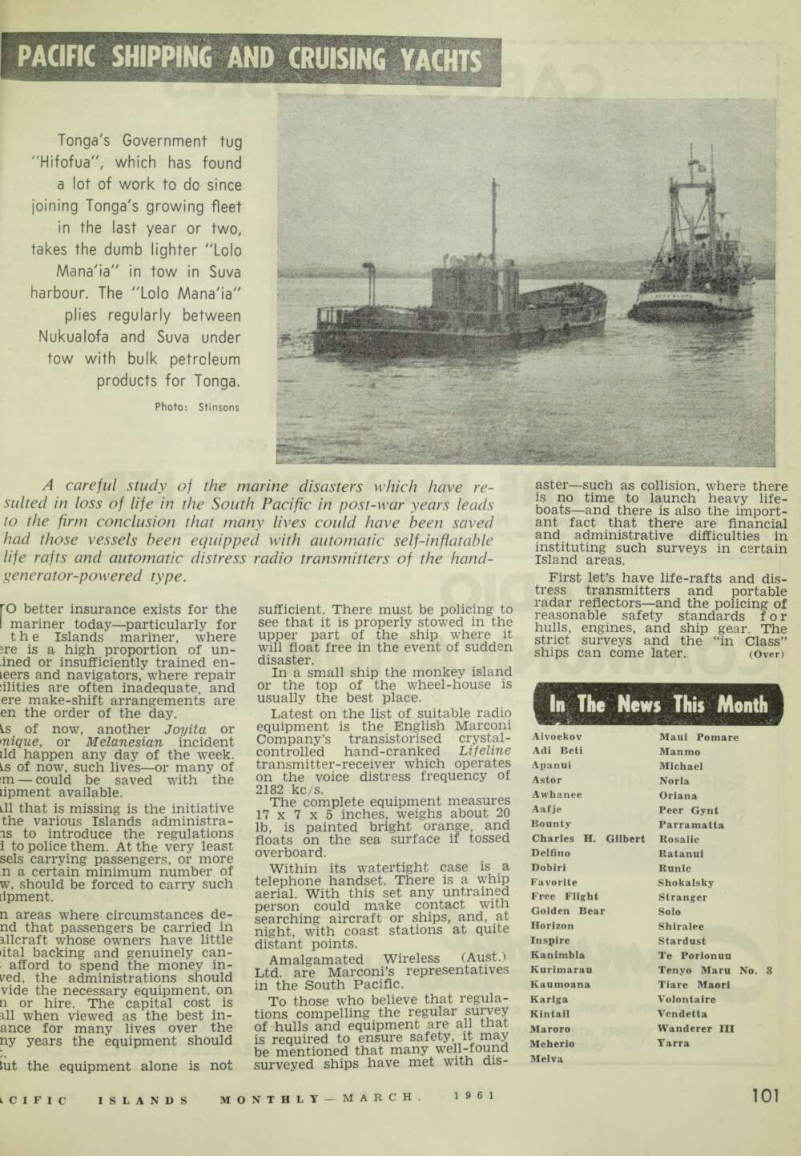
Tonga's Government tug "Hifofua", which has found a lot of work to do since joining Tonga's growing fleet in the last year or two, takes the dumb lighter "Lolo Mana'ia" in tow in Suva harbour. The "Lolo Mana'ia" plies regularly between Nukualofa and Suva under tow with bulk petroleum products for Tonga.
Photo: Stinsons
• New Regs. In Cooks: In
le Cook Islands, maritime safety is »ing approached from the angle \ the ship’s radio station meeting srtain requirements.
New regulations have just been •epared—but they do not call for ly form of self-contained emerg icy distress transmitter, which is ie only means of communication ice the ship’s batteries are sub erged or the main equipment is her wise out of operation.
When the new regulations come to force every trading or fishing ssel of over 30 ft waterline length sed in the Cooks and intended to crate more than 10 miles from nd must carry a transmitter of least 30 watts aerial power and minimum daylight range of 750 lies on one of its frequencies.
Ships operating only in the nthern Group must be equipped r 2182/2162 kc/s transmitting and ceiving.
Vessels trading to the Northern *oup must also have the local msmitting frequencies of 4122.5 d 8245 kc/s. There must be main d emergency batteries, a clock, emergency light, battery charg ? facilities, certain tools in a ;ked tool-box, and a spare aerial ide up.
There must be at least two proved operators, and neither of ese should be an engineer—who iuld be otherwise engaged in an lergency.
A. proper radio log must be main ined, with a record of the cou pon of the batteries signed at ?ular intervals by the master, rhe aerial must be erected before s ship leaves port, and the trans fer must be tested on all its iquencies by communication with rotonga Radio prior to leaving at port, on every voyage.
Regulations governing lifeboats 3 also being prepared. The draft dilations do not require the carri e of inflatable rafts, though they ty replace rigid lifeboats if the ner desires. The passenger licence il be fixed according to the avail le lifeboats.
» Training Ship Cruise: The
lifornia-based US Department of mmerce merchant marine officers’ lining ship Golden Bear was due Pago Pago in mid-February in 3 course of one of her regular uses, and would probably be seen some other Polynesian ports, too. twin-screw, welded steel turbo ctric vessel of 6,059 tons gross, s ship was built by the Walsh iser Co. in 1945 at Providence, Ne last reported her in South cific waters in 1955, though she iy have been south since then, ptain C. G. Bowman, USCG et.) is in command.
► Pinching The Pilgrims:
me months ago there were reports >ot that the lamb-liner Delflno, inging to a Sydney buoy these
many months, might soon do a charter voyage with pilgrims from Indonesia to the Red Sea.
Now it looks as though another equally well-known Australian coastal passenger ship, the 11,004ton Kanimbla, just sold to Pacific Marine Transport of Hongkong, might have got the charter.
Under the Liberian flag she was to leave Australia for Japan in Feb ruary for conversion to her new duties. Delfl.no (ex Westralia ) still lay at Sydney.
• Joining The Family; The
239 -to n Auckland-built Rosalie sold to New Caledonia some years ago and recently owned by Mr.
Andre Mouledous, has now joined Captain Emile Savoie’s “del Mar”
line. As Sorana del Mar she made her first run to Australia in Feb ruary, The previous Sorana del Mar was purchased as Wombat in Australia in September, 1954, and sold again to a Brisbane firm in August, 1956.
She may since have undergone another name change, or been scrapped, as she is no longer listed in Lloyd’s Register.
The other present “del Mar” ships in the Savoie fleet are Maria del Mar ex Marua —third of the post war series to bear the name—and Damadora del Mar ex Comer a.
• Under The Red Flag:
Some further details of that Russian ship Shokalsky, which the world’s Press said “disappeared” after leav-
\ Suva in December, show that ; was flying the flag of the Russian vy, had a gross tonnage of 3,500 is approximately, a length of 278 and a speed of 18 knots or more. professional seaman who looked r over said she was a very poorly ished vessel “as drab as they ne” but that some of her female entists made a somewhat better )wing. fhe tall, bearded professor in irge of the scientific work —be it eking sputniks or whatever —who 1 lost a leg at Stalingrad, said it the ship would return to Suva April. mother Russian boffin-s hip isumably also one of the fleet of lar-ships which has been loiter in Central Pacific waters for iks past, was also to drop in to /a, unless plans were changed, r name was given as Aivoeikov; other details. »ome of the “mysterious” light ;hes and flying objects reported m Fiji in recent months might 1 be traced to these vessels which apparently been launching kets as part of a space research ject. iaptain Stan Brown, of Maroro, d can be considered a reliable erver, reported one such display lights early January when his d was in the Lau Group. ’he only reason for Shokalsky iling hurriedly from Suva a day ad of schedule” was because her th was required for another sel and she had no reason to lain longer in port under the cir istances, according to a Suva in nant.
Memo For Beach
MBERS: Drift-bottles may be th less than ambergris, but erthless any bottles of a batch several thousand being released ntervals this year in the vicinity
of the Hawaiian Islands will be of considerable oceanographic interest if found on beaches south of the Line.
Their purpose is to provide fuller knowledge of ocean currents in the Hawaiian Islands.
Some may drift up on beaches there, but many will carry on south westward and might well enter the South Pacific current system some where in the Gilberts area.
The bottles are of clear glass, ballasted with a small amount of sand to make them ride low, free of windage.
They also contain an addressed
card with instructions for filling it in. On the back of the card are bright orange stripes to attract at tention.
Any finder returning a card will receive a chart showing the time and place that the bottle was re leased. The Fish and Wildlife Ser vice vessel Charles H. Gilbert will make the launchings.
• Back To New Guinea;
Berg Shipping Company’s 297-ton Kurimarau, running petroleum pro ducts in drums out of Suva to the Gilberts and Samoa for the past four years, is now to be based at Lae, NG, due to a decrease in the drum-oil trade with the appearance of a number of new bulk-oil in stallations in her present operating zone.
Originally built for Lever’s Solo mons trade in 1930, this little ship was later acquired by the BSIP Government.
She operated for a while in Papuan waters under charter to APC upon hoisting the Berg house flag and went to Fiji following an extensive refit at Ballina and Syd ney.
Among various rumours in Suva concerning BP vessels was one in January that Ratanui —also largely in the drum-oil trade—might also be based in New Guinea. (Over)
Canadian Visitors
Fiji recently had a visit from three frigates of the Royal Canadian Navy. Here a guard and band from the frigates put on a display for Suva in a march from the King's Wharf.
Workers and pedestrians pause to watch.
Photo: Stinsons
• Lct For French Poly
NESIA: Completing a 52-day pas age from Rouen, the brand-new jCT-type landing craft Meherio ecently arrived at Papeete as a re ilacement for the war-time-built 'e Porionuu owned by the Govern ment Public Works Department, rhich foundered off Huahine in uly, 1959.
The latter vessel was 235 tons ross. The new ship, built by Etab ssements Varnier at Rouen, is 210 ons gross and 180 tons net, with a argo capacity of about 160 tons.
She is a welded craft 128 ft long y 261 ft by 5 ft loaded draught nd is powered with two pairs of iesels single-reduction geared to vo shafts. The four motors are laudouins.
The vessel is equipped with gyro compass, direction finder, and R/T. he will be used like her prede essor for the carriage of heavy onstruction equipment and laterials between the many islands f French Polynesia.
• New Sausage Tanker:
Oracone Operations Ltd. of the UK as recently commenced production f a third and larger model of its übberised nylon tubular tank arges.
There are thus now three models vailable ranging from 10,000 to 03,000 gallons capacity—3s tons, 00 tons, and 370 tons.
Dracone barges, which seem to ave obvious applications in cer ium Islands areas, are now in use m many parts of the world, includ mg Australia, A recent purchaser is the Nomi os Shipping Company of Greece, hich is using dracones for the de very of fresh water to some of the rreek islands.
The new large model, known as “ype-K, is about 227 ft long and )i ft in diameter fully loaded, mpty, it winds on a reel to about ft diameter.
Experiments are now in hand to 3e if these flexible tankers can be sed also for the carriage of grain.
They can be classified with Lloyd’s ist like rigid vessels, are much lore easily towed by a tug, and are oiled up and carried on deck on aeir reel if not in use on the return oyage.
• Summer Fishing; This
immer for the first time a Japan se tuna mothership fleet has been perating in the South Pacific. In me past, mothership operations ave been confined to the winter nd spring months in these waters.
The Taiyo Company’s Tenyo laru No. 3, heading the fleet of 15 mgliners, made a run in to Suva or bunkers and water in mid anuary and was to call again in ebruary before returning to Japan or drydocking.
In May she will head south again s usual, with the first Taiyo fleet f the new season.
• READY FOR WORK: Captain Helbig’s Noumea-registered 270-ton ex-naval YMS-type vessel Volon taire—better remembered as the French Navy’s Tiare and predeces sor to the present naval craft of the same name and type, completed refit in Suva in February.
She had been there converting to cargo carrying since November. She will now operate, it is understood, in the New Caledonia-Loyalties trade.
•An Unrecorded Loss; Un
recorded previously in these pages, we now learn that the 190-ton Papeete-registered ex-subchaser Kariga was lost in the Marquesas about a year ago.
Under the name of Kaumoana this vessel lost her propeller east of the Marquesas while on delivery voyage from France via Panama in 1952.
She was unable to make radio contact with Papeete so despatched
a lifeboat under sail to the Mar quesas where it arrived safely to fortunately find a French warship anchored. This vessel was de spatched to tow the derelict in.
• Open For Bids: Bp’S Suva
based wooden 56-ton auxiliary ves sel Totoya, damaged on a reef in the Lau Group last September and later refloated and towed to her home port, is now for sale as she lies at moorings in Suva’s Bay of Islands.
She was built by Marlow & Co. in Suva in 1927 and largely rebuilt by Whippy’s yard in 1951.
• She May Go Places: An
other Suva vessel, the former Fiji Government 49-ton patrol craft Adi Beti, recently declared surplus and sold to Messrs. Alf and Robert Lepper, is said to be under con sideration by another syndicate now.
Their plans: to head her to
rards the UK when they go on fur nigh. She was built by the Fiji WD in 1927.
• Ng Weather Broad
ASTS: From the annual summary I Notices to Mariners which ap ears at this time of the year, it is oted that during the past year le Port Moresby and Rabaul coast ations have instituted regular R/T gather broadcasts for smallships.
For Moresby-VIG on 6405 kc/s ansmits his bulletin at 0018/0718 MT Monday to Saturday inclu de, and at 0018 GMT only, on indays and holidays.
Rabaul-VJZ on 6410 kc/s is listed transmitting daily at 0618/2103 VIT. Thursday Island-VII on 10 kc/s transmits weather daily
0648/2318 Gmt.
Fhese are the only stations in the w Guinea area making routine ather broadcasts for smallships— th the addition of course of the rt Moresby broadcasting station iich has weather bulletins several les each day from its two trans fers on 1250 kc/s and 6130 kc/s. » STILL UNSAFE: Though all own World War II mine-fields in ? Islands have long since been ept, many areas are still classi d as unsafe for anchoring due to >sible mines or unexploded depth arges. tfilne Bay (Papua), Blanche Bay ew Britain), and Gazelle Harbour ougainville) have potential depth arge dangers. rhe possible mine-danger areas lude the approaches to Port iresby, Kavieng, Buka Passage, againville Strait, the Shortlands, .laita, the New Hebrides, New ledonia, parts of Fiji, Tongatapu, nafuti, Butaritari, Mili and Wotje
in the Marshalls, and Truk in the Carolines.
There are no known dangers in the South Pacific east of Tonga.
• New Light On Currents:
As a result of a recent research cruise by Scripps vessel Horizon, mariners will have more accurate information on ocean current move ments in the extreme eastern South Pacific.
It has been proved that there is an eastflowing surface current spread over about 300 miles of lati tude between 5 deg. S and 10 deg.
S. Less strong than its northern hemisphere counterpart, the North Equatorial Countercurrent, it can yet push a ship well east of her course.
Charts which at present show an
unbroken cold Humboldt Current sweeping the length of the South American coast from the Antarctic to the tropics will also have to be revised.
Horizon proved that there are two separate current systems—one off Chile and another off Peru. Be tween them is an area of compara tively dead and relatively warm water which is a prolific tuna fish ing area.
The cold waters of the north flowing Peru current were found to be underlain by a current flow ing in the opposite direction.
Horizon was not able to deter mine what happens to east-flowing Cromwell current after it passes the Galapagos.
The Scripps research vessel Stranger, operating in Thailand waters since May, 1959, will leave Bangkok in March and after carry ing out oceanographic work en route, will arrive at San Diego, her home base, in May.
• Shifting The Fijis; It Is
anticipated that some of the Fiji Islands will have a new position on navigation charts after the Fiji Lands Department has completed work with a pair of “little black boxes” which it currently has on loan from the British Directorate of Overseas Surveys.
The instruments are tellurometers and are essentially radio trans mitter-receivers. Based on the fact that speed of radio waves is known, these instruments can measure dis tances of up to 50 miles within an accuracy of nine inches.
Some of the Lomaiviti and Lau Islands are known to be inac curately charted. These instru ments will establish their correct positions.
Similar work has recently been carried out in the Solomons with the same instruments.
[?]ew addition to Samoa's shipping service was made early in February with the launching the MB "Telefoni" which was built at Apia for H. & J. Retzlaff Ltd. The "Telefoni" 42 feet long with a beam of 12 feet and draws 4½ feet. She is powered by Gardner [?]ylinder engine giving a cruising speed of 11½ knots. She was built by Mr. Vincent Ah [?] to an Australian design. Timber used was kauri with a sheathing of yellow cedar. will carry passengers and copra between Savaii and Upolu. Picture shows the new ship being moved on rollers along Beach Road, Apia, prior to the launching.
Samoana
Nauru has nearly completed a new twin cantilever for loading its valuable phosphate deposits.
This recent photograph, taken by Mr. M. Wilder, shows the "Trienza" moored at the buoy.
• Passing Stranger: A
nail ship which loitered for a tiile off Rarotonga on January 20 used some speculation until radio ntact disclosed that she was the and new American-built tuna pper Favorite, manned by eight istralians and bound from San ego to Sydney, on delivery to an istralian tuna fishing company, ic was a vessel of 125 tons gross.
• Pirates—And Looters:
racy on the high seas—well to the :e recently—is comparatively rare lay, but looting on the high seas if anything, on the increase. \ fair sample of it was seen when 3 new Orient liner Oriana made r first trip to Sydney and San ancisco and return.
Almost every one of the hundreds specially designed ashtrays was >len—“souvenired” is the word w used—from the public rooms :oughout the ship in the course the Sydney-to-Sydney circuit.
Tow to replace the attractive ash ys are plain aluminium ones.
• Still On The Bottom; The
l-ton, two-masted schooner Tiare tori, damaged by fire and sunk the fire-fighters in six fathoms Fareute, Papeete Harbour, in ouary, was still on the bottom in d-February. 3 lans were afoot to raise her as in as conditions were suitable— ;re had been some bad weather.
► For Cooks Trade: Captain
[gh Williams, of Sydney, who has in operating vessels in the Cook a-nds inter-island trade for some irs past—first Inspire, then Melva, i latterly Dohiri —purchased the rman-b ui 11 steel single-screw sel Apanui from the Northern lamship Company of Auckland e in February.
The purchase was made following announcement by New Zealand’s v Minister of Island Territories it it had been decided to sub ise the operations of inter-island pping in respect of vessels which i “in survey” with one or other the recognised classification ieties, such as Lloyds, Bureau ritas, or to New Zealand Marine partment survey standards. anui meets the requirement.
Taptain Williams had also just jotiated a three-year agreement the carriage of citrus fruit from er Southern Group islands to the v processing factory of Gregg & The agreed freight rate of 3/- per e will permit economic operation this new industry which should one of great value to the Cooks.
Vpanui, built 1938, is a vessel of tons gross, 139 nett. She is vered by an English Allen diesel make more commonly found afc auxiliary in large ships, lobin is up for sale but mean ile will continue to operate in the 3ks with Apanui as required. She s undergoing annual refit in
Auckland in February. Both ships will probably head for the Cooks in March-April.
Apanui is being replaced by a new vessel currently building in the Pacific Islands Shipbuilding Co. yard in Hongkong.
• New Name, New Life: Sold
to Australia Pacific Shipping Com pany (Hongkong) Limited, the New Zealand Government’s 34-year old, 1,215-ton, fruit-and-passenger vessel Maui Pomare was expected to be heading for the Far East by mid- March, wearing the new name May flower —a symbol of good luck in China —and the new port of registry, Hongkong.
The ship’s company of European officers and Chinese crew was, fit tingly, to be under the command of Captain L. C. Boulton, who was master of the ship from 1930 until he reached Government retiring age a quarter of a century later.
In all, the ship made 231 voyages from New Zealand to Samoa, the Cooks, Niue, and—once at least —to the Chathams. The money that has been poured into the operation of the “Pom Pom” through those years is astronomical.
In 1955 alone, £lBO,OOO was spent in putting her in suitable condition for another five years of service pending her replacement. Offered for sale at the end of last year she
ought a best bid of just £lO,OO0 — us the cost of the fuel oil in her nks.
Mr. James Lee, Chinese managing rector of the Hongkong ship brok g firm to whom she was knocked iwn, said in Auckland in February at he had not yet re-sold the old ip, but that she would certainly on be back at work in some trade, rhaps based in Formosa.
There was no question of scrap- Qg her at present.
A cargo for the northbound yage to help cover the cost of the livery, was still being sought in id-February.
• Still Searching: Mr. S.
mnett, returning to his Auckland adquarters after looking at a :ond-hand ship in Australia in bruary, said that the French lynesia subsidiary of his company A. B. Donald Limited—was still fidng another ship to be based at peete.
Fhe Australian vessel had proved suitable and a company repre itative would now look at likely ssels in European waters. • MORE SHIPPING? Discussions re “in train” for additional ship ig services to outlying tropical ands of NZ, said the NZ Minister Island Territories, Mr. Gotz, in bruary. He didn’t name the ands. ‘Shipping has been a major Dblem for these islands,” he said. am hoping to devise a major leme by which shipping can be •re regular. If this can be done I i confident the export of copra a be increased.”
Je added that he hoped it might possible to establish a tuna anery in the islands.
» New Observatory: The
■lP’s new seismological observ >ry at Honiara has been opera nal for the last couple of months, e observatory has three seismo ■ters in an air-conditioned vault, d can help warn against tidal ves caused by earthquakes. The lipment is designed to record •thquakes within a range of 600 les of Guadalcanal, although the mary object is to detect any mge in the condition of the cano on Savo Island, 20 miles ay.
• Tulagi Fishing: Fishing
trials carried out in January by SPC Fisheries Officer H. van Pel, in fishing grounds within easy reach of the SPC Fisheries Course head quarters now being established on Tulagi, BSIP, showed that they were rich. There were excellent catches of mackerel, trevally, schnapper and three varieties of tuna.
Twenty-five trainees from four Pacific territories will attend a two month course at Tulagi in July. An Australian, Mr. Murray Aylett, who has just been appointed Fisheries Officer for the Solomons, will be an instructor for the course.
• Ships In Funeral; Two
ships provided the funeral pro cession for August Nicholas Lanzarotte, 67, when he was buried on his New Ireland plantation in February. Lanzarotte, who was born
on Thursday Island and who went to New Guinea in 1904, died at sea in his own vessel Manmo, and after a church service at Rabaul his body was taken back to his ship for the 120-mile crossing to his plantation.
A second ship, the Michael, fol lowed with a party of mourners.
Flowers were thrown on to the sea as the ships passed.
• Freighter Aground: The
British freighter Runic went aground on a reef north of Lord Howe Island in February while en route to Auckland from Brisbane.
When the 13,587-ton Shaw Savill ship couldn’t be refloated in the first attempts, most of the crew were taken off by the Australian destroyer Vendetta and landed in Sydney. In 1953 the Runic damaged her stern while berthing at Ham burg and about a year later she ran aground in dense fog off the south coast of England. In 1955 she spent six weeks in Wellington for the re pair of a damaged boiler. • NEW FRIGATE: The second of the RAN’s new anti-submarine frigates HMAS Yarra began her sea trials in Melbourne in February.
The Yarra was built at Williams town Naval Dockyard, in Melbourne.
She was known as a Type 12 frigate, based on the RN’s Whitby class, but these designs have been modified for Australian conditions, and have more extensive air-condition ing. According to the Navy, they
Geic
Launch
The Resident Com missioner of the GEIC has a new launch, built in the Wholesale Society's Boatyard at Betio, Tarawa. It was designed by Martin Wilder and built under his supervision. Its length is 26 ft, breadth 9 ft, draft 2 ft 6 ins.; powered with 100 hp Perkins diesel engine.
offer a “new standard of comfo< for frigate crews”, which will ce:: tainly be good news if it’s true. For frigates are being built. The firs HMAS Parramatta, completed lu sea trials in December. Yarra an Parramatta will be commissioned i July, and the other two frigates wi be launched later this year and wi join the fleet in 1963.
• Better For Passengers
Because Australian interstate shifl ping has been getting less an less over the years (the recent saj of the Kanimbla has reduced tli number of licensed interstai passenger vessels to one) the Com monwealth Government in Februai announced that it had “liberalisec the conditions under which bj overseas liners can carry passenger between Australian ports.
Under the new procedure, shij ping agents will be able to obtai permits to carry passengers up i six months ahead of sailing date At the moment passengers do n« know until a day or two before sail ing whether or not the overseas sh; is allowed to carry them betwee ports.
The original legislation coverir the issue of permits was to gh protection to Australian coash passenger vessels.
News of Cruising Yachts;
THE TASMAN RACE: The eight Trans-Tasman Yacht Race, and tH first to be sailed since 1954 (AucH land-Hobart) was won on handica by the new 38-ft Sydney cuth Norla owned by the Halvorse brothers—their fourth win in fou attempts.
Norla’s elapsed time from Auch land to Sydney—eight days seve hours 39 minutes, was howevt bettered by the 57-ft steel Sydne cutter Solo with fastest time t seven days 22 hours 11 minutes, an by the 73-ft Victorian schoone Astor with seven days 22 hours 8 minutes.
All three beat by a considerab) margin the previous best elapse time of slightly more than 10 daj set by Halvorsen’s Peer Gynt in 194 J Under the handicap system th actual placings in the latest ever were Norla first, Solo second, an the 40-ft Australian cutter Kinta third.
One of the 15 boats withdrew—th 34-ft Auckland ketch Bounty pu back from 300 miles west of th Three Kings with her owner suffer ing a mild heart attack.
The American 52-ft cu 11 ee Awhanee, which had cruised dow* through the Islands to Aucklant. crossed the line some two days be hind the winner, and tenth in th final placings.
Last home was the 28-ft Aucklan r ketch Shiralee— for which she woe a special £25 prize. Her elapsed tim was 15 days 15 hours 45 minutes.
The weather was variable, with fair breeze for the start, followed lx
ms just west of New Zealand, m some heavy weather, and a fair ish. ) » WANDERER 111, of England i the Hiscocks, currently cruising northern New Zealand waters, I head on for New Caledonia in itinuation of the west-bound ise at the beginning of April. 1 AAFJE, 60-ft schooner with d and Evelyn Gaylord, Tony •ter, and Pete Smiley aboard ived in Honolulu January 23, 23 r s out of Bora Bora. The ooner left San Francisco in June I has visited the Marquesas, rniotus and Society Islands. The ylords plan on sailing for home t at Sausalito very soon.
FREE FLIGHT, 34-ft Atkins 3h, returned to Honolulu in late tuary from Tahiti. Owner Ron derman and Bob Silver aboard.
Flying Walrus, 37-Ft Bill
'den ketch of Vancouver, BC, ived Honolulu February 1. John i Diana Wells and two-year-old ghter sailed the boat from Bora a to Hilo, Hawaii in 23 days. The Us’ have been cruising the South ific for four years. Present plans to sail to Los Angeles, Calif., in 11.
STARDUST, the 112-ft con ned Fairmile, which has been in . out of PlM’s pages since it left ney in July, 1959, with a team nen and women pleasure seekers, ie the news again in the Hono l Press in February, nder the heading, “Hollywood w Charges Tyranny in South s”, the Honolulu Star Bulletin I a team of eight photographers, )rs and skindivers arrived at lolulu by air “with a tale of a innical South Seas charter boat >per”. They said they had hired ptain Richard Smith”, of the irdust, on November 11, in •eete, to cruise the islands while 7 shot documentary films, he Press report went on, “How r, they claimed he put them to
work as crew members, confiscated their equipment and refused to re turn them to Tahiti when they de manded he do so. They claimed they finally jumped ship and caught a ride from the Marquesas to Tahiti aboard a copra boat. South Pacific Air Lines extended them credit to purchase tickets to Hawaii”.
Stardust, when it left Sydney, was supposed to be on a three months cruise to America. PIM reported at the time that “the betting along the Sydney waterfront was that half the amateur crew would leave at the first port of call” Islands cruising being what it is. In fact, all the originals had gone by the time Stardust left Fiji, except for skipper R. S. Smith.
"Stardust”—see below.