Tahiti’s Youth ?
pp. 61-62 · Read in the full issue
Beryl Sawyer Reports from Papeete
What Is The Future For Tahiti’s Youth ?
Tahiti’s Protestant monthly, Vea Porotetani, in a story entitled ‘What will happen to Tahiti’s youth?’ deplores the lack of employment openings for Tahitian young men and women in Papeete. A few Tahitians are able to obtain work in the new hotels as kitchen help, waiters, waitresses and the like—and the more fortunate as hostesses and office workers.
But in a country without industries, without even a future in agriculture, what sort of a future awaits the new generation of Tahitian youth?
Economists reply that Tahiti’s future lies in tourism, but for a Tahitian that means a life of servitude in hotel work. Surely this is a sad future for those equipped mentally and physically for better things?
A POSSIBLE solution might be found in the creation of enterprises directly connected with the land, or with fishing—the canning of fish and the making of preserves, etc.
Vea Porotetani asks, surely this would not be more difficult than the construction of an international airport’
Meanwhile, figures issued by the French Government Tourist Office reveal that in 1960, 6,151 tourists visited French Polynesia.
These figures comprise the arrivals by air and do not include some 14,000 persons who arrived for a one-day or two-day stopover aboard passenger liners.
Of the 6,151 tourists, 70 per cent, were from the United States; 19 per cent, were Anglo Saxons; 10 per cent, were Europeans and one per cent, from Asia or South America.
“TJELP!” say some local wags, IX ‘‘Tahiti is beginning to look like the French Riviera!”
Visiting Tahiti recently were the Earl of Dudley, Princess Marie Grace Radzivill, and former French cinema producer (Carnet du Bal ) Alfred Fua, who has since turned from film-producing to the sale of de luxe clothing to such notables as the Prince of Monaco.
Also on the Tahiti scene was Alfred Cartier (no relation to the famous French jeweller), owner of a block of seven buildings on the Paris Champs Elysees, here in Tahiti to look over the possibilities of building yet another hotel.
The latest hotel project on paper is announced by George Rolley, of the South Pacific Investment Com pany, Washington, who “played possum” for several weeks before announcing that he has acquired for hotel construction a section of magnificent beach and bay land at Taravao, some 40 miles west of Papeete. (Over)
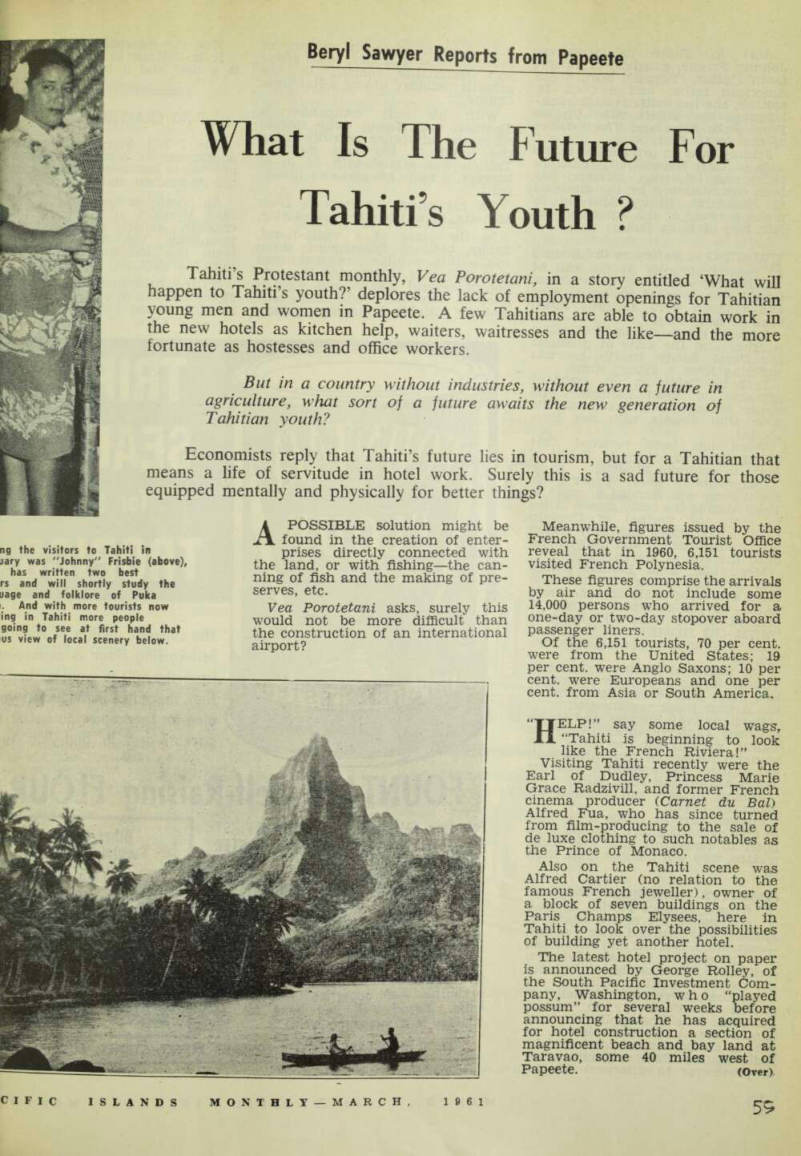
[?]ng the visitors to Tahiti in [?]uary was “Johnny" Frisbie (above), has written two best [?]rs and will shortly study the [?]age and folklore of Puka And with more tourists now [?]ing in Tahiti more people going to see at first hand that [?]us view of local scenery below.
Also in Tahiti is authoress Johnny Frisbie, daughter of Robert Dean Frisbie, “Ropati”. Born of an American father and a Cook Is. mother, she has written two English language best sellers, Miss Ulysses From Puka-Puka and The Frishies of the South Seas.
Johnny, who in private life is the wife of Carl Hebenstreit, Honolulu radio and television director, has been commissioned by the directors of Honolulu’s Bishop Museum to make a study of the language and folk lore of Puka Puka.
FILMING of Mutiny on the Bounty ceased abruptly at the end of January and stars, cameraman, technicians, tons of costumes, wigs and makeup were abruptly flown back to Hollywood.
Reasons given—the spell of rainy weather and the state of producer Sir Carol Reed’s health —he was suffering from a kidney stone.
Left in Tahiti is an assistant producer, a head gardener and flower arrangements man, and the good ship Bounty with her crew aboard. . .. .
Word has been received that MGM plans to return to Tahiti in April to continue filming.
Comments a local paper, “No doubt those who decided to come to Tahiti during the rainy season failed to read the journal of Captain Bligh, which states ‘the rainy season begins in November and may extend until the end of March!’”
Meanwhile, local French citizen and ceramist Frank Fay has been fined a total of 25,579 francs—about £AI28 —as self-confessed author of painted street signs in Papeete,
“Mgm Go Home!”
He will appeal against the de cision.
The next film venture to come to Tahiti, during a brighter season in late July, will be the Britishers of the Arthur Rank organisation.
Producer Ivan Foxwell, and writer Geoffrey Cotterell, are already in Tahiti, working on the script and scenario for a new film which will be entitled, Tiare Tahiti, starring James Mason and John Mills.
Filming in July will continue for about six weeks.
Foxwell says he hopes to be able to take over the entire laorana Villa hotel to house his cast and tech nicians, who will number more than 60. r HITTS se 1 f-styled Robinson Crusoe. Jacques Talrich, has quit the simple life of the island of Mehetia and returned after a month —emaciated, bearded and sunburned —to the delights of easier living in civilisation. He was able to last out the required month in solitary.
Divorced, 36-year-old Talrich was chosen in Paris from among hundreds of willing applicants for a simple life on a desert island, as part of an experiment conducted by radio station Europe Number One to prove (or to disprove) that a
man, accustomed to the comforts of modern living in a city, could adapt and acclimatise himself to the primitive solitary life of a Robinson Crusoe.
With his only companion a Tahitian dog, Kazan (who started off on the adventure by badly biting the hand of his new master), Talrich was armed with 66 lb of luggage, a radio set and two bread fruit.
On his return to Papeete from Mehetia, he was barely recognisable.
In the place of a white-faced, flabby, taciturn Frenchman, there was a thin, voluble, brown-skinned man who only interrupted the eat ing of several steaks and French fries to converse loudly and ani matedly with his dinner companions.
Was the experiment a success?
It is difficult to say, but Talri is a new and a better man.
P-Ng Crayfish Industry
The P-NG Fisheries departme is carrying out a survey which cok put “up to 50,000 crayfish a year” the Australian market.
An administration official said Port Moresby in February that; crayfish export industry “look promising”. The crayfish would coi from the Papuan coast betwe Port Moresby and Yule Island.
Native fishermen last year s* 30,000 crayfish in Port Moresby du ing the season February to May