New Hebrides’
pp. 51-59 · Read in the full issue
Air War
“You can see now what has happened as a result of your ’ °rk. What was a useless belt of bush has now been turned into ime thing useful for the benefit of all living here, and all our reams have come true {pointing to the aeroplane ). Now is ot the time to let up. We must follow closely the directions ven to us by these people if we want to move ahead”
A native chief said this at the opening of Loasia airfield on mna. New Hebrides, on November 18, 1960.
OSE words were significant, soming as they did from that nan, in that of all places. The which has led up to it is a nating one. starts in 1954-5 when the ,te company Societe Calc ine de Transports Aeriens came into existence oumea, New Caledonia, to pro an internal air service connect- Noumea, the Loyalty Islands the Isle of Pines, primarily for lative people. was successful, and the fleet soon expanded. Managing tor was Monsieur F. Martinet, made the first flight from New lonia to Paris, in 1938. e company now has a big staff excellent workshops at mta Airport, Noumea. It soon ne obvious to M. Martinet an air service would be success n the New Hebrides.
Bob Paul's Plan wever, M. Martinet was anti ed in the New Hebrides, b Paul, then operating an -island vessel, the Miti Vaka, in 1952 discussed with the ch Resident Commissioner,
Monsieur Pierre Anthonioz, the idea of a New Hebrides internal air ser vice.
It was then thought possible that Transpac might be able to operate in conjunction with a company which could be formed within the New Hebrides, and in 1956 Tran
spac’s senior pilot, Monsieur La farge, was the guest of Paul on Paul’s plantation at Lenakel, Tanna.
Lafarge was looking at the possi bilities of an air link between Noumea and Vila, via the Loyalty Islands and Tanna.
Tanna was of utmost importance, too, for an internal airline.
It is 50 miles closer to Fiji than Vila. It is a stepping stone on the route from the Loyalty Islands to Vila. It is a very lovely island, with great tourist possibilities. It has a good road network and good sites for airports of any size.
Its 8,000 people live on extremely fertile land, rich in agricultural products, including cash crops.
Native Help Needed But virtually the whole of the land surface of the island is owned by the natives and as the law stands, no airport could be built without their consent.
Nothing came of discussions at
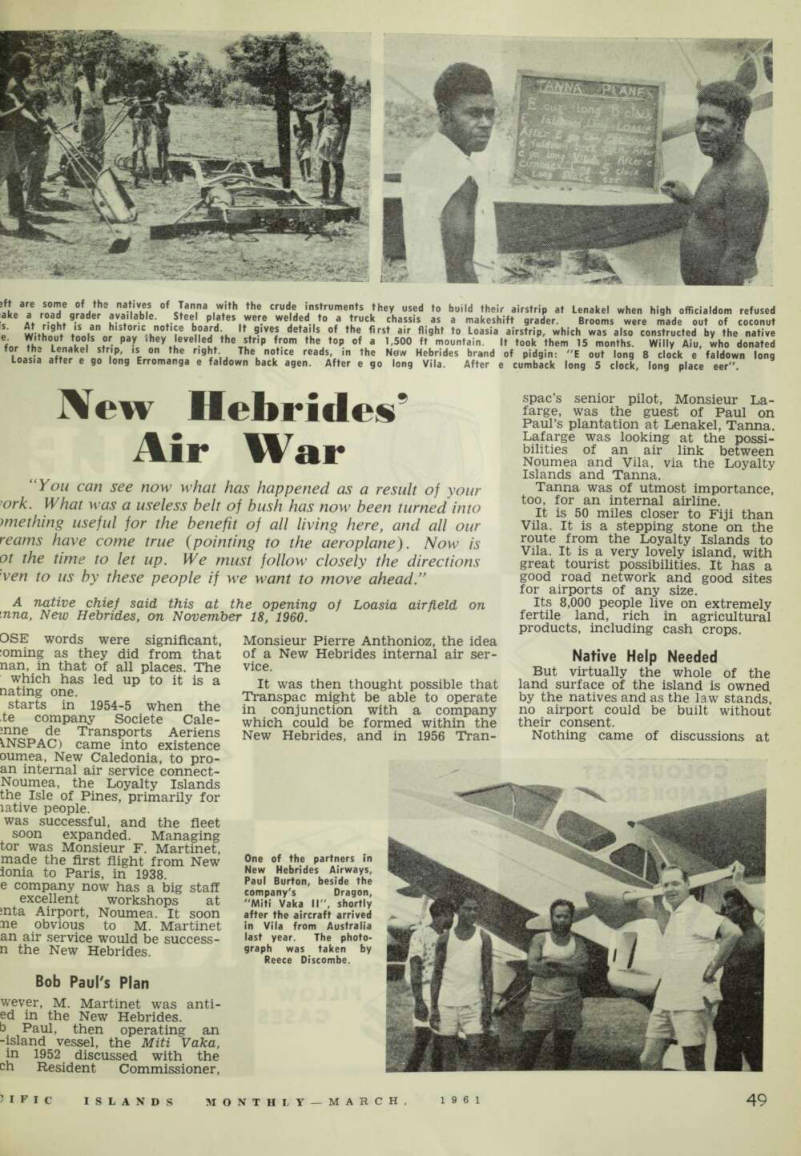
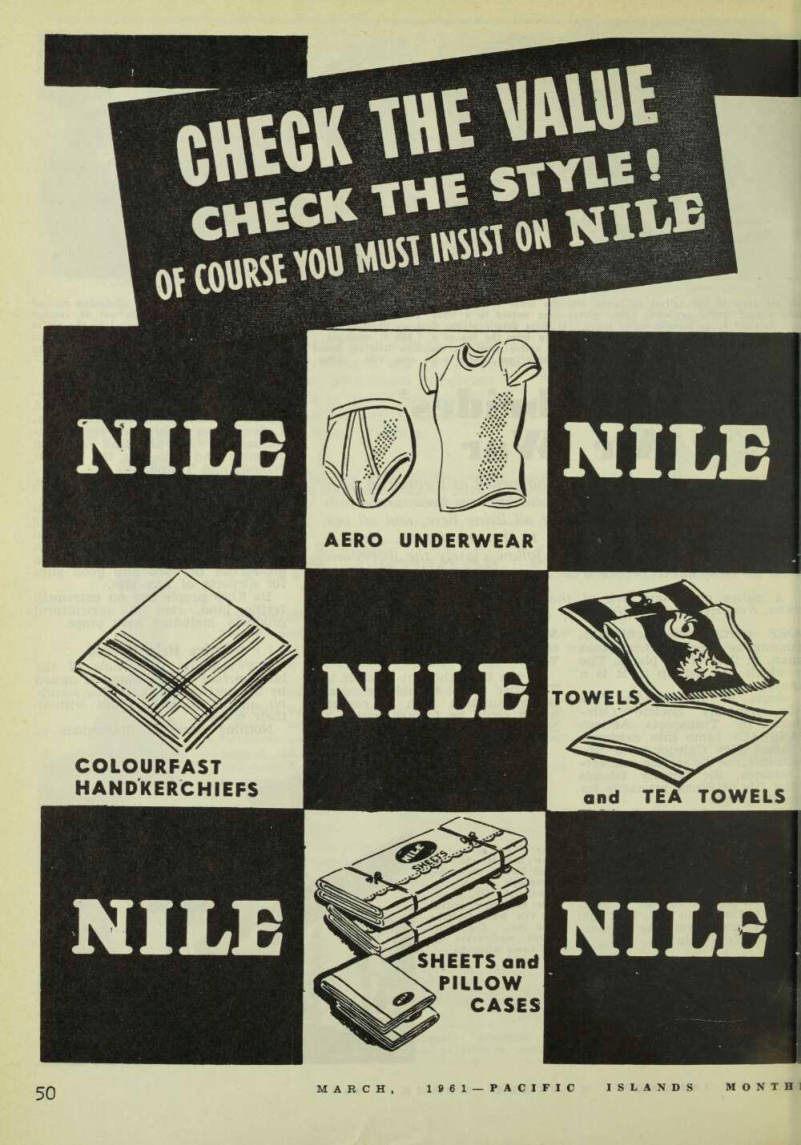
[?]eft are some of the natives of Tanna with the crude instruments they used to build their airstrip at Lenakel when high officialdom refused [?]ake a road grader available. Steel plates were welded to a truck chassis as a makeshift grader. Brooms were made out of coconut [?]s. At right is an historic notice board. It gives details of the first are flight to Loasia airstrip, which was also constructed by the native [?]e. Without tools or pay they levelled the strip from the top of a 1,500 ft mountain. It took them 15 months. Willy Aiu, who donated for the Lenakel strip, is on the right. The notice reads, in the New Hebrides brand of pidgin: "E out long 8 clock e faldown long Loasia after e go long Erromanga e faldown back agen. After e go long Vila. After e cumback long 5 clock, long place eer".
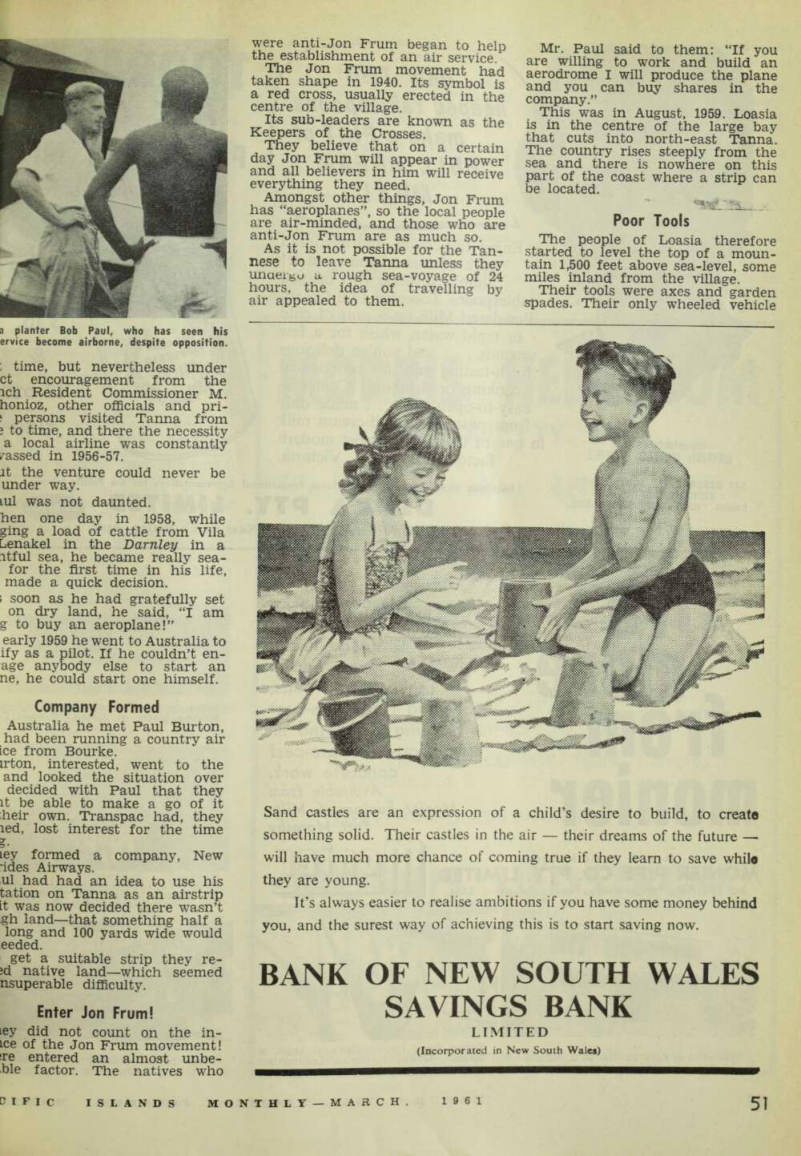
One of the partners in New Hebrides Airways, Paul Burton, beside the company's Dragon, "Miti Vaka II", shortly after the aircraft arrived in Vila from Australia last year. The photo graph was taken by Reece Discombe.
: time, but nevertheless under ct encouragement from the ich Resident Commissioner M. honioz, other officials and pri i persons visited Tanna from i to time, and there the necessity a local airline was constantly /assed in 1956-57. it the venture could never be under way. ml was not daunted, hen one day in 1958, while ging a load of cattle from Vila Lenakel in the Darnley in a itful sea, he became really sea for the first time in his life, made a quick decision. ► soon as he had gratefully set on dry land, he said, “I am g to buy an aeroplane!” early 1959 he went to Australia to ify as a pilot. If he couldn’t en age anybody else to start an ne, he could start one himself.
Company Formed
Australia he met Paul Burton, had been running a country air ice from Bourke. irton, interested, went to the and looked the situation over decided with Paul that they it be able to make a go of it heir own. Transpac had, they led, lost interest for the time tey formed a company, New ’ides Airways. ul had had an idea to use his tation on Tanna as an airstrip it was now decided there wasn’t gh land—that something half a long and 100 yards wide would ceded. get a suitable strip they re- Jd native land—which seemed
nsuperable difficulty.
Enter Jon Frum! tey did not count on the in ice of the Jon Frum movement! ;re entered an almost unbe ble factor. The natives who
were anti-Jon Frum began to help an ah semce taken shane rtf^v™Vn? ad a red £SSf ce ite 0 sub lMdpVs U n?p' fv , Keenpr? b of OWn aS the K ThPv S Jmf fw SS ™ i. • dnv Inn tt™™ 6 miS B !?™ ll a - certam nnd a ? pear .. ] j ri P°wer pvprvthiw Wlll receive everything they need.
Amongst other things, Jon Frum has “aeroplanes”, so the local people are air-minded, and those who are anti-Jon Frum are as much so.
As it is not possible for the Tannese to leave Tanna unless they undergo a- rough sea-voyage of 24 hours, the idea of travelling by air appealed to them.
IVIr Paul said tn fhpm • “Tf vnn are willing to work and’build Y an aerodrome I will produce the plane compZny." ° an bUy Shar6S “ the This was in Au g ust > 1959. Loasia 18 111 the centre of the large bay that cuts into north-east Tanna.
The country rises steeply from the sea and there is nowhere on this part of the coast where a strip can be located. m ...
D T , Koor ' oo,s The people of Loasia therefore started to level the top of a moun tain 1,500 feet above sea-level, some miles inland from the village, Their tools were axes and garden spades. Their only wheeled vehicle
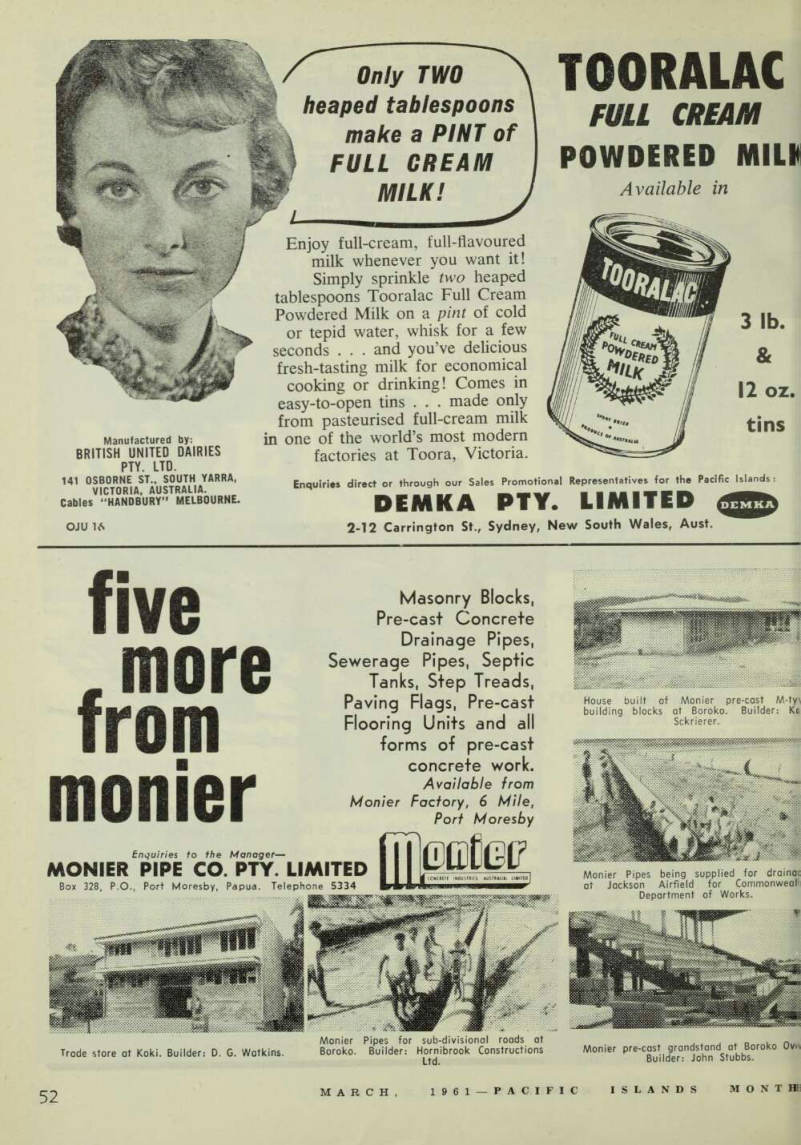
[?]a planter Bob Paul, who has seen his [?] ervice become airborne, despite opposition.
s an old car trailer capable of ding half a yard of earth. Slowly i painfully the work proceeded, irteen great banyan trees were ved up piece by piece and burnt.
The bush was cleared little by le and the top of the hill re ved and used to fill the saddle ween it and the next hill. l hurricane destroyed the young onuts and very little copra could made for the next six months, s people filled in time by work on the airstrip.
'rom time to time Paul supplied dstuffs, such as rice and tinned ats, to help them along. With coming of the winter, the air p was sufficiently advanced to in planting couch grass.
Officialdom's Attitude
•n Burton’s arrival in the New )rides, Paul and Burton sub ted written plans to the two ident Commissioners. This im iiately raised difficulties, as there ; no Condominium legislation erning the operation of commer airlines within the Group, he then French Resident Com sioner, M. Favreau, appeared ently opposed to the introduc l of the service, owever, as the construction of airstrip proceeded, Transpac ime interested again in the Ability of connecting their ser s with Vila, via Tanna, and be negotiating within the Group private capital, with the inten of forming a new company )e known as Hebridair. be French RC agreed with the ;ish RC, Mr. John Rennie, to ig in the two air advisers, at led to the respective High Com mons, M. Donzel, of Noumea, Mr. Corbin, of Honiara, t a meeting between the air ad rs and all interested parties in
December, 1959, New Hebrides Air ways agreed to operate Transpac machines in New Hebrides on a charter, the proceeds to be pooled Starting date was to be February 25, 1960.
Meanwhile a second airstrip was being built.
The people of the Lenakel area, on the coast, had become interested and were building a strip about half a mile from Paul’s plantation.
Here, the Loasia performance was being repeated. Using the most primitive tools, an airstrip was cut and levelled, from heavily timbered country.
It is the practice in NH to hire out Condominium-owned earth moving equipment to the general public, and the services of a grader
were now sought from the British Agent at Isangel.
He made available a small grader, but his action was countermanded upon the orders of the then French Resident Commissioner, and the grader was withdrawn. No one knows why.
Said the Tannese: “Why does the Government tell us we must move with the times, then cut the ground from under our feet?”
Transpac Comes Back
Following the meeting in Decem ber, 1959, Transpac became active in the New Hebrides.
M. Martinet flew to Tanna in his private Stinson plane, landing on the ash plain below the volcano,
[?] ot Bob Paul's sons inspects a Jon Frum [?]e on the ash plain at the foot of Yaouwey, active volcano on Tanna. The volcano is [?]ed 1o the Jon Frum movement because that where he is supposed to live. There are various gates of the sort in this area.
>re benzine had been left for i by the Condominium vessel, •inante. nth the assistance of George £ht, of Lenakel, an arrangement i made with the native people fc a strip should be constructed Transpac’s own use on native i near Lenakel. ut, after two hundred yards had i cleared, the natives stopped k; and nothing that the French :rict Agent could do would in -5 them to start work again.
Dr various reasons the charter mgement plans for February, , did not eventuate, ew Hebrides Airways decided to an aircraft of its own, and in tralia in April, 1960, Burton and I bought a Dragon Rapide that been serving as an aerial ambu e in Queensland, le aircraft was overhauled, n an Australian certificate, 3 for twelve months, and chris d Miti Vaka 11. le pair flew it to the NH via Moresby, Rabaul, and Honiara.
Still No Grader •ossing the long stretch of ocean reen Honiara and Santo one Dr gave trouble, but they An il the flight safely.
Tanna there was feverish ac y to complete the strip at ikel sufficiently to allow the 'aft to land, and there was t excitement when the Dragon Ide came in sight. did land, but with so little ?in of safety that 500 natives shed up to the French District it and asked that the grader made available to finish the eld. le District Agent, however, re ted that as he was acting under •uctions from Vila, the grader i not be made available. He d, however, pass on their re difficult situation was averted surton constructing a makeshift er by welding steel plates on truck chassis. This was towed Qd a Land-Rover, sst of the grading was * by rubbing the ground with c pieces cut from the butt end sconut fronds and mounted on s. was three weeks before the f°n Rapide was able to take rom the strip, to go to Noumea iiscussions with Transpac. ilations with Transpac were still , as they always have been, ys Paul: “New Hebrides Air ! kept Transpac informed of all ss and that firm made repre ssions to the Government to us to get started, still on a i of co-operation. They have very straight all the way along line.” it there has been some strange oeuvring against the Austra air interest; and if Transpac
are not in it, suspicion points to other French interests.
For three months of last year after its arrival, the Australians’
Dragon Rapide was flown as a private aircraft in the New Heb rides, for it was not a registered operator.
Improvement!
Things improved after last Octo ber. The Parliamentary Under-Sec retary of State for the Colonies, Mr. Julian Amery, flew to Tanna and took a great interest in the progress that had been made.
Soon after his return to Vila, Messrs. Paul and Burton were in formed that an inspector of Civil Aviation would be sent from New Zealand to Noumea, at the request of the Government of Fiji, and that if his report were satisfactory, a validation of current Certificate of Airworthiness and Registration would be issued.
In October, the Dragon Rapide was taken to Noumea, where M.
Martinet made available the whole of the workshop facilities of Trans pac, and generally made Paul and Burton very welcome.
The aircraft returned to Vila with its certificate in November, New Hebrides Airways Limited was meanwhile registered as a company, the aircraft issued with the letters VQ-FAZ and the company allowed to commence regular services be tween Tanna and Vila as from early November, 1960.
The first flights in the NH were received with great enthusiasm.
“Ship finished now!” was the way one New Hebridean expressed it.
It had been argued in Vila that no Hebridean would pay £5 to fly from Tanna to Vila when he could make the same journey by ship for £2.
All Want a Ride In the first week of operations 35 passengers paid to travel between Tanna and Vila, each way, necessi tating daily flights.
At Lenakel there is a tremendous pride of possession. £570 has already been subscribed by the local Tan nese people to purchase a share in the aircraft.
A regular watch has been estab lished over the aircraft when it is not in use. An emergency service is manned at every landing and take-off. Assistance is given with the maintenance and servicing of the aircraft.
An airport taxi service has been established; and further work is being carried out on the strip, de spite the lack of any mechanical aids.
The cleared land in the vicinity of the strip has been laid out in gar dens and the construction of a hangar has been commenced. (Over)
[eanwhile, on the top of the intains, in the “middle bush”, people of Loasia were heart ier! at the thought of the work t had gone into their airstrip, they felt that it would now no ?er be of any use. he late starters at Lenakel had the plane.
oasia Mourns—Then Rejoices
owever, Paul Burton decided ; the work was sufficiently far meed to permit a landing. 3 a result, a landing at Loasia carried out, to the great joy he Loasia people. It was decided iave an “official opening” of the trip on the following Friday, No ber 18. It was a social and ial event of importance—all the ve people took part. It is their it the excitement was not con i to Tanna. Here at last was 3thing important and modern the New Hebrides people could or themselves. i Aniwa, a small atoll to the heast of Tanna, the people a “Custom field”, i Futuna (a steep-sided moun ■top rising vertically from the fic, to the east of Tanna) the nese, who are great travellers sailors, cut down their precious lut trees across the top of the d and eventually made a ser ble airfield some 650 yds in h.
Quoin Hill, northeast Efate, jmergency strip 1,200 yds in h has been completed on a er American wartime field.
A Major Topic Now
Tongoa, a small heavily lated island in the centre of ?roup, several hundred people Jutting a strip along a razor ridge. roughout the group the estab
lishment of air transport is a major topic of native discussion.
If enthusiasm and hard work can produce them, it will not be long before the group is dotted with air fields.
But the native peoples wish to re tain the control of these airfields in their own hands.
In the interests of safety a com promise will have to be reached; but the measures have not yet been worked out.
Meanwhile M. Martinet of Trans pac has continued his company’s interest in the New Hebrides. A French company has been formed, known as Hebridair.
In mid-December, on the day that M. Martinet left the New Heb rides to return to Noumea after forming the company, a Fiji Air ways Heron touched down at Vila on the proving flight of what is shortly expected to become a regu lar British service from Fiji to the Solomons via the New Hebrides.
Since December, Fiji Airways has operated several charter flights through the NH in anticipation of a regular service.
Thus, in the air, the New Hebrides is finally looking up.
Jon Frum Again And what of the Jon Frum move ment? The leaders are already em barrassed by the comings and go ings of the Dragon Rapide, so close to their headquarters.
But theirs is not primarily an anti-European movement. It is, in its present manifestation, rather anti-Government and anti-Mission.
Basically it is an expression of a desire for a more advanced way of life, which they feel can be obtained through a better form of education and leadership than either the mis sions or the Government are at the moment providing.
These people also feel that they must not surrender the things that
can help them achieve it, particu larly control of the land. They will work on a road themselves rather than allow the Government to re pair it with mechanical equipment, in case it gives the Government the right to claim the road.
Last month one of the interested Australians summarised the events of the last year or two this way: “New Hebrides Airways have had to build their own or organise and assist in the building of the air fields, with no assistance whatso ever from the Government—in fact, fierce opposition—and fight a poli tical war and push a very lethargic British Government into register ing them, put up with ‘spies’ travel ling on the aircraft, and all the petty goings-on of political wars.
“We are still battling; but our allies, the natives themselves, have stuck to us through the worst patches and we are indebted to them. Also there are now six Tanna people who would not be alive to day but for the plane.”
Memorial to Harold Gatty
[?]pbell Town, Tasmania, birthplace of Pacific aviator Harold Gatty [?] died in 1957, is erecting a memorial to him ("PIM", Feb., p' The townspeople also hope to endow a scholarship for a local [?]d with proceeds from the memorial fund, which is still open [?] memorial itself has been built by students of the Hobart [?]hnical College, for the cost of materials only. It is in a form a globe, showing the route Gatty and Wiley Post took in the first [?]ht around the world, and mounted on a 20 ft steel column [?]ve the globe is a replica of Post's aircraft, "Winnie Mae". Here the globe, photographed in the PMG depot, Campbell Town last [?]th, as it awaited erection. On the right is the Warden of Campbell [?]n, Cr. J. C. O'Brien, with the PMG line foreman, Mr. E Davis. [?]w, children of Mr. K. G. Worsley, Campbell Town's Council clerk, [?]lay the "Winnie Mae" and the plaque which will go on the [?]e of the monument. The plaque reads: "This monument is to our the memory of Harold Gatty who in 1931 won world fame an air navigator after his record-breaking flight with Wiley Post the Winnie Mae'. During the Second World War as a Group [?]ain in the RAAF he was Director of Air Transport for the Allied [?]es in the Pacific Area. Born at Campbell Town, 1903—died at 1957. This memorial was constructed by the Hobart Technical College. J. C. O'Brien, Warden, 1960".