Towards Goodwill
pp. 35-41 · Read in the full issue
What Are We Doing Towards Goodwill In The Islands ?
Stuart Inder Comments on People and Events
The interveiw with Sir John Gutch in this le, containing as it does so much information m a man who has just completed a highly cessful and popular five-year term as Britain’s ]h Commissioner for the Western Pacific, is ertheless almost as valuable for the things ; ch Sir John does not say.
is hardly to be expected that ;he holder of such a delicate in :ernational post in the Pacific speak as freely to the Press as :an in confidential reports to the ne Government. It is very satis fy that in this interview he chosen to speak as frankly as has. he points which he does not e, but which I think he implies tiis interview are: i) The British islands of the stern Pacific are now likely to ance very swiftly, but that both British and Australian public not realise how swiftly, or what advancement will mean. Par larly is Australia in the dark as he importance of their progress. )> Despite the fact that the ley which the UK Government jutting into the BSIP compares mrably with what Australia is ting into New Guinea, in pro :ion to the population of both ;es, more money is still needed he Solomons if the government o keep ahead of economic and tical demands there. :) The New Hebrides could de p into a serious problem for ;ain and France unless the two ers get together soon and de t just what shape they think constitutional future of that itory should take.
These are all important matters.
They have existed for some time but they have developed apace in Sir John’s five-year term.
How they are handled in the next five years will be of vital concern.
Sir John himself in his quiet way has done a great deal towards mak ing the right people aware of them —including Australians. But only re peated pushing and publicity in the right quarters will get things done.
A great deal more publicity is needed in Australia for instance if Australians are to become aware that the Solomons and the New Hebrides even exist.
In the last 10 years, Australia has heard a great deal abput how im portant is the goodwill of South East Asian countries to her welfare.
The man-in-the-street knows all about that. It has been drummed into him on every hand.
We Need Goodwill
Only in the last 12 months has it apparently begun to occur to any body in Australia that the goodwill of almost 2,000,000 natives under Australia’s own control in P-NG is one day going to be just as im portant. , With consciences, or perhaps geographical knowledge, as sluggish as they are, how long is it goms to take before Australians realise
that the British Solomons, right alongside New Guinea, and the New Hebrides, right alongside the Solomons, are also Australia’s close neighbours whose goodwill we are going to need?
And what is more important, how long before anybody admits that now is the time when assistance should be offered to them?
We Take No Interest
It seems hardly believable that Australia, as separate colonies be fore Federation, took more interest in the New Hebrides before the turn of the century. If Australia had been able to talk as one at that time, the situation in the New Hebrides today would probably have been very different.
But it is not yet too late.
Australia ought to show all it can that progress in the Solomons and the New Hebrides is as much in her interests as is progress in NNG and P-NG.
Progress in the two halves of the island of New Guinea is the subject of regular international confer ences, and frequent exchanges. But there is nothing of the type regularly operating in regard to the New Hebrides, BSIP and P-NG, although Sir John expressed appreciation of the co-operation extended by the P-NG Administration. Is this lack
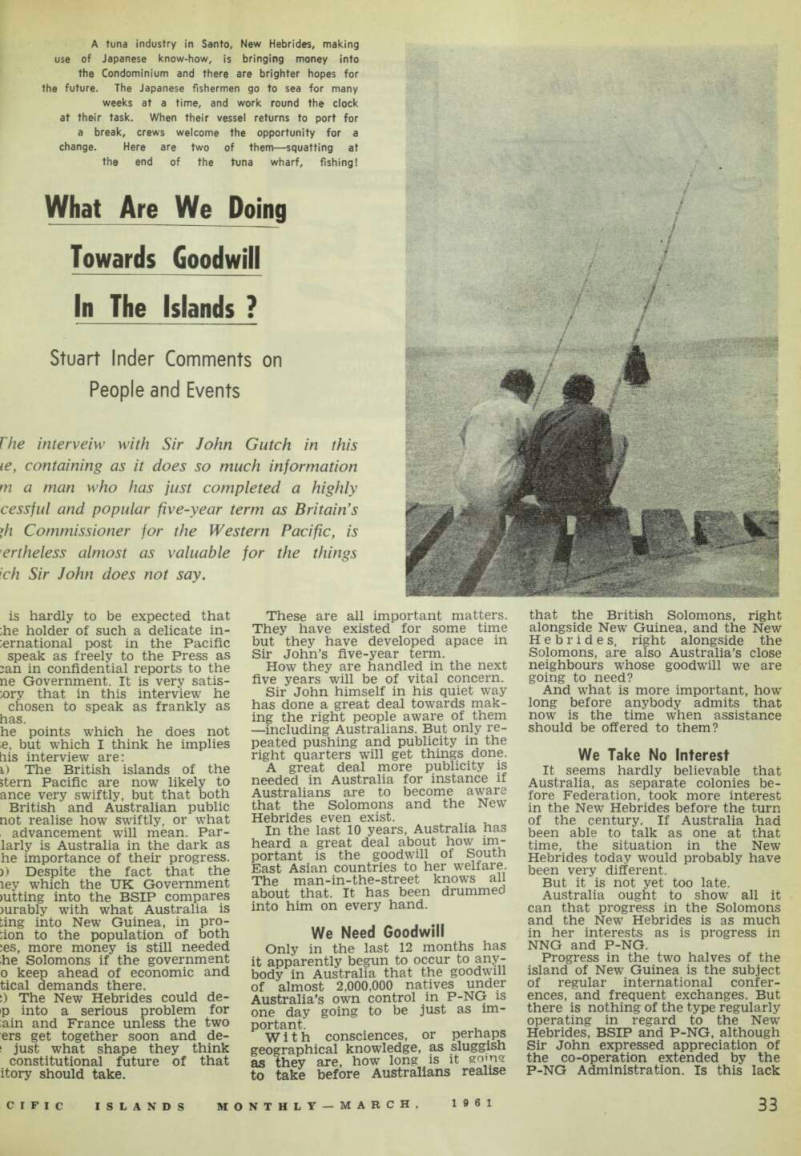
A tuna industry in Santo, New Hebrides, making use of Japanese know-how, is bringing money into the Condominium and there are brighter hopes for the future. The Japanese fishermen go to sea for many weeks at a time, and work round the clock at their task. When their vessel returns to port for a break, crews welcome the opportunity for a change. Here are two of them—squatting at the end of the tuna wharf, fishing!
because the British Commonweaj takes itself too much for grant© Australia makes friends with t Netherlands, but doesn’t bother go to any trouble with Britain!
Buses to Indonesia •J? , Australia can afford to se c gilt buses to Indonesia, it can affc to offer much-needed education and other kinds of help to ti Solomons and the New Hebrides; Sir John makes it clear in his i teryiew that amongst the thin which these territories need mosti help with education.
At present there are BSIP tec meal students training in Rabai The Protectorate pays for thu studies but is this necessary?
We can offer, and should offer, mm in the way of training facilities a; free scholarships for those who c; reach the standard, and there w be a growing number reaching f standard in the years ahead.
This will be the case in the N< Hebrides too—but there we can al do something of a slightly differ© order.
Are Commonwealth relations delicate that the Australian Prin Minister can’t raise at a Prin Ministers’ Conference in Londo the importance of an internatior discussion between France ai Britain on the future of the Ne Hebrides?
It’s in Australia’s interest for the to be an intelligently planned futu for the New Hebrides, and Austral should press for something to done.
The Condominium can’t real progress until the two powers rea*. agreement on exactly what they at supposed to be trying to do then Obviously, they haven’t yet done s
Future of New Hebrides
One assumes that both Britat and France are working vague towards a Council with legislatfi powers, but neither of them knor exactly what form it should take Possibly Britain’s! idea of a politic: future for the New Hebrides is dii ferent from that of France.
Naturally enough, Britain worn probably like to see the New Hebridf make some kind of political arrange ment with the rest of the Wester Pacific.
France, just as naturally, ms like to see the New Hebrides ir fluenced eventually towards Ne Caledonia.
There are some people who ss, let the French have it all now that the French have put in moc money and done most to build it ut Britain, they say, virtually ignore' the place for years and only mn has started to take any real interee in it.
All these things should be diii cussed now.
The protocol, which has had vei; little done to it over the last 50-ocb years, needs revision in some inr portant respects, because of weak
>ses that have developed. Here is opportunity for Britain and mce to discuss a revision of the )tocol in conjunction with a full ,le conference designed to hammer / some kind of blueprint for these inds, islands which at the moment not have even a joint education icy.
Jany of the difficulties in the New brides are caused by this lack a political blueprint, iway from politics, British and mch planters and businessmen i Government officials, too, seem get on very well together on the ole. On these levels the Con ninium is in fact a fairly good mple of friendly relations —of in lational “togetherness”, if you ►ut it is the future of the New iridean himself which is at stake v, and he himself is beginning to e an interest in it and will do so reasingly. ’he political moves which the tish and French make in the ;t 10 years are vital to him. ust as vital —just as dangerous haps—are the decisions which the i powers do not make. r E humans being what we are, it is probably not surprising that one hears few whole-hearted lutes to Islands’ administrators n people in their own area. Nor it merely a case of a prophet ing no honour in his own land, en criticism is quite personal. •ne hears that such-and-such a ior departmental head, or admin ator, is “not really a bad fellow, ...” followed by what is sup ed to be the good oil. Perhaps
the question has two faces Perhaps he drinks too much, or he is a wowser because he doesn’t drink enough. Perhaps he is a snob, or he mixes too casually with one or two of his favourite hoi polloi, whom he leans too much on for advice. Or perhaps he is none of these things— it’s just that his wife is a pain in the neck.
How to be Popular
All of this observation is by way of introducing my own very personal comment that Sir John and Lady Gutch will be missed a great deal from the Solomons because they have been a genuine example of how to live in the box seat for five years with o ut invoking any personal criticism.
In the Solomons you never heard, “The Gutchs are nice, but . .
What you heard was, “The Gutchs are nice . . .” followed by examples of just how nice they were. There were always plenty of examples.
How could anybody leave the South Pacific with a better record than that!
Sir John will be lost to the Colonial Office following his retire ment, but he won’t sit back and rusticate in the English woods. He will probably enter the London busi ness world about mid-year. And good luck to him.
“11/HEN I’m flying over the reef,” ft says Tom French, “I usually take her down to about five feet. I go up to eight feet when I see anybody walking out there!”
Tom must be exaggerating a little bit, although I wondered later when I flew with him in his happy little four-seater Piper Caribbean around the reefs.
Tom’s Caribbean has the distinc tion of being the only aircraft per-
manently attached to a South Pacific hotel—Fiji’s Korolevu.
He started it as an experiment, and the experiment has paid off. In the first 15 months since the air craft first operated in October, 1959, it carried 2,600 people on 1,200 flights. These figures exclude such things as forestry surveys, tours of inspection and air searches.
Tom encourages visitors to fly direct to the hotel from Nadi international airport or Suva, rather than spend hours on the road. He also makes scenic flights.
It hasn’t surprised Tom to find that American tourists take to his air transport best of all.
“They think less about getting into an aircraft than others do
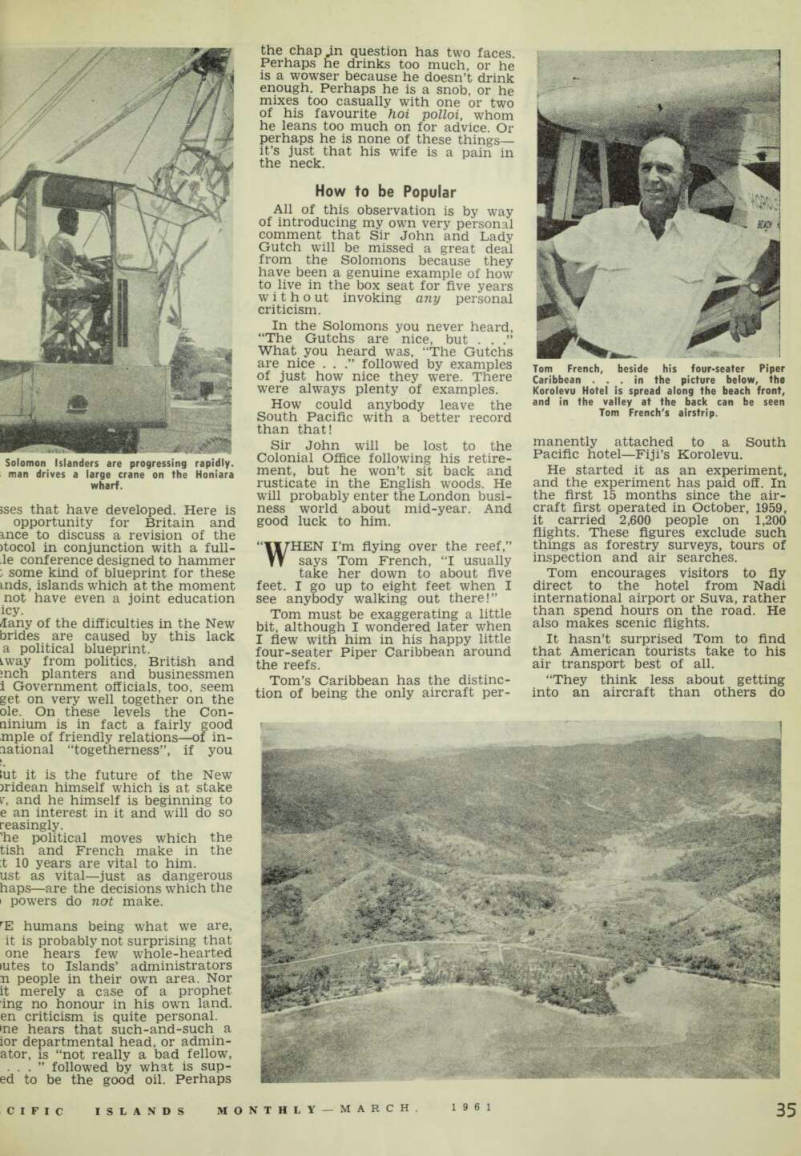
Solomon Islanders are progressing rapidly. [?]man drives a large crane on the Honiara wharf.
Tom French, beside his four-seater Piper Caribbean ... in the picture below, the Korolevu Hotel is spread along the beach front, and in the valley at the back can be seen Tom French's airstrip.
lout getting into a car,” he says. : soon realised a lot of them were it even interested in looking at le scenery, so now I have equipped le cabin with magazines, like a mtist’s waiting room.”
Easy-going Tom French is a 54- ;ar-old Australian, who used to be bank clerk until he was taught to / after winning a scholarship in 34.
During the war, when he was with e RAAF in New Guinea, he and erry” Pentland used to fly old st-off Tiger Moths, or “anything ittered”, in c 1 o a k-and-dagger lerations, putting down on beaches, c.
All Theory!
That was the theory, anyhow, but )m says all he remembers rescu g personally was a goat which got ngled up in a barbed-wire fence.
He did a great deal of flying in ji after the war, before Fiji Air tys got going. His Taylorcraft, rich he bought for $4OO in a box, is pretty famous during the four ars he operated it on charter work.
He has other interests in Suva w besides flying, and he will obably go back to them soon now irolevu is a success. But flying is s first love.
LSO met on the islands round- L about recently—William W.
Brandt, who has a high-sound- Z title as curator of the Common salth Scientific and Industrial Re irch Organisation’s National New linea Insect Collection, Canberra, hat that means is that he has },OOO moths and butterflies in his ssession, mostly collected by him f.
Fhe figure is something in that ler, anyhow. Brandt’s face will ht up. and he will fall over his irds in enthusiasm, when he tells u of the thrill of the chase after tterflies. There is no more dicated man than the remarkable andt, and whether or not you re for butterflies, Brandt is in 'esting because of his scientific votion.
■ fl we l known in the Western Pacific. He has been collectmg Lepidoptera from these islands, which he refers to as the Papuan sub-district, for the last 10 years. , .. . , .. , , H e does the job the hard way, climbing the razor-back ridges, and moSfhf atVttaS 1 with th nobo o d r v f hS
Hearn of nativT carriL and nf?en
?ven without Item '
even wunout
He Wants Them All
„ William Brandt has set his heart on identifying all the species of Lepidoptera in Papua-New Guinea.
It’s a 20-year programme, on which
he has already spent 10 years. He reckons he has another five years’ field work before he can go to Europe to check on the species which were taken there in the old days.
Many are in the British Museum, and the Dutch have the next biggest collection Butterflies and moths have been collected from those parts for 150 years. sa y s Brandt - Warships took some Qf the first to Europe) and missionaries took others. All these have to be studied from the point of view of the discoveries of the last 10 years, “I must keep working until my collection is safe!” says Brandt.
The P-NG administration still
[?] lliam W. Brandt, who has already devoted [?] large slice of his life to butterfly hunting.
rovides a grant of £l,OOO a year > help make the collection, although i 10 years this has lost a lot of s buying power.
It’s no surprise, probably, that e is a little critical of some over ;as scientists who make occasional speditions to his area, backed by ig grants from wealthy museums.
What Can You Collect?
“What can you collect in a week • two in New Guinea?” says the ian who has been collecting for ) years, and who is only just half ay. “You can spend a lot in equip ent and in fares and accommoda on in getting from the other side ' the world, but what value do you ;t from the money you spend?”
In the early days, Brandt tried ;tting missionaries and natives to flp collect, but it never worked out. be natives especially did too much image to his specimens.
On a typical New Guinea expedi m these days Brandt may employ carriers to help move his bulky tting boxes (where the specimens e kept with pins through their iddles), plus about a dozen four illon drums of kerosene for the
lamp which attracts his moths and for his cooking primus. He may let the carriers go as soon as he gets where he is going, and recruit others along the way. He pays off each line before he recruits others, Npuer Mac Trouble Never nas ,roume “I never have any trouble with labour because I always pay,” he says, “I also take a lot of stick to bacco. Everything I get on the trip x pay f or That often includes wa ter ” Once he paid £l2O for carriers to take him from Saidor to the Finisterres and back. He was away four months that time,
Tt . , . . Qc
Upon the has paid s &S & shilling a bucket for ’ .. . . And up there on the ridges the J s much to jin and much to make him p there, a butterfly may move 3 for half an hour a week, but when he moves Brandt has often got a rare specimen, , finnn 5f® n “where and 9,000 ft in New w 90 per cent, of my specimens have been new to science”.
In one three-week period at that height, he had only three good nights.
Like most dedicated scientists, Brandt loses himself completely in his work, and out in the field he is inclined not to notice discomforts, and to brush aside the smaller problems. He stands on ceremony for nobody; consequently he can be a puzzle to some people who come up against him.
How To Catch Moths “The best nights are warm and dark with no moon,” says Brandt, He sets his lamp on a ridge be hind a white sheet, and snaps poison bottles over the specimens as fast as they appear. On good nights he may keep going the whole night through, “scared to put my light out for fear just the specimen I want will appear in a few more minutes”.
Often dawn arrives to find Brandt has not found time from his labours to mount his specimens; a task which must be done within a few hours as they relax from the fumes in the bottle. Then he has a furious job of work ahead of him mounting the moths as they relax. On these occasions he is unable to go chasing butterflies.
By the time he has finished that job. night may have fallen again and so he goes on with the moth hunt.
He’s had no sleep, but the game’s afoot and it’s all for science.
Brandt is 55 now. When those 20 years are up he is hopeful—although he is by no means sure—that his collection will be about as complete as any one man can make it.
A hand clasped on the leather case which contains many of his poison bottles, William Brandt, aboard the “Tolagi", looks out on one of the Solomon Islands, as he arrives on an expedition.