Territories TALK-TALK
pp. 33-34 · Read in the full issue
With Tolala
Lately I have noticed that newly-launched cargo cults have a decided American background in their ethical con struction. This tendency has been remarked on by others.
[THERE is no one more than I who L realises the debt we owe to the U.S. services during War 11. ut I also realise that the average merican citizen—be he serviceman, >urist, scientist or missionary—is at always realistic in his approach i the native mind.
In his endeavour to ingratiate mself with the primitive peoples ’ the world he has the tendency to ;come extravagant in offering wards in order to attain his >jective.
His enthusiastic patriotism and merosity, by the time they are anslated by an interpreter, are too ten misunderstood by his native idience.
And, once again, we have that in plicable danger arising out of “it’s it what was said or the speaker tended to say as much as what e native thinks he meant to say”.
This danger of misinterpretation of course, not only applicable to e citizen of the United States. [t is a danger that besets all new mers who have not a really work le language with their native teners. Great offenders are mem rs of ships’ crews, using a garbled igin chop-suey talk to convey sir ideas of justice for the wage rner.
Little wonder then that we have ne ambitiously-inclined sophis ates cooking up Yankee sub irines; a setting of eggs that tch out soldiers, and all that sort thing. it seems as though as a cautionary asure the Administration might m a team of licensed interpreters, ly primed as to the dangers of interpretation by enthusiastic v-chums, and one to be attached each party making contact with mitive or near-primitive people. >uch a system might easily save ; Administration many a future idache.
pping Up
ence notice in a P-NG newspaper article under the heading tfGVR Recruiting Drive Starts lay”. ’here follows an ostensible official id-out about the support the ninistrator will give to such a /e and how public servants will granted leave while serving with unit. bllowing on the Pacific Islands
Regiment riot affair, John Citizen may be excused if he assumes that the authorities realise that the native regiment “ain’t just wot it orter be”.
Whether they realise also that an
adequate—repeat adequate—defence
force requires, at least, officer per sonnel who know something about the country and its people is another matter.
Australian officialdom has an un happy knack of trying to force New Guinea to conform with Australian conditions and standards, instead of adapting itself to New Guinea conditions.
That was only too well illustrated in War 11, with the troops in Rabaul awaiting the Japanese in vasion, when it was only at the eleventh hour that the Army re cognised the existence of the NGVR unit in Rabaul and, even then, not at all graciously.
And yet, when post-mortems were held and the final figures went up, it was generally admitted that the local units, such as the Coast watchers and the NGVR, played a most important part in the show. (I will qualify that statement: It was admitted by the U.S. brass, but I don’t recall any orchids being tossed about by the Aussie heads.) There is and always has been, in New Guinea, despite social integra tion and club-land camaraderie, an inherent jealousy between Army Brass and NG long-time residents when military matters come into the picture.
The former are envious of their local experience and the latter don’t like being pushed around by coves who don’t know conditions, and further more, won’t take advice.
It was just as apparent in War I, when the AN&MEF landed, as it was in War 11.
Let’s hope then that in the new drive for PNGVR recruits there is ample provision made for experi enced Territorians to occupy some, at least, of the senior ranks and that their voices are not dimmed by the impractical adherence to army traditions in Canberra.
The Anti-Canberra
Complex
Following on my last paragraph it’s strange in a way (or is it?) that non-Canberra people have developed an antagonistic attitude towards the Australian Capital Territory. It used
to be anti-Melbourne, when gov ernment departments were estab lished there.
You meet the individual Can berra-ite and he seems to be quite an acceptable sort of bloke: Has a job to do, y’know; must conform to regulations and all that sort of thing. All of which you quite re alise.
But you admit to yourself he’s an unrealistic sort of blighter. Other facets you also realise, especially in correspondence, in his inexplicable
superiority; his domineering man
nerisms and the dictatorial phrases he employs to convey the simplest messages.
Why can’t someone suggest a campaign Towards Better Under standing between the Masses and the mis-called Public Servants; for the dispensing of the worn-out, antediluvian officialese in corre spondence and a general attempt at get-togetherness between official and non-official folk of the Com monwealth?
It would make life so much easier for everyone.
Let's Have
A Museum!
An orchid for Mr. Justice Mann for his attitude towards the estab lishing of a “museum more than just a museum but a very alert organisa tion. very much alive and stretching out its influence throughout the Territory”.
It has always seemed strange to me that anyone desiring to see New Guinea native curios, artifacts, and natural history specimens must needs go to New York, Chicago, Rome or Sydney; the home of these exhibits would be the last place to see any systematic collection.
Mr. Justice Mann has stressed the
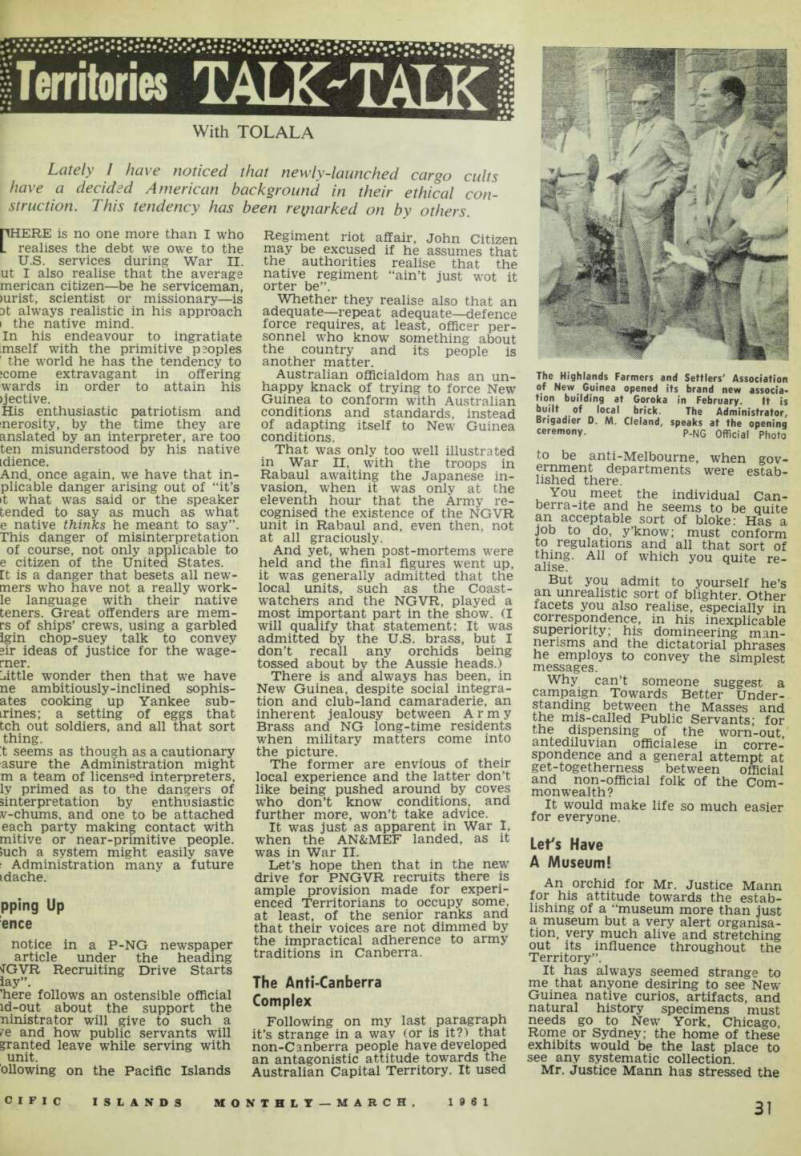
The Highlands Farmers and Settlers' Association of New Guinea opened its brand new associa tion building at Goroka in February. It is built of local brick. The Administrator, Brigadier D. M. Cleland, speaks at the opening ceremon y. P-NG Official Photo
importance of marine biology that could be put on exhibition. How true!
Sydney’s Taronga Park has an aquarium which owes its popularity, in the main, to New Guinea pro ducts. And these, if my memory serves me right, were first intro duced in the early ’3o’s through the enthusiasm of an employee of Choi s e u 1 Plantations Ltd., at Soraken, Bougainville, and “Sandy”
Campbell, skipper of Macdhui, whose place has more recently been taken by that enthusiastic mariner, Bill Wilding on the Bulolo.
Whitehead, of Soraken, used to spend his spare time collecting marine specimens off the reefs around Saposa Island and the im mediate neighbourhood. And a very good job he did, too.
Incidentally, the last I heard of “Whitey”, a most lovable lad, was being caught up with by the Japs in Kavieng and liquidated there.
Here’s wishing you luck, Y’Honour, and may the housing be not a mod. con. fibro, unimaginative structure.
What about Keith McCarthy’s scheme for a ceremonial native house as mentioned by me in March, 1960 Talk-Talk.
An Old Time
Token
A reader writes enquiring as to the approximate date of issue of some tokens by a store in NG owned by Mouton.
I should say round about 1908-9.
The Belgian, Jean Baptiste Octavius Mouton, arrived in New Guinea as a cabin-boy in one of the Marquis de Rays’ vessels in 1880.
After that famous Utopian expedi tion folded up a few years later, he worked for Queen Emma for some years and then eventually started trading and planting on his own.
He planted up the Kiniqunan property, adjoining Vunapope Mission headquarters at Kokopo which, in the ’3o’s he sold to the mission.
Incidentally, he owned The Rabaul Times when the Japs invaded Rabaul in 1942. He died about 1947.
During the German days it was the usual practice for planters to issue tokens to their native em ployees in lieu of money, which were acceptable only in the planters’ own trade stores.
It was a practice common throughout the South Seas in those days. There were no banks then; the Big Trading Firms acted as bankers for their various clients.
Before 1899, when the German government was established in New Guinea, the administering body was the Neu Guinea Kompagnie, which issued its own currency—the now much-sought-after bird-of-paradise coins. In the British Solomons, Burns Philp had a note issue at one time.
It was only during the Australian military occupation of New Guinea, after War I, that the Common wealth Bank was established in
Rabaul and cheques took the place of “chits”, or orders on the various companies.
After a poker game it used to be the usual practice for the loser to write a “chit”, addressed to the com pany financing him: “Please pay to Tom Jones the sum of three thousand marks and debit my account. Bill Smith.”
I have known of several occasions when company white employees’ accounts were in “the red” and they were transferred temporarily from Rabaul to a good productive plant ation. There they received liberal commission for copra and shell shipments, which soon “squared” the accounts in the books, and they returned again to the capital.
Now, that was a Welfare State!
The Question
Of Mixed Races
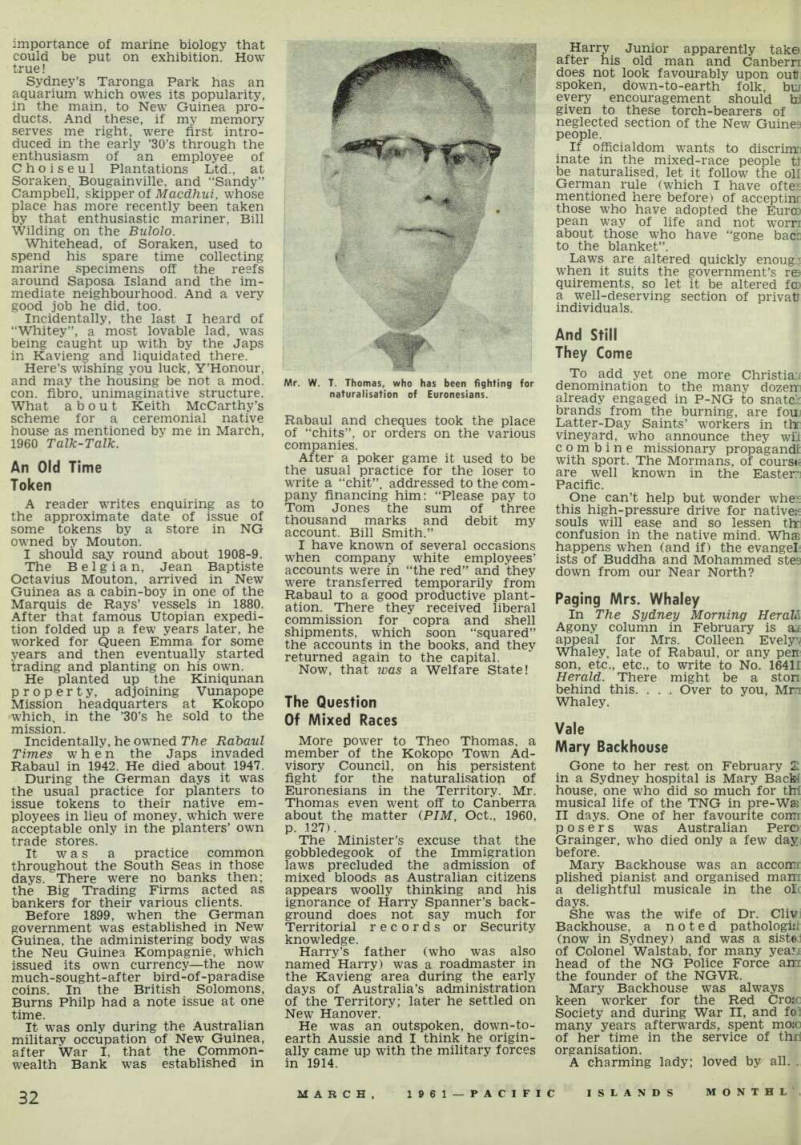
More power to Theo Thomas, a member of the Kokopo Town Ad visory Council, on his persistent fight for the naturalisation of Euronesians in the Territory. Mr.
Thomas even went off to Canberra about the matter (PIM, Oct., 1960, p. 127).
The Minister’s excuse that the gobbledegook of the Immigration laws precluded the admission of mixed bloods as Australian citizens appears woolly thinking and his ignorance of Harry Spanner’s back ground does not say much for Territorial records or Security knowledge.
Harry’s father (who was also named Harry) was a roadmaster in the Kavieng area during the early days of Australia’s administration of the Territory; later he settled on New Hanover.
He was an outspoken, down-to earth Aussie and I think he origin ally came up with the military forces in 1914.
Harry Junior apparently take after his old man and Canbern does not look favourably upon out spoken, down-to-earth folk, bu every encouragement should tri given to these torch-bearers of neglected section of the New Quines people.
If officialdom wants to discrimn inate in the mixed-race people tt be naturalised, let it follow the oil German rule (which I have oftee mentioned here before) of acceptinr those who have adopted the Euros pean way of life and not worn about those who have “gone bacc to the blanket”.
Laws are altered quickly enough when it suits the government’s res quirements, so let it be altered fos a well-deserving section of private individuals.
And Still
They Come
To add yet one more Christian denomination to the many dozens already engaged in P-NG to snatac brands from the burning, are fouj Latter-Day Saints’ workers in thr vineyard, who announce they wfi combine missionary propagandt with sport. The Mormans, of course are well known in the Eastern Pacific.
One can’t help but wonder whes this high-pressure drive for natives souls will ease and so lessen thi confusion in the native mind. Whss happens when (and if) the evangeL ists of Buddha and Mohammed stea down from our Near North?
Paging Mrs. Whaley
In The Sydney Morning Herald Agony column in February is a£ appeal for Mrs. Colleen Evelyy Whaley, late of Rabaul, or any pen: son, etc., etc., to write to No. 16411 Herald. There might be a ston behind this. . . . Over to you, Mrn Whaley.
Vale
Mary Backhouse
Gone to her rest on February 2 in a Sydney hospital is Mary Back! house, one who did so much for thf musical life of the TNG in pre-Was II days. One of her favourite comr posers was Australian Percy Grainger, who died only a few day before.
Mary Backhouse was an accomr plished pianist and organised mam a delightful musicale in the olic days.
She was the wife of Dr. Cliv Backhouse, a noted pathologhi (now in Sydney) and was a sisteJ of Colonel Walstab, for many yean head of the NG Police Force am the founder of the NGVR.
Mary Backhouse was always keen worker for the Red Croso Society and during War 11, and fo: many years afterwards, spent moio of her time in the service of thrf organisation, A charming lady; loved by/ all. .
Mr. W. T. Thomas, who has been fighting for naturalisation of Euronesians.