[?] Ttle Of The P-Ng
pp. 73-75 · Read in the full issue

Tbade Blanket
By a Staff Writer
>o Papua-New Guinea natives J bigger, woolier, stronger, more ensive blankets? Probably not, but eems that they are going to get n just the same. It is believed that new specifications for so-called de” blankets, which will be Jtted shortly, will bump the price blankets for native labour, ex e, from about the present 10/- to ■ or more each.
I IE size of the blankets will be increased from the present 48 in. x 72 in. to 60 in. x 80 in.; instead of being made from 50 cent, wool they will be made n 100 per cent, wool and will e a very high tensile strength, his last requirement has Mr.
A. Cook, of the Belgian Chamber Commerce in Australia, baffled, sees it as an attempt to “freeze ’ Belgium blanket manufac jrs from their portion of the FG trade which they have en- Jd for the last 30 years, he new specifications, he be es, will suit an Australian mill he expense of the Belgians, who it is not worth while to alter ir machinery to produce the ti-tensile blanket.
The reason why the P-NG Administration wants a blanket that has very little nap but enough strength to swing a Tarzan through , is not known - The Belgium mills say they are happy to produce a blanket to meet all the new requirements except the high tensile strength, for a price of 30/-. But, they fear that, although their price might be 15/- lower than Jie nearest Australian price they will lose the trade.
Nparlv I net Out iNeany lost uut The all-wool Belgian blanket has a lot of “nap” and feels like a blanket; while the high-tensile blanket feels and looks like a piece of flannel.
Some years ago, the Belgian mills nearly lost out on the P-NG trade when the Department of Territories rejected their tender (although it was the lowest) on the grounds that
if the blankets were exported to Australia they would be liable to heavy duty, The Belgians successfully appealed to the Minister, by pointing out that the Department specified de livery to P-NG, and thus no Aus tralian duty could be considered applicable.
On a per capita population basis, Belgium is one of Australia’s best customers for wool. And at present Belgium’s unhappy economic posi tion at home, following gigantic losses in the Congo, makes her apt to see these things darkly, It seems likely that the P-NG Administration (for which read the Department of Territories) is not trying to make things tough specific ally for Belgium but is aiming at another supplier—Japan, According to the last trade figures available—those for 1958-59—P-NG imported blankets worth £82,062
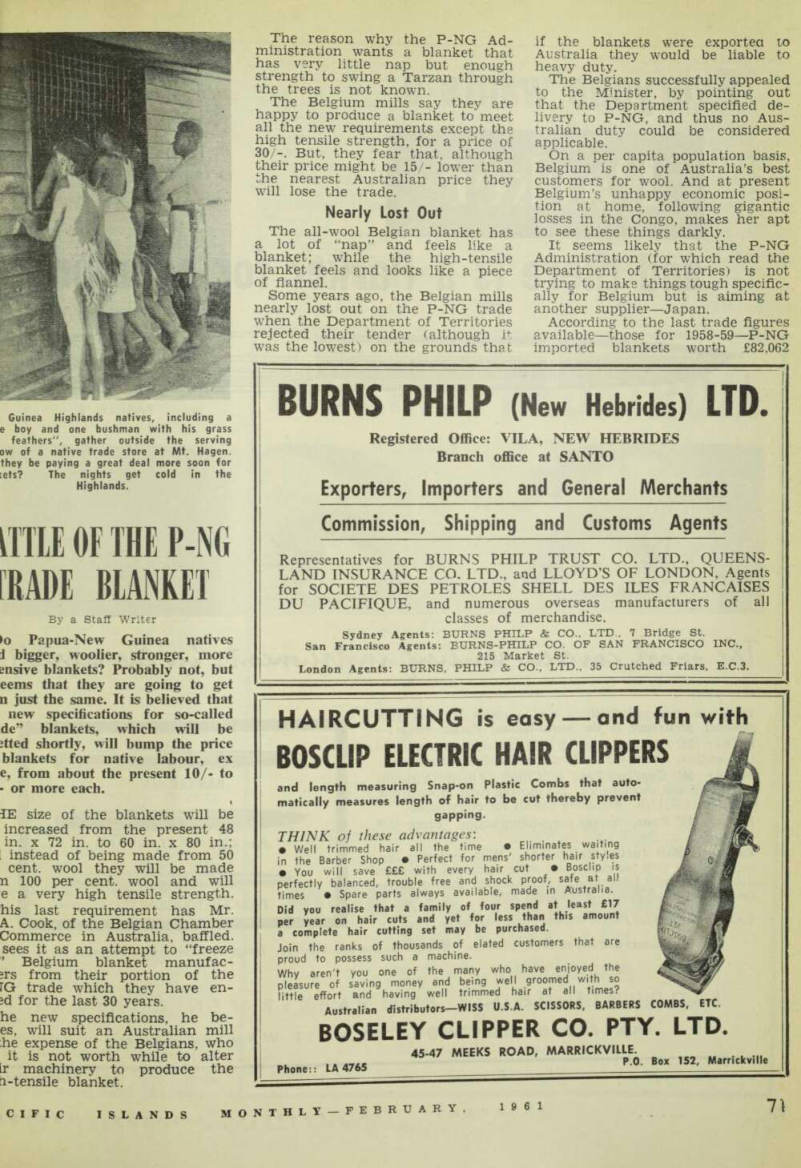
Guinea Highlands natives, including a [?] e boy and one bushman with his grass [?] feathers", gather outside the serving [?] ow of a native trade store at Mt. Hagen. [?] they be paying a great deal more soon for [?] ets? The nights get cold in the Highlands.
year. Of this amount Australia ibuted £36,333 worth; Belgium ; and Japan £33,836.
Blanket Values
1956-57, the total value of ets imported was £94,357, with alia having a £54,923 slice of ike, Belgium £6,435, and Japan, 0. In 1957-58, the total was 7, wit h Australia’s share 4, Belgium’s £5,935 and Japan’s 8. will be seen, therefore, that igh Belgium’s share of the has remained more or less mt over those three years, has encroached on Australia’s quite effectively, old “trade blanket”, com y issue to contract native ', hasn’t changed much in a of generations and seems illy to have filled the bill.
work conditions, their greatest use seems to be serape fashion, for misty or wet mornings, when the blanket’s drab colour blends beautifully with a dark skin and a doleful, dawn expression.
With normal use, and even without “high tensile strength” thev seemed to last out the first period of pre-war indenture or post-war contract.
Probably the new specifications were" that 1 things are getting better all the time, e?e g n for NG contract labour. ’
Prfr h 6W years ,- ag0 ’ remember, British seamen lived like pigs in
g g ’
Employers Meet Costs ** 1 „ The cost of better blankets will, °\ course ’ have to be met by em ployers, of whom the Administration 15 T tbe biggest in P-NG.
Latest figures show that 18,000 natives including police, were em- Pi 0 ?®?* by , the Administration, so that if each blanket is to cost 30/- Zme an added C ° St ° f
thSb»er
makes S he ,.S? mmOnWo i? ltl ? ?)n e n s n f . wlll P ay a bout of and 1 P-NG payers the rest.’ X "