ispossessed New Guinea Germans Were
pp. 67-71 · Read in the full issue
Worse Off Than Even They Knew
most of the white residents of Papua-New Guinea iy, the name of the Expropriation Board doesn’t mean a thing. ! yet 40 years ago it was an administering body in > Guinea which in some respects had greater powers than Administration itself. In this, the concluding of two ies specially written for ‘TIM”, Gordon Thomas — “Tolala” — Us some events of that early, unprecedented staking, which in many ways laid the dations for Australian tropical experience.
By Gordon Thomas
With between 250 and 300 German plantations to be brought under Expro Board control at the end of World War I, plus all the assets of the big German trading com panies, and a team of mostly untried Australian ex-servicemen to do it the task that was still ahead of us in 1920 was not easy.
was not made any easier, in ne way, when in May, 1921, mstralian Civil Administration over the Government of New ea from the Australian military, had in turn taken it over from Germans. der the edicts of the newly ed Mandates Commission of league of Nations, native wel policy became the chief con ation. In this, the new Admin uon clashed with the Board, e main work was to safeguard lerman assets, and at the same put everything on an economic ere had been little trouble the Military Administrator ;adier-General Tom Griffiths) as a professional soldier, sciated the position, e new Civil Administrator was aer Brigadier-General, Evan Visdom, also a keen military but also a one-time politician astern Australia, and he arrived time when relations between Administration and Board were what tense, because of a hous jroblem.
i Board and Administration
e board’s staff in Rabaul was asing at an abnormal rate and nmodation was required; but j of the commercial bungalows occupied by Government ils and they took a dim view ;ing turfed out of their homes he sake of board employees, suggestion in the right quarter i South that the activities of board were being prejudiced ? to a house shortage, etc., etc., ;ht about an easing of the ion.
Yet at no time was there an open breach between those two Government concerns. The junior officers of both services mixed well in pub and club life and friendly rivalry
existed in the somewhat restricted sporting world, Tennis and cricket were only in their infancy in early ’2l; there was no cinema and very few motor cars;
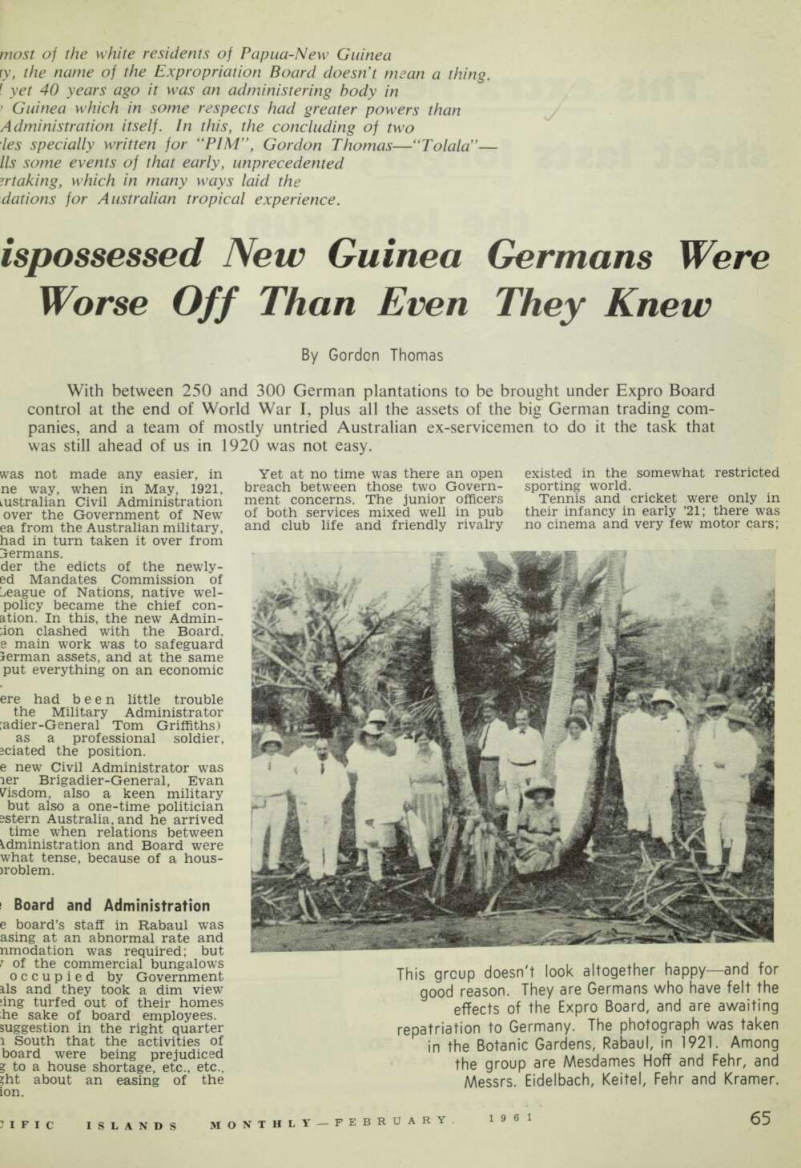
This group doesn't look altogether happy—and for good reason. They are Germans who have felt the effects of the Expro Board, and are awaiting repatriation to Germany. The photograph was taken in the Botanic Gardens, Rabaul, in 1921. Among the group are Mesdames Hoff and Fehr, and Messrs. Eidelbach, Keitel, Fehr and Kramer.
electric light, so the popular reation after office hours in aaul was a pub-crawl, or a visit the fan-tan schools in China n. >n official levels, relations were lewhat different, t one period when the board was iping the bottom of the financial rel to meet current commit its, owing to a hold-up of ship g and delay in payment for copra !S, the Administration presented account to the Board for some 3 of thousands of pounds. It rep mted unpaid rents and licence ; on trading stations throughout Territory which had been nmulating for years. But pay it had to be made forthwith— ;lse! hese trading stations represented man assets that must be pre yed, so the board was in a spot, uddenly, someone had a brain e and remembered that the NDL irf in Rabaul had been re asoned by the military in 1914 so much a day (I forget the )unt but it was certainly not nuts) and nothing had ever been i! he contra account tendered by board far exceeded that re ed from the Administration, it round went to the Board! is not surprising that the ne Minister’s Department gave a pathetic ear to the board’s de ids in the early days of its rations. he expropriation and repatria of the German residents eared to be of more importance a the routine task of governing old-time German colony, whose ient economy and future de pment was practically in the ds of the board, ative welfare was not a high rity in those early days of the gue of Nations before it was )erly functioning and while still bling around for policies and ex ;s to enforce the ideals that r on underlined the needs of the ve peoples.
RSA Is Formed ith the increased arrival of 'd staff—all of them returned iers—it was only natural a ich of the Returned Soldiers’ jciation (as it was then called) ild be formed, and this was done i rally in early 1921, with Fred ey as president, and F. V. nders as secretary. I forget the :r officers, but I do remember ; “Nobby” Clark and Jack Gil e were amongst them, and I appointed publicity officer, t the initial meeting a big wail recorded from the married men mse they were not permitted to g their wives to the Territory. :om the very first the board had alated that its employees could be accompanied by their wives. 3 was a characteristic edict of as, the chairman.
TcP^ in f years he had been Island Inspector for Burns, Philp he never tolerated married men havl™.lves. lves plantations.
They would spend too much time, he claimed, in the bungalows and Vh g p iV SiJ?t 6 ifi^ ndiVided attention 10 me plantation. .
Very Vocal
Pinf . But the selected staff of BP plantations was slightly different to a. hundred or so Dissrers for
“ «Teen°= fflS
The RSA meeting was very vocal on this point and, as publicity officer, I was instructed to get busy
and start an agitation for the policy to be revised.
I did so by sending a report of the meeting, in suitable language, to the association’s official organ in Sydney.
This apparently caught the eye of the p r i me Minister, the inimitable “Billy” Hughes, who immediately put machinery into operation— much to the disgust of Lucas.
T , h J dld re i lor . t ' but I encountered its 3-fter-effects
&&,%SStfSS ffi
***%“&& .“gfS&S
showed, without doubt, that the campaign of the Diggers had been successful. Later, in 1921, many im
patient couples were re-united and the RSA felt it had had its first victory over autocratic bureaucracy.
Appeals By Germans
Bv the beeinnine of 1922 th P Board had less properly organised. It had taken over the big stores in Rabaul and in the outports; many of the German planters and their families had arrived in Rabaul where they were domiciled for the most part in the local hotels, receiving sustenance.
Other Germans had filed appeals against their expropriation and their cases were listed for hearing by a Special Tribunal, appointed for that purpose.
Protests were lodged by the Germans against various edicts of the Australian Government, amongst
them the price to be paid for a full bearing coconut palm on the estates as taken over by the board; the amount of the sustenance ’ paid whilst awaiting transportation to Gei ™£iny and the value of the per-
Sermlnv' 1^
a full was
eventually nrif-d2? ifi/m YbP
Snance at £1 a da and the value of personal possessions^other
than clothing wa<f Sri
m Clotnmg) was fixed at £25.
XA . t r Worse lo Come Appeal cases lasted for months, Tension was rife in many cases. It is not to be wondered at if in some cases open hostility was not ex pressed towards the board by these de-possessed old German settlers Unfortunately for them the worst
was to come—of which they hai no premonition.
But history records that whe: they arrived in Germany, armei with their lists of assets to be col lected from the German Govern ment, which had been credited fo these assets on a gold basis in th Reparations Account, these one time plantation owners were com pensated by their own Govemmen in the current paper money whic' had become so inflated that it re quired millions of marks to purchas a packet of cigarettes!
I heard of one repatriated plante who stated the proceeds from hi plantation had provided him wit] a good dinner—without oountini the wine!
Some of the appeal cases wer successful. The map of Europe hai been changed. Persons who ha been staunch Germans (even hold ing Government positions) sudden! realised they were Poles or Czecho Slovaks and as such were not classei as ex-enemy nationals.
Getting Into Stride
By the middle of 1923 the boan had become bureaucraticall; stream-lined, and the paper war wa in full swing.
Systems, which at the start hai been somewhat slap-happy, hai been tightened up.
The headquarters of the board i] Rabaul now occupied the first floo of the big New Guinea Compan' store building, which in late' years became W. R. Carpenter’ store (and was burned down in th middle ’Thirties although their pre sent store occupies the same site) Here were assembled an army o desks, filing cabinets and typists fo the half-dozen odd sections of th board’s activities: the executivi officers in private cubicles, whili outside were ranged the paper littered desks of the various sections accounts, stores, plantations, ship ping and insurance.
In separate buildings nearby wen the workshops, medical and nativi labour sections.
All the time, data was being col lated for statistics and the compila tion of catalogues for the eventua sale by tender of the properties.
Parenthetically, let me add, thai at one period Lever Brothers toyec with the idea of making a bid fo] all the properties en bloc, and I was deputed to accompany George Fulton, their Island Inspector, tc “have a look” at plantations in the Kavieng and Witu areas. For vari ous reasons the deal fell through.] Tenders Called For The first tenders were called for in 1926 when certain township allotments and plantations were offered.
Every encouragement was given the ex-servicemen to tender; special terms were laid down for them, and the Big Firms showed a decided
ingness to finance those re led men who were known to n, and had had plantation ex ence. onsequently many one-time rd employees now became ters —in name at least—of pro ves they had previously been laging. And some of them have e well as a result of their early rd experience, plus careful man nent and business acumen, here come to mind such names Dyson Hore-Lacy, Harold Cold 1, Jock Mac Lean, Fred Archer, bur Cresswell, Bill Middleton, ny” Edgell, Norman Whiteley, MacGregor, Claude Rouse, k Gilmore and there must be srs whom my ageing memory not recall off-hand, nd then there are those whom Japs took away on their last age in the Montevideo Maru; old rd hands, some established, srs working towards that end: L. (“Nobby”) Clark, who had a O/C Workshops and later be le a member of the Legislative incil and president of the State SAILA; Dick Moore, “Birdie” on, Tom Garrett, Noel O’Dwyer, 7 Allen, Col McKellar, Frank [nders, Bill Box, Latham Hamil , Lou Carson and others.
Changes In the Board <y the time the first properties e put up for tender there had n many changes in the board’s sonnel. ucas, as chairman; Jolley, as his >uty, and Cliff Judd, as business nager, had all resigned. J. T. ner, as finance member, had ided over his duties (and was
later to become Public Service Com missioner in Canberra).
Colonel Peck occupied the box seat as chairman for some time, to be succeeded later by J. C. Archer (O/C Auditors at one time) as custodian. “Clarrie” Archer is now Administrator of the Northern Ter ritory. Edwin McCarthy, who was also chief of the Knights of the Green Ink (Auditors) for a while is now a Knight in the true sense of the word, and Australia’s Am bassador at The Hague.
Many of those old board person alities have gone to their long rest now: Lucas, Jolley, Pinner, Judd and Peck. A. V. Chisholm, for some years board secretary and later one of the Big Six at Edie Creek gold fields, has also passed on.
In Retrospect
And now ... 40 years after the board was first created there re mains one lone personality in Rabaul that handles the reins of the one-time flourishing organisa tion—Arthur Richards, who started his board career as manager of Arawa plantation down in Bougain ville in the early days of 1921.
“Richie” has seen many changes.
Looking back, after all these years, one cannot but realise what a stupendous and unprecedented task the board was faced with in the early days of its formation: the in ternational legal technicalities, the domestic sociological problems and the economical structure.
There were no precedents to act as guidance for the formation of policy; replacement for the experi enced German executives, planters skippers and storemen were con fined to Australian ex-servicemen, most of whom had had no tropical experience, nor knowledge of hand ling native labour; and, beneath the surface—sometimes not too thinly veiled—there was an antagonism to this new regime, this post-war Government instrument organised to deprive the old Colonial Germans of the assets which they had built up through hard work for many years.
But these same Diggers made good, and I do not think any other race of men could have accom plished the same task with the same success.
Admittedly mistakes were made; there was vacillation on a political level at times; there was bureau cratic arrogance to hide official ignorance and, amongst the em ployees, there was the occasional “dud” whose dishonesty was dis covered and the “necessary action taken”.
But, by and large, they were a good mob who did a good job.
Their memorial stands in coconut plantations throughout the Terri tory, whose production was main tained during that difficult transi tion period when the Aussie Digger proved the value of his natural adaptability and initiative.
Headquarters of the old Expro Board with all its ramifications was on the first floor of this building, which had formerly been owned by the New Guinea Company, and which later was W. R. Carpenter's store.
At left is Brigadier-General Wisdom, a keen military man who nevertheless gave the Board some headaches when he took over from the military occupation as Civil Administrator in NG.