They're Searching
p. 37 · Read in the full issue
For Shells
rom a Special Correspondent most people, sea shell col g is a pleasant and a not
ions hobby which serves
>mbat island boredom or
f the universal yen to collect
iful objects.
to a group of American sts in Philadelphia, the study e marine mollusks of the il Pacific is an important, ange research project to in man’s knowledge of oceano 7, marine geology and oceanic es. e 1839, when the famous list, Titian Peale, began ex ? the Pacific for marine shells, :ademy of Natural Sciences of elphia has been specialising ; study and classification of ’ a period of 149 years, ny scientists have described new species of shells and 3d a research collection of 5 million specimens. 955, a special research pro le was begun under the joint es of the Natural Science ation of Philadelphia, ling the effort to survey and raph the marine shells of the and Pacific Oceans is Dr. R. • Abbott, conchologist on the ny staff. ributing scientists include utstanding men as Dr. A. W.
Powell, of the Auckland In and Museum, Dr. William
J. Clench, of Harvard University.
Dr. Harald A. Rehder, of the Smithsonian Institution, and Dr.
Tadashige Habe, of Japan. \
Fifteen Expeditions
Fifteen expeditions have been undertaken in the last six years, usually in co-operation with local fisheries and biological stations, to such places as the Palau Islands, Dutch New Guinea, New Caledonia, Western Samoa, Zanzibar and Madagascar.
Other expeditions are planned for such conchologically little-known places as the Marquesas, Tonga, Cook Islands, Borneo, Andaman Islands, Seychelles, and the Red Sea.
Specimens of even the common sea shells are greatly needed from many other areas to facilitate the research work.
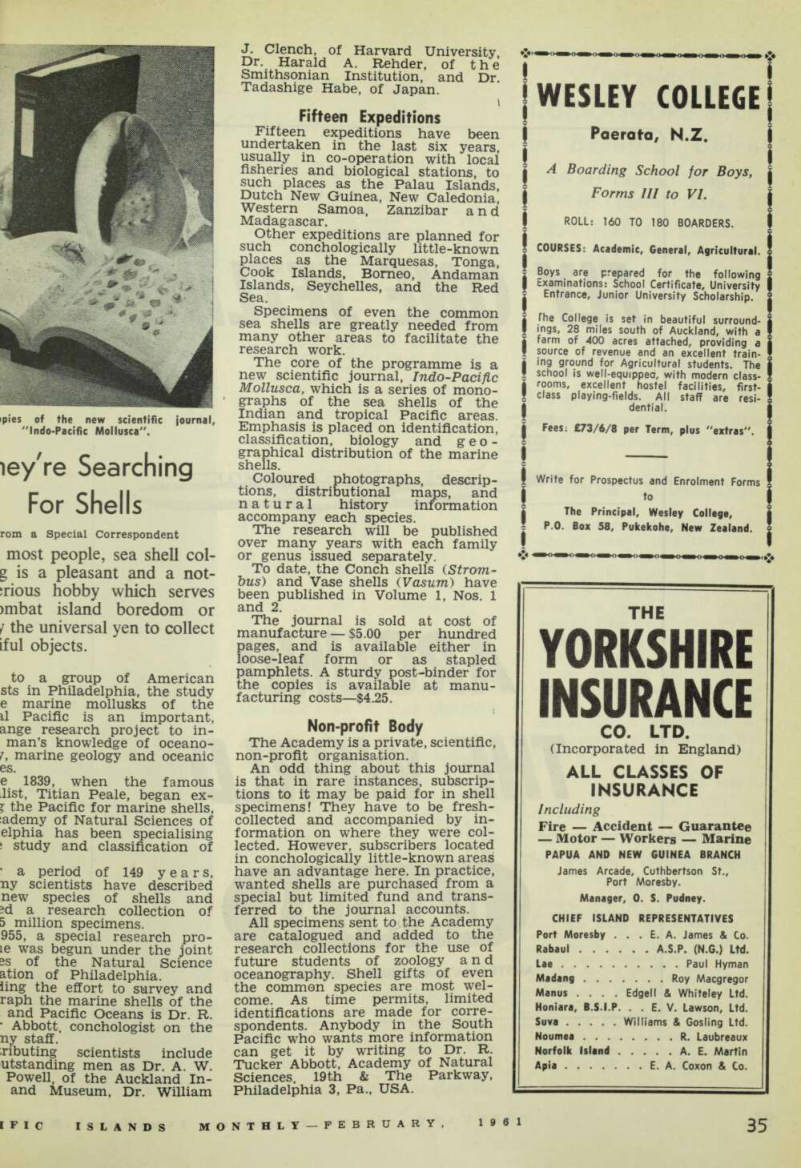
The core of the programme is a new scientific journal, Indo-Pacific Mollusca, which is a series of mono graphs of the sea shells of the Indian and tropical Pacific areas.
Emphasis is placed on identification, classification, biology and geo graphical distribution of the marine shells.
Coloured photographs, descrip tions, distributional maps, and natural history information accompany each species.
The research will be published over many years with each family or genus issued separately.
To date, the Conch shells (Strom bus) and Vase shells ( Vasum ) have been published in Volume 1, Nos. 1 and 2.
The journal is sold at cost of manufacture —55.00 per hundred pages, and is available either in loose-leaf form or as stapled pamphlets. A sturdy post-binder for the copies is available at manu facturing costs—s4.2s.
Non-profit Body
The Academy is a private, scientific, non-profit organisation.
An odd thing about this journal is that in rare instances, subscrip tions to it may be paid for in shell specimens! They have to be fresh collected and accompanied by in formation on where they were col lected. However, subscribers located in conchologically little-known areas have an advantage here. In practice, wanted shells are purchased from a special but limited fund and trans ferred to the journal accounts.
All specimens sent to the Academy are catalogued and added to the research collections for the use of future students of zoology and oceanography. Shell gifts of even the common species are most wel come. As time permits, limited identifications are made for corre spondents. Anybody in the South Pacific who wants more information can get it by writing to Dr. R.
Tucker Abbott, Academy of Natural Sciences, 19th & The Parkway, Philadelphia 3, Pa., USA.
[?] pies of the new scientific journal, "Indo-Pacific Mollusca".