The Editors' Mailbag
pp. 28-29 · Read in the full issue
No Nuts on
The Coconuts
There comes a time (or so it seems) when we’ve all got to make sacrifices for Art, but some make them more reluctantly than others.
During the month we received this broadside from Lema Low, now of Norfolk Island, once of Fiji and Pago Pago: “I could not believe my eyes when we opened the PIM and the new cover appeared! And I can assure you that it will be a long time be fore we become accustomed to the change. We loved the old cover, with the two graceful palms, lovingly en twined, and the row of palms in the background. The two skimpy little palms on the new cover haven’t even got any coconuts on them! Even the little wide-eyed girl on the De cember cover (she looks like a Rotu man) seems rather scared of what the postman will bring!”
Well, there’s some who liked it and some who didn’t—and amongst the latter you can count a number of people in this office.
If it makes Mrs. Low feel any better, we can assure her that the instructions that went to the artist were that he should reproduce, in miniature, in the left, top corner of the new cover, an exact replica of the old “lovingly entwined” coco nut trees.
We don’t pretend to know what does on in an artist’s mind, but what came back in that top, left hand corner was two stiff, white weeds. Repeated return trips to the artist at least induced the palms to entwine, to have leaves on their
fronds, and segments in their sten More we couldn’t do, and aft taking expert opinion, we have be convinced that no one, with val reason, could expect an artist’s ir pression of a coconut palm to lo like a coconut palm—and that t. white weeds on PI M’s cover real are 1961 coconuts, if you tell you self often enough that they are. (1 wonder copra has come down wi such a thud).
We hate to think what’s going happen this month when Mrs. 1a opens her PIM and finds that t whole thing has turned blue. I revolutionary, of course, and may even horrible, but no one can s that we haven’t noticed these “win of change” blowing over the Pacif or aren’t even trying to keep i with the Joneses.
No PArt's in
The Family
In a short, five-line letter, IV Richard Seddon, Executive Offic for Social Development, Soul Pacific Commission, Noumea, poir out that he is not a descendant the late “Dick” Seddon, one-tir Prime Minister of New Zealand.
The only thing that the late Di and the present Richard have common is that New Zealand w the birthplace of both.
In January PIM, in commenti] on the reappointment of Mr. Seddi to the SPC for a further five yea: we said that he was a grandson the once-famous Dick. It was just misplaced, editorial association ideas, for which we now apologise,
The Coastwatcher Mixture
As Before
The Reader’s Digest, Febnia issue of the Australian editio repeats its old story by John Hers that it published back in 1944 (fro the New Yorker) about Lieutena John Kennedy and his PT bo that was run down by a Ji destroyer.
Not a line of it had been alter from the original; the san mysterious, non-existent Lt. Winco of the New Zealand Army is sa to have rescued him—which mig] teach Australia’s Mr. Reg Evar now of Sydney, who really did tl rescue job, not to be so silent : future.
PIM gave the full story of tl rescue of the man who is no President Kennedy in the Janua issue. The subject had been kick( around, and various clues offere in every issue of PIM from la October on. The hare was original
running in October by PlM’s dand man, J. P. Shortall. ; the end of the article in the ;ralian edition of the February lex’s Digest there is a small note to say that “as this issue i to press” the Sydney Daily graph discovered a Mr, Reg is who “claims” to have been one to have rescued Lieutenant nedy. ho sent a canoe for Lieutenant nedy isn’t any longer in doubt; “discovered” Mr. Reg Evans is trendy another matter, •mmander Eric Feldt, of the itwatchers, told PIM in Novem (p. 27) that Reg Evans was the ted man, and in the same th Mr. Evans contacted us. was weeks before the Daily graph had anything to say on matter. cidentally in early February, Australian representative of Christian Science Monitor, on, contacted PIM for a follow ■tory on Mr. Evans, as he did hink Evans’ account was known merica. me magazine of February 10, that on the new President’s in the White House there is coconut shell on which Navy t. Jack Kennedy had scratched a age asking for rescue after his iiad been rammed,” etc. Evans ’t say anything about a coconut note, but if there was one, it s that Kennedy had a pretty sense of history, even then, if jmembered to get it back during ew hours he subsequently spent Evans at the latter’s post, banker member of a group of rican businessmen currently ng Australia appeared on a iey TV station the other night ing a “Kennedy pin”—part of lesign of which is a PT boat. So, way and another it seems that, ►ugh President Kennedy might forgotten who sent that canoe him, he certainly hasn’t for m the incident.
vard, Democracy!
r hat’s all this blurb from Radio ralia about Queen Malietoa of «rn Samoa visiting Sydney,”
writes an irate New Zealander. “Is she calling herself queen these days —and if so, of what? Or is it just another sample of Radio Australia ABC ignorance of the Islands? In matters of pronunciation of well known Islands place-names they put over the most awful blues. The ‘Queen’ touch sounds like the Syd ney Sundays papers—and they’ll all have Queen Salote of Tonga on their backs if they don’t watch out.”
Our trans-Tasman friend will be pleased to note that the wife of High Chief Malietoa was down on the list of delegates to the Pan Pacific Women’s Conference in Canberra as just plain “Mrs”. The ABC (which, in spite of what he says, usually knows better), the other radio and TV stations and the newspapers were, however, all in full cry after the “Queen” of Western Samoa. One or two of them perhaps got it right—one paper in fact did print a firm disclaimer from an embarrassed Mrs. Malietoa that she was a “Queen”, However, although Australians are supposed to hate pretentious ness worse than sin, they are all suckers for royal titles. No Islander ever appears in print here below the rank of “Princess”, and it is only fair to say that if the wives of West Samoa’s other two High Chiefs had come to Australia, they also would have been promoted, and, without fear or favour, called Queen Tamasese and Queen Mataafa.
Ownership of
Casandy Estate
Mr. A. Andy Andersen, of Casandy Estate, Goroka, New Guinea, writes: In your January issue, you have an article (“Petition to Wind up NG Coffee Enterprise”, page 45), which mentions my name and my estate in connection with a pro moter, namely, Mr. Frank Austin O’Sullivan.
I should like to make it clear that I had my property up for sale and that Mr. O’Sullivan merely took an option on the place to buy it. I have no other connection with Mr.
O’Sullivan or the defunct New Guinea Coffee Estates Ltd.
At the time he purchased the option, he told me he was the leader of a large organisation in London which was liquidating its holdings there in order to buy up large coffee plantations here in New Guinea. In the option paper, he gave me his address as 341 Queen Street, Bris bane. Later, when I wrote to him, protesting about certain advertising in the Sunday Telegraph, the letter was returned to me marked, “not known”.
Last June, while I was in Sydney, I consulted a solicitor, but we could not locate Mr. O’Sullivan.
I request that you make it known that Casandy Estate is a legitimate plantation producing coffee and is in no way to be construed as being part of New Guinea Coffee Estates Ltd.
Have You Seen Any
I. molucca Lately?
Mrs. Eva Standen, who with her husband Harrie, has completed 25 years now at the Bamu River Mission (“The Mission in the Mud”) in Western Papua, tells us that a couple of months ago a local native shot an Ibis with a Commonwealth Scientific and Industrial Research Organisation tag on its leg.
They returned the tag to the CSIRO, and received an enthusiastic reply, although it has been the second band returned to them from those parts within a month.
CSIRO scientists say that the Bamu River bird and the other (from Kukipi), reveal hitherto un suspected movements of species that breed in Australia. This particular White Ibis ranges from the Moluccas through New Guinea to Australia (except the SW of WA and Tas mania) . The bird itself is closely related, if not identical, with the Sacred Ibis of Egypt—T. aethiopica. (The one found in the Bamu River areas is called Threskiornis molucca) .
The Bamu bird was shot in No vember —one year and 11 months after it was banded as a nestling at Reedy Lake, Kerang, Victoria.
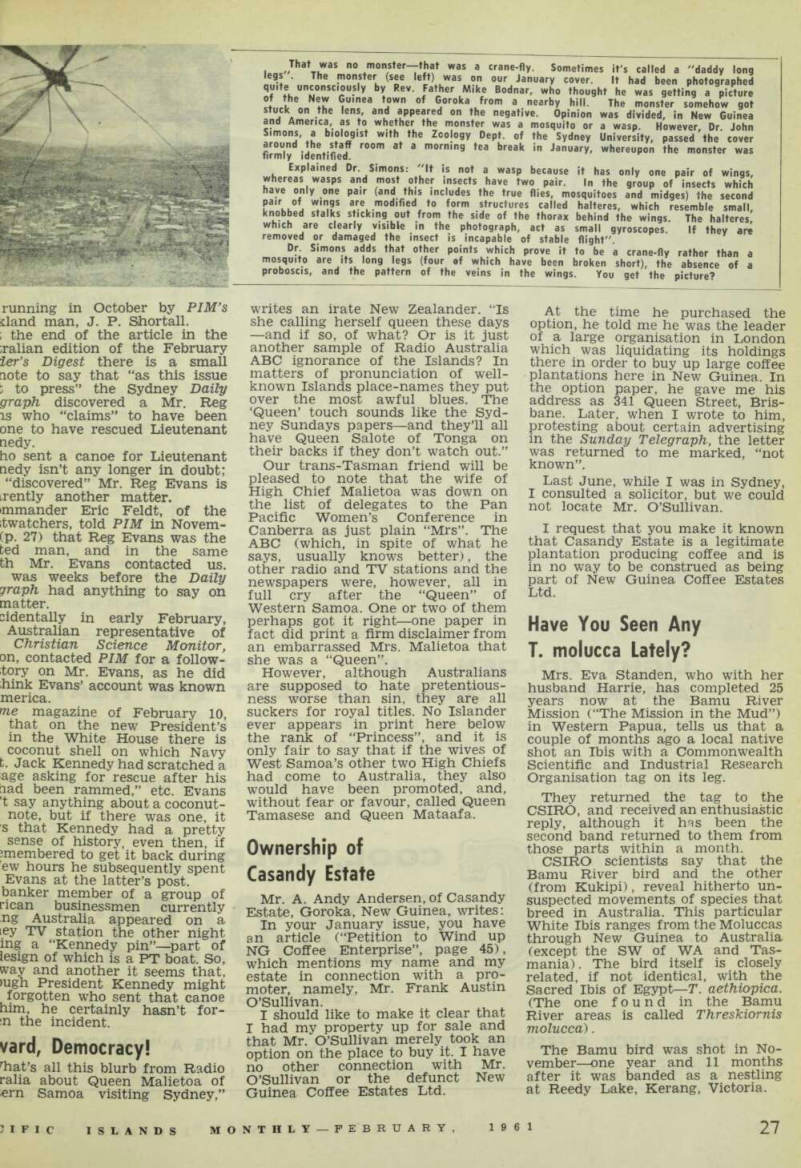
That was no monster—that was a crane-fly. Sometimes it's called a "daddy long legs". The monster (see left) was on our January cover. It had been photographed quite unconsciously by Rev. Father Mike Bodnar, who thought he was getting a picture of the New Guinea town of Goroka from a nearby hill. The monster somehow got stuck on the lens and appeared on the negative. Opinion was divided, in New Guinea and America, as to whether the monster was a mosquito or a wasp. However. Dr John Simons, a biologist with the Zoology Dept, of the Sydney University, passed the cover around the staff room at a moring tea break in Januar y, whereupon the monster was firmly identified.
Explained Dr. Simons: "It is not a wasp because it has only one pair of wings, whereas wasps and most other insects have two pair. In the group of insects which have only one pair (and this includes the true flies, mosquitoes and midges) the second pair of wings are modified to form structures called halteres, which resemble small, knobbed stalks sticking out from the side of the thorax behind the wings. The halteres which are clearly visible in the photograph, act as small gyroscopes. If they are removed or damaged the insect is incapable of stable flight".
Dr. Simons adds that other points which prove it to be a crane-fly rather than a mosquito are its long legs (four of which have been broken short), the absence of a proboscis, and the pattern of the veins in the wings. You get the picture?