Commentary
pp. 27-28 · Read in the full issue
stralia Must Get
c The Fence
I Australian economist, Sir Douglas Copland, proposed in January that Australia and the lerlands should get together and i the whole island of New lea over to the UN as one trust tory. ; said Australia and the Nether s would have joint responsibility the trust, together with two r trustees from South East , who would be nominated by UN. le proposal wasn’t received with h interest, which is not surpris anybody really believes that two ;rs working together can help Imitive country to progress they Id go and take a long look at New Hebrides, where 50 years Condominium system haven’t sved anything. tiat four countries, plus the e of UN, would do with a ical hotspot like the two New leas is too horrible even to con date. is true that the Dutch will be >y to get their share of New tea off their hands. And it is true that, when the time comes, ralia has every intention of get rid of hers. ,t by “getting rid of”, neither try means “throwing away”, ey can’t throw their territories % for they are already too ly committed. e political developments which have sponsored there these last months now make it impossible :hem to do anything else but . up their territories and hand . back to the natives, e time has passed when either on of the big island can be ed over to anybody else with he natives being consulted. And . the vocal members of the e population would ask for in new Councils is “independ ’, despite the unhappy fact not one of them at the moment any idea of the meaning of vord. t that’s the way of the world, e only doubtful quantity in the Guinea question today is In sia. e insists she wants Dutch New ea. The only way to get it ti is now left open to her is ?ht for it. is would be utter stupidity, but mid hardly be the first time dity had started a war, and Russia’s help, Indonesia is ibly stupid enough to try it. lat the Australian Government
has got to do now—what it should have done at least 12 months ago when behind-the-scenes diplomatic pressure began to be applied with some force by the Dutch—is declare where it stands so Indonesia is left in no doubt. • Australia should publicly sub scribe to the Dutch viewpoint that the present co-operation between P-NG and NNG in the adminis trative field should be widened to a full-fledged, financial, economic and military co-operation. • Australia should make perfectly clear internationally whether it will or will not militarily back the Dutch if their position in NNG is attacked by a third party, • Australia should make it per fectly clear within Australia what the guiding principles for the future are to be, so that there will be no misunderstanding among political parties, trade unions and the public generally on where Australia stands. ☆ ☆ ☆
After the Danube and
Taj Mahal—What?
SOMETHING like a crystal ball with built-in electronic com puter would be a help in cal culating the number of tourists who are, at any given time, drift ing about other people’s countries, spending money.
But people and organisations do make calculations along these lines and one of the answers to one of the questions is that 50,000,000 people became tourists at some time during 1959.
In a world population of 2,000 million, that is one in 40 people, which still leaves room for improve ment, particularly in the Pacific.
The European tourist is a poor bet as a potential Pacific customer, his lust for foreign travel being easily satisfied by crossing the nearest frontier or the English Channel.
It is on America that most Pacific tourist hopes turn, and the Americans have always had Hawaii and the West Indies—so much easier to get to, so much better equipped. But there must be a good time coming, and not only from the direction of America.
A large proportion of those 50 million tourists are persistent globe trotters not just “once only” types, and having done the sights and cathedrals of Europe; the temples of Bangkok; seen the Taj Mahal by moonlight; the midnight sun from North Cape; the Danube when it’s blue; taken in the winter sports at St. Moritz; cine-shot lions in Africa —what is there left?
The Pacific.
What are we doing about it?
Scattered through this issue of PIM there are descriptions of numerous embryo tourist schemes, most of them still in the talking stage. Whether they blossom and bear fruit depends on the amount of effort behind them from there on.
Fiji, fortunately placed at a Pacific crossroads, has her tourist industry well in hand. Tahiti is getting into the same happy position. New Caledonia has done a lot of organisational work but hasn’t developed any great tourist trade, yet.
Papua-New Guinea has indulged in a great deal of wishful thinking about a tourist industry and done least of all about it; and now little
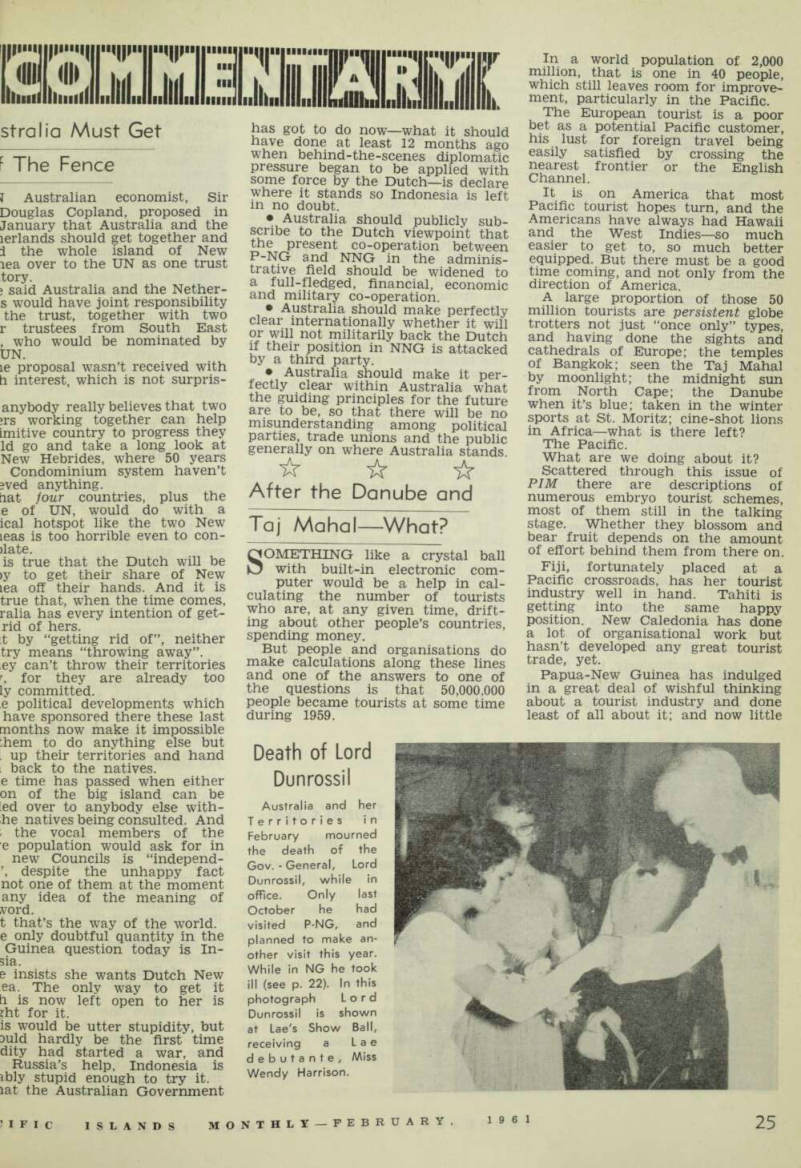
Death of Lord
Dunrossil
Australia and her Territories in February mourned the death of the Gov. - General, Lord Dunrossil, while in office. Only last October he had visited P-NG, and planned to make an other visit this year.
While in NG he took ill (see p. 22). In this
photograph Lord
Dunrossil is shown at Lae's Show Ball, receiving a Lae debutante, Miss Wendy Harrison.
New Hebrides, is also bent in getting into the picture and has set the wheels turning.
Four months ago, a tourist as sociation was formed in Port Moresby, but little more seems to have been done in organisation, as yet. They are talking tourist hotels there too, but so far without any hard, cash backing.
The New Hebrides, on the other hand, which is in some respects, the most unlikely of tourist centres, already has its hotel site picked, £50,000 in hand and some very forward-looking plans, including a gambling casino.
The development of a tourist in dustry needs much private and public capital and faith, and above all, some idea of where the country itself is going. Possibly P-NG’s off-and-on thoughts about tourism can be attributed to the fact that a lot of its European residents are doubtful where the Territory is going.
But whatever any Territory, any where, does about it, there is one sure thing—the growth of travel and tourism will continue to be one of the phenomena of the post-war world.
It was for this reason that PIM began, experimentally, a travel sec tion in January. It is designed as a two-way service—to help sell Pacific tourism to our readers in America, Australasia and elsewhere; and to tell our Pacific readers, who are the most frequent and ac complished holiday-takers in the world, about some of the avenues now open to them abroad.
We hope, particularly, that Pacific territories which are interested in developing a tourist industry, will take advantage of this new section.
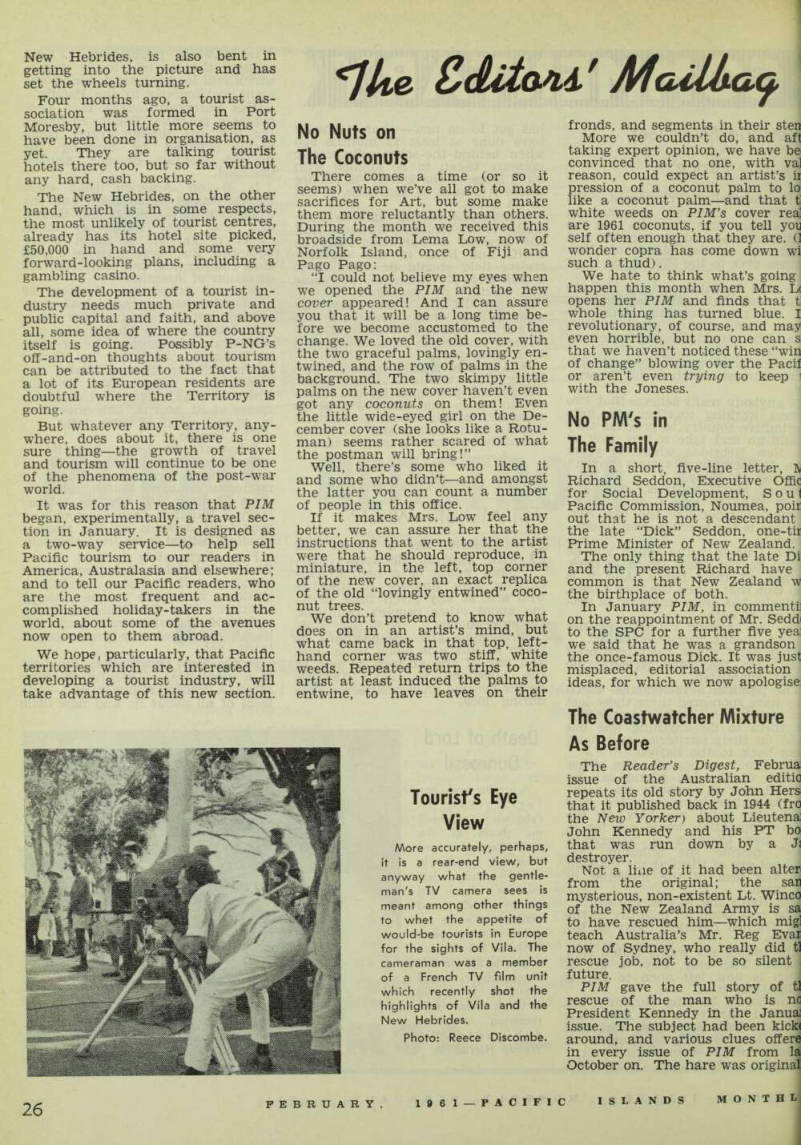
Tourist's Eye
View
More accurately, perhaps, it is a rear-end view, but anyway what the gentle man's TV camera sees is meant among other things to whet the appetite of would-be tourists in Europe for the sights of Vila. The cameraman was a member of a French TV film unit which recently shot the highlights of Vila and the New Hebrides.
Photo: Reece Discombe.