Did A Ghost Ship
pp. 35-37 · Read in the full issue
Sail From Here ?
By a Staff Writer
A passage from Bishop Leo Scharmach’s book (This Crowd Beats Us All), to which the Rev. A. H. Voyce refers in his letter published on this page is the first time that any serious doubt has been cast on the fate of the civilian internees of Rabaul, and the soldiers from the Rabaul garrison in total, about 1,000 persons. However, at various periods since the war, rumours have circulated that there was in effect “no Montevideo Maru”.
AMASS grave was discovered on Matupi in recent years, with the relics the Bishop describes, but there was no suggestion that this grave could have contained anything like 1,000 bodies. Which
ever way you look at it, and even taking into consideration the Jap anese talent in this direction, 1,000 bodies would not be so easily dis posed of, even if the victims dug their own grave and were machine gunned into it. It is % unlikely that such slaughter would have escaped everyone. Someone, native or other wise, would have spread the news.
Mr. Gordon Thomas, who was one of the only half-dozen Rabaul residents to survive in Rabaul, strongly discounts the idea that the men were not shipped away or that they were killed at Matupi.
He says the grave at Matupi held about 30 bodies; shortly after he was released from the Japs and was down in Australia, he was sent a detailed description of the remains by the Australian Government. From the description, he was not able to identify any as being those of men who were supposed to have been shipped away on the Monte video Maru. The watch that was found he identified as belonging to a man who was never in the Montevideo Maru contingent.
He was under close guard in Rabaul himself at the time the ship is said to have sailed and did not witness it himself; but after he was
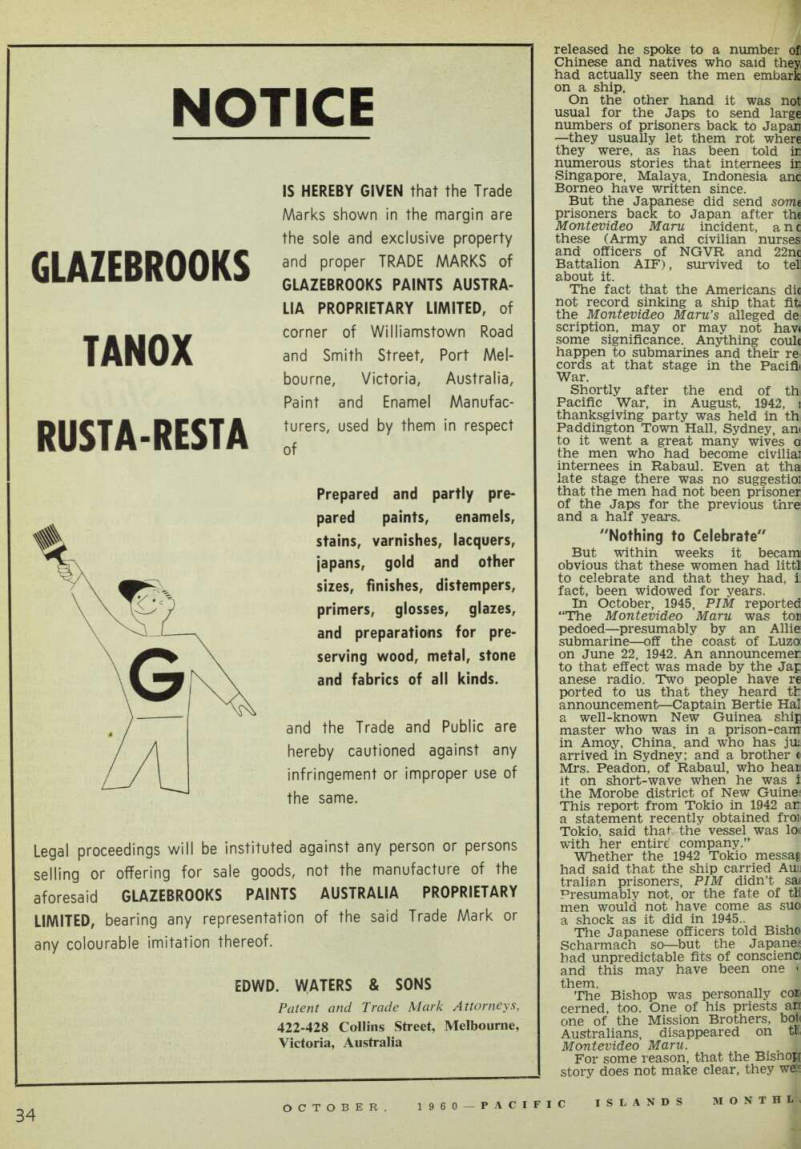
Was there a plaque of this memorial stone to the prisoners on the "Montevideo Maru?" This is how the stone looked in September. If there was a plaque, where is it, and what did it say?
Photo: M. R. Hayes.
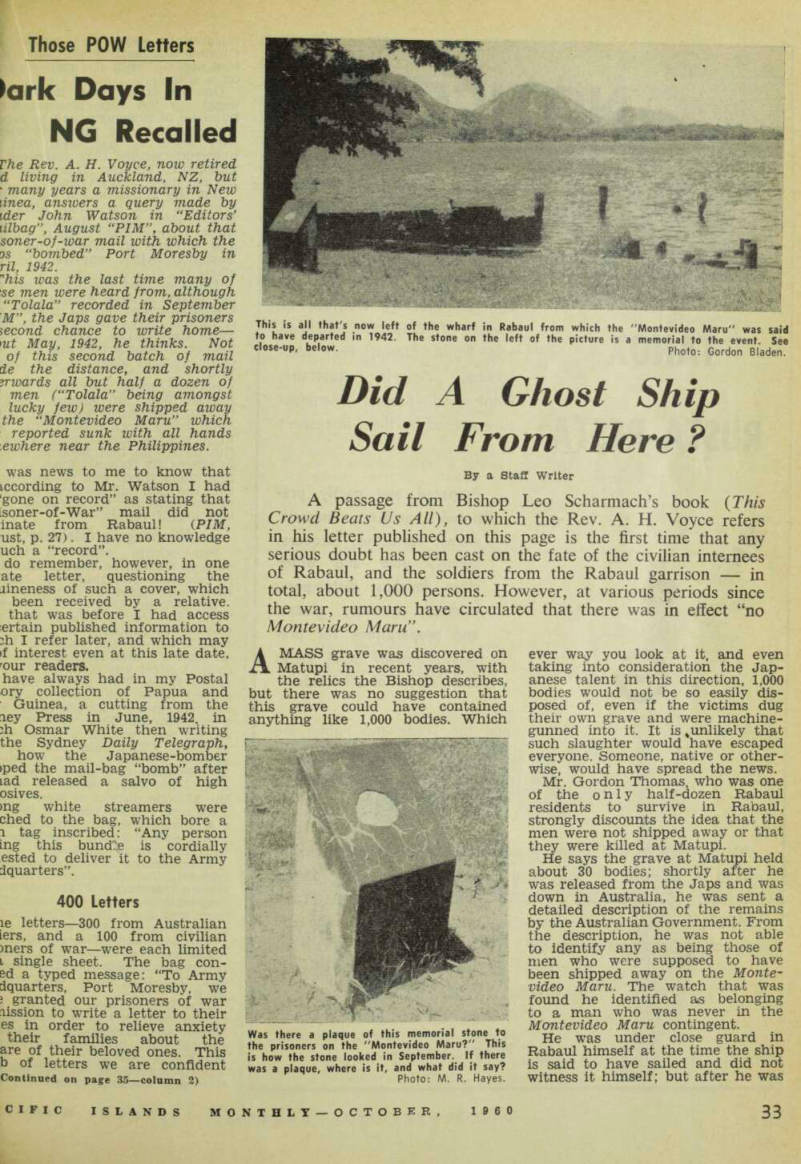
This is all that's now left of the wharf in Rabaul from which the "Montevideo Maru" was said to have departed in 1942. The stone on the left of the picture is a memorial to the event. See close-up, below. Photo: Gordon Bladen
released he spoke to a number of Chinese and natives who said they, had actually seen the men embark on a ship.
On the other hand it was not usual for the Japs to send large numbers of prisoners back to Japan —they usually let them rot where they were, as has been told ir numerous stories that internees ir Singapore, Malaya. Indonesia anc Borneo have written since.
But the Japanese did send some prisoners back to Japan after the Montevideo Maru incident, anc these (Army and civilian nurses; and officers of NGVR and 22nc Battalion AIF), survived to tell about it.
The fact that the Americans die not record sinking a ship that fit the Montevideo Maru’s alleged de scription, may or may not haw some significance. Anything coule happen to submarines and their re* cords at that stage in the Pacific War, Shortly after the end of th.
Pacific War, in August, 1942, i thanksgiving party was held in th.
Paddington Town Hall, Sydney, am to it went a great many wives a the men who had become civiliai internees in Rabaul. Even at tha late stage there was no suggestioi that the men had not been prisoner of the Japs for the previous thre and a half years.
"Nothing to Celebrate"
But within weeks it becami obvious that these women had littl to celebrate and that they had, ii fact, been widowed for years.
In October, 1945, PIM reported “The Montevideo Maru was ton pedoed—presumably by an Allies submarine —off the coast of Luzot on June 22, 1942. An announcemer to that effect was made by the Jap anese radio. Two people have re ported to us that they heard th announcement—Captain Bertie Hal a well-known New Guinea ship master who was in a prison-cam in Amoy, China, and who has juu arrived in Sydney: and a brother « Mrs. Peadon, of Rabaul, who hear it on short-wave when he was i the Morobe district of New Guine* This report from Tokio in 1942 an a statement recently obtained fron Tokio, said that the vessel was lo* with her entire company.”
Whether the 1942 Tokio messag had said that the ship carried Aujj tralian prisoners, PIM didn’t sat Presumably not, or the fate of til men would not have come as suo a shock as it did in 1945..
The Japanese officers told Bisho Scharmach so —but the Japane* had unpredictable fits of conscieno and this may have been one < them.
The Bishop was personally cofi cerned, too. One of his priests an one of the Mission Brothers, foot< Australians, disappeared on tK; Montevideo Maru.
For some reason, that the Bishop story does not make clear, they we;e
?led out from the rest of the isionaries under “house arrest”
Vunapope, and sent to Rabaul. ; Japanese interpreter told the lop that they would be “back in days”—but that was the last sver saw of them, he Bishop’s story is an interest -and even entertaining—one of ;e dark days. It has been run s' as a serial in the Sydney 'ioUc Weekly and the Sunday aid.
In Book Form > well, it has now been issued book, which is available from of the Catholic bookshops, and i the Catholic Weekly, 104 pbell Street, Sydney, at the est price of 10/6. Anyone who anything to do with the Terri during that period will find the ing of it rewarding, though the Bishop was at that technically of German mality, it is clear from the ative that any privileges the ionaries got during the Jap pation—and almost the only was that they were not taken md ry’rdered en masse—came ly frolr the personality of the ip, and not because Germany Japan were both members of Axis. The Japanese tended to on everyone European as be n the wrong side of the fence.
Bishop Was Polish
the time of the Japanese in n of Rabaul, the Bishop had lish passport, and in fact, re td himself as Polish. However, he was born, Poland was at time partitioned—and he had d in the German army as a her bearer during World War aring the time between the when Poland was again an in dent nation, the Bishop again le a Pole. However, as the lese officer pointed out to him Rabaul was taken in January, Germany again owned his part land, and thus he was a “Ger a footnote about this see-saw of affairs, the Bishop says: r World War JI, Poland re red that disputed part and I i Pole again. By the end of war. I was fed up with these :es. As my work is neither in any or in Poland, but here in territory, under the Australian applied for naturalisation. It ranted in 1946. I swore allegi and loyalty to the reigning sign and I meant it then as s Marjorie Stewart, Women’s :st Officer of the South Pacific nssion has concluded six 1 in Fiji * In September eft the Colony to spend a I,. in Tonga and from there all go to Western Samoa.