There’s A (Financial) Revolution
p. 39 · Read in the full issue
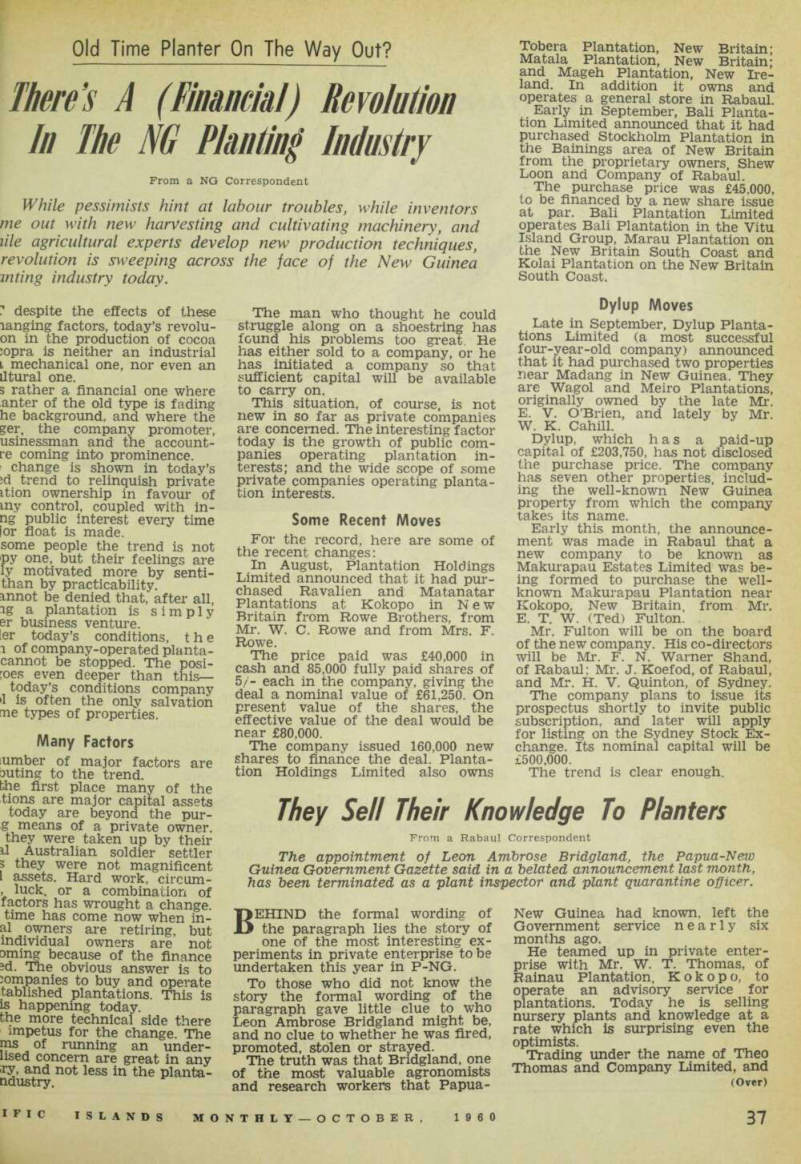
Old Time Planter On The Way Out?
There’s A (Financial) Revolution In The NG Planting Industry
From a NG Correspondent While pessimists hint at labour troubles, while inventors me out with new harvesting and cultivating machinery, and lile agricultural experts develop new production techniques, revolution is sweeping across the face of the New Guinea mting industry today.
7 despite the effects of these langing factors, today’s revolu on in the production of cocoa ;opra is neither an industrial i mechanical one, nor even an Qtural one. 3 rather a financial one where anter of the old type is fading he background, and where the ger, the company promoter, usinessman and the account re coming into prominence. change is shown in today’s ;d trend to relinquish private ition ownership in favour of my control, coupled with in ng public interest every time ior float is made, some people the trend is not py one, but their feelings are ly motivated more by senti than by practicability, annot be denied that, after all, ig a plantation is simply er business venture, ler today’s conditions, the i of company-operated planta cannot be stopped. The posi ;oes even deeper than this— today’s conditions company •1 is often the only salvation me types of properties.
Many Factors
lumber of major factors are outing to the trend, the first place many of the tions are major capital assets today are beyond the pur g means of a private owner, they were taken up by their il Australian soldier settler 3 they were not magnificent I assets. Hard work, circum , luck, or a combination of factors has wrought a change, time has come now when in al owners are retiring, but individual owners are not oming because of the finance sd. The obvious answer is to ’ompanies to buy and operate tabhshed plantations. This is is happening today, the more technical side there impetus for the change. The ms of running an under hsed concern are great in any ;ry, and not less in the planta ndustry.
The man who thought he could struggle along on a shoestring has found his problems too great. He has either sold to a company, or he has initiated a company so that sufficient capital will be available to carry on.
This situation, of course, is not new in so far as private companies are concerned. The interesting factor today is the growth of public com panies operating plantation in terests; and the wide scope of some private companies operating planta tion interests.
Some Recent Moves For the record, here are some of the recent changes: In August, Plantation Holdings Limited announced that it had pur chased Ravalien and Matanatar Plantations at Kokopo in New Britain from Rowe Brothers, from Mr. W. C. Rowe and from Mrs. F.
Rowe.
The price paid was £40,000 in cash and 85,000 fully paid shares of 5/- each in the company, giving the deal a nominal value of £61,250. On present value of the shares, the effective value of the deal would be near £BO,OOO.
The company issued 160,000 new shares to finance the deal. Planta tion Holdings Limited also owns
Tobera Plantation, New Britain; Matala Plantation, New Britain; and Mageh Plantation, New Ire land. In addition it owns and operates a general store in Rabaul.
Early in September, Bali Planta tion Limited announced that it had purchased Stockholm Plantation in the Bainings area of New Britain from the proprietary owners. Shew Loon and Company of Rabaul.
The purchase price was £45,000, to be financed by a new share issue at par. Bali Plantation Limited operates Bali Plantation in the Vitu Island Group, Marau Plantation on the New Britain South Coast and Kolai Plantation on the New Britain South Coast.
Dylup Moves
Late in September, Dylup Planta tions Limited (a most successful four-year-old company) announced that it had purchased two properties near Madang in New Guinea. They are Wagol and Meiro Plantations, originally owned by the late Mr.
E. V. O’Brien, and lately by Mr.
W. K. Cahill.
Dylup, which has a paid-up capital of £203,750, has not disclosed the purchase price. The company has seven other properties, includ ing the well-known New Guinea property from which the company takes its name.
Early this month, the announce ment was made in Rabaul that a new company to be known as Makurapau Estates Limited was be ing formed to purchase the well known Makurapau Plantation near Kokopo, New Britain, from Mr.
E. T. W. (Ted) Fulton.
Mr. Fulton will be on the board of the new company. His co-directors will be Mr. F. N. Warner Shand, of Rabaul: Mr. J. Koefod, of Rabaul, and Mr. H. V. Quinton, of Sydney.
The company plans to issue its prospectus shortly to invite public subscription, and later will apply for listing on the Sydney Stock Ex change. Its nominal capital will be £500,000.
The trend is clear enough.