Dark Days In
pp. 35-38 · Read in the full issue
Those POW Letters Dark Days In NG Recalled
The Rev. A. H. Voyce, now retired d living in Auckland, NZ, but ■ many years a missionary in New dnea, ansivers a query made by ider John Watson in “Editors’ lilbag”, August “PIM”, about that soner-of-war mail with which the os “bombed” Port Moresby in ril, 1942. n his was the last time many of se men were heard from, although “Tolala” recorded in September M”, the Japs gave their prisoners second chance to write home — mt May, 1942, he thinks. Not of this second batch of mail de the distance, and shortly rrwards all but half a dozen of men (“Tolala” being amongst lucky few) were shipped away the “Montevideo Maru” which reported sunk with all hands ewhere near the Philippines. was news to me to know that iccording to Mr. Watson I had ‘gone on record” as stating that isoner-of-War” mail did not inate from Rabaul! {PIM, ust, p. 27). I have no knowledge uch a “record”. do remember, however, in one ate letter, questioning the fineness of such a cover, which been received by a relative, that was before I had access ertain published information to :h I refer later, and which may >f interest even at this late date, r our readers. have always had in my Postal ory collection of Papua and Guinea, a cutting from the aey Press in June, 1942. in :h Osmar White then writing the Sydney Daily Telegraph , how the Japanese-bomber iped the mail-bag “bomb” after tad released a salvo of high osives. >ng white streamers were ched to the bag, which bore a i tag inscribed: “Any person ing this bundle is cordially ested to deliver it to the Army 400 Letters ie letters—300 from Australian iers, and a 100 from civilian mers of war—were each limited l single sheet. The bag con ed a typed message: “To Army Port Moresby, we i. granted our prisoners of war fission to write a letter to their es in order to relieve anxiety their families about the are of their beloved ones. This b of letters we are confident
Continued on page 35—column 2)
will never fail to receive a warm welcome from all addresses. The letters are left unsealed for the convenience of censorship on your side. We sincerely hope that by your good offices the whole of the letters will find their way to the respective destinations. The Japanese Headquarters”.
Only recently, I have secured a copy of Lionel Wigmore’s Official War History, The Japanese Thrust, where on page 674 he states: “Soon after the Australians entered captivity, the Japanese per mitted them to write letters home.
Several mail-bags containing these letters were dropped during an early air raid on Port Moresby. On the outside of one of the bags a message in English to Major-General Morris, stating that “no doubt the addresses would be glad to receive the con tents of this ‘bomb’.
And, again, in Qantas Aeriana, page 105, it is stated, under a head ing, Japanese deliver Prisoners’
Letters : “A courtesy gesture was made by the Japanese Military Authorities when they dropped a number of
letters from prisoners of war held by them. At first our troops were not sure as to whether this might have been a trick of some kind, but examination proved them to be genuine letters, which were quickly gathered up and handed to Army Intelligence. They totalled approxi mately 374 items. The letters did not bear any postal markings and stated that the senders were in good health and well treated.
Gave Much Information tetters were forwarded to Melbourne, where much informa tion was gathered as to the names of other prisoners and when this examination was concluded they were handed to the postal authorities, to be sent as registered mail to the addressee.”
The Aero Field, published in England states (March, 1950), that on April 28, 1942, letters from Aus tralian prisoners of war at Rabaul were dropped over Port Moresby by Japanese bombers.
I remember promising myself that some time I would write to
some of the wives of Methodist Missionaries who were taken prisoner by the Japanese in Rabaul, and ask for one of those covers— but I never have. Once the tragic information about the fate of those who were allegedly taken away on the Montevideo Maru was made known, I felt that it would be sacrilege to disturb such folk in their sorrow, though I had known many of those who were lost.
Only yesterday (Sept. 6, 1960) I received from the writer of your August “Mailbag” query, Mr. John Watson, a series of articles clipped from the Australian Press, and written by Bishop Scharmach, of Vunapope, who was, at that time a prisoner of the Japanese at Rabaul, in which he stated that in his opinion there never was any such vessel as the Montevideo Maru! [Here is the relevant passage about the ship: Now a strange thing happened. Officers from Rabaul, whom I had not met, came to see me. Nothing official! After some small talk, they volunteered the informa tion that all the civilians were put on board the “Montevideo Maru” but on the way to Japan the ship was torpedoed near the Philippines and all the civilians lost.
This was sad news, indeed. Two more Japanese officers called on me on different days giving the same report. I grew sus picious. Never before had Japanese officers, of their own accord, given the slightest indication of the Empire’s losses.
After hostilities, the question of the “Montevideo Maru” came before the War Criminal Court at Rabaul. The Japanese
told the Australian authorities what the had told me. But investigations at II Navy headquarters disclosed that th Americans had never torpedoed a ship lihl the “Montevideo Maru” near the Philip pines.
Further, a mass grave had been dh covered at Matupi near Rabaul. Alleged! there were found in the grave wrii watches and other things identified as b* longing to the people who were supposi to be on the “Montevideo Maru”.
Piecing this together, it is highly pro! able that a “Montevideo Maru” new existed. The prisoners were taken by tnn to Matupi and other places. Most like they were equipped with spades and we ordered to dig a trench, after whii machine guns mowed them down. It won have been easy to throw the bodies in a: bury them. That would have been in kee ing with their forces’ procedure elsewhe; Just to put investigators on the wroi track they assiduously spread the story the “Montevideo Maru”.] And only a month ago I receiv one of the POW covers at last through an old friend who wrc to the widow of the Rev. L.
McArthur, who was one of the mi who went down with Montevid Maru.
This cover bears all' the mai
described in Qantas Aeriana, w:
the Melbourne Bulk Postage bj
registration label No. 1070, plus t
red “Opened by Censor” sticker, a
the “Passed by Censor” mark.
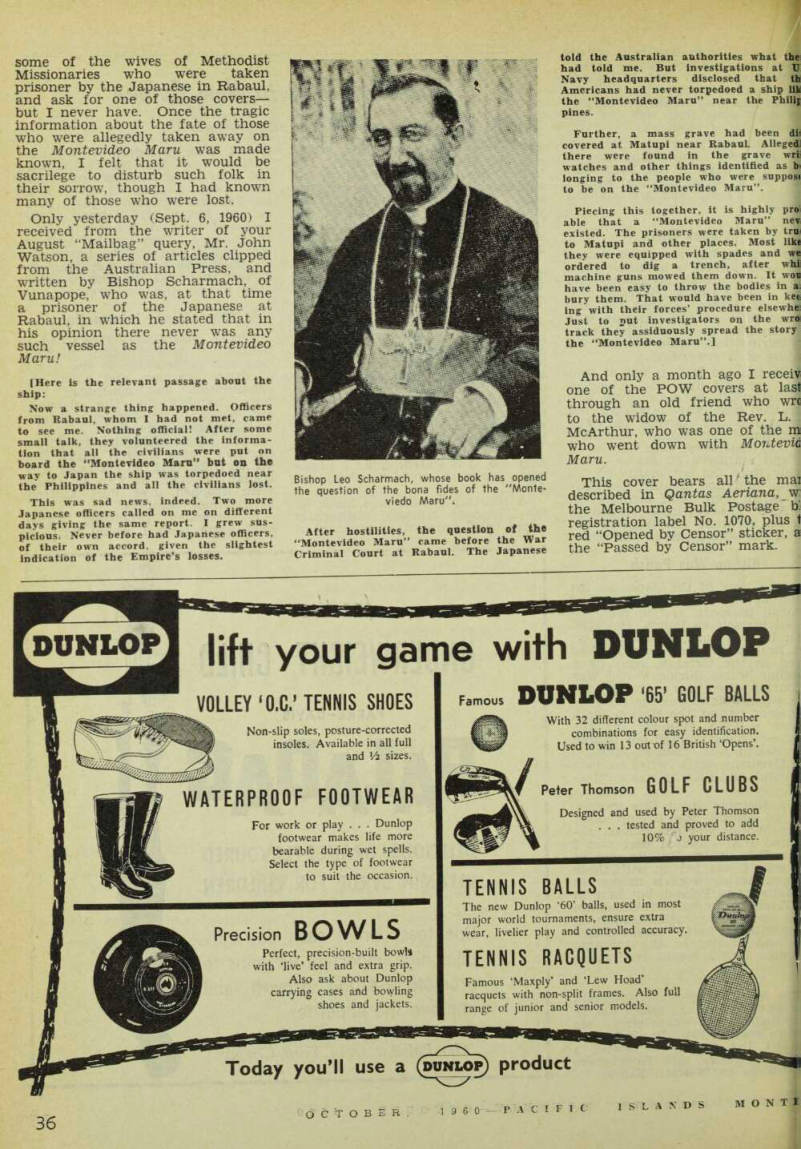
Bishop Leo Scharmach, whose book has opened the question of the bona tides of the "Monte viedo Maru".