Taking Time Out
pp. 39-41 · Read in the full issue
Sydneysider At Home Base Taking Time Out For Television
It was Old Territorians’ night at Sydney television station ATN on the last Sunday in August, when four men braved the glaring white light of this medium to try to prove to Mainland Australians that homs and forked-tails are not currently being worn by all Europeans in Papua-New Guinea.
HE brave men were Messrs. Mick Leahy, R. F. Bunting, R. W.
Robson and Graham Kingsford ith. Mr. Kingsford-Smith used 3e a coffee planter at Goroka, but v is a Sydneysider and arranges se discussion panels profession r. He therefore deserves all he 3. tick Leahy, one of the discoverers the New Guinea Highlands in early 1930’5, and now the owner the biggest cattle station in the ritory, has been crossing swords ;ly with all the experts who have n tossing the Territory back to natives. He was filled with sionary zeal, and would have ?d a den of lions to get over his it that some reassurance for the opean settlers in the Territory ild be in order before Australia ked out. ; was the other two who were the ctant dragons—mostly, I suspect, luse they both live for a fair t of the year in Sydney, and as ilar television viewers have seen it of the prominent figures of time cut down to size by the orting process of the TV camera. he previous week, in that same ion, there had been the spectacle the Commonwealth Treasurer, ;old Holt, defending his Budget mst the barbs of Federal Opposi i Leader Calwell.
Tiat the Treasurer said may have ii pure wisdom; but I swear that it viewers were more diverted by
the Holt profile, with which a pixilated TV camera completely filled their screens, and even more so by the Holt ear that, by some third-dimensional trick, appeared to be drawn out of the Holt face like a wind scoop, and actually wiggled and twisted like an animate creature in its own right, as its owner drove home his points, Mr. Holt is a reasonably good looking man and is still on the right side of 60; but, according to that malevolent camera, he could have been 90, and with that great mane of silver hair brushed back he looked like a kookaburra with ears, no mo™. , ™hat then would the cameras do
“ ssssrszsnss e
Or crumple up their faces like old rubber dolls? Magnify each whisker and wart or freckle? Or by some juxtaposition of features and a 100to-one chance, might one o 1 * other of them turn out to be actually telegenic?
Being human, this is probably what they thought as they sweated out the preliminaries in that huge barn-like studio with its miles of trailing wire, its cameras and its pendant microphones, and its white arc-lights beating down on the table where X marked the spot.
The whole place had something of the atmosphere of a hospital theatre before a major operation.
Looking as though they might sud denly take fright like stallions and paw the floor and neigh, they are led off, one by one, to where a phlegmatic, small female encases them in sun-tan pancake make up. paints their eyelids green and the tips of their noses something else and, thus finally prepared for the ordeal, they seat themselves at the table beneath the lights.
Robson Discovers
The Highlands
The three cameras move in for the kill, and Mr. Kingsford-Smith goes into his introductory remarks, followed smartly by a short section of film on New Guinea that is sup posed to get viewers in the right frame of mind. The three other participants brace themselves for the trials to come.
The film speeds on, native pot makers dissolving into what looks like natives digging a hole and then the whole lot dissolving into a seismographic explosion as the film hops the sprockets of the projector and jazzes and leaps to a full stop.
The floor manager yells “cut”; the cameras draw back; and Mr.
Kingsford-Smith produces what could be described as a calming smile. The others look blank.
Fortunately this is being put on video-tape for showing later in the night, so no great harm is done, and after a few minutes they get going again. Mr. Kingsford-Smith again makes his introductory speech, the newsreel takes over and, with only a small shudder at the critical moment, manages to stay on its sprockets; Messrs. Leahy, Bunting, and Robson tense themselves again for the introductions.
Two of them might have tensed themselves a bit more if they had known that at that very moment the cameras were getting their wires crossed, and that Mr. Robson, who obviously didn’t know the gun was loaded, was employing the distin terested look of an Egyptian mummy
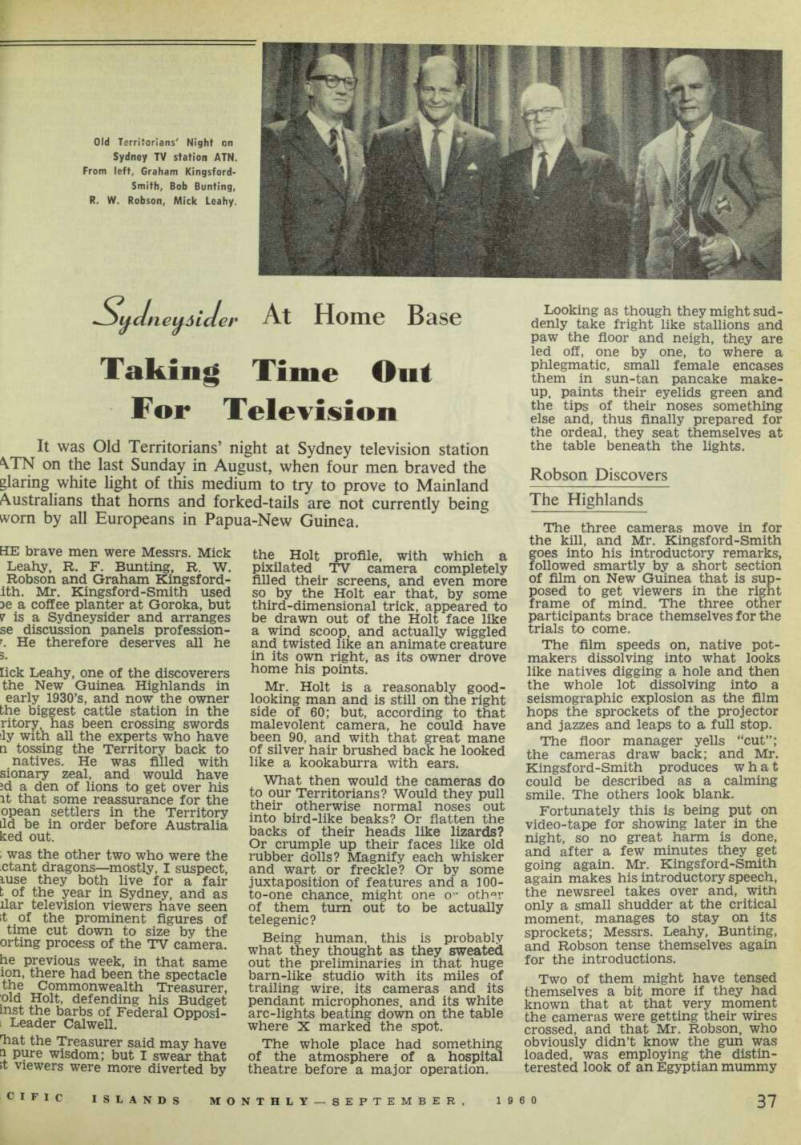
Old Territorians' Night on Sydney TV station ATN.
From left, Graham Kingsford- Smith, Bob Bunting, R. W. Robson, Mick Leahy.
while being introduced as “Mr. Mick Leahy, who discovered the Ne'w Guinea Highlands”, And Mr. Leahy, who didn’t knov the camera was on him, either, while suitably composing his face into the right expression for tearing strips off theorists, was being shown to the unseen audience as “Mr. R. W Robson, the founder and publisher o the Pacific Islands Monthly But, after this final sortie, th( gremlins departed and the four mei settled down to a calm and reasonee discussion of the place of Europeai private enterprise in New Guinea and why Australia can’t just do j Congo and pull up stakes and flit.
The minor miracle of these thing —at least as far as the interestei bystander is concerned —is that hav ing spent half of the afternoon i] a dozen apparently unconnectei fiascos, the whole thing should b delivered later that night suspended between shaving-crear advts., certainly—but for all thai neatly packaged into a 25-minute programme that hangs together an actually makes sense.
The $64 question so far as Guinea is concerned, of course, i whether all the trouble which thi entailed for the participants reall pays off. The answer is that it coul hardly fail to do so—so far as it wen There should be more of this soi of thing, better timed and dishe up in various l sugar-coated ways fc today’s viewer or listener.
Ten o’clock on a Sunday nigh when Sydney Suburbia—the sectio that most needs educating aboi P-NG —is likely to be preparing fc bed is not the best time for this tyi of programme. Nor is 30 minute including the sponsor’s soap or flj spray, the introduction and tt warming-up period, sufficient tirr for four men with ideas to produc the kind of verbal bombs that ai likely to jolt viewers from the chairs.
Nonetheless, those who deliberate; set out to see it, and those wt lingered on after the Sunday mov and survived the advertisements ths attended it, could not help bi observe that these men who defende the rights of private enterprise : the Territory had no smell of brim stone about them, but spoke ar acted and (in spite of the worst tU television cameras could do) looke like normal men, and that the arguments were logical.
Picking ’em Up
Putting ’em Down Marathon walking is just like an other kind of walking said ex-pos: man George Lockwood, when I plodded into Sydney during tl month after walking 2,800 mill across the Continent from Fr mantle since mid-March.
According to George, it’s just matter of picking ’em up ar putting ’em down, until you g where you want to go—not that tl:
me hasn’t been ruined, but! >orge had a lot to say about these I girls that natter about eating iss, and not drinking beer, and ving babies at 100. \t about the same time, the old 1 in question—Dr. Barbara Moore vas giving the Australian fruit lustry a big boost in America. In j course of putting on a tantrum the San Francisco Air Terminal, ? pelted Customs oiffcials with the stralian fruit they wouldn’t let : take into the States —amongst ; assortment, “two of the biggest mges” this fruit-and-veg con sseur had ever seen. flDout a day later (such is the age), she was storming the US ibassy in London with six Aus lian lemons and two Australian ties which had somehow escaped • US Customs net. What happened the flora and fauna is not re ded, but Dr. Babs ticked every i off properly about the San incisco do.
Tie modern phenomena of the Barbara Moores are something ponder about in idle moments, t of the darkest period of last pish mid-winter, she sprang ly~fl e dged onto the front pages the sensational Press with the ertion that she would walk from in O’Groats to Land’s End on
nothing more inspirational than honey, nuts and carrot juice.
No sooner had the doctor proved her point, than a teenager took up the challenge and mowed some days off her time; and then holiday-camp tycoon, Billy Butlin, weighed in with handsome cash prizes for the fastest time for the same route. No less than 500 people staggered off into the February mists, snows and gales of northern Scotland to prove that the Second Elizabethan Age did not find the spirit of adventure en tirely dead in Englishmen (or women).
For weeks they strode or limped down the length of the UK, and even at the end of March stragglers were checking into the bleak hotel at the tip of the long nose of Corn wall. These were not, of course, fuelled by carrot juice alone; most of them were doing about 10 miles to the gallon of mild-and-bitter.
That Long,
Long Trail
But though others might better the doctor’s walking, she was always one hop ahead in publicity. She went quickly off to the United States to walk across the North American continent, and when the small centre called Blacktown, on the fringe of Sydney’s metropolitan area, had some sort of anniversary in July, it was Dr. Moore who came all the way out here to provide the piece de resistance.
For the edification of Black townians she promised to walk the 400-odd miles from Albury in a week. Such a stroll, she said, would be a flea-bite. But this was the flea that turned and bit; and as the good doctor plugged on, complaining bitterly of the hard bitumen roads, her poor, sore feet and our ghastly winter weather, one week lengthened into two. Not that she didn’t get a flattering amount of attention: whole towns along the way turned out to see her pass, and panting radio and TV reporters interviewed her on the run.
She had. she claimed, definitely halted the ageing process by her diet of honey and nuts. At 57 she was still capable of having a baby (by which one assumed that she was still —though why go into gynaecological details), but just for the heck of it, she would wait until 100 before she let motherhood overtake her.
She was born in Russia, at one time was Russian champion female motor-cyclist, was currently married to an Englishman, and expected to live to 200.
Her recipe for a long and healthy life included a lot of walking (obvious), nuts, honey and fruit — and no meat, alcohol or sex. It seems to me like the made-to-order re mark to bring forth the classic re tort: Under those circumstances, you don’t live longer—it only seems longer!