And The People
pp. 31-37 · Read in the full issue

The Places You See ...
You Meet
Some Notes Made by STUART INDER Round-and-About the Islands, but Mostly in the Solomons.
“It’s a cow of a river!” said BSIP Public Works Department works supervisor John Schenk, tossing a pebble into Guadalcanal’s troublesome Lunga. “We have had 34 rises of more than three feet in the last three months of building this bridge
ND what’s more—in another L three months period they had to put 11 temporary bridges er that river, because the Lunga iparently made up its mind it dn’t want anything permanent, id kept sweeping the bridges away nly one was lost—otherwise the me bridge was recovered and re aced as soon as it was swept fay).
The Lunga seems to be getting mething permanent, now, how er. I saw a steel bridge going i with a main span 210 ft, with a :ondary span of 160 ft, and a 27 clearance from the centre of the er. One concrete pier goes 19 under the river.
Hie builders insist that this bridge really going to stay there— spite the view of some of the :als who say the piers will be dermined. rhis attitude reminded me of lat the New Guinea locals used say when the Markham River dge was being built near Lae. ie Markham would change course
and leave the bridge out on its own, they said—but the Markham Bridge was still intact when I drove over it a fortnight after I worshipped at the banks of the Lunga.
The Lunga Bridge is important because it connects Honiara with the coastal road, and also the big Henderson Field. This last year the missing bridge has been very inconvenient, and one Of the sore points of life for many BSIP people.
To get across the river now you have to wait on the bank while a makeshift pontoon is laboriously hauled across by six boy-power engine, guided by a pulley arrange ment. The boys merely haul on the rope (cost of the boy-power— £42 per month). It’s a slow busi ness, although it must be deadly dull work for the locomotive power, too.
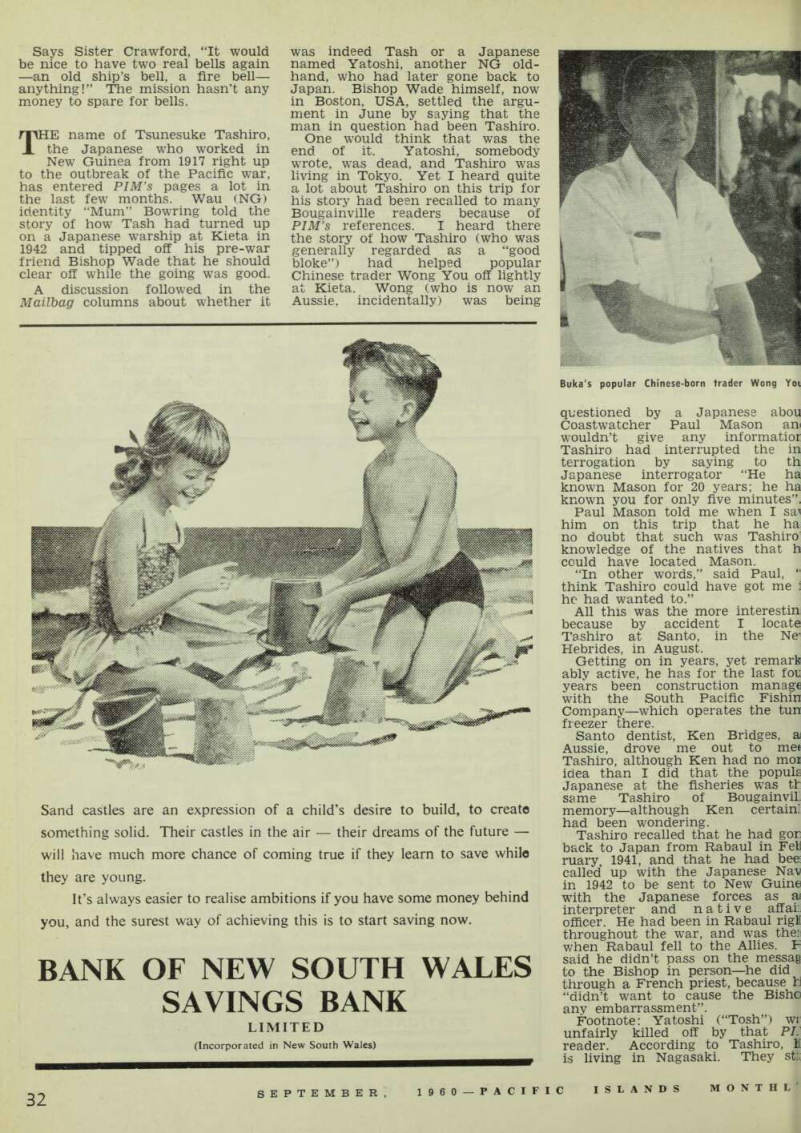
Since the aircraft have been landing at Kukum, at the Honiara side of the river, Henderson is getting to look a bit neglected— note the photograph. But it shortly should come back into its own.
Honiara people are hoping for really big things when Fiji Air ways begins its projected Fiji- Honiara service, even if it is only a fortnightly one. There has been great enthusiasm engendered at the announcement (I understand there has been a hold up because of some technical argument but the scheme will certainly go through).
This much-needed Pacific link, which will open up an entire new travel route, would have gone through much earlier if not for some prickly international problems that have been associated with the New Hebrides part of the chain.
I predict both the Solomons and the New Hebrides as an up and coming tourist attraction in the South Pacific. Apart from the BSIP’s war story (for some details
see T Topicalities, p. 81) it has the kind of upspoilt charm which was the reason why Rarotonga was voted Number One by those sophisticated American shi p s’ passengers over the last couple of years.
I always thought Honiara people were supposed to be inclined towards stuffed-shirtiness, but wherever I heard that, it was a monstrous slander. Perhaps, if any thing, Honiara might collectively have a slight inferiority complex,
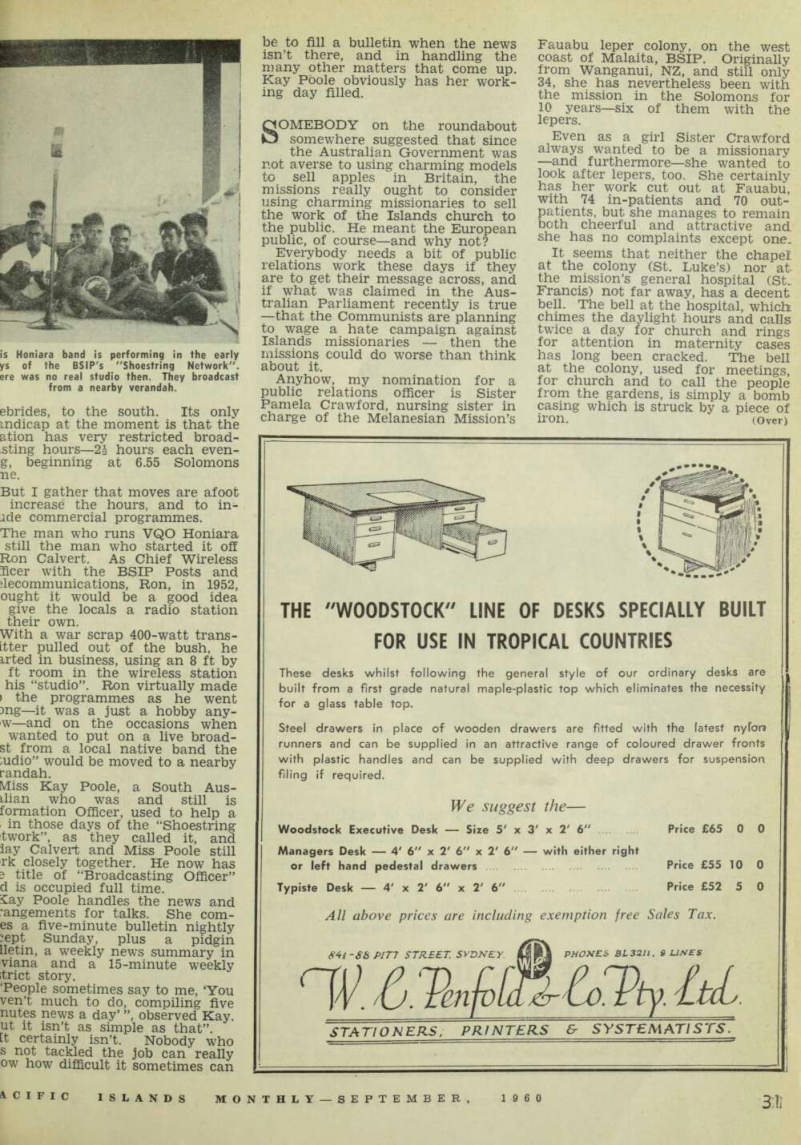
Malaita's Sister Pamela Crawford.
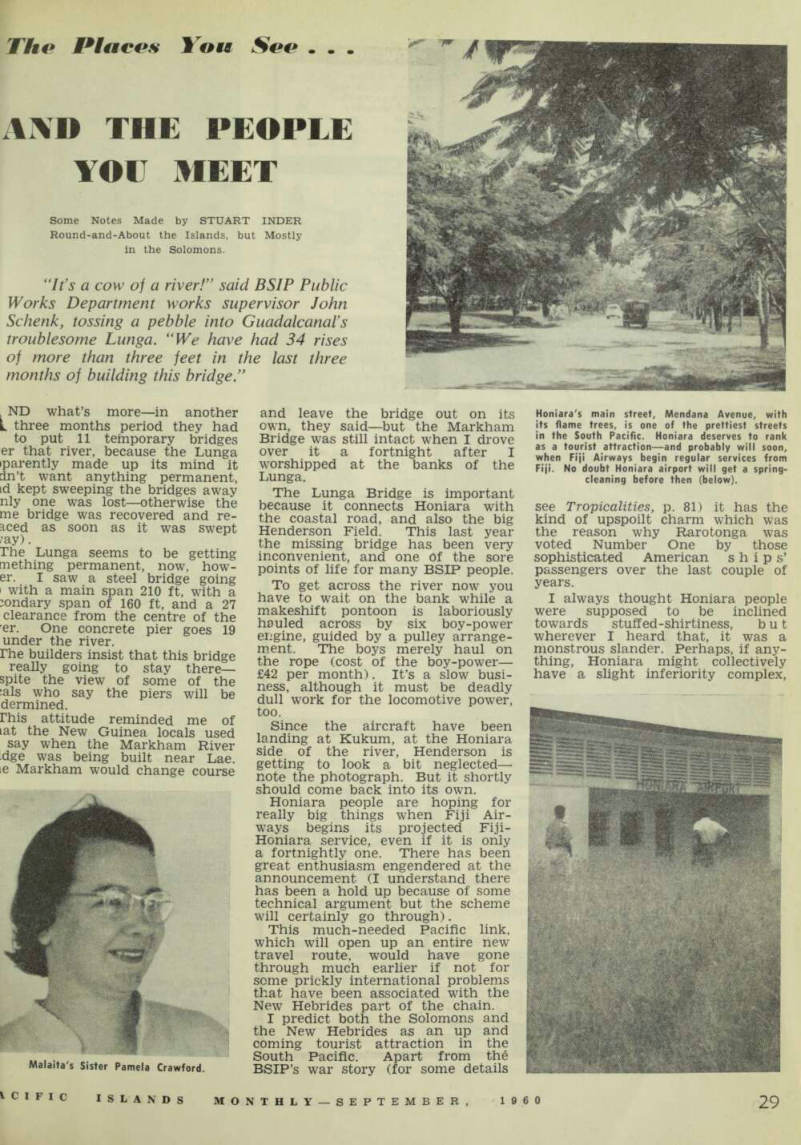
Honiara's main street, Mendana Avenue, with its flame trees, is one of the prettiest streets in the South Pacific. Honiara deserves to rank as a tourist attraction—and probably will soon, when Fiji Airways begin regular services from Fiji. No doubt Honiara airport will get a spring cleaning before then (below).
but that will go when more peop] begin to travel through there.
Mendana Avenue, with its line of flame trees, is one of the pretties streets in the South Pacific, an the views from the nearby ridge are superb. And if the standai of design already seen in one c two of Honiara’s new Governmei buildings is going to be the norr then Honiara will be hard to bea The old quonset-hut look is on tl way out.
One personal criticism: Bulk fu installations are rather necessar especially when they mean cheapi petrol, and they also have to 1 accessible. But they shouldn’t t allowed to take over the pick « the beauty spots, and it might m yet be too late for Honiara 1 keep its approaches free of the kir of eye-sores that ruin so man other places.
AT Honiara I found one of tl most modern little broadcasts studios in the Islands —hea< quarters of the Solomon Islan Broadcasting Service.
It’s all air-conditioned, and tl standard of the programmes is sui that Port Moresby’s VLT6 seems be losing many of its evenii listeners to it —mostly in the Ne Britain and Bougainville ares Honiara Radio also covers the Ne
The Lunga River's six boy-power pontoon fer[?] in operation in August. The rope they ai[?] hauling on spans the river.
Honiara's radio man Ron Calvert.
ebrides, to the south. Its only mdicap at the moment is that the ation has very restricted broad sting hours—2l hours each even g, beginning at 6.55 Solomons ne.
But I gather that moves are afoot increase the hours, and to in ade commercial programmes.
The man who runs VQO Honiara still the man who started it off Ron Calvert. As Chief Wireless Beer with the BSIP Posts and decommunications, Ron, in 1952, ought it would be a good idea give the locals a radio station their own.
With a war scrap 400-watt trans fer pulled out of the bush, he irted in business, using an 8 ft by ft room in the wireless station his “studio”. Ron virtually made i the programmes as he went mg—it was a just a hobby any w—and on the occasions when wanted to put on a live broad st from a local native band the ;udio” would be moved to a nearby randah.
Miss Kay Poole, a South Aus ilian who was and still is formation Officer, used to help a in those days of the “Shoestring twork”, as they called it, and lay Calvert and Miss Poole still rk closely together. He now has 3 title of “Broadcasting Officer” d is occupied full time. £ay Poole handles the news and 'angements for talks. She com es a five-minute bulletin nightly :ept Sunday, plus a pidgin lletin, a weekly news summary in viana and a 15-minute weekly itrict story. ‘People sometimes say to me, ‘You ven’t much to do, compiling five nutes news a day’ ”, observed Kay. ut it isn’t as simple as that”. [t certainly isn’t. Nobody who s not tackled the job can really ow how difficult it sometimes can
be to fill a bulletin when the news isn’t there, and in handling the many other matters that come up.
Kay Poole obviously has her workmg day filled.
SOMEBODY on the roundabout somewhere suggested that since the Australian Government was not averse to using charming models to sell apples in Britain, the missions really ought to consider using charming missionaries to sell the work of the Islands church to the public. He meant the European public, of course—and why not?
Everybody needs a bit of public relations work these days if they are to get their message across, and if what was claimed in the Australian Parliament recently is true —that the Communists are planning to wage a hate campaign against Islands missionaries then the missions could do worse than think about it.
Anyhow, my nomination for a public relations officer is Sister Pamela Crawford, nursing sister in charge of the Melanesian Mission’s
Fauabu leper colony, on the west coast of Malaita, BSIP. Originally from Wanganui, NZ, and still only 34, she has nevertheless been with the mission in the Solomons for 10 years—six of them with the le P ers - Even as a girl Sister Crawford al ways wanted to be a missionary 7“ a , furthermore—she wanted to L ook after le P,ers, too. She certainly work cut out at Fauabu, Wl th 74 in-patients and 70 out- Patients, but she manages to remain both cheerful and attractive and she has no complaints except one.
It seems that neither the chapel at the colony (St. Luke’s) nor at the mission’s general hospital (St.
Francis) not far away, has a decent bell. The bell at the hospital, which chimes the daylight hours and calls twice a day for church and rings for attention in maternity cases has long been cracked. The bell at the colony, used for meetings, for church and to call the people from the gardens, is simply a bomb casing which is struck by a piece of iron. (Over)
[?]is Honiara band is performing in the early [?]ys of the BSIP's "Shoestring Network", [?]ere was no real studio then. They broadcast from a nearby verandah.
Says Sister Crawford, “It would be nice to have two real bells again —an old ship’s bell, a fire bell— anything!” The mission hasn’t any money to spare for bells. r_ , . , .
E name of Tsunesuke Tashiro, the Japanese who worked in New Guinea from 1917 right up to the outbreak of the Pacific war, has entered PI M’s pages a lot in the last few months. Wau (NG) identity “Mum” Bowring told the story of how Tash had turned up on a Japanese warship at Kieta in 1942 and tipped off his pre-war friend Bishop Wade that he should clear off while the going was good.
A discussion followed in the Mailbag columns about whether it
was indeed Tash or a Japanese named Yatoshi, another NG old hand, who had later gone back to Japan. Bishop Wade himself, now in Boston, USA, settled the argu ment in June by saying that the man in question had been Tashiro.
One would think that was the end of it. Yatoshi, somebody wrote, was dead, and Tashiro was living in Tokyo. Yet I heard quite a lot about Tashiro on this trip for his story had been recalled to many Bougainville readers because of PlM’s references. I heard there the story of how Tashiro (who was generally regarded as a “good bloke”) had helped popular Chinese trader Wong You off lightly at Kieta. Wong (who is now an Aussie, incidentally) was being
questioned by a Japanese abou Coastwatcher Paul Mason an v/ouldn’t give any informatior Tashiro had interrupted the in terrogation by saying to th Japanese interrogator “He ha known Mason for 20 years; he ha known you for only five minutes”.
Paul Mason told me when I sa: him on this trip that he ha no doubt that such was Tashiro 1 knowledge of the natives that h could have located Mason.
“In other words,” said Paul, “ think Tashiro could have got me i he had wanted to.”
All this was the more interestin because by accident I locate Tashiro at Santo, in the Ne 1 Hebrides, in August.
Getting on in years, yet remark ably active, he has for the last for years been construction manage with the South Pacific Fishin Company—which operates the tun freezer there.
Santo dentist, Ken Bridges, a Aussie, drove me out to mee Tashiro, although Ken had no moi idea than I did that the populs Japanese at the fisheries was tb same Tashiro of Bougainvib memory—although Ken certain! had been wondering.
Tashiro recalled that he had gor back to Japan from Rabaul in Fefc ruary. 1941, and that he had bee; called up with the Japanese Nav in 1942 to be sent to New Guine with the Japanese forces as ai interpreter and native aff ai: officer. He had been in Rabaul rigH throughout the war, and was the: when Rabaul fell to the Allies. F said he didn’t pass on the messag to the Bishop in person—he did through a French priest, because h “didn’t want to cause the Bisho any embarrassment”.
Footnote: Yatoshi (“Tosh”) w: unfairly killed off by that PL reader. According to Tashiro, If is living in Nagasaki. They st:;
Buka's popular Chinese-born trader Wong You
rite to each other and Tashiro ill keeps in touch with Bishop r ade. >AUL MASON, incidentally, is the president of the recently formed Bougainville Improve mt Association, which appears to ,ve a lot of local backing and )ks like going places. This is be use membership is not confined ly to the European planters, but has native. Chinese and mission ;mbership. It is, as secretary F. R. ;Killop pointed out, “non jtional, and working for the gen ii good of Bougainville”. \.nd Bougainville, as a whole, cer nly needs some general good done ■ it. It gets a disgustingly poor il from the Administration — irely, I suspect, because it’s too ■ from anywhere, and too busy iducing things, to be heard. The ole 4,100 square miles of Bougain le (which produces more copra in Papua, and which has one rticular 40-mile stretch of eastern istline growing more than 5,000 of produce a year) has no arf, no real roads and is given equipment or men to keep the t tracks it has got in repair. I I’t suppose there is a foot of bitu n in the whole of Bougainville, at Boroko, part of Port Moresby’s t-expanding suburbia, I saw one Le strip of sealed road near the pping centre that appeared quite lecessary. How Bougainville could re used it!
Tie difference in the amount of ney being spent in Moresby corn ed with the rest of the Terri 7, and Bougainville in par ilar, is now so great that sud ily, this time, the position seemed be indecent.
It’s painful to have to report as an ex-Moresbyite that what New Britain and the islands have been so bitterly insisting these many years is at last coming true. The islands earn the cash—Port Moresby spends it. On itself. r:E reference to Honiara’s hospitality reminds me of the genuine hospitality that is also Norfolk’s. On “boat days” the island is a busy place, and there is plenty of work going on as the islanders attempt to beat Norfolk’s foul seas and unload the Tulagi with the minimum of loss. Despite this, nothing is too much trouble for the lighterage men in helping out Tulagi’s passengers who attempt to put foot on Norfolk soil from a madly heaving small boat. Often passengers get ashore un ceremoniously with the aid of a cargo sling, as I did, but there is always a helping hand from the islanders.
Thus, it’s all the more surprising that the Norfolk Island Council should have snubbed Senator Paltridge so obviously the other day (see news pages) and then decide to apologise. The snub was not typical, certainly.
When I called, I was struck by the fact that although there was certainly a strong difference of opinion on how the Council should conduct its affairs, with some rip snorting arguments going on in the best tradition, there were no real personal animosities. I got the most polite attention from both sides of the fence.
A humorous sidelight to the present argument is the way Norfolk News, the Administration’s roneoed weekly news-sheet, has been given a thorough pounding by some of its disgruntled readers —mostly Council members.
The editor of the News, I under stand, is Administrator Leydin, who, no doubt, is learning the hard way what it’s like to be an editor and to attempt to please all the people all the time.
Most frequent complaint is that it allegedly quotes out of context parts of Council minutes, which thus can be “misleading”. Others also insist on full publication of various pieces of intelligence, and
Santo's Tsunesuke Tashiro.
Bougainville planter F. R. McKillop has other interests besides the Bougainville Improvement Asso ciation—orchids. At his plantation a few miles north of Kieta he has thousands of orchids growing —the trees are almost swamped with them. He exchanges them with orchid lovers all over the world, and is himself regarded as an expert on the New Guinea varieties. Here he is in his hot house showing some species to a visitor. Miss Jean Keeton.
Norfolk Island's Mr. F. Needham, Council president.
mplain when they can’t be fitted to the News’ pages. There isn’t i editor who hasn’t heard all that fore.
Norfolk News dutifully reports 3st of the complaints of its critics le main story for the issue of igust 25 is headed “Council Not 3ased with Norfolk News”) and inly attempts to point out that is doing the best it can with its lited resources and that it is iking every effort to be impartial.
Ind it is being impartial, and lerally doing a good job, but one i imagine that the Administration Norfolk is hoping fitfully that i day may come when private ;erprises will take from its adders the burdensome respon ilities of newspaper ownership! ncidentally, I heard the same t of thing in the New Hebrides 1 the Solomons —both newspaper ; territories, whose Administra is say they would welcome a vspaper if somebody would offer start one.