Territories TALK-TALK
pp. 31-33 · Read in the full issue
With Tolala
A reader with an enquiring turn of mind writes: “You have several times mentioned Choiseul Plantations Limited and its estates in Bougainville. How come the name? Surely Choiseul Island is part of the British Solomons
TRUE. Your geography is quite correct, according to present day boundaries. The company was formed in the early 1900’s and started off at Lutee on Choiseul, but later was unable to expand owing to no more freehold land being available.
In December, 1912, the Company’s Island Inspector (W. H. Lucas) in company with J. W. Campbell, one Df the company’s plantation man agers, proceeded to Bougainville in the Sideia, chartered from the Solomon Islands Development Co., md skippered by W. J. Buckley (of whom we still hear occasionally) co look for pastures new in German territory.
The result of this tour, which re ceived every assistance from Ger nan officialdom, was the selection if areas at Soraken, Baniu, Teo lasino and Arigua. All have proved ?ood investments, as the Company’s balance sheets show annually It may be coincidental but in Bougainville there are several com lanies other than Choiseul with nisleading names.
A coffee plantation was started ifter War I by a Sydney syndicate m land at the rear of Raua planta tion. It was called Rugen Harbour 3 lantations. Now, Rugen Harbour is ocated down the south coast of 'Jew Britain.
Just before War I a chap named Dogswell, who at one time was a government official in the Gilbert md Ellice Group, spent a consider ible time looking for suitable coffee and and he picked on some near which gave the company its lame. But there was a hitch in the legotiations, and ultimately the and behind Raua was selected. (In cidentally, Cogswell made most of lis inspections in a craft called the fella, with a young chap named Mackay as skipper. Mackay was ater murdered by natives on the louth coast of New Britain just prior co War I.) Another mis-named company is hat controlling Numa Numa. It is called the Buka Plantations and Frading Co. It has no property on Buka —only at Numa Numa and Bonis, both on Bougainville.
And there is Toimonapu, down che south coast of Bougainville. It aras originally owned by the New Britain Corporations Ltd., started n the German days by a Sydney company, but later taken over by BP.
There may be others in various spots; but I cannot remember them at the moment. . . . Anyway. . . .
What’s in a name? The dividends are just as sweet.
"They Fade Away . .
When thinking of these old-estab lished plantations, it is only natural to think, too, of the men of 40-odd years ago who were engaged on the work of planting up these areas: Felling, clearing, lining out and planting the many thousands of coconuts which are now symetrical lines of palms yielding comfortable revenues to shareholders.
Not so long ago, I entered the Sydney office of BP in Bridge Street and there, on each side of the entrance are the War Honour Rolls containing many of the Company’s staff from the various islands who
joined the Forces to fight for Freedom. Of special interest was the list headed “Solomon Islands” for War I: Annandale, S. Gillies, N.
Campbell, A., Harding, F. G.
MC. Mackay, D. R.
Campbell, J. W. Shelley, P.
MM. Thomas E. L G Elrington, H. Wood, J. H.
Evans, H. P. Wright. E. A. M.
The first four names are of men who, to my knowledge, all at one time had connections with CPL in Bougainville, the first three have gone west”. Mackay and Wright were killed in action, and with the exception of one, I know not where the others are.
Does anyone want to comment?
That Matter of Titles
A name that has lately appeared much in the P-NG news is that of “Dr. Reuben Taureke”, the president of the P-NG Workers’ Association.
He is, I understand, a very capable and efficient Papuan who completed a course at the Central Medical School in Suva, Fiji, and the in sistent references by journalists to him as “Dr. Taureke” are doubtless as much embarrassing to him as to the bona fide medicos. From what I hear of his character, he is the last person to have any desire to sail under false colours.
There is going to be a lot of Press utterances about P-NG in the future, so let us step off on the right foot; otherwise the Territory and Australia are going to suffer from an epidemic of over-zealous Australian editors urging on their “Special Representatives” for some thing “sensational”, interspersed with human interest stories, which could do a great deal of harm to the present situation. (See “Com mentary”, page 25).
On the Political
Chopping Block
I was rather alarmed at a head ing appearing in the South Pacific Post (19/7/60) : “ALP view: NG Major issue for next election”. It was quoting a Sydney message from ALP officials, prior to the arrival in P-NG of their leader (Mr. A. A. Calwell).
This did not add up for me after Calwell’s urge for a Joint Parlia mentary Committee to go into the NG situation, with the inference that it would be treated as a non par ty issue.
However, more recent reports of the ALP tour of NG do not indicate that politics are to be left out of the argument, and it must be con fusing for the interrogated indigenes, who have paraded before these various VlP’s on “Fact-Finding Missions”, to sort out Arthur from Martha. (Or is it Arthur from Paul?) Ostensibly these tours are made
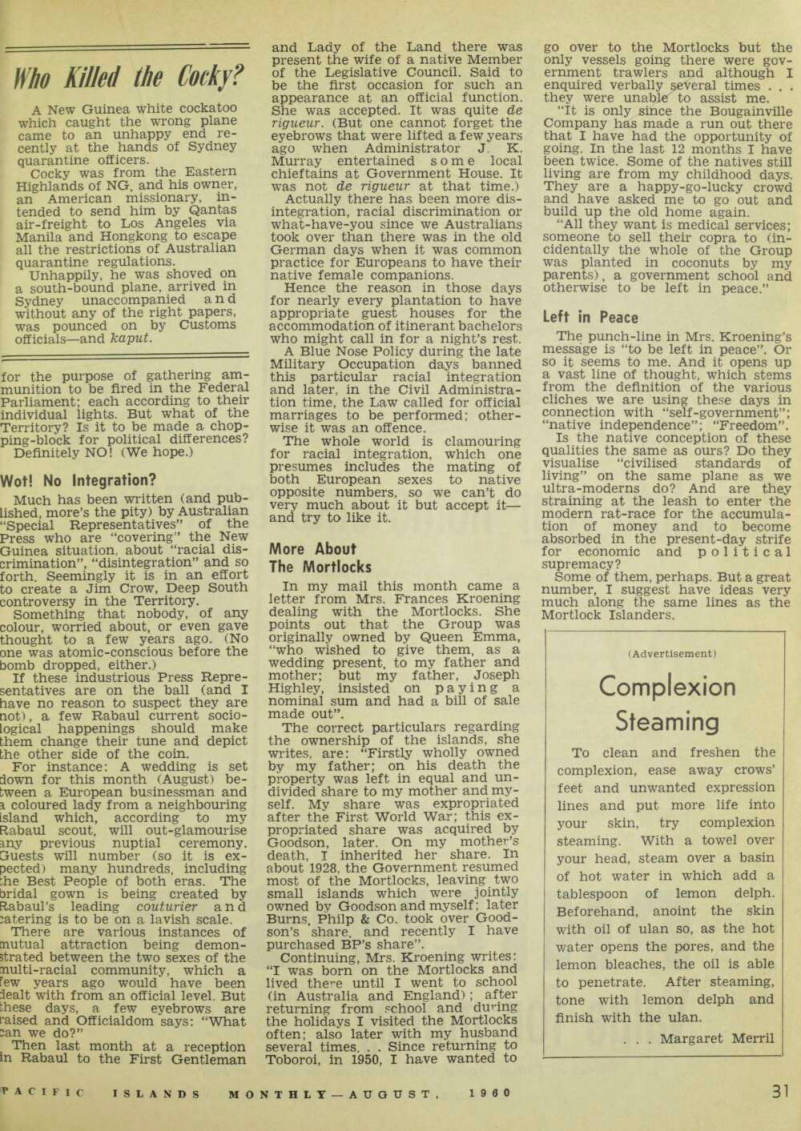
This is Jawing Muttu Gware, 23, of Butibum village, Lae, sitting at his desk in the office of the "New Guinea Times Courier". He's a cadet journalist, the first in the Territory.
Muttu, was a clerk at Malahang Native Hos pital before joining the "Times Courier". He's responsible for the Pidgin English page in that newspaper.
Muttu's brothers and sisters are all bright youngsters. An elder brother is a teacher at a Mission school in Mendi; a sister is a teacher at Lae Administration school. Another brother is a trainee technician of the Posts and Tele graphs Dept., and the baby of the family is still at school.
Muttu is an Assistant Cub Master and treasurer of his village Sports Club.
Photo; Pat Robertson.
for the purpose of gathering am munition to be fired in the Federal Parliament; each according to their individual lights. But what of the Territory? Is it to be made a chop ping-block for political differences?
Definitely NO! (We hope.)
Wot! No Integration?
Much has been written (and pub lished, more’s the pity) by Australian “Special Representatives” of the Press who are “covering” the New Guinea situation, about “racial dis crimination”, “disintegration” and so forth. Seemingly it is in an effort to create a Jim Crow, Deep South controversy in the Territory.
Something that nobody, of any colour, worried about, or even gave thought to a few years ago. (No one was atomic-conscious before the bomb dropped, either.) If these industrious Press Repre sentatives are on the ball (and I have no reason to suspect they are not), a few Rabaul current socio logical happenings should make them change their tune and depict the other side of the coin.
For instance; A wedding is set clown for this month (August) be tween a European businessman and a, coloured lady from a neighbouring island which, according to my Rabaul scout, will out-glamourise any previous nuptial ceremony.
Guests will number (so it is ex pected) many hundreds, including the Best People of both eras. The bridal gown is being created by Rabaul’s leading couturier and jatering is to be on a lavish scale.
There are various instances of mutual attraction being demon strated between the two sexes of the multi-racial community, which a few years ago would have been dealt with from an official level. But these days, a few eyebrows are raised and Officialdom says; “What 3an we do?”
Then last month at a reception in Rabaul to the First Gentleman
and Lady of the Land there was present the wife of a native Member of the Legislative Council. Said to be the first occasion for such an appearance at an official function.
She was accepted. It was quite de rigueur. (But one cannot forget the eyebrows that were lifted a few years ago when Administrator J, K.
Murray entertained some local chieftains at Government House. It was not de rigueur at that time.) Actually there has been more dis integration, racial discrimination or what-have-you since we Australians took over than there was in the old German days when it was common practice for Europeans to have their native female companions.
Hence the reason in those days for nearly every plantation to have appropriate guest houses for the accommodation of itinerant bachelors who might call in for a night’s rest.
A Blue Nose Policy during the late Military Occupation days banned this particular racial integration and later, in the Civil Administra tion time, the Law called for official marriages to be performed; other wise it was an offence.
The whole world is clamouring for racial integration, which one presumes includes the mating of both European sexes to native opposite numbers, so we can’t do very much about it but accept it — and try to like it.
More About The Mortlocks In my mail this month came a letter from Mrs. Frances Kroening dealing with the Mortlocks. She points out that the Group was originally owned by Queen Emma, “who wished to give them, as a wedding present, to my father and mother; but my father, Joseph Highley, insisted on paying a nominal sum and had a bill of sale made out”.
The correct particulars regarding the ownership of the islands, she writes, are: “Firstly wholly owned by my father; on his death the property was left in equal and un divided share to my mother and my self. My share was expropriated after the First World War; this ex propriated share was acquired by Goodson, later. On my mother’s death, I inherited her share. In about 1928. the Government resumed most of the Mortlocks, leaving two small islands which were jointly owned by Goodson and myself; later Burns, Philp & Co. took over Good son’s share, and recently I have purchased BP’s share”.
Continuing, Mrs. Kroening writes: “I was born on the Mortlocks and lived until I went to school (in Australia and England); after returning from school and during the holidays I visited the Mortlocks often; also later with my husband several times. . . Since returning to Toboroi, in 1950, I have wanted to
go over to the Mortlocks but the only vessels going there were gov ernment trawlers and although I enquired verbally several times . . . they were unable to assist me.
“It is only since the Bougainville Company has made a run out there that I have had the opportunity of going. In the last 12 months I have been twice. Some of the natives still living are from my childhood days.
They are a happy-go-lucky crowd and have asked me to go out and build up the old home again.
“All they want is medical services; someone to sell their copra to (in cidentally the whole of the Group was planted in coconuts by my parents), a government school and otherwise to be left in peace.”
Left in Peace
The punch-line in Mrs. Kroening’s message is “to be left in peace”. Or so it seems to me. And it opens up a vast line of thought, which stems from the definition of the various cliches we are using these days in connection with “self-government”; “native independence”; “Freedom”.
Is the native conception of these qualities the same as ours? Do they visualise “civilised standards of living” on the same plane as we ultra-moderns do? And are they straining at the leash to enter the modern rat-race for the accumula tion of money and to become absorbed in the present-day strife for economic and political supremacy?
Some of them, perhaps. But a great number, I suggest have ideas very much along the same lines as the Mortlock Islanders.