The Editors' Maillay
pp. 29-143 · Read in the full issue
Plunge-Back Into
NG Aviation History
Mr, John Watson (27 Merivale Street, South Brisbane, SI, Q’ld.) collects data on pioneer aviation in the Pacific Islands and he has a jouple of curly questions for any Mew Guinea Territorian who can assist: The first concerns the “Prisoner )f War” mail that was dropped over Port Moresby on or about April 28, 1942, and which came from Rabaul. 3e says that the Rev. Harry Voyce las gone on record to the effect hat that mail did not, in fact, go ’rom Rabaul; but Mr. Watson says hat there is too much evidence igainst this theory.
He thinks that “Tolala”, or one of he other half-dozen survivors of he Rabaul tragedy, might be able o clear up this point by recalling ust when the Japanese gave per nission for their 22nd Battalion s OW’s and their civilian internees o write home. He would like to mow also what Japanese squadron lew the mail to Port Moresby and Iropped it?
Going even further back into New Jumea history, Mr. Watson would ike some details of two now de unct air companies. The first, >apuan Airways, apparently of >alamaua, which operated a DH6O jrcraft, with registration of VH JLE, in 1932. The second, Rabaul Lirways, which operated a Genairco
Vh-Uny), In 1933.
Can any reader help on any of hese matters?
\'s a Masalai
Last January, “Tolala”, writing bout the magical powers of certain lonoliths found in New Guinea de snbed one on Jame Island, Buka assage. He said that he had been Did that the monolith had been ttnbuted to “Children of the Sun” pre-historic people who were sup osed to have lived in those parts nee.
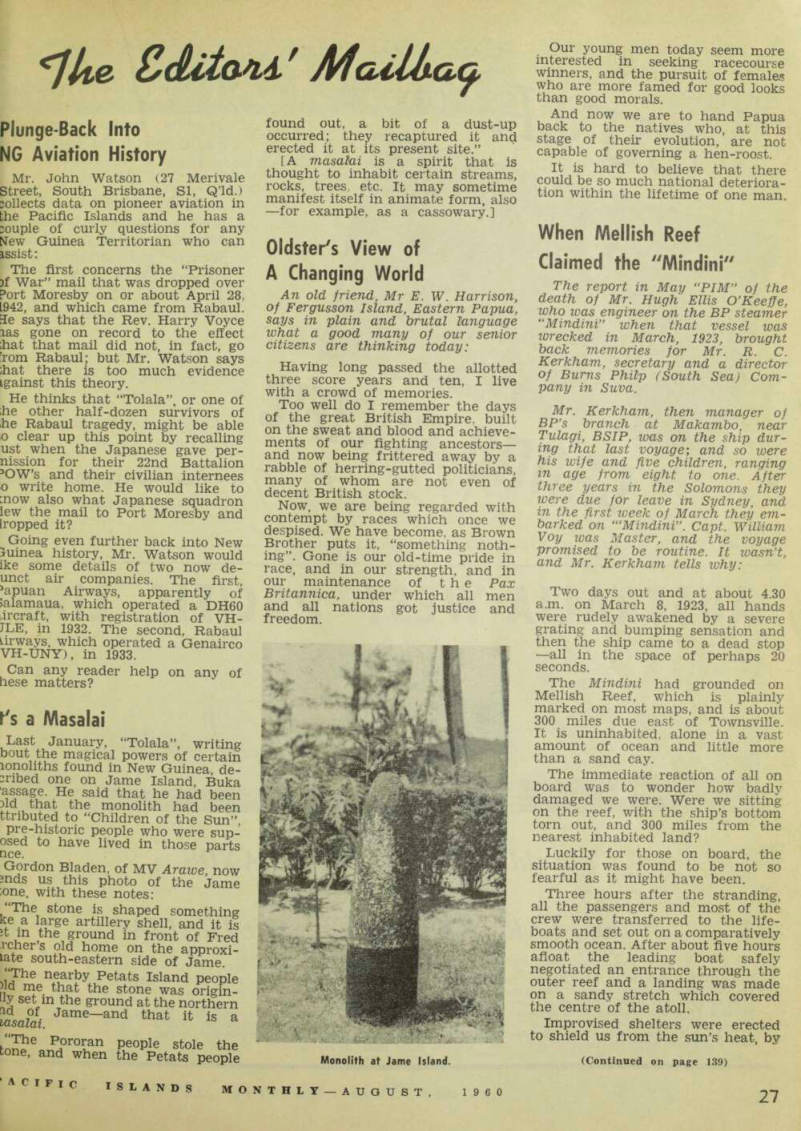
Gordon Bladen, of MV Arawe, now jnds us this photo of the Jame ;one. with these notes: “The stone is shaped something ke a large artillery shell, and it is ; t m the ground in front of Fred ichers old home on the approxi mate south-eastern side of Jame. ‘y he nearby Petats Island people id me that the stone was origin dy set in the ground at the northern Jame and that it is a ..“H 16 Pproran people stole the tone, and when the Petats people
found out, a bit of a dust-up occurred; they recaptured it and erected it at its present site.” [A masalai is a spirit that is thought to inhabit certain streams, rocks, trees, etc. It may sometime manifest itself in animate form, also —for example, as a cassowary.]
Oldster's View of
A Changing World
An old friend, Mr E. W. Harrison, of Fergusson Island, Eastern Papua, says in plain and brutal language what a good many of our senior citizens are thinking today: Having long passed the allotted three score years and ten, I live with a crowd of memories.
Too well do I remember the days of the great British Empire, built on the sweat and blood and achieve ments of our fighting ancestors — and now being frittered away by a rabble of herring-gutted politicians, many of whom are not even of decent British stock.
Now, we are being regarded with contempt by races which once we despised. We have become, as Brown Brother puts it, “something noth ing”. Gone is our old-time pride in race, and in our strength, and in our maintenance of the Pax Britannica, under which all men and all nations got justice and freedom.
Our young men today seem more interested in seeking racecourse winners, and the pursuit of females who are more famed for good looks than good morals.
And now we are to hand Papua back to the natives who, at this stage of their evolution, are not capable of governing a hen-roost.
It is hard to believe that there could be so much national deteriora tion within the lifetime of one man.
When Meilish Reef
Claimed the "Mindini"
The report in May “PIM” of the death of Mr. Hugh Ellis O’Keeffe, who was engineer on the BP steamer “ Mindini” when that vessel was wrecked in March, 1923, brought hack memories for Mr. R. C.
Kerkham, secretary and a director of Bums Philp (South Sea) Com pany in Suva.
Mr. Kerkham, then manager of BP’s branch at Makambo, near Tulagi, BSIP, was on the ship dur ing that last voyage; and so were his wife and five children, ranging in age from eight to one. After three years in the Solomons they were due for leave in Sydney, and in the first week of March they em barked on ’“Mindini”. Capt. William Voy was Master, and the voyage promised to he routine. It wasn’t, and Mr. Kerkham tells why: Two days out and at about 4.30 a.m. on March 8, 1923, all hands were rudely awakened by a severe grating and bumping sensation and then the ship came to a dead stop —all in the space of perhaps 20 seconds.
The Mindini had grounded on Meilish Reef, which is plainly marked on most maps, and is about 300 miles due east of Townsville.
It is uninhabited, alone in a vast amount of ocean and little more than a sand cay.
The immediate reaction of all on board was to wonder how badly damaged we were. Were we sitting on the reef, with the ship’s bottom torn out, and 300 miles from the nearest inhabited land?
Luckily for those on board, the situation was found to be not so fearful as it might have been.
Three hours after the stranding, all the passengers and most of the crew were transferred to the life boats and set out on a comparatively smooth ocean. After about five hours afloat the leading boat safely negotiated an entrance through the outer reef and a landing was made on a sandy stretch which covered the centre of the atoll.
Improvised shelters were erected to shield us from the sun’s heat, by
(Continued on page 139)
Monolith at Jame Island.
using tarpaulins, oars, boat hooks, SgM an a d tTeas P t re ?n r the t ?e S e? end tbat The atoll was devoid of any useful ta| e onh? a scattertoe at f r tuft| re sel SSL scatterm S °f tufty, rank weather Mellish Reef
sea so itVas^ttte S St M?
ence spared the Mindini survivors such an experience since most likely
none would have survived to tell the tale.
The weather situation was made more alarming since the month of March in those latitudes is con sidered to be the cyclonic period of the year.
An interesting feature of this atoll is that it is nothing but a vast nest for armies of sea fowl of many descriptions who lay their eggs in profusion, hatching them amongst the grass tufts previously mentioned.
The screeching of these birds all night long, which seemed like a concerted protest against the in vasion of their sanctuary, made
3ep impossible. The birds circled st over our heads in thousands.
Meanwhile the Mindini was pound g heavily on the reef and all hope her recovery was abandoned. She, th her cargo, eventually became total loss.
In 1923 wireless telegraphy was it so very old and all survivors eculated as what would have been eir fate had the wreck occurred few years earlier. Immediately the Indini “hit”, the wireless officer d sent out his SOS signal, re iving prompt response from feral sea and land stations, rhe news was flashed to Towns le (Queensland) that morning and at evening the Australian news pers published an account of the eck. The steamer which eventu y came to the rescue of the sur rors was the British Phosphate mmission’s Nauru Chief. rhe survivors were only about 36 ars on Mellish Reef, then all hands re safely delivered aboard the cue ship bound for Samarai, where •angements had been made by the ners to connect with another isel of the BP fleet, the SS ninda. transhipment was made without y hitch and Morinda. with the litional passengers on board, pro ved on her journey from Samarai Cairns.
Cairns we joined what was then :arded as the luxury steamer lother of the BP fleet) Marella the last stage of the journey to fney via Brisbane. )n arrival at the three Australian ms we were beseiged by reporters particulars, and some rather ■bled reports were spread.
Sydney was reached at long i trip from Tulagi having taken t about double the time it should re taken under normal conditions