Norfolk Is. Has An Economic Theory
pp. 22-145 · Read in the full issue
Mainlanders Show Islanders How
Norfolk Is. Has An Economic Theory And A Sit-Down Strike
Apart from Papua-New Guinea, where residents don't like what they have got in the way of a Legislative Council, there are two other Territories in the S.W. Pacific where some residents don't think they will like what they are going to have. STUART INDER, one of PIAA's editors, who has been in those parts, has made a survey, and here and on the next page gives some details of the arguments that attend the setting up of both new Councils.
NORFOLK IS., July 24: Those notorious winds of change are blowing fiercely over this scenic isle at this moment, draw ing extra strength from the recent statement by Prime Minister Menzies that it is “better to give self-government too soon than too late”.
MR. MENZIES was talking about New Guinea, but Norfolk thinks the principle can just as easily be applied to Australia’s easternmost territory as to its northernmost.
Norfolk would like self-govern-
ment now. The island’s brand-new Island Council—meant by the Gov ernment as a step towards self government—is in revolt, and local political affairs are in their greatest turmoil since 1954-55, when things were so unhappy that they petitioned the Queen for “democratic control over our domestic affairs”.
The Council in mid-July—less than a month after its inaugural meet ing—approved by four votes to three a new petition of sorts, in the form of a recommendation to the Minister for Territories, for a new deal. The main points: • The Norfolk Island Act and Ordinance, under which the new Council has just been established after years of delay, “doesn’t meet the basic aspirations of the people in their democratic rights”; doesn’t deal with the petition to the Queen, and is unacceptable. • Norfolk is being subjected through the Council to taxation without representation, because local people are not given control of Norfolk’s revenue and expenditure.
The Council wants complete control. • Norfolk has to have the power to make its own laws, to be approved by the Commonwealth Parliament, as now. • The Council wants advisory powers “on all other matters such as economies in management, and to have complete freedom in its initiative concerning matters related to policy for the island’s develop ment”. • The Council wants a new con stitution, so it can have six or eight elected members, with the Admin istrator as ex-officio chairman, “a position similar to that of a manag ing director with a board of directors”. • Norfolk’s annual Common wealth grant should be correctly labelled for what it is—not a free hand-out but a “refund of revenue”.
Norfolk is merely getting back the money it has already paid out in
concealed taxes on purchases it makes in Australia. • Pending these amendments toi the Norfolk Island Ordinance, or Act, the Council desires to take; over no powers but those of an ad visory nature.
Dwindling Population
The Council’s recommendationsE were presented to the Council in the form of a written statement from Cr. W. N. Selby Newbald, andf adopted without amendment. The full statement fairly bristles with quotable quotes.
It points out that Norfolk’s popu lation (480 adults) has been drop ping steadily because “of the proved unsuccessful Government of the island”.
“Remote control has failed miser ably”. There has been “unwarranted depression and dissatisfaction” and the overheads are beyond the island’s economy. The Minister is incorrect in saying Local Government offered greater autonomy than ever, because “Norfolk was once a Colony with powers to make laws up to 1897”.
And furthermore, “a misunder standing as to why we choose to live here and the type of life w© wish to live, has imposed a code of administration that is completely out of place—its failure is self evident.”
Administrator C. S. Leydin, who has the job of handing the Council’s views on to Mr. Hasluck, is. apparently not too sure that he understands everything the Councili says it wants.
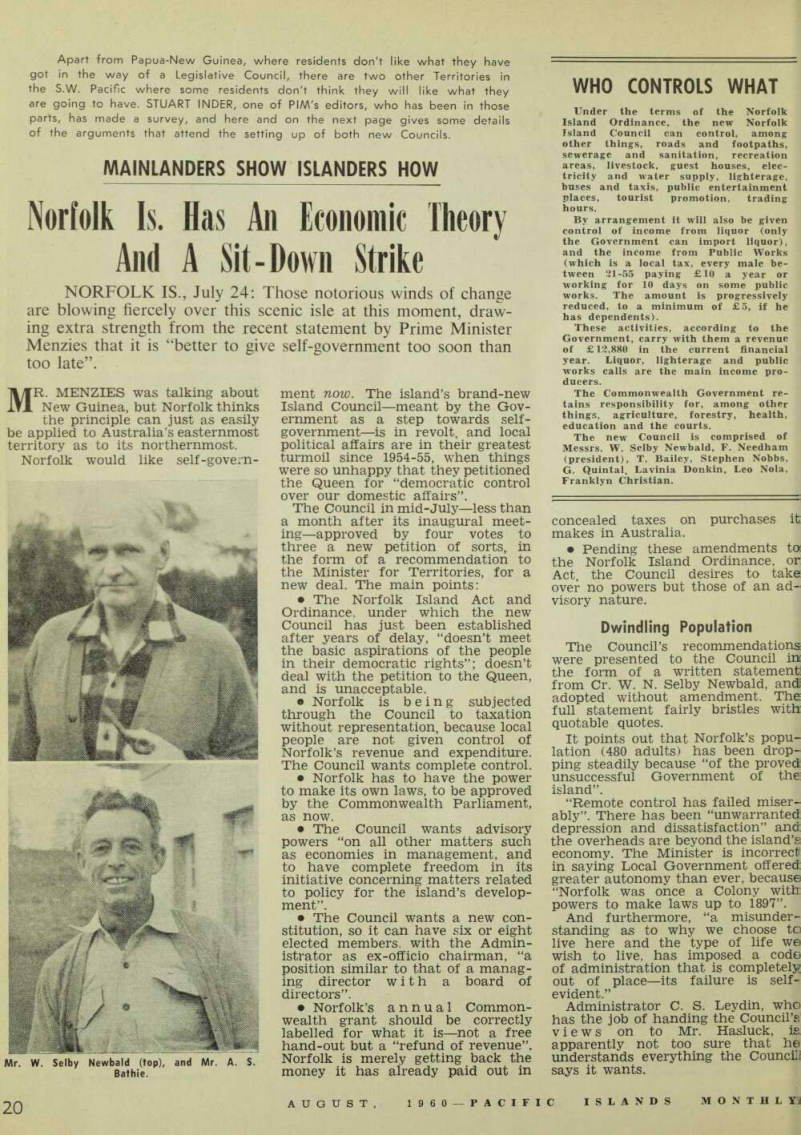
Mr. W. Selby Newbald (top), and Mr. A. S.
Bathie.
He has asked the Council if he can meet it to clear up some points.
Meanwhile he has allowed himself the comment that he is “naturally disappointed that the Council found the Ordinance unacceptable, as it represented effort spread over two years or more in discussions with the Advisory Council, preparation of drafts and amendment of them to jive what the Advisory Council had igreed would be a fair and workable jonstitution for the Council.”
He added that the activities the Council had been expected to carry >ut (see box) would have brought i revenue of £12,880 to the Council, md, as far as he was concerned, it vas more than sufficient to cover heir running costs.
So now, nothing is happening on he Council, and everywhere it’s the Teat topic of conversation. It’s im jossible to know whether Norfolk Is. esidents really support the Council’s ctions or not. In the thick of it, hree names are being heard —those f Mr. Selby Newbald, Mr. Fred leedham and Mr. A. S. Bathie.
They all have one thing in common -they’re mainlanders—a mainlander eing anybody who isn’t an islander, ’he islanders, many of them escendants of the Bounty mutineers, ave a habit of quietly and politely anging-up against mainlanders on rucial issues, but something appears a have gone wrong with the ractice lately.
"Out" —With Three Notices I discovered Mr. Newbald in a harming house hidden behind an nposing, locked gate, with a strand f barbed wire on the top; two otices declared that he was OUT nd a third said that visitors eren’t welcome at the particular our I happened to be there un rmounced.
But I climbed the barbed wire nd knocked, and it says something )r Mr. Newbald’s own charm that received a friendly welcome.
Mr. Newbald has been in Norfolk L years. Before that he was briefly i New Zealand, and before that e retired as sales director of a ■ oup of light engineering com anies in the English Midlands.
The recent troubles at Norfolk, cplained Mr. Newbald, started be tuse the people were annoyed at le Advisory Council. When that ive way to the Norfolk Island ouncil in June, the people gave leir votes to a group of pro ressive candidates who campaigned i the same platform—that is, to ring back democracy.
A majority of the groupers got ito the Council of eight, and rouper F. J. Needham was elected ouncil President.
“Our win was a bit revolutionary, suppose,” said Mr. Newbald. “We iclude two mainlanders—Mr. Need
(Continued on page 143)
ham and myself.” (The two topped the poll), Mr. Newbald said an income of £12,800 to run the commitments the Council was expected to take, wasn’t enough. You wouldn’t look at a busi ness under the terms the Council was given.
“We would only find ourselves in debt, so there is no point in taking over Local Government on those terms. We’ll dig our toes in, right at the beginning.”
What will happen if the Minister rejects the Council’s recommenda tions? Will the groupers resign?
“We will take the matter to the people and ask them what they want us to do.’”
It's A Norfolk Is. Theory Mr. Newbald estimates that Norfolk provides the Australian Government with at least £40,000 a year through purchases the islanders make in Australia. (Nearly all Norfolk’s im ports come from Australia.) He says the Australian companies supplying the goods pay all kinds of taxes to Australia as a result of their sales.
And islanders paid income tax on their Australian holdings.
All this was islanders’ money, so the annual grant was merely a way of giving it back to them on the pretence that Australia was being generous.
Thanking the courteous Cr. New bald, I got into one of Norfolk’s three taxis to set out in search of Cr. Needham, and found myself talking to the courteous Cr. Leo Nola, who happened to be driving it. He’s the only other mainlander of the eight councillors, but since he is married to an islander some people forget it.
Said Mr. Nola: “The Council can make a go with a revenue of £12,800. I would try it. There is no use simply sitting down. The Council has to come up with something con structive. They’re just up in the clouds. The things the Administra tion has kept from us. such as educa tion, are the things that would run us into debt, anyhow.”
Mr. Nola said a lot of people, in cluding him, didn’t understand Mr.
Newbald’s theory about hidden charges being owing to Norfolk from the Australian Government. Norfolk
bought some things from Hongkong, too, but Norfolk would have a hard time trying to convince the Hong kong Government that it should hand over the taxes in them to Norfolk.
Mr. Nola located Council President F. J. Needham for me just as he was setting off from the Cascade Bay jetty at the wheel of a battered truck.
Mr. Needham, who came from New Zealand 14 years ago, obligingly stepped down for a few words. There doesn’t appear to be any personal animosities—just a difference of opinion.
It was a crisis year in Norfolk, Mr. Needham said. It was now or never, politically. Remote control had been given a fair trial. The islanders knew something was wrong but didn’t know what to do about it, and couldn’t offer anything better than what the Council was doing.
“We gave them our platform and they voted for it.”
Minister's Interest in Antiquities
Mr. Needham said Mr. Hasluck’s only interest in Norfolk was the early convict-built buildings at Kingston He spent money on them, but not on things that counted.
The Council was being offered a third of the island’s revenue, but all the headaches. It was just a trap.
It couldn’t make the thing work on the money offered.
He added that the Council was prepared to fight on the issue, and if necessary send another petition to the Queen.
I found Mr. A. S. Bathie at the other end of the island leaning on the counter of the Government’s liquor bond store, which looks like a well-stocked bottle department of a Sydney hotel.
Mr. Bathie is a mainlander, too, an Australian, but he isn’t a Councillor. However, he was a mem ber of the old Advisory Council (not one of whom was re-elected), and in Norfolk he has the reputa tion of being the real leader of the opposition, even if he hasn’t a seat for himself.
He likes to write colourful letters on the subject of the Council to Norfolk News, which is a roneoed Administration news-sheet on Nor folk affairs.
He pointed out that on the voting at the election the Council “didn’t represent the majority”, as the group’s total was less than the combined total of the opponents, whose votes had been split.
Said the energetic Mr. Bathie, as I lined him up against a wall for a photograph, “There isn’t an Island Council. It’s all just Newbald.
They’re going to take on the whole Australian Government, but they won’t beat ’em!”
And a lot of people on this island are saying that if there could be another election the islanders may take a different view of things.
But they could be wrong, too!