Timetable For Burns
p. 20 · Read in the full issue
Future Of Fiji
Timetable For Burns Plan Of Reform
WHAT consideration is being given by the Colonial Office and the Fiji Government to the Burns Commission Report on Fiji’s problems, and when did the Min ister expect to make a statement of policy regarding the Burns re commendations, were questions asked in the House of Commons on July 25.
The Colonies Minister (Mr.
Macleod) replied: “Decisions on many of the minor recommendations in the Burns Re port have been reached.
“But on the major issues—notably, the proposals for the reorganisation of the land, and the future of the separate Fijian Administration — the Government of Fiji wishes to allow ample time to obtain the con sidered views of the general public, or members of the Legislative Coun cil, and on those matters affecting particularly Fijian rights, and the
interests of the Fijian authorities and people.
“The Fijian Affairs Board has already spent much time in study ing and discussing the report. It is being considered by Fijian Provincial Councils at special meetings this month, by the Council of Chiefs in August, and by the Legislative Council in September or October.
“In the meantime, a development plan for Fiji based on the recom mendations in the Report, is being prepared.
“I do expect to make a statement later in the year, when I have con sidered the recommendations of the Fiji Government on the major issues.”
Fijian People Not Happy
Up to the end of July, a number of the Fiji Provincial Councils had considered the Burns Report re commendations.
No official reports have been pub lished; but unofficial reports in dicate strong opposition among the Fijians to the proposed changes in the Fiji Administration.
All reports show a strong anti- Indian sentiment. The Ba Council —one of the most powerful—formally resolved to oppose any part of the Burns Report which “helped the Indians”.
There appears to have been a sharp upsurge of alarm that the position of the Fijian landowner now is threatened by the rapid growth of the Indian population, and that the British-controlled Government tends to side with the Indians.
An outstanding figure among the younger Fijian leaders is Ratu K. K. T. Mara, MA, a prominent official in the Fijian Affairs Dept.
He is strong, quiet, purposeful and outspoken; and he has very definite ideas about the Burns Reform Plan.
So far, he has not been antagonistic but he has been very critical; and as the Plan moves forward slowly through the Provincial Councils, he is in the lead of those Fijians who require clarification and reassur ances.
The Governor is in constant com munication with the Fijian leaders, especially Ratus Mara, Penaiaj Ganilau, E. Cakobau, and others.
Ratu Mara acknowledges that the?
Indians now are a permanent estab lishment in Fiji; but he flatly re fuses to contemplate any plan in which the future of Fiji depends on greater unity between Fijians and Indians, and the withdrawal of the= Europeans. In his view, the Euro peans must always be there, to hold the balance fairly and justly be tween the two bigger communities.
Ratu Mara, an outstanding figure among the younger Fijians.
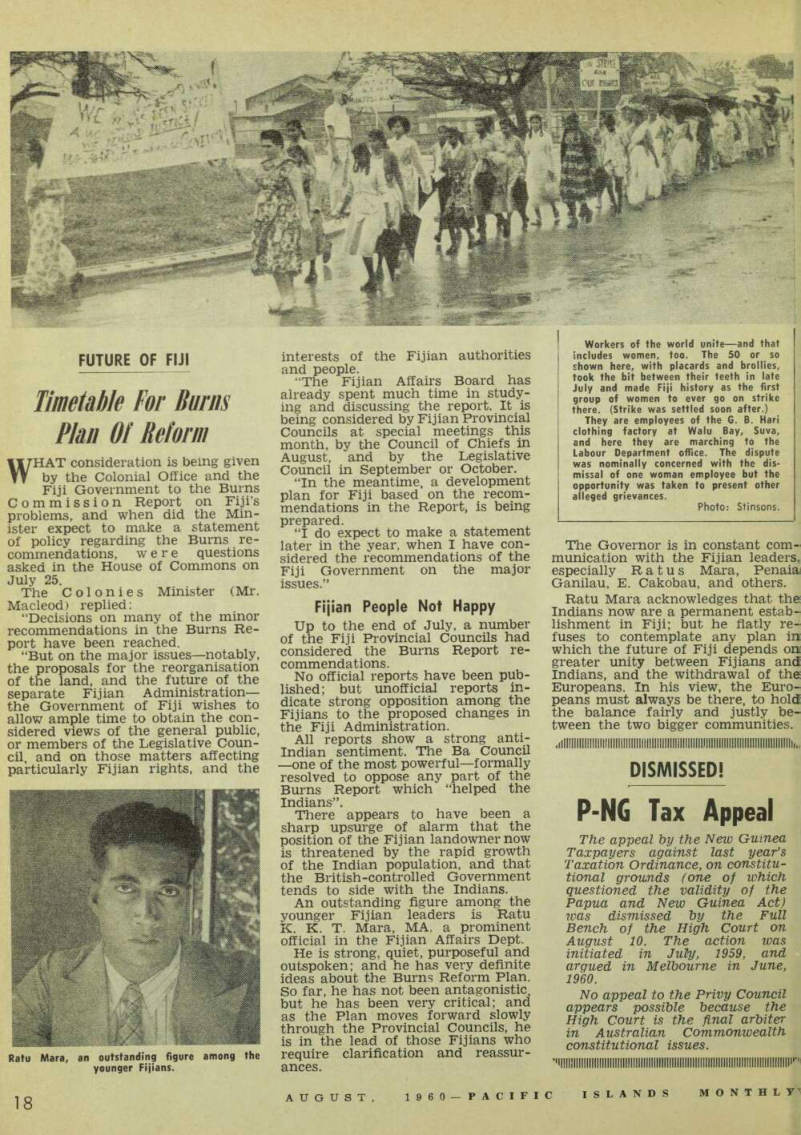
Workers of the world unite —and that includes women, too. The 50 or so shown here, with placards and brollies, took the bit between their teeth in late July and made Fiji history as the first group of women to ever go on strike there. (Strike was settled soon after.) They are employees of the G. B. Hari clothing factory at Walu Bay, Suva, and here they are marching to the Labour Department office. The dispute was nominally concerned with the dis missal of one woman employee but the opportunity was taken to present other alleged grievances.
Photo: Stinsons.