The Month's New Reading
pp. 90-97 · Read in the full issue
With Judy Tudor
No one but Australia’s own Frank Clune would attempt to squeeze a book of 264 pages out of the 190 miles journey (“ramble-amble”, he calls it), between Sydney and Canberra.
That's over a page per mile, which is pretty good going, even for Frank.
NOT that the Clune literary cavortings, both in time and space, don’t range far and wide from that narrow piece of bitumen.
Starting from Vaucluse —e very reader of Clune knows that he lives in Vaucluse, which, in Sydney, is just the best—practically everything reminds him of something else. Of the bad old Convict days (all convicts, according to Clune, were maligned angels, victims of a vicious system); of Bushrangers, who are his heroes; of Dastardly Police and Troopers; of Wild Colonial Boys.
To say nothing of pieces of for gotten history and personal anecdote.
Perhaps “squeeze”, used in the first paragraph above, is the wrong word entirely in connection with Author Clune. His literary output floods out like water from a burst reservoir, and if the real Sydney- Canberra journey were carried through in such spate, poor Mrs. C. —Brown Eyes, in Clune books, where she is now one of the standard props —must have been quite dizzy before they reached, as her husband put it, the Hard Heart of the nation. (Meaning that the Commissioner for Taxation lives there), It is said in the trade that Frank dictates all his works onto a machine, a typist transcribes them, and the result is sent, as is, to his publishers. This is probably quite un true, although his books have the sound of having been spoken, against time, on a radio session.
But Clune in Australia is to be infinitely preferred to Clune abroad fßoaming Round Europe. Tale of Tahiti. Flight to Formosa, etc., etc., etc.). And if, by some piece of literary chemistry, you could put some of Clune’s Australian stories in a crucible and render-out the Clunisms and other solecisims, you would probably come up with some plain Australian history that is in teresting now and will become quite valuable as time goes on.
The best thing in the current Clune, and quite worth the rather exorbitant price of 27/6 that the publishers put upon it, is the story of Stella Maria Sarah Miles Franklin, better known by her two last names, Miles Franklin.
Her erratic and extraordinary career has, no doubt, been set out in print on previous occasions, but as far as this reviewer is concerned, it was left for Frank Clune to shed some light on this enigmatic Aus
tralian novelist whose All That Swagger is still the most brilliantly written and most readable story of Australian pioneering. It was left for him to suggest, too, that that other Australian novelist, '“Brent of Bin Bin”, who produced another classic of its kind in the 1930’s {Up the Country ) was simply Miss Franklin under another name. (“Brent of Bin Bin” produced other novels subsequently, but these, according to Clune, were probably in collaboration with another Aus tralian women writer who also chose to live in England).
Miles Franklin wrote her first novel in 1899, when she was 19. She called it My Brilliant Career, and as it was written in the first person, the people around Goulburn, which provided the setting, read a great deal more into it than was intended, imagined that they saw some of themselves caricatured, and were suitably indignant. To escape from their unsought attention, Miss Franklin went to Melbourne, and a few years later, to the United States
where she stayed until the outbreak of World War I, when she crossed to England, enlisted in one of the women’s services, and went tc Salonika.
Except for one brief visit, Mild Franklin did not return to Australia until 1933. In her entire life—and she was 75 when she died in Sydney in 1954—she wrote only four boold under her own name ( My BrilliavX Career, in 1899; Old Blastus o\ Bandicoot, in 1931; Bring thi Monkey, in 1933; and All Thai Swagger, which won the Prioi Memorial Prize in 1936).
After All That Swagger, in 1936 she appears not to have written anything else—even in collaboration with Mary Fullerton, who is sup posed to have been the other part of “Brent of Bin Bin”.
In the years just before and just after her last novel, Clime says that he saw a great deal of Miles Franklin, and, with Brown Eyes as the third member of the party, they travelled together by car in South Australia, Victoria and NSW.
For once in a while, Author Clune is quite reticent as to the reason for this —but for what you did tell, we humbly bow and say, Thanks, Frank, (JOURNEY TO CANBERRA. Published by Angus and Robertson, Ltd. Australiar price, 27/-.)
It's That Nino And
The Aussies Again
11/’HEN an Australian book, pub f? lished in Australia, sells 250 000 copies, it is not only unusual, it is downright miraculous. It has
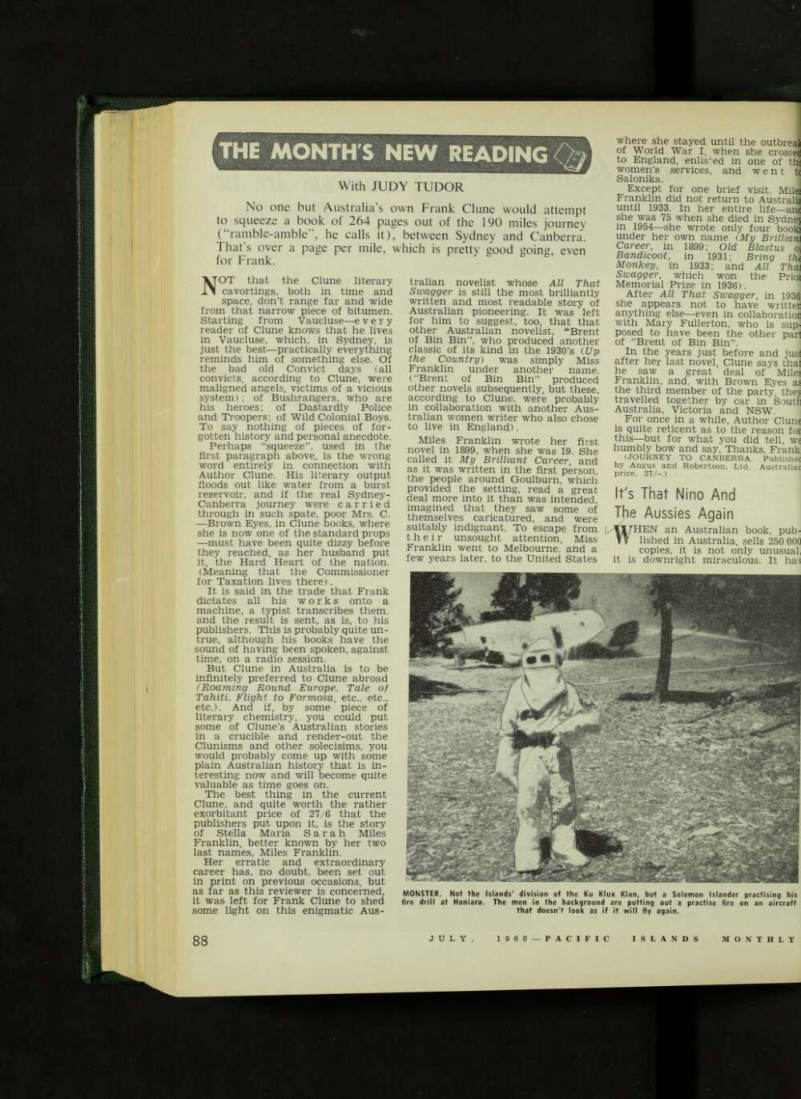
MONSTER. Not the islands' division of the Ku Klux Klan, but a Solomon Islander practising his fire drill at Honiara. The men in the background are putting out a practise fire on an aircraft that doesn't look as if it will fly again.
ppened only once —Nino Culotta/ in O’Grady’s They’re a Weird )b. [n Weird Mob, Nino, a migrating irnalist from North Italy, took a ) in Sydney as a builder’s labourer order to get to know the Aus ilians better.
Nino had prided himself on his owledge of English, and in fact, □ke like a phrase book. But that ls the first thing he learned about istralians: They didn t speak Eng h.
The second thing was about that
her Australian phenomenon—male
ateship.
On these slim threads the book is based —and from John O’Grady s traordinary genius for getting istralian dialogue down on paper, ,me success. Oddly, perhaps, the >ok appealed strongly, not only to istralians, but to New Australians do identified themelves with Nino id his assimilation troubles. This id quite a part in boosting sales.
So much for Weird Mob. But with ich success, something further ong the same lines was inevitable, id in 1959 John O’Grady went to irope to gather the material for return match. The result has just ;en published— Cop This Lot.
This tells the story of how Nino, is Australian wife Kay, his builder lend Joe and his wife Edie, and ieir friend Dennis, visit Europe, id in particular, Nino’s family who ve about 20 miles outside Milan.
Can a sequel ever be as good as le first book? Would Cop This Lot :and on its own as a successful tory, without the prop of Weird lob? These are questions to which very reviewer who chuckled at the rst Nino, is now trying to propound rudite answers.
The answer is probably “no” to oth questions; but as a logical con inuation of the adventures of those haracters, if a continuation there iad to be, it is hard to see how ohn O’Grady could have improved >n it. .
At times it does come perilously lose to plain corn—as, for example, vhen the Australian party meet up vith that beloved instrument of Continental plumbing, the bidet, ind discuss its possible use and vhether it is intended for washing ;he feet. But, as in Weird Mob, the ’antastic Australian dialogue steers ;he story round some sticky pa f ches md provides a number of the verbal dots that delighted fans in the first aook.
The language difficulty, of course, helps. When on a train journey be tween Karlsruhe, they ignore an an nouncement in German, and go on eating breakfast in the dining-car.
When Joe leaves first, he finds that everything that was once behind has been detached. He returned to the dining car, “wild eyed and running”.
“Hey,” he yelled, “the bloody train’s
gone.’”
“Wodda yer mean gone? Gone where?”
“Gone to buggery. There’s only one carriage behind this one. Were stuck in a siding miles from bloody nowhere.”
“Yer mad.”
“Mad, am I? Come and ’ave a look. We been got at. Suitcases an’ everything. Gone ter buggery.”
They finally found the right piece of train again, by running miles over tracks and between shunting engines while frenzied German officials screamed at them and blew whistles.
Along with his talent for repro ducing dialogue, O’Grady has in
sight into character and his own way of expressing it. In few words Nino is the everlasting sentimentalist, the Australians, casual to the last.
It was decided the women should travel to Europe in some state; the men, so they wouldn t have to “dress up”, in a cargo ship which they picked up in Fiji. In the Australian view, it was an ex cellent idea to have two months holiday away from one’s spouse, but Nino was torn by emotion, and as the plane pulled out of Mascot, leav ing Kay waving from the tarmac, he wept. He tpld himself that he was just a sentimental Italian, then he glanced across the aisle to Joe.
Joe, too, was looking serious and
/ quiet. He obviously wasn’t en ng the departure any more than o. Nino called across to him: is all right. They will be all it.”
Drright be buggered,” said Joe, icy bend about a foot every time goes over a bump. Wodda yer con’s in them tanks on the ends? ,d?” oe’s mind wasn’t on wives or nen; he was worried about the g, tapering wings of the Super istellation aircraft and their well >wn habit of trembling like a leaf a breeze. ’o sum up: Your sequel is Lght, Nino, but, as Joe might say, use hoggin’ the flamin’ idea to ,th, but. It’s a smart author who iws when to take another tack, 1 we’d hate to see Nino degener into some kind of an Australian lyanna series. tefore he took to writing books, in O’Grady was a pharmacist, and the time They’re a Weird Mob s published, he was working in it capacity in Western Samoa, ring his time in Apia he wrote novel about that Territory and mght it back to Australia with n. lis publishers put it on ice—until
lird Mob’s sequel appeared—but
might be a good idea to bring out of the deep freeze now. There ? stil) a lot of people undecided to whether this bloke can really ite, or is just a recorder of the i-bal antics of homo sapiens Aus ilensis.
COP THIS LOT. Published by Ure ith, Sydney. Australian price, 17/6.)
3—The Way That
ley Saw It
WER hear of Mt. Hercules, 37,783 i ft high —B,OOO ft more than Everest? Or “moolah’s”—animals :e tigers? Or scorpions 13 inches tig, and trees 337 ft high?
This was New Guinea, as seen by gentleman called Captain Lawson, io also discovered buffaloes, onkeys, wild goats and vultures in e same territory.
Modern journalism? No—“ Captain iwson” wrote his Wanderings in New uinea in 1875 and probably thereby t the pattern for all the literary hoppers that have been told about le Territory ever since. (When aptain Moresby challenged the uthfulness of the book, it was ithdrawn from sale; no one ever »und who “Captain Lawson” really as.) This is one of the sidelights in small booklet on New Guinea dis ivery just published by the OxfOTd hiversity Press in their “Australian
xplorers” series.
As with a lot of other publica ons from semi-academic institu ons, this one arrived quite un erased on the editorial desk. lin ing, too, which is a pity.
Purely commercial publications
are never lacking in blurb, and their purpose is always quite obvious. But with the booklet under discussion, and many others in the same category, it is not clear just what purpose they are designed to serve.
This one could be a sort of “historical reader” for junior high school pupils; or, at a pinch, de signed for general reading—although, as the “general reader” now seems to have switched over to TV Westerns, it is difficult to see where this particular audience would come from.
The story covers concisely and in terestingly the period from the Portuguese and Dutch navigators in the early 16th century, to Clancy’s penetration of the Lavam
Valley in the Southern Highlands in 1954, It mentions all the explorers we know the Leahys, MacGregor, Hides, the Champions and the rest.
But in a booklet of 32 pages it can’t do much more than whet the appetite for more —and this it suc ceeds in doing very well.
The author is Roger Joyce, who is unknown to us, and it is interesting to see that he spares the space to say in relation to exploration of the NG’ Highlands; “. . . . The German surveyor Detzner, who went inland when the war broke out and man aged to remain hidden till 1918 .. . was the first European to reach the grasslands of the Central High lands.” <° ver)
Vhether Detzner ever did reach Highlands has been a matter controversy ever since his book ut his alleged NG adventure was dished in Germany, in the 1920’5. * “war” has broken out sporadic r in PIM ever since 1933 or 1934, I it all came up again for dis sion last year. Detzner, who we ierstand is still alive, has never hered to contradict the allega i that he never got closer to the jhlands than the Saruwaged nges.
Australian Explorers New
INEA. Published by the Oxford Uni sity Press. Australian price, 4/-.)
istair Maclean
>es It Again
OR a rattling good yarn, Alistair Maclean is hard to beat. He has given us some pretty good stuff, t the least of them HMS Ulysses i d The Guns of Navarone. iclean, a Glasgow schoolmaster, pt from obscurity to fame over gh t following publication of ysses, and he deserved it (that rticular book sold over a quarter a million copies within six mths, a record for a first novel).
Vlaclean’s latest book, Night ithout End, isn’t up to the same mdard as either Ulysses or The ms of Navarone, but it has the me well tried Maclean recipe action and suspense, and aclean-enthusiasts won’t be dis
pointed,
Maclean, as usual, manages to -etch a point a bit too far here id there but—again as usual—it iesn’t seem to make much differ lCo.
Night Without End tells of a crash an airliner on the Greenland ice p. close to where an IGY station being operated by Dr. Peter ason and a team. It soon turns it that this is no ordinary crash id hardbitten Dr. Mason finds mself involved in a spy drama hich has to be played out in the iddle of an Arctic winter. He wins it in the end, of course, but only ■ter a series of narrow escapes that imetimes threaten to freeze your iood solid. (NIGHT WITHOUT END. Published by ollins. Australian price, 18/6.)
»ony Lands A
[ecord Catch
VS we have said, Arthur Upfield’s mysteries are not always of the most mysterious and his enouements sometimes lack the ig surprises of other thriller writers. However, in the background department he is tops, and for his urrent model The Mystery of 'wordfish Reef— the Progress Asso iation (if there is one), of Ber nagui NSW South Coast, should
erect some sort of monument to him. It is about the best publicity that neck of the woods has received since the late Zane Grey put his seal upon it as a big-game fishing resort.
Although the South Coast of NSW has always been known as a good fishing ground, it was not until the early 1930’s that it was discovered that it was the haunt of marlin— or swordfish—in the summer months.
Bermagui, a small village, became the centre for this sport, and still remains so for those who can afford the expense involved.
Once, long ago, when your re viewer was much younger and per haps sillier, she spent a week-end at Bermagui. It was primarily for romantic purposes but af er the traditional Sunday meal at the pub (of roast beef and apple pie with thick yellow cream), she was mis guided enough to go “outside” in a fishing boat with the reason for it all and a bunch of local fishermen.
She spent the afternoon, while the rest of the party fished, lying in the bottom of the boat with two gummy sharks, getting rid of the cream, etc and envying the sharks which had died quite quickly.
This was her first and last visit to Bermagui—but she was pleased to note that the sea off that spot did not affect Upfield’s part aborigine sleuth in the same way.
Although we are more accustomed to having Detective Inspector Napoleon Bonaparte detecting around the arid outback (where his creator spent a lot of time as a young man), he not only took to the sea like a born sailor, but succeeded in landing the second biggest sword fish ever.
It is hard to decide whether this is a story about game fishing, with a mystery about the disappearance of the Do-Me thrown in; or jus" the other way about. But, in any event, it is a bright piece of Upfieldism, and calculated to do no harm at
all to the Australian business of big game fishing.
(The Mystery Of Swordfish Reef.
Published by William Heinemann, Ltd.
Australian price. 15/6.)
He Lived To
The Tale
Stanley S. Pavillard Looks
like a Spaniard, has a name that might be foreign, and has a medical practice in Las Palmas.
It could all add up; or it could be just environment triumphing over heredity. He acts British enough, in all that elastic term can mean In 1940, he went as a medical officer to Malaya and until the balloon blew up, lived the normal existence of any bright young doctor around that rubber growing community. , . „ Like many other people in Malaya, war—real war—came unexpectedly, springing up right there at the bottom of his garden. .
He became Medical Officer in the Ist Straits Settlements Volunteer Forces, and in this capacity ulti mately became an inmate of Changi and after various vicissitudes, ended the war in Thailand. Sixteen years later, back in Las Palmas, he wrote Bamboo Doctor, which has just been released in Australia.
We have lost count of the number of stories about life as a prisonei of war of the Japenese, and so it all boils down to what there is that is new to say about this one.
Firstly, of course, it is written by a doctor, a doctor, moreover, who was responsible not only for in geniously patching up the abused bodies of fellow POW’s, but, through his bluff cheerfulness and his belief that nothing was too much trouble if “his patients” were to benefit, helped keep the men around him on a mentally even keel.
The second thing about this book, is the time it happened to be pub lished. Read in conjunction with the great hoo-hah that has been going on in Tokyo in recent weeks over President Eisenhower’s visit (which didn’t come off) and the signing of the American security treaty: and the shelling of Quemoy Island by Red China because Eisenhower dared to visit Nationalist held Formosa, it tends to make even the most ardent do-gooder feel that we could have saved ourselves a lot of future trouble if we had not drawn the line at just the Nagasaki and Hiroshima bombs.
It is hard to believe now, that one set of humans could be so cold bloodedly cruel to another set of humans; that men should have been expected to live under such condi tions as existed in the Japanese POW camps. But these cruelties did happen not only in Malaya and Thailand but even closer to home, in the South West Pacific. (BAMBOO DOCTOR. Published by Mac millan and Co.. London. Australian price, 22/6.1