Americans Are Nice
pp. 89-101 · Read in the full issue
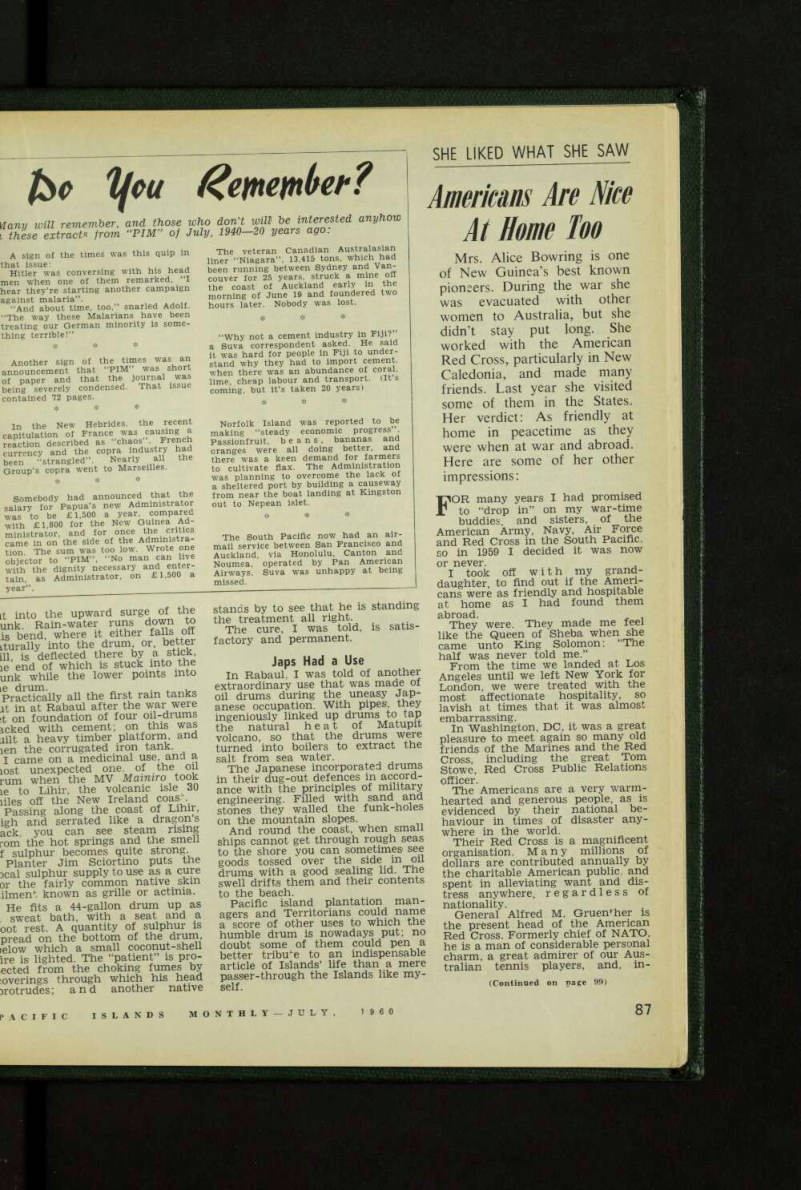
She Liked What She Saw
Americans Are Nice At Home Too
Mrs. Alice Bowring is one of New Guinea’s best known pioneers. During the war she was evacuated with other women to Australia, but she
didn’t stay put long. She
worked with the American Red Cross, particularly in New
Caledonia, and made many
friends. Last year she visited some of them in the States.
Her verdict: As friendly at home in peacetime as they were when at war and abroad.
Here are some of her other
impressions:
FOR many years I had promised to “drop in” on my war-time buddies, and sisters, of the American Army, Navy, Air Force and Red Cross in the South Pacific, so in 1959 I decided it was now or never.
I took off with my grand daughter, to find out if the Ameri cans were as friendly and hospitable at home as I had found them abroad. , .
They were. They made me feel like the Queen of Sheba when she came unto King Solomon; “The half was never told me.”
From the time we landed at Los Angeles until we left New York for London, we were treated with the most affectionate hospitality, so lavish at times that it was almost embarrassing.
In Washington, DC, it was a great pleasure to meet again so many old friends of the Marines and the Red Cross, including the great Tom Stowe, Red Cross Public Relations officer.
The Americans are a very warm hearted and generous people, as is evidenced by their national be haviour in times of disaster any where in the world.
Their Red Cross is a magnificent organisation. Many millions of dollars are contributed annually by the charitable American public, and spent in alleviating want and dis tress anywhere, regardless of nationality.
General Alfred M. Grueifiher is the present head of the American Red Cross. Formerly chief of NATO, he is a man of considerable personal charm, a great admirer of our Aus tralian tennis players, and, in
(Continued on page 99)
dentally, is a champion tennis ayer himself. , Mr. Kevin Kelly, Australian Chair an of Committee of United ations, gave a luncheon par"y in ir honour at UN Delegates Room, id we were invited afterwards to isten in” on this and on a sub iquent occasion, to a discussion on ew Guinea affairs.
Kevin Kelly has a beautiful leaking voice, and elegant grace of iction—if one can use such a hrase—and I admired immensely his lurteous and diplomatic handling r a very mixed assembly of UN elegates.
Admission, One Cabbage
In Virginia we stayed wi f h Lucy irockett, the American authoress, nd her mother. Lucy introduced us 3 Bob Porterfield, founder of the amous Barter Theatre. During the epression years of the early hirties, handsome Bob, an actor limself, had a bright idea to help ither out-of-work actors. He re used that most people could not,
at that time, afford money for theatres, but that a system of barter might appeal to them. He acquired an old building in Abingdon, got to gether a team of actors and actresses, among them many famous stars of stage and screen today, made the price of admission to their shows farm produce—a cabbage, eggs, any kind of food-stuff, so the actors could at least eat—and presto, the famous and immediately successful Barter Theatre was launched, and is still flourishing in Virginia. Bob now has a model farm, with a rotor actor and all mod. cons.
I went to the USA, as I said, mainly to meet again many cherished friends; and secondly, to sample the much publicised “Ameri can way of life,” and I found very little difference from our Aussie living-standards in the corresponding income groups. .
They buy their goods in fancier packages, whh increased cost accord ingly; and housewives are able to purchase almost any kind of food that is ready to pop into the oven.
We are very fortunate in Australia and in New Guinea with our all
the-year-round temperate climate,
making expensive central heading and air conditioning (very comfort ing in the extreme changes of tem perature in America) unnecessary.
Taking it all round, the more I saw of the rest of the world, the luckier I feel we are, and considering the comparative youth of our nation and the small population, I feel quite smug about being an Aussie.
Meeting Mrs. Roosevelt
The highlight of my visit was meeting Mrs. Eleanor Roosevelt, for whom for many years I have had the greatest admiration. When she first asked me to visit her I was committed to a prior engagement to visit friends in “the Roosevelt country” in Georgia, where her uncle Teddy Roosevelt’s parents were married and he was born.
But, to my great joy, she repea f ed the invitation some weeks later. She is a charming woman; friendly and natural in manner, very much more attractive than her photographs Sh ?n‘Washington, DC, whilst being driven round by a Negro driver, he asked me had I seen the Lincoln Monument. I said yes, but that I would like to see it again.
When we arrived, he said, “Every time I pass this monument, I think of that wonderful Mrs. Roosevelt.
Do you know, Ma’am, when the Daughters of the American Revolu tion refused to have Marian Ander son sing at their reunion, Mrs.
Roosevelt brought her down here, where she sang to thousands of American citizens, right here on the steps of the Memorial to The Father of Freedom! Now, wasn’t that something, Ma’am?”
It certainly was.