Territories TALK-TALK
pp. 50-51 · Read in the full issue
With Tolala
A pat on the back for Bob Bunting and the interest he hal shown in the Forgotten Islands that comprise the Bougainville district (June PIM , p. 39) and I see from more-recent NG newspapers that the Administrator has been making a tour of inspection and somewhat glowing accounts given (presumably from the pen of a PRO) of a steel bridge in Buin and a floral -! decorated air-strip on Buka.
MORE practical developmental planes, as outlined by Bob Bunting, are not mentioned.
No doubt they will “receive consider ation in due course”. Bougainville is a long way from Port Moresby.
And I mean just that.
But then it was ever thus.
These geographically-s itua te and islands in the Solomons have for years been expected to battle along under their own steam to a great extent.
In Retrospect
Well do I remember the months we waited in Bougainville for the advent of the Australian Military Forces to take over the district when War I broke out. Rabaul was cap tured by our troops in September, 1914, but it was not until December of that year our siege was lifted and we could breathe freely again.
It was no light task to keep the wheels of planting turning for six months without supplies.
In 1912, when I first went to Buka there were only a half a dozen planta tions on Bougainville and one on Buka. There was Gustav Thurm’s planting at Dewau on Buka and then on Bougainville Carl Diercke at Tinputz; Buka Trading & Planting Co.’s plantation at Numa Numa (an Australian company); Louis Summer at Aropa; Fehr at Iwi; Peter Hansen at Kekere and Hickey at Toimona pau (also an Australian concern).
There were three European traders in Buka: Paul (“Karkar”) Schmidt for Queen Emma at Pororan (whom I relieved), Eric Sjoberg for Hern sheim & Cos. at Petats and Thurm at Dewau, who also had a trading station down in Buin. Thurm was financed by the Neu Guinea Kom pagnie. The only mission repre sentative then was Father Flaus at Burunotui. Our shipping communica tion was the NDL steamer Sumatra.
By 1914, however, BP’s child, Choiseul Plantations Limited had opened up big areas at Soraken.
Kunua, Ban iu, Teopasino and Arigua, and Capt. “Squeaker” Hamil ton had started Inus.
I left Bougainville in 1915 and when I returned from War I at the
beginning of 1921 there had more plantation development According to the old German Lad Laws of 1900, certain virgin lad areas had to be improved within! years and the HSAG Compar (which had taken over Qued Emma’s assets) had contracted wit individual planters to plant u virgin land at Kessa, which m being carried out by Schnackenberg Raua by Les Mutton and Mabiri t Ludwig Kramer. The DH & Pi owned Jame and Sale Islands an contracted with Charlie Huson ft the planting.
Needless to say, after an absent of nearly six years I saw mar changes on my return in Januarj 1921. Kessa was a well-planted are and anew estate had been develope at Karola Harbour, adjacent t Dewau; Jame was a compact sho and there was a potential plantatio at Tulaen, started by Huson whi] planting up Jame; Mathias Islam in Buka Passage, was planted an a government station had bee established at Bonis (later to b transferred to Sohano Island) an it was there I met up with Cec: Levien for the first time, who wa in charge of the station.
I lunched with him and was some what surprised when he insisted o: doing all the cooking. And aver excellent cook he was, too!
Calling at District Headquarter at Kieta I met up with Kiap Harr Cardew (later to be the first Nativ Protector in TNG in Rabaul). Hi Medical Officer was Dr. W. L. Calo\ and no better known medico t ailing Islanders who, to this daj seek him out in his Macquarie Street Sydney, rooms.
But Bougainville remained th Forgotten Island during the Ex propriation Board’s regime. The bi| plantations had their own tie-uj for transport; the little bloke hat to be content with what he coult get and shipping became a problem This problem was a contributing factor in the early ’3o’s for the ole NDL (German) line to inaugurate a shuttle service to Hongkong with the Bremerhaven and later othei boats. In post-War II years shipping
ill a problem in this area and istrumental, I believe, in the ishment of the now-flourish ougainville Shipping Co. s noteworthy, perhaps, that problems were overcome not vernment assistance or inter n but purely by private enter- Was the
Writer?
ich reminds me of rather an ng incident which occurred in the late ’Twenties (I think s) when an article appeared > Sydney Mail entitled. “A Trip Copra Catcher”, depicting vhat intimate details of the dure adopted on some of the island vessels, the rather up ask with which planters and rs were faced in these For i Islands, coupled with critical nations by the writer, whose appeared as “Wanda Lust . lal photographs from Buka and ainville left no doubt as to the ty. ivas not until some years ibaul over a noggin or two with shipping manager of one of did I realise how wide d had been the ramifications e article. companion mentioned the aches he had had searching -nger lists of interisland vessels ng for Miss Wanda Lust, ad Office in Sydney wanted the 1 of the vessel and the captain "was responsible for divulging >any business to a “round ier”. The search had been in en out of the goodness of my t (and after a couple more ins) I told my shipping com on that he was at the moment tie presence of Wanda Lust. I not record his remarks; the or would not pass them, any- Tale Can - Be Told id this incident brings to mind many chuckles I had had ter when editing The Rabaul es in the middle ’Twenties. Older ients of Rabaul (they are few ) will probably remember the nen’s Column on the back page he paper, which consisted of a ■ty letter from Nan to Marjorie. ost of the important social hap ings were referred to with the il comments made by one woman mother and I believe they were i with interest—more especially ig to Nan’s anonymity. rho was she? It became a general stion where the local ladies ‘gathered; each eyeing the other i suspicion. The Administrator s 3 was named Nan. Surely it
couldn't be the First Lady in the I Tea M s™me ny oAh q e Ui i e adief imping that they were responsible. I knew they were not. It was the same srribe who later created Wanda Lust. ad i warcfl A Book Of Verse You can’t beat the Islands’ folk for thinking up some novel way to earn an honest penny for a good cause Latest evidence of this to reach me is an effort in verse entitled, Kaviana, written by S. M. Pasley, and sponsored by the Kavieng Branch of the Red Cross Society.
It is printed at Vunapope, by the courtesy and generosity of the Sacred Heart Mission”. It is dedicated to the memory of the late William Johnson, “whose sense of humour, kindness and charity were such outstanding facets of his character .
There are a dozen “poems” and a leeend entitled King David’s Dream.
But as most of the subjects are of purely “Sal interest the outside reader cannot fully appreciate their TOISI But I do like the Prologue: They built our little township atop
aShJSSI tf "with white beaches,
and the sunshine of His smile.
When the sun sets over Nusa, and the purple shadows fall, We are thankful that we live here, in this fairest spot of all.
Take a bow, Sid., and I hope it
brougM *Um shekels to the
Who Was Kubary?
Here’s a query from Lew P rl^ay, directed towards students of New Guineana: “Does anybody in New Guinea know anything about a chap called ‘Kubary’? I believe he came to Rabaul in the Queen Emma days and he seems to have be en one of the people with local knowledge that made more easy than it might have been the take-over by the Germans, «j have heard it said that he was tosse d out of the Philippines for D i av i ng his own brand of politics f h ere.
“When Ray Sheridan visited Bill Bil Is j and SO me time ago, tracking down stories abou t the Russian sc i e n ti s t Miklouho-Maclay, the Islanders told him that a man named ‘Kubary’ had called in from time to see Maclay, and that he went out to survey some of the offshore islands of Madang with the Russian. The Bili Bil Islanders were quite definite in their that Maclay had another friend besides the two mentioned m he There^ 6 ” rfver on the Ral coast called “Kuban”, too.”
M n pi pn tv " i~y Talk-Talk sorry but sickness has cramped my at fa a bit this mo nth. Hence the brevity.
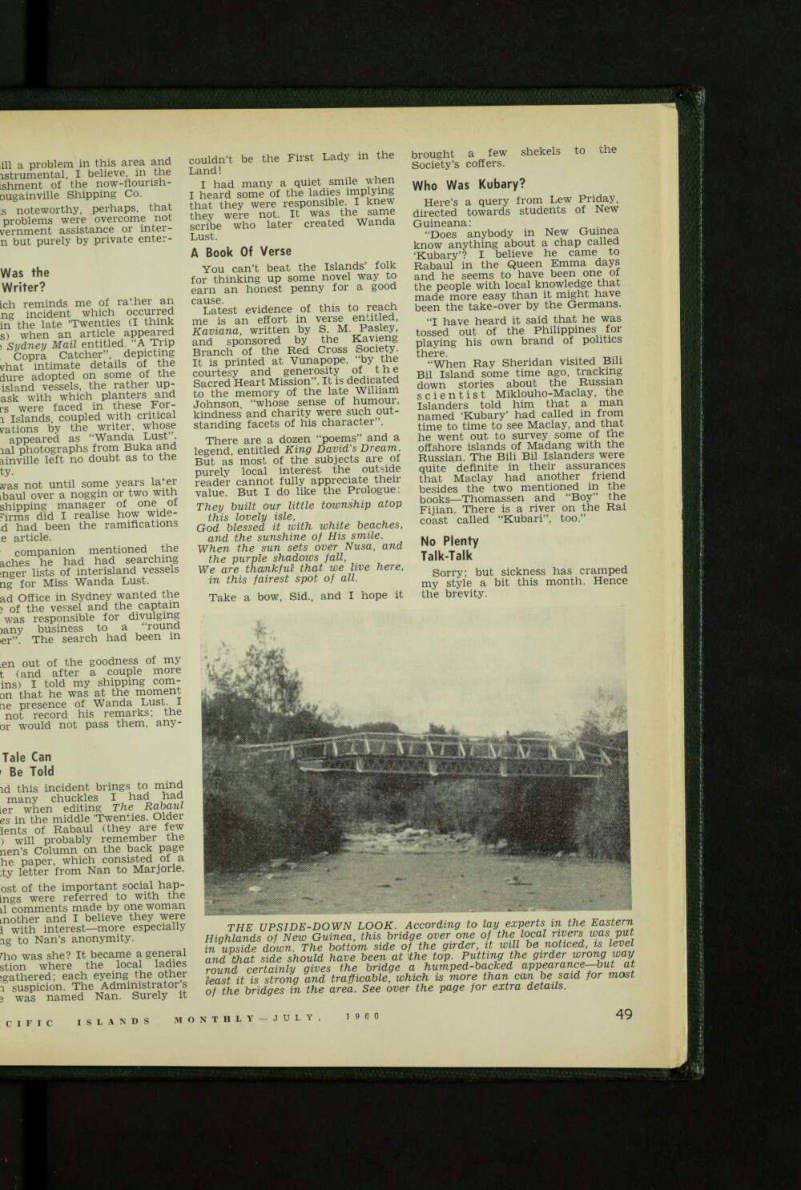
THE UPSIDE-DOWN LOOK. According to lay experts in the Eastern Highlands of New Guinea, this bridge over one of the local rivers was put in upside down. The bottom side of the girder it will be noticed, is level and that side should have been at the top. Putting the girder wrong way round certainly gives the bridge a humped-backed appearance—-but at least it is strong and trafficable, which is more than com be said for mast of the bridges in the area. See over the page for extra details.