Education Right At Home
pp. 47-49 · Read in the full issue

It's There If They Want It
Education Right At Home In The Territory
By a “PIM” Correspondent
One of the risks that European parents have to take wh™ froniml service is that, once their children reach school age, f literal 'lv sel the lalt of them. This, however, isn’t true in Papuo i Guinea any more; there now are educational facilities available n Pre-School to Secondary levels —but only a small proportion of ents are taking advantage of them.
;RE are various reasons for iis—quite valid ones, such as ic wisdom of getting children >f a tropical country into a jrate one (and also out ot rv where they tend to become more “spoiled” than normal); > not so valid reason of accept :he snob value of a “good
vever, these arguments which
been going on for years in j- and most other tropical ories, need not concern us We are interested only in the that parents in the Territory at present, not availing them s of all of the educational rtunities that are offering there heir children.
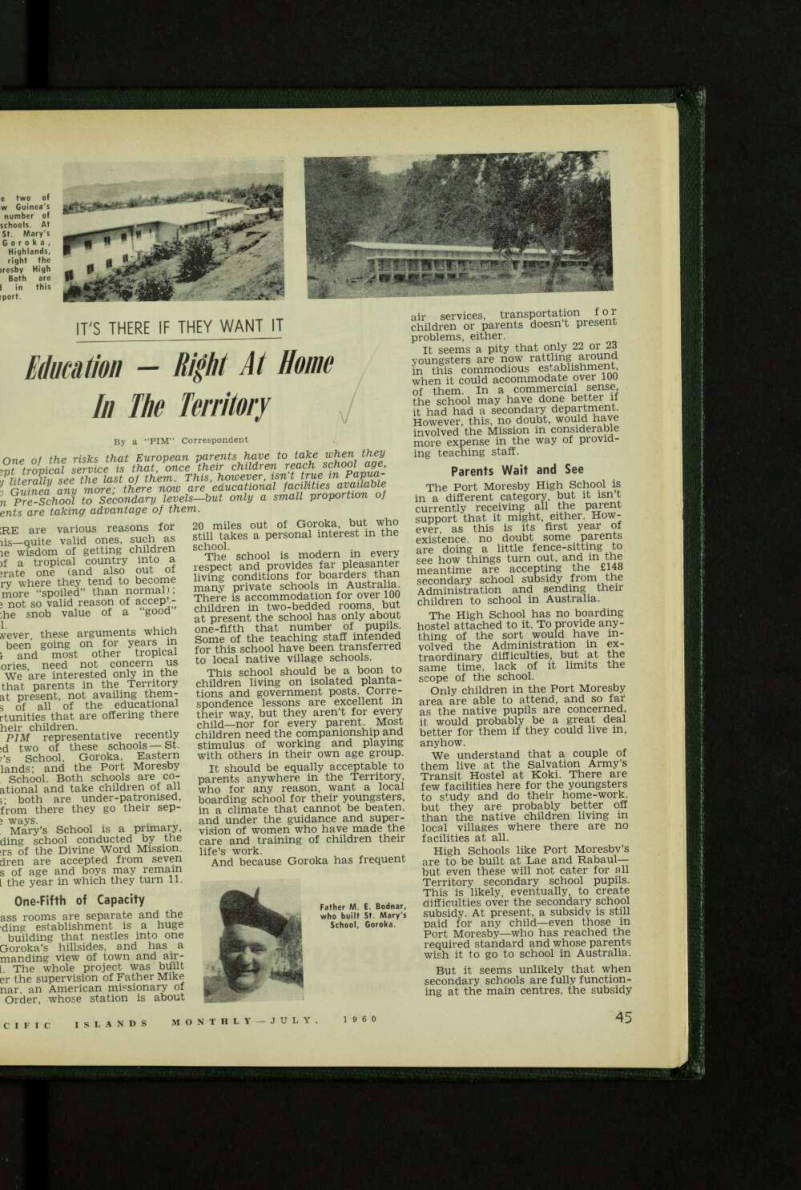
PIM representative recently >d two of these schools St. r s School, Goroka. Eastern lands; and the Port Moresby School. Both schools are co ational and take children of all r both are under-patronised, from there they go their sep ; ways.
Mary’s School is a primary, ding school conducted by the ts of the Divine Word Mission, dren are accepted from seven s of age and boys may remain L the year in which they turn 11.
One-Fifth of Capacity
ass rooms are separate and the ■ding establishment is a huge building that nestles into one Goroka’s hillsides, and has a manding view of town and air [. The whole project was built er the supervision of Father Mike nar. an American missionary of Order, whose station is about
20 miles out of Goroka, but who still takes a personal interest in the school.
The school is modern in every respect and provides far pleasanter living conditions for b(3arders than many private schools in Australia.
There is accommodation for over 100 children in two-bedded rooms but at present the school has only about one-fifth that number of pupils.
Some of the teaching staff intended for this school have been transferred to local native village schools.
This school should be a boon to children living on isolated planta tions and government posts. Corre spondence lessons are excellent in their way, but they aren’t for every child—nor for every parent. Most children need the companionship and stimulus of working and playing with others in their own age group.
It should be equally acceptable to parents anywhere in the Territory, who for any reason, want a local boarding school for their youngsters, in a climate that cannot be beaten, and under the guidance and super vision of women who have made the care and training of children their life’s work.
And because Goroka has frequent
air services, transportation for children or parents doesnt present problems, either.
It seems a pity that only 22 or 23 youngsters are now rattling around in this commodious establishment, when it could accommodate over IOU of them. In a commercial sense, the school may have done better ii it had had a secondary department.
However, this, no doubt, would have involved the Mission in considerable more expense in the way of provid ing teaching staff.
Parents Wait and See The Port Moresby High School is in a different category, but it isnt currently receiving all the parent support that it might, either. How ever, as this is its first year of existence, no doubt some parents are doing a little fence-sitting to see how things turn out, and m the meantime are accepting the £l4B secondary school subsidy from the Administration and sending their children to school in Australia.
The High School has no boarding hostel attached to it. To provide any thing of the sort would have in volved the Administration in ex traordinary difficulties, but at the same time, lack of it limits the scope of the school.
Only children in the Port Moresby area are able to attend, and so far as the native pupils are concerned, it would probably be a great deal better for them if they could live in, anyhow.
We understand that a couple of them live at the Salvation Army’s Transit Hostel at Koki. There are few facilities here for the youngsters to study and do their home-work, but they are probably better off than the native children living in local villages where there are no facilities at all.
High Schools like Port Moresby’s are to be built at Lae and Rabaul — but even these will not cater for all Territory secondary school pupils.
This is likely, eventually, to create difficulties over the secondary school subsidy. At present, a subsidy is still paid for any child—even those in Port Moresby—who has reached the required standard and whose parents wish it to go to school in Australia.
But it seems unlikely that when secondary schools are fully function ing at the main centres, the subsidy
[?] e two of [?] w Guinea's number of schools. At St. Mary's Goroka, Highlands, right the presby High Both are [?] in this [?] port.
Father M. E. Bodnar, who built St. Mary's School, Goroka.
,e still extended to everyone, question will then be —which en are to get it? t Moresby High School this has 57 pupils, seven of them >s Classes are divided into 5 *1 and 2, and supervision is led for correspondence courses Queensland and New South i for those pupils who have ed a higher grade. Next year 3 will come into being, there year by year, other classes ie added until the whole high I class will be available, present 15 subjects are taught se include commercial subjects Dutch (presumably following juggestion of the NNG-P-NG rence). There are five full- European teachers and two ig part-time teachers, under lirection of the school’s head er, Mr. J. C. Reilly.
French Comes Easy
Reilly says that native nts do reasonably well in com on with European students— suffer mostly because at least i-quarters of their time is spent
non-English-speaking environ
and this is one reason why he :s a boarding hostel attached e school would be a good thing. ■ Reilly said that some of the re students are doing extraord ly well in French, a subject at h they have started off from )ch with first-form European Iren. This could prove ePher all things being equal, they hold their own with European Iren intellectually; or that, as have already had to learn a ign language —E ngl i s h—their is are conditioned to the pro i the material side, the school been going through the usual ling pains. At end of May, pupils had no proper desks, but were dng at tables borrowed from all the town; scientific equipment the science room had arrived i some vital bPs missing; and playing fields of the future are nothing but a bulldozed clay iit on the credit side, there eared to be an excellent relation > between pupils and teachers— icthing that could only happen, daps, when the teacher-pupils o is about 1:10. Perhaps, too y realise that they are part of experiment and one that the : of the Territory is watching h interest.
Tie present unit of six classrooms th woodwork room in the base nt) is one of the first Port resby buildings made of bricks, is planned that five more similar ts will eventually be built out re on that pleasant Boroko hill e. Let’s hope that P-NG’s first )eriment in mixed-race, secondary ication is a success, and that the low of pupils keens pace with this ibitious building project.