The Guides
pp. 83-93 · Read in the full issue
It's Jubilee Year For The Guides
By Lew Friday
This year marks the 50th anniversary of the Girl Guide
Movement. The Jubilee, to be
celebrated in Britain with inter national rallies and three days of massed entertainment at
Wembley Pool, offers the oppor
tunity to pay tribute to the work that is going on in the Islands.
IN some places the job is an uphill one—as, for instance, in Papua- New Guinea, where last year there were 2,500 Guides and Brownies. The few European Guiders do their best, but as the Rabaul Area Commissioner’s report for 1958-59 puts it, “The native ,hii dren are not easy to teach and at times we despair of ever getting through to them, but perhaps we can instill some useful knowledge into them.”
The Territory Commissioner, Mrs.
D. M. Cleland (wife of the Admin istrator) invited me recently to visit the Guide House in Port Moresby, opened in 1956 as Territory head quarters and training centre. There I was shown round by Miss Nancy Kempt, former camping adviser for NSW, and now Guide trainer in New Guinea. She introduced me to the nine girls whom she is train ing to be trainers, and showed me their neat, mat-strewn dormitory.
They come from many parts of the Territory. (Over)
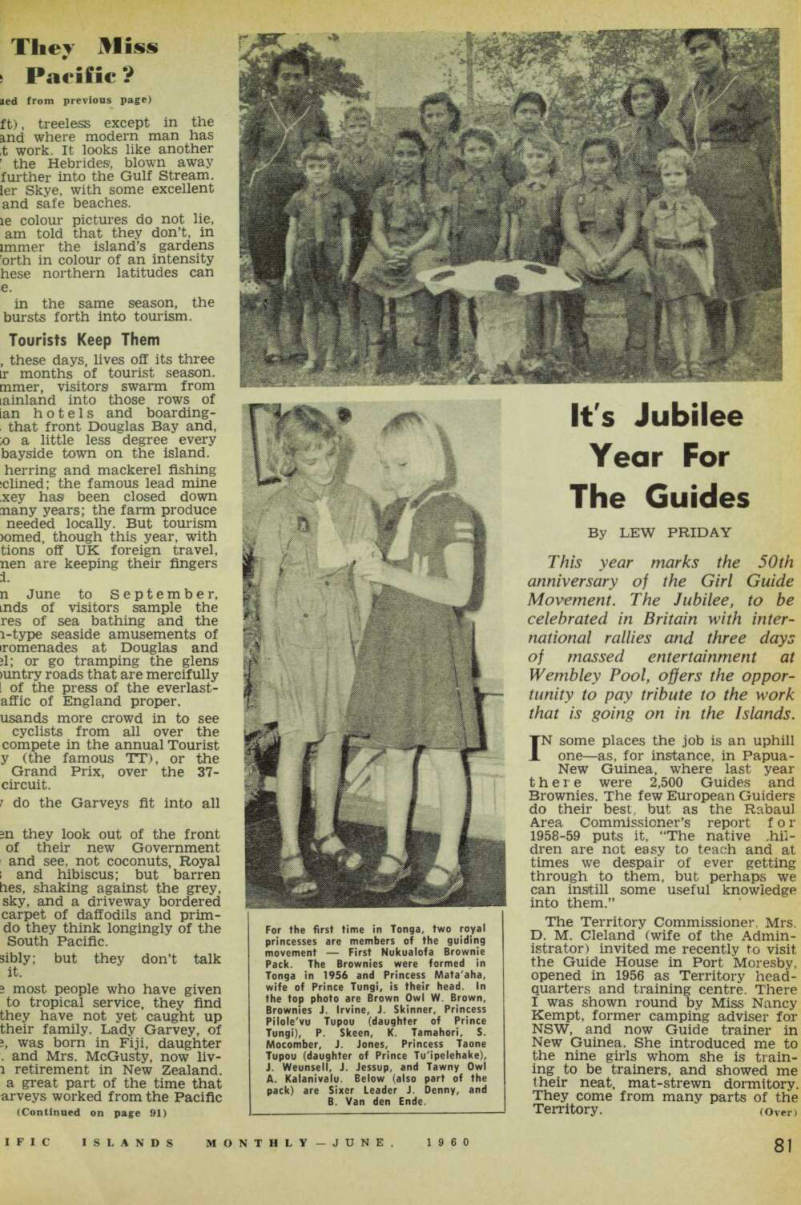
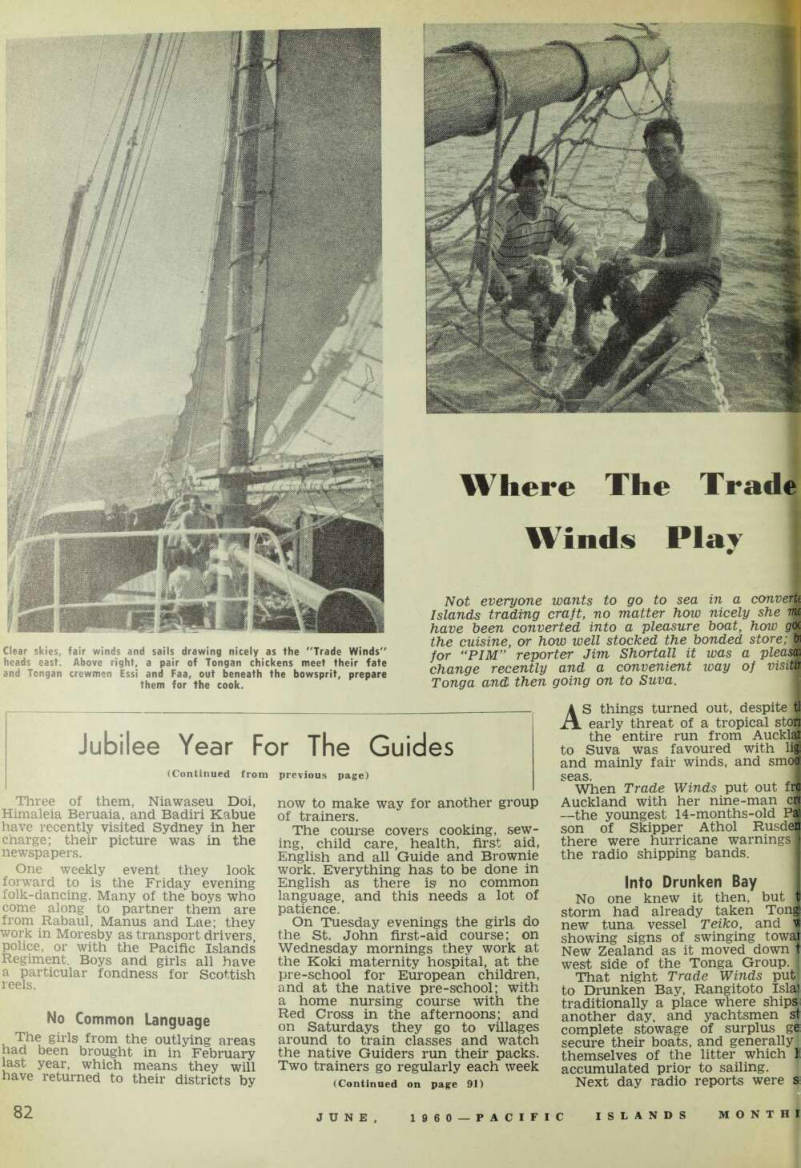
For the first time in Tonga, two royal princesses are members of the guiding movement First Nukualofa Brownie Pack. The Brownies were formed in Tonga in 1956 and Princess Mata'aha, wife of Prince Tungi, is their head. In the top photo are Brown Owl W. Brown, Brownies J. Irvine, J. Skinner, Princess Pilole'vu Tupou (daughter of Prince Tungi), P. Skeen, K. Tamahori, S.
Mocomber, J. Jones, Princess Taone Tupou (daughter of Prince Tu'ipelehake), J. Weunsell, J. Jessup, and Tawny Owl A. Kalanivalu. Below (also part of the pack) are Sixer Leader J. Denny, and B. Van den Ende.
Three of them, Niawaseu Doi, Himaleia Beruaia, and Badiri Kabue have recently visited Sydney in her charge; their picture was in the newspapers.
One weekly event they look forward to is the Friday evening folk-dancing. Many of the boys who come along to partner them are from Rabaul, Manus and Lae; they work in Moresby as transport drivers police, or with the Pacific Islands Regiment. Boys and girls all have a particular fondness for Scottish reels.
No Common Language The girls from the outlying areas had been brought in in February last year, which means they will have returned to their districts by
now to make way for another group of trainers.
The course covers cooking, sew ing, child care, health, first aid, English and all Guide and Brownie work. Everything has to be done in English as there isi no common language, and this needs a lot of patience.
On Tuesday evenings the girls do the St. John first-aid course; on Wednesday mornings they work at the Koki maternity hospital, at the pre-school for European children, and at the native pre-school; with a home nursing course with the Red Cross in the afternoons; and on Saturdays they go to villages around to train classes and watch the native Guiders run their packs.
Two trainers go regularly each week
(Continued on page 91)
io Island, the TB and Han hospital, near Port Moresby, they help the Guides and es.
They'll Move About in their villages after their the girls will be employed association as trainers. The that they will travel round e a circle of villages as pos ,raining the women in cook eedlework, laundry, child I, and inducing them to teach lildren so that they may for their Guide badges, a mile or two away at Port >y is a second Guide House, d, with its handicraft shop native crafts are sold, ade a point of visiting the >uide House in the Territory, t Rabaul. This is handsome House, which cost £5,000, aich was only opened in Jan last year. To this Rabaul its liberally contributed money, and material. When Lady -Powell, the World Chief
Guide, was there in March, 1958, it was a mere framework of steel.
I found a white Brownie troop enjoying games under Brown Owl Mrs. Arthur Hall. Native Brownies outside were enjoying themselves tying knots, which they held up for me to see. They have regular meet ings on Tuesday afternoons, and sometimes they go out on hikes and picnics. They make scrap boxes which they take to Nonga hospital for the native children.
Mrs. A. Richardson, wife of the regional forestry officer, is the Rabaul Area Commissioner.
In Kavieng, where there is a native Guide Company and a Brownie Pack, the Area Commis sioner is Mrs. J. Park.
The Rabaul report to which I have referred says that in the 1958-59 year new companies were formed at Pila Pila, Nodup, Matupit, and Rabaul township; a new Brownie Pack at Pila Pila also.
Older companies are at Tavui, Raluana, Kalamanaguna, Vunairi maand; the Rabaul Brownies in Rabaul.
The report added: “One of our greatest problems is the continual moving population; a native Guider is no sooner appointed and com mences a group, than she moves to another locality, and unless she is chased up does no more Guide work. This goes on all the time and the guides themselves move just as much. It is a really uphill job try ing to be a Guider here.”
So you have to take off your hat to these women for the work they are doing in the face of such dif ficulties .