From The Pacific Isles
pp. 82-93 · Read in the full issue
To The Isle Of Man
From Judy Tudor.
On. a fine day, from the highest point on the Isle of Man, you can see England, Scotland, Wales and Ireland. Repeat on a fine day and according to the pretty, souvenir booklet, in colour, that they sell at the airport.
r\N the day we visited the Isle, it \J seemed doubtful if the pilot could see it, and we flew down unongst the purple clouds of rain ind the bumps at 2,000 feet, pre sumably the better to pick out the vhole, tip-to-tail, 30 miles of it rom the rest of the wet, heaving :rish Sea.
Early April is a chancey time to dsit Man. or for the matter of that, my other place north of the Thames.
But we didn’t have any choice if we vere to see how Sir Ronald and Lady Garvey were surviving the switch from directing the destinies jf a tropical Pacific Island group, to performing the same duties for a sub-arctic island off the coast of England.
It mattered little if the “mar vellous” weather of the previous evening (and every kind of weather short of actual rain or snow, and with no reference at all to tempera ture, is regarded as “marvellous” here) had given place to the usual half gale with steady downpour.
This was the day and we were for it. In sweaters, scarves, rain coats, umbrellas, plastic rain boots, look ing, as usual, like overstuffed duck billed platypus, we faced the elements and the airways.
Plus a Fiji Parrot Sir Ronald and Lady Garvey, with young daughters Lavinia and Juha, and a Fiji parrot, left Fiji at the end of 1958 for pre-retiren * en -/'nln ave in En £ lan d- In the winter }2 5 ? (prudently, so that they t the worst), they found ana bought a charming old Suffolk
farmhouse near Ipswich, and the 90 acres of land that went with it. (Most of the acres are let to a local farmer; on the remainder, Sir Ronald plans some experiments in asparagus growing).
Then, on the day before the family moved in, Sir Ronald was offered the Lieutenant-Governor ship of the Isle of Man, for an initial term of five years.
With two young daughters still to educate, they could not afford to turn it down. They lived in the farmhouse during last summer, and, in the autumn, reluctantly moved out, leased it to an American family for two years 1 , and —complete with Fiji parrot and a new poodle
pup—took up the gubernatorial task again, at Douglas, Isle of Man.
The Kingdom of Man is the kind of anachronism that the English love. It elects no member to the House of Commons but is attached to the bigger Kingdom through the British monarch (one of Queen Elizabeth’s titles is “Lord of Man”), and the Home Office (Sir Ronald Garvey’s new boss). It governs it self through Deemsters and Council and House of Keys, the members of which occasionally get together in a third convocation, the Tynwald.
That Other Kingdom Man raises its own revenues income tax and social services or the same scale as the Other King dom—and pays its own way, which is not an easy thing for any smal community in these days of let' government-do-it.
There is no trace of Saxon o Roman influence on Man; the peopli are of Celtic and Scandinaviai origin. (Ronaldsway, site of th modern airport, is not named afte the latest Lieut-Governor, but afte the Viking, Ronald, who used th nearby beach to haul up his long boats.) Physically, it is an island I rounded green hills highest poir
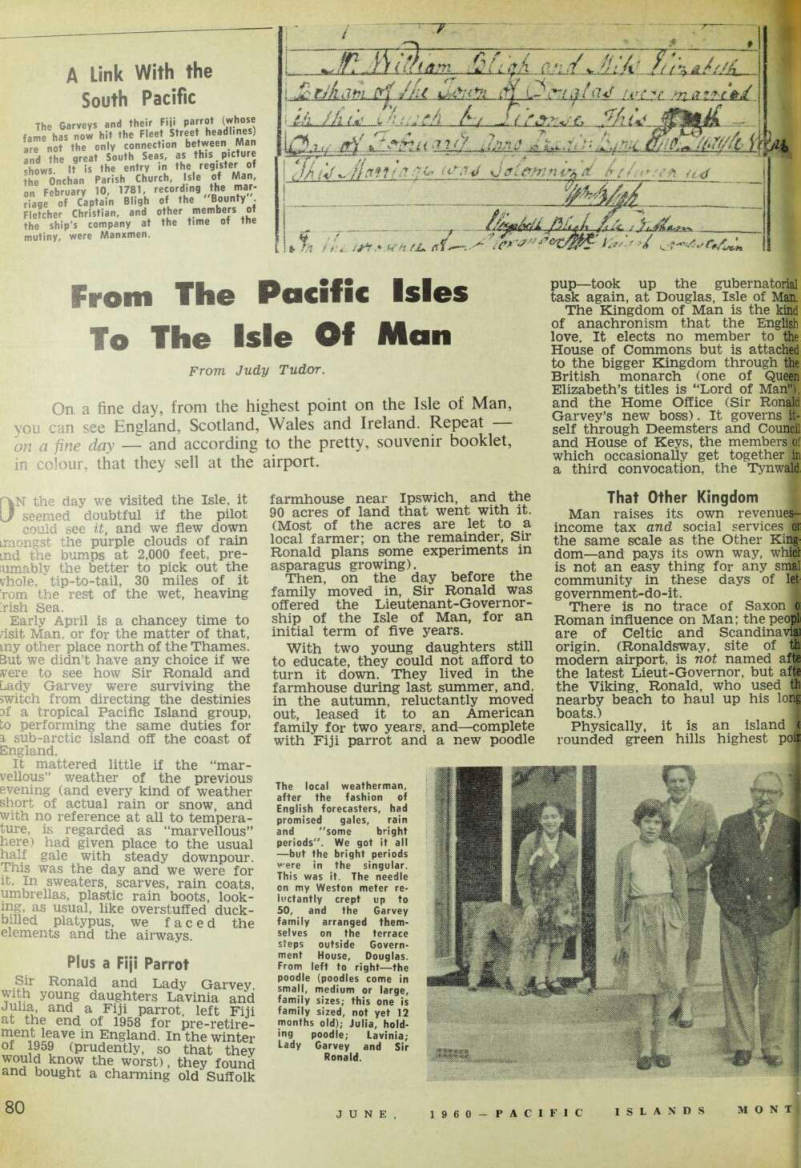
A link With the
South Pacific
The Garveys and their Fiji parrot (whose fame has now hit the Fleet Street headlines) are not the only connection between Man and the great South Seas, as this picture shows. It is the entry in f he register of the Onchan Parish Church, Isle of Man on February 10, 1781, recording the mar riage of Captain Bligh off the "Bounty”
Fletcher Christian, and other members of the ship's company at the time of the mutiny, were Manxmen.
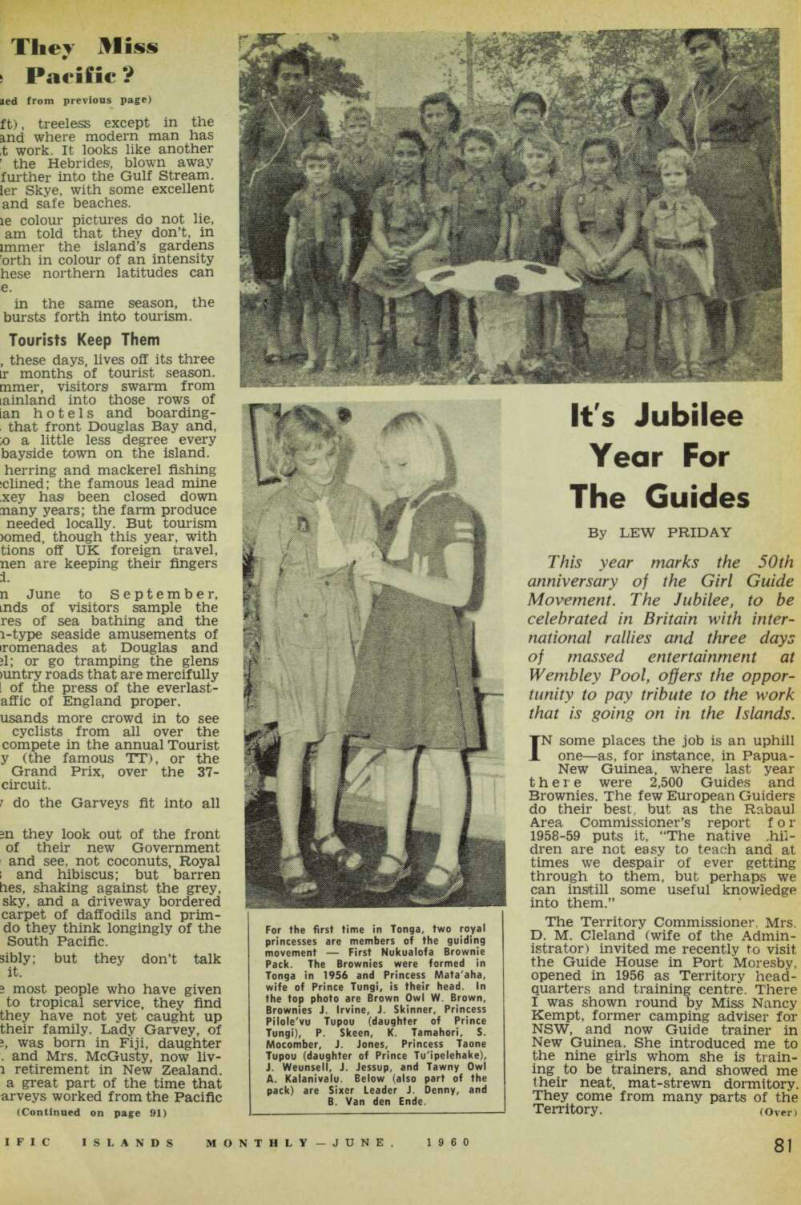
The local weatherman, after the fashion of English forecasters, had promised gales, rain and "some bright periods". We got it all —but the bright periods were in the singular.
This was it. The needle on my Weston meter re luctantly crept up to 50, and the Garvey family arranged them selves on the terrace steps outside Govern ment House, Douglas.
From left to right—the poodle (poodles come in small, medium or large, family sizes; this one is family sized, not yet 12 months old); Julia, hold ing poodle; Lavinia; Lady Garvey and Sir Ronald.
ft), treeless except in the and where modern man has ,t work. It looks like another f the Hebrides, blown away further into the Gulf Stream, ler Skye, with some excellent and safe beaches, le colour pictures do not lie, am told that they don’t, in immer the island’s gardens ’orth in colour of an intensity hese northern latitudes can e. in the same season, the bursts forth into tourism.
Tourists Keep Them , these days, lives off its three ir months of tourist season, tnmer, visitors swarm from lainland into those rows of ian hotels and boarding , that front Douglas Bay and, u a little less degree every bayside town on the island, herring and mackerel fishing iclined; the famous lead mine xey has> been closed down nany years; the farm produce needed locally. But tourism >omed, though this year, with tions off UK foreign travel, nen are keeping their fingers 1 n June to September, mds of visitors sample the res of sea bathing and the i-type seaside amusements of iromenades at Douglas and 5l; or go tramping the glens >untry roads that are mercifully I of the press of the everlast affic of England proper, usands more crowd in to see cyclists from all over the compete in the annual Tourist y (the famous TT), or the Grand Prix, over the 37circuit. t do the Garveys fit into all m they look out of the front of their new Government and see, not coconuts, Royal ; and hibiscus; but barren hes, shaking against the grey, sky, and a driveway bordered carpet of daffodils and prim do they think longingly of the South Pacific. sibly; but they don’t talk it. 3 most people who have given to tropical service, they find they have not yet caught up their family. Lady Garvey, of j, was born in Fiji, daughter . and Mrs. McGusty, now liv i retirement in New Zealand, a great part of the time that arveys worked from the Pacific
(Continued on page 91)
into Africa, to Central America and back to the Pacific, son Anthony and eldest daughter Grania were at school or university in England.
Now that the Garveys themmselves are in the UK permanently,
Anthony has migrated to Australia and Grania is working in the Berkeley Square Branch of the bank of NSW, in London.
With the two young “after thoughts”, Lavinia and Julia, the fates have been kinder. They were able to go to school in Suva, and now again locally, on the Isle of Man.
Settled Down Well For the rest of it, the Garveys seem to have fitted into Man with no more trouble than they once adjusted themselves to life in the G & EIC, Suva, East Africa or British Honduras.
They can tell you the history of Man right back to the Vikings; Sir Ronald indicates that, in certain respects, the administration of Man is one of his toughest assignments (I imagine that the Manxman has his fair share of Celtic stubborn ness) ; Lady Garvey remembers to bow and wave to the fairies who live in the Glen, as we cross the Ballalona bridge on our rush to the airport, and is her usual charming self to every VIP and Visiting Fire man who comes within the orbit of Government House.
And what do the local Manxmen think about having a Governor fresh from the far-fung, outlandish tropics they do not wot of? An in teresting question, but one we had little time to explore. Those few we did talk to didn’t seem unduly per turbed, one way or another.
And that is as good a point as any at which to leave this visit to the Garveys; but leave it, as I did, with a thought as to what would have been the reaction had the position been reversed—with an ex-Governor or Man newly arrived in Suva.
“No experience,” they would wail there, into their tea-cups. “Just what you’d expect from the Colonial Office,” they’d weep into their beer.
Our masters at Whitehall apparently have a theory that a good administrator is a good admin istrator irrespective of latitude In that they are probably right, and in any event, Sir Ronald Garvey now seems to be in an excellent position for proving it.