Australia's Fabulous
pp. 79-81 · Read in the full issue
Pearl Fortune Isn't
From a Special Correspondent in London There has been a certain amount of consternation in a jdest office in Holborn , London, ECI, in recent months fol ding publicity in American “Time”, and in certain Australian wspapers, about the cultured pearl project that went into oration a few years ago in the tropical north-west of Western us tr alia.
CORDING to the newspaper :»rophets, Australia soon could Llmost be getting off the sheep’s and riding to greatness and on profits from cultured pearls, •rding to the Holborn office of -alian Pearl Co., which is in ;je of Mr. B. A. Norman, most ' T hat the newspapers say can I a lot of watering down; It is >ely in the foreseeable future Australia will be reaping the t.ous pearl fortunes that have conjured out of the hat by articles in question, je stories have meant a shut l of publicity from the Aus jin end—whether you are sell •earls or peanuts it does no good our market when rumours of a ;ng flood get into circulation, metheless, when I interviewed [Norman in his London office ipril, he was able to explain a her of angles of the cultured i business as it applies to Aus a.
Once Only The Japanese
.e culturing of pearls was a :,nese preserve before the war was carried on almost ex wely in the Japanese home ids (some attempt was made to luce them in Palau, in the [lines, and, it is believed, in tnesia, but with indifferent suc !ter the war, the Australian lO conducted experiments in Ihern Australian waters using niques learnt in Japan. They meed pearl of a sort, experi tally, and were willing to pass • method on to anyone In
terested, but no one came along to carry the business into the com mercial field until, around 1956-57, Mr. Keith Bureau, of Brown and Bureau Ltd., big-time Australian import-export firm, joined Ameri can and Japanese interests in form ing Pearls Pty. Ltd.
They set up their enterprise in an isolated bay on the north-west coast of Australia, where conditions were considered suitable, and brought in a team of 30-odd Japanese experts to supply the technical skill. The Australian Pearl Co., which had been in the pearl-selling business for years before they were cultured in Australia, was appointed agents for the UK and the Continent. (This company, it is understood, also has a more direct interest in Pearls Pty.
Ltd.).
According to the Time article, what Pearls Pty. Ltd. has produced in the way of the cultured article within two years of getting into business has “the jewellers of the world agog”.
Nobody's Agog
In his London office, Mr. Norman refused to be agog, or to turn metaphorical handsprings over the prize that Time and the newspapers have put into the syndicate’s lap.
Nonetheless, from some of the facts supplied, it is evident that the pearl company has every right to be pleased with operations to date, and that results, judged on Japanese home-island standards, have been spectacularly quick.
The Japanese home industry uses Martensi pearl shell in which to (Over)
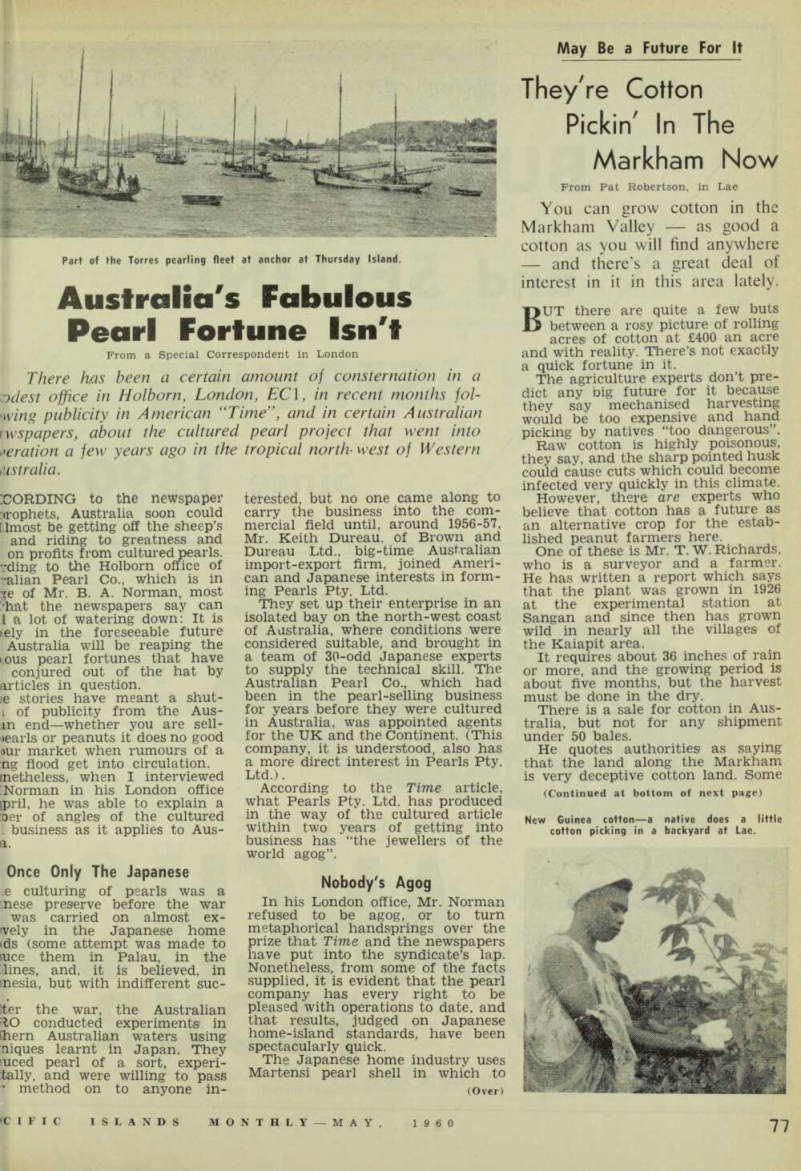
Part of the Torres pearling fleet at anchor at Thursday Island.
It the seed of the future pearl. : type of shell, in comparison . Australian shell, is small and qpable of producing a pearl of ee than 11 mm. ne shell used in NW Australia is and this has produced Us between 11 and 15 mm. The r varieties of shell are not inter ngeable—the Maxima will not i in Japanese home waters, and [ Martensi will not adapt itself r.ustralian conditions. Up to the sent the Japanese shell has one mintage over the Australian —it be “bred in captivity” and is before produced systematically i in quantities required. The Aus 3an shell is a “as is, where is” position at present and must be ).ered where it exists naturally, sriments are continuing on jding it systematically, ne most significant difference reen the Japanese industry and so far developed in NW Aus -3a is the speed with which the [ls are produced. In Japan, four bs is the minimum time in which possible to produce a pearl of mercial size. About half that : is required to produce a some :t bigger pearl under NW Aus san conditions. And size, if not jything, is a big factor in deter ;lng the value of a pearl, ne first Australian cultured [is went onto the London market he end of 1958. How many have i produced and what they are h is information that the com -7 is not likely to divulge. But they are pleased with their r;ure up to date must be obvious, □netheless, there is a difference x syndicate such as Pearls Pty. producing a high-class product, the £5,000,000 cultured pearl in
dustry that one Torres Strait pearler foresaw for Queensland in a Brisbane Sunday newspaper in late February. According to this optimist, culturing pearls could within 10 years fill the vacuum created since the war when the pearling industry folded up due to competition from plastic buttons.
It has yet to be proved that pearls can be mass-produced on such a scale under Australian conditions.
But even if this is possible, it is faulty economic reasoning to sup pose that a vast increase in produc tion can be accommodated within the existing market without some adjustment to price.
At the moment, demand for pearls is somewhat greater than supply, but a sudden flood of the dimensions
imagined by the Torres Strait pearler could tip the scales very much in the opposite direction, with disastrous effects all round, Australia has another problem that the Japanese industry never had to face —the importation of know-how. Without Japanese tech nical skill neither Pearls Pty. Ltd. nor any other company could hope to get past the first hurdle. Im porting these people with the neces sary technical skill could prove a real obstacle to large-scale develop ment of the industry in Australia.
The original Japanese cultured pearl industry was built against a background of plentiful, cheap—and skilled—labour. And that’s some thing that northern Australia has not got.