For NG Towns ?
pp. 71-77 · Read in the full issue
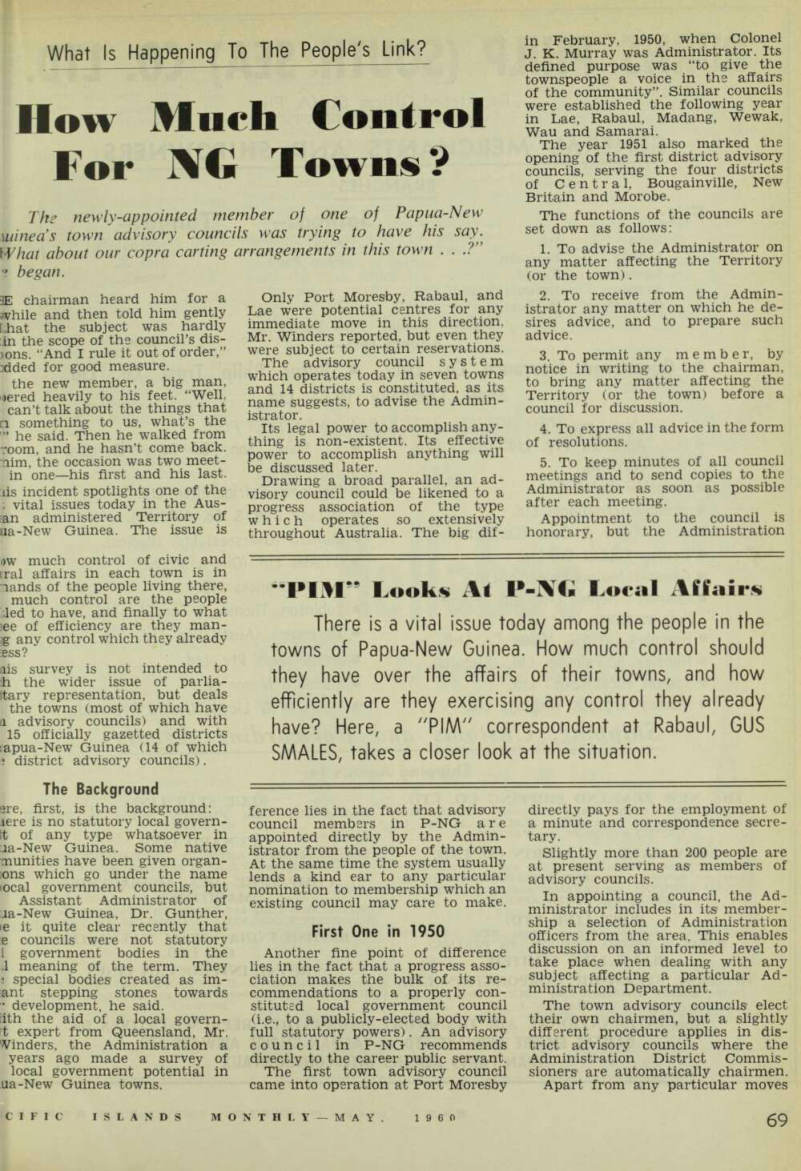


What Is Happening To The People's Link?
How Much Control For NG Towns ?
The newly-appointed member of one of Papua-New guinea’s town advisory councils was trying to have his say .
What about our copra carting arrangements in this town . . .?” ? began.
3E chairman heard him for a while and then told him gently [ohat the subject was hardly in the scope of the council’s dis )ons. “And I rule it out of order,” udded for good measure. the new member, a big man, oered heavily to his feet. “Well, can’t talk about the things that n something to us, what’s the he said. Then he walked from •room, and he hasn’t come back, aim, the occasion was two meet in one —his first and his last. ,iis incident spotlights one of the ; vital issues today in the Aus- Ean administered Territory of ua-New Guinea. The issue is ow much control of civic and tral affairs in each town is in nands of the people living there, much control are the people led to have, and finally to what jee of efficiency are they man jg any control which they already =ess? nis survey is not intended to ih the wider issue of parlia- Itary representation, but deals the towns (most of which have ii advisory councils) and with 15 officially gazetted districts ;apua-New Guinea (14 of which * district advisory councils).
The Background
ere, first, is the background: iiere is no statutory local govern- It of any type whatsoever in ua-New Guinea. Some native munities have been given organ ions which go under the name local government councils, but Assistant Administrator of ;ia-New Guinea, Dr. Gunther, ie it quite clear recently that e councils were not statutory I government bodies in the 1 meaning of the term. They : special bodies created as im ant stepping stones towards • development, he said. iith the aid of a local govern t expert from Queensland, Mr.
Winders, the Administration a years ago made a survey of local government potential in ua-New Guinea towns.
Only Port Moresby, Rabaul, and Lae were potential centres for any immediate move in this direction, Mr. Winders reported, but even they were subject to certain reservations.
The advisory council system which operates today in seven towns and 14 districts is constituted, as its name suggests, to advise the Admin istrator.
Its legal power to accomplish any thing is non-existent. Its effective power to accomplish anything will be discussed later.
Drawing a broad parallel, an ad visory council could be likened to a progress association of the type which operates so extensively throughout Australia. The big dif
ference lies in the fact that advisory council members in P-NG are appointed directly by the Admin istrator from the people of the town.
At the same time the system usually lends a kind ear to any particular nomination to membership which an existing council may care to make.
First One in 1950 Another fine point of difference lies in the fact that a progress asso ciation makes the bulk of its re commendations to a properly con stituted local government council (i.e., to a publicly-elected body with full statutory powers). An advisory council in P-NG recommends directly to the career public servant.
The first town advisory council came into operation at Port Moresby
in February, 1950, when Colonel J. K. Murray was Administrator. Its defined purpose was “to give the townspeople a voice in the affairs of the community”. Similar councils were established the following year in Lae, Rabaul, Madang, Wewak, Wau and Samarai.
The year 1951 also marked the opening of the first district advisory councils, serving the four districts of Central, Bougainville, New Britain and Morobe.
The functions of the councils are set down as follows: 1. To advise the Administrator on any matter affecting the Territory (or the town). 2. To receive from the Admin istrator any matter on which he de sires advice, and to prepare such advice. 3. To permit any member, by notice in writing to the chairman, to bring any matter affecting the Territory (or the town) before a council for discussion. 4. To express all advice in the form of resolutions. 5. To keep minutes of all council meetings and to send copies to the Administrator as soon as possible after each meeting.
Appointment to the council is honorary, but the Administration
directly pays for the employment of a minute and correspondence secre tary.
Slightly more than 200 people are at present serving as members of advisory councils.
In appointing a council, the Ad ministrator includes in its 1 member ship a selection of Administration officers from the area. This enables discussion on an informed level to take place when dealing with any subject affecting a particular Ad ministration Department.
The town advisory councils elect their own chairmen, but a slightly different procedure applies in dis trict advisory councils where the Administration District Commis sioners are automatically chairmen.
Apart from any particular moves
n the community may make private bodies or organisa , or at specially convened public rings, the advisory council sys irepresents the only direct link v between the people and the ijigement of their towns.
"One Or The Other" the surface, the link appears Ty weak one. ople, including those who have id on councils, are apt to ask: 7 can the councils accomplish ning when they have no basic ir to do anything, anyway?” dt there can, in fact, be no half rjures. If a town has to have rhing, it must have full statu local government, or it must ion an advisory system. would be ridiculous, for in se, to form some sort of body ih had full power to order a job and yet had no technical staff »ioney of its own. And if you are to give it technical staff and =ey—then it becomes statutory government, aving established that point, we ± fall back on the opinion of :xpert such as Mr. Winders and ise that full local government jiot be workable in the average ritory town today simply at the i of a hat. other words, under existing iitions, the advisory council sys appears to be the most gen ;ly applicable plan in Papua-New :iea for providing community in [ice in civic affairs. There are, of :se, countless different ways of the system could be operated. [hat is the part which the com iity and the Administration are :ng in the system as it exists ;,y? The situation is not pretty, often there is apathy from members, apathy from the lie, resignations because of dis tements, discussion not always •d on fact, lack of frankness on part of some Administration *.ers over contentious problems, a tendency to treat meetings as Ities rather than as parts of a y-flowing process. own advisory councils at Port •esby and Rabaul have gone •mgh particularly stormy ses .s. At Rabaul in particular •ost half the council resigned in :ody last year. Public feeling was i, that the council was not perly reconstituted again for sn months. This is not good, and its to a basic fault.
It the same time it cannot be too •ngly stressed that mass resigna is tend to react badly against a ncil rather than to stress any it of principle. The feeling is t no matter how unhappy a inber may be about something,
he is not helping by dropping every thing. If he deeply wanted to achieve something he would hang on and fight.
Not Attended
Meetings are open to the public, but it is indeed a red letter day when any person turns up to listen.
This, too, could point to an apathy which may have deeper roots in the council system itself rather than in inherent public disinterest.
There is a noticeable tendency at some council meetings for emotional outbursts, sometimes not based on fact, which must of necessity under mine the trust which the Adminis trator places in the proceedings of those particular councils. This points to the observation made earlier that some council members
act the part of members only at meetings, and fall to realise that the meetings are actually incidents in a procedure which should be flowing from day to day.
The same point results in con fusion during deliberations —no one remembers what has been said on a subject at earlier meetings, few have investigated a problem that was foreshadowed at a previous meeting.
And on the Administration side, there are faults. Officers rarely seem to have the courage to come out and give a definite opinion, even if they preface it with “In my opinion. . . .” This points to a basic fault somewhere, because if the meetings are to be of any value to the Administrator, straight talk ing is essential from his own officers, even if the talk does come off the
And it is no disgrace to have lihange an opinion later, nhe factor which causes this leence could be that the meet ; are public property. If they ee in camera the real bones of roblem might come to the surface re quickly, yet it seems obvious discussions should nevertheless cpublic. sespite all this, there is little cbt the advisory council system is uuinely giving the community a in affairs. The Administra i is under no obligation to wide anything of this nature, but jtas done so. secondly, the record shows that sappreciable bulk of Administra ,i action has actually been imple nted following advisory council ommendations. finally, the council system pre ss a big pool of community nussion which must have a valu s background towards policy as [hole in the Territory, and which dthe same time has brought be s the public itself issues which >e otherwise cloudy.
Reason For Weaknesses Yhat are the reasons for its Lknesses? me of the biggest reasons put ward by members themselves is if the Administration has often len certain lines of action without tiering to consult the council werned.
Tnder the terms of reference of councils there is no answer to s accusation —the Administration is not have to bring up a single :ug if it doesn’t want to. .lut in the interests of the smooth ming of the system, the Admini ation would be advised to pay ae care to this point if it wants extract maximum efficiency from council system. .nother point of criticism is that councils will never command full confidence of the public He members are appointed by the ministrator rather than elected public ballot.
"his suggestion is at least worthy consideration, even to the extent considering mixed councils —some mbers elected, some appointed. .L third major point of criticism t that the subjects which can be :cussed are excessively restricted.
"Fiddle Too Much" in analysing this point, reference made to the terms of reference oted earlier which appear to be te adequate. It is suggested that many councils fiddle around the mt of a discussion far too long arguing whether or not the tter is allowable. :f they went ahead and discussed anway they would probably be ;hin their rights 99 times out of
100. In any case, the Administrator would probably prefer to read and act on a precise subject, even if it were outside the normal work of a council, rather than wade through two pages of minutes terminating in an out-of-order ruling.
A very basic subject of criticism which could well cause today’s weaknesses in the system is that the advisory council system is fundamentally inadequate and that something different should be tried.
While the system is not funda mentally inadequate, some changes could certainly be made to good effect.
It is unfortunate that many speakers who have criticised the system have not suggested some thing they believe would work more efficiently.
Among members of the public outside council membership there is very little direct criticism of the present system, but there is an in creasing attitude of regarding the councils too lightly. More than anything else this attitude can be blamed on the way that Admini stration officers and council members have used the councils, rather than to any basic weakness in the system itself.
Administration's View
So much for what the people and the members say about the councils. What does the Admini stration feel?
Judging from remarks made from time to time by senior officials, the Administration is disappointed at the trend which has developed in some councils. It’s view seems to be that councils were set up to advise the Administrator mainly, but in stead are being used by some mem bers as a public soap box.
What is being said by some councillors, according to the Admin istration, does not help the Admin istration help the community. There is not enough constructive criticism.
It was apparently envisaged by the Administration that the ad visory councils would form a type of honorary assistant Administra tion staff, the members of which would be selected for their value as advisers on matters of public in terest.
Need Something
This interpretation of the work of the councils is a particularly enlightening one. It cannot be stressed too strongly, however, that no matter how valuable a council of this type would be. there would have to be some additional wider bodv.
The people need some sort of or ganisation in which they can publicly outline their views, and publicly criticise the Administration if they want to.
If a system could be devised
ji would combine the two rrements—an inner advisory and an outer campaigning —then new life might be in- Jl into the over-all relationship 3 ;en Administration and public. 1h a system deserves consid wi. conclude this survey, here is mm ary of the situation:
(Situation
There is no statutory local inment in Papua-New Guinea.
The officially recognised voice oeople have in controlling the >s of their towns is through item of advisory councils.
The sole implementive power >ese councils is to offer advice the Administrator of the Jtory, who is under no obliga to accept that advice.
Membership of the councils is re Administrator’s appointment, iis made up of representatives ue public and some officers of Administration.
’Strength
Records show that an sciable proportion of the emendations of advisory sils is, in fact, implemented by Administration.
IThe council system is provid j, genuine outlet for expression oinion on public matters.
Council discussions are building , valuable pool of background ion toward Papua-New Guinea y.
'Weakness
There is some evidence of :iy towards the council system the members themselves and the public.
There is a general failure .n the councils to treat the cil system as an ever-present -flowing process.
There is a noticeable tendency tome non-factual and emotion led material to enter council i.ssions.
Administration officers are ■times hesitant to come right the open during council dis :ons.
Criticism
Council members suggest: The Administration implements 7 matters without consulting councils.
The scope of subjects for dis ion is limited to an unnecessary ee.
The system is fundamentally equate because its powers are wide enough.
The public suggests: There cannot be full con ice in the councils until the .cil members are elected by ic ballot.
3. The Administration suggests: • Some councils have not developed in exactly the manner which was anticipated. • Excessive attacks in public instead of reasoned constructive criticism are being made from some councils.
The Opinion
1. Taking into consideration all the circumstances, an advisory council system best meets the civic needs of Papua-New Guinea today, but it is conceded that there are more ways than one in which such a system can be conducted.
2. The blame for weaknesses which have been observed does not lie solely with the system itself, but with the way in which council members have used the system. 3. The system is not funda mentally inadequate.
The Future
1. No change is needed in District Advisory Councils. 2. Town Advisory Councils at Port Moresby, Rabaul and Lae (and possibly later in other centres) could be reconstituted, but what is needed is a workable scheme for this. So far none has been ad vanced.