'Time For Tapa Curtain
pp. 55-59 · Read in the full issue

To Be Taken Down'
This is the last of two articles dealing with the Burns Cont usion report on Fiji, specially written for Pacific Islands vnthly” by Professor O. H K. Spate, Professor of Geography \ the National University at Canberra. Professor Spate is at :*Sent in the United States on a lecture and study visit. His 5 7 1 article, published in April, stressed that it was “now or wer” for Fiji, and that the Fijian people themselves had to utribute their full share instead of being subsidised passengers. ■ now enlarges on this view.
By Professor O. H. K. Spate
There can be no doubt of the fact that the so-called "communal system" the Fijians presents very serious obstacles to the economic advance not only themselves but of the Colony; in part because of its links with the land ques ;; in part because of the cost of the Fijian Administration which maintains it iapart from its own taxing of the Fijians, it receives a subvention equal to cost of the normal District Administration, which latter is often at least as h concerned with Fijians as with Indians; but mostly, perhaps, because it :ps its people, to a large extent, mere passengers. The Burns Commission ap jches these obstacles with all the finesse of a bulldozer.
51HAPS only a bulldozer could iiift them; still, this seems un :Drtunate as tact and tactics. It too true that earnest friends le Fijians have done them a igreat disservice (and still do) ontinual uncritical harping on very real virtues, with nothing on the debit side, and by a sque idealisation of the much •eal efficiency of the system as :ding an almost perfect village are State, and of the separate n Administration as a highly issful form of indirect rule: the ectness is much more conspicu than the success or the rule, gh this is not for lack of rules.
"Pride and Self-Pity"
iis attitude has fostered among IFijians a stultifying blend of ; and self-pity; it is certainly that the Tapa Curtain was en down and this protective but iculating sentimentalism re - ;d by plain speaking. But plain xing should give its reasons as as its conclusions: shock ipy may be essential —I think it mt by itself it is not enough, e weakness of the Report on “public relations” side is the regrettable in that most well med and detached observers — tically everybody with no ional or material vested interest :he system—will emphatically b with most of the recommenda ; on Fijian affairs: they are in iral radical but correct, is not that the evidence was r ailable or unconsidered—29s of 612 written statements were i Fijians—but that on essential ts it is just taken as read.
Practically speaking, the Commis sion says “away with the communal system”, and leaves it at that.
Away with it indeed; that was the whole point of my own Report on the economic problems of the Fijians. It is impossible to avoid this reference; for if the Com mission did not spell out its reasons for jettisoning the communal system, it should at least have indicated its authority. The authority most con veniently quoted is mine; and this is not a mere personal complaint, since I am directly and generously acknowledged in places where this is less important to the Commis sion’s aims, and where reference could have been spared.
Sick of Communal System Many, quite likely most, Fijians in the more developed areas are sick of the communal system and its absurdly perfectionist Regula tions and Programmes of Work, unenforced and unenforceable except in a spasmodic manner which adds to the irritation.
But here and now they would prefer the Fijian Administration, with all its patent faults, to multi racial local government—even though they cheerfully demand the abolition of the office of Bull, the key official through whom the Ad ministration impinges on the village (the village headman they can usually manage. . .).
They might in time accept a transition to a real local govern ment, and indeed objectively con sidered the Commission’s proposals are for a necessary phased transi tion, not a drastic stroke-of-the-pen break. But admitting that the final
’[l would demand much ad hoc iing out, one feels that more A t with advantage have been I the same, one must be grateful [he clear-cut statement that the in Administration has had its and should cease to be, even jgh the case against it could been made stronger still. ; intentions were good (but then, road to hell. . .) but it was lied to two incompatible aims; the more inherent, the pre ation of tradition touched as ; as possible by modern devices; other, modern economic de ament. ; tools, being mediaeval (and is scarcely a figure of speech!) : fitted for the former task, is, of course, on land questions acceptance by the Fijians is iy to be most difficult to secure.
"Pious Hope"
ne Commission recognises this Its grudging admission that the aqali system “might be allowed :ontinue for the time being” (I d have wished for a stronger Ige: it is certainly the worst of three possible landowning units inally available) and in its even ;s grudging agreement that the uy of Fijian Reserves cannot be i; away with “unless 1 and until in public opinion is in favour iich Si change”. ie Commissioners hope that this ige of heart “will not be long yed”: as pious a hope as ever hoped. ley are on stronger ground in ng attention to the actual run ; of the Reserves, especially the delays in settling them, with consequent ruinous “policy” of aal tenancies-at-will, than which ling could be less conducive to I farming. ley are undoubtedly right also nsisting that leases should be er—6o years, or 99 for tree *s. ie Commissioners’ whole attitude
is based on the vital distinction be tween ownership and user—para doxically, a distinction which could be more easly grasped under the old Fijian system before it was codified into regulations.
In matters of drainage and con servation also it is essential that owners of land, whoever they may be, should come to realise that, in their own long-term interest, some controls should be accepted: much potentially good land is wasted be cause no means have been devised to ensure recovery of drainage rates due from a mataqali, since its land, if in Reserves, is not alienable in any manner, even short-term.
Crazy Paradox
The Report draws attention to the crazy paradox that the Department of Agriculture cannot rehabilitate 40,000 acres of eroded land in Ba — it is so badly eroded that it has had to be closed to any use, and yet, forsooth, the Department would have to pay an “economic rent” to work on it!
I have seen some of this land; It is so degraded that even bracken seems to be fighting a losing battle; what is the “economic rent”? This draft legalism reduces the protec tion of Fijian land interests to an absurdity.
Some of these difficulties might be overcome by the adoption of the Commission’s recommendation that a mataqali should be allowed to in corporate itself. With due safe guards (e.g., reservation of a propor tion of subsistence garden land, akin to the exemption of tools of trade and distraint) mataqali land could then be mortgaged without affecting ultimate ownership. This would go far to offset one standard Fijian complaint, that they cannot raise money on their land “like the Indians”.
In copra areas, capital for de velopment could be raised much more easily if the Fijian Develop ment Fund Board (italics mine) were to reverse its strange ruling
that a Fijian cannot use his credit in the Fund—a compulsory saving, be it noted—to repay a loan from the Agricultural and Industrial Loans Board, which would auto matically be for productive expendi ture.
Cut the Rake-Off There is likely to be general, if not Chiefly, approval of the recom mendation that the rank-and-file of a mataqali should receive a larger share of rents, by simply cut ting out the rake-off now taken by superior Chiefs.
In another direction, the suspension of the produce taxes, with which the Fijian Administra tion proposed to finance its own de velopment policy, may be regarded with mixed feeling: the proposal was certainly meant as a step forward, though most observers (and probably the Fijian countryside as a whole) were not altogether happy about the prospects of anything really sig nificant being done without much more thought and overhauling of the machinery than seemed likely.
By and large, however, I feel that the Commission has not allowed sufficiently for the fact that the Re serves are regarded by the ordinary Fijian simply as a re-insurance for the guarantee of the land made, or thought to be made (and anyhow confirmed by many Governors and Secretaries of State) in the Deed of Cession; and that is quits simply the Ark of the Covenant.
Difficult to Implement
Unless, then, the distinction be tween ownership and user can be brought home, it may be difficult to implement the proposals for tea, coffee, cattle, and forestry: where are sufficiently large areas, for suf ficiently long leases, to be found without trespassing on the domains of mataqali, some of which may well be recalcitrant?
Unless the Government of Fiji is the government not just ..tt l ® Fijians but of everybody in *iji, has overriding powers—doubt less heaped about with safeguards— c?,n>J ease nd clearl y needed for "r a ? Ub lc pur P° se as the estab lishment of a new industry, it is not master in its own house: the r^ uisite of Government. As re *SS* Reserv , es ’ such powers, if they as l^sho 0 u t ld aS br tent and eXpliCl ‘ Politically, the Commission's major
Fiji From The Air
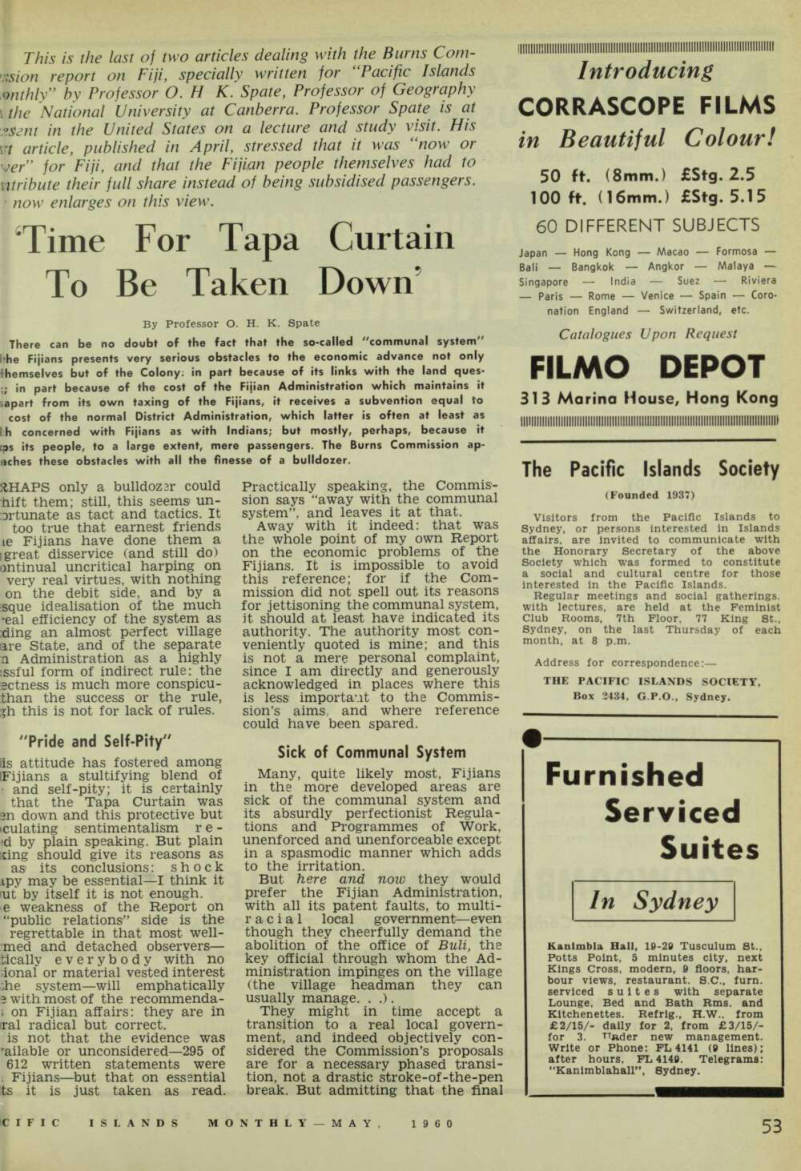
These photographs are part of a series of Fiji recently taken by Rob Wright, of the Fiji PRO. from the air. Others in the series were published in April. At top is the Korovou area, with the Tailevu hotel in the background.
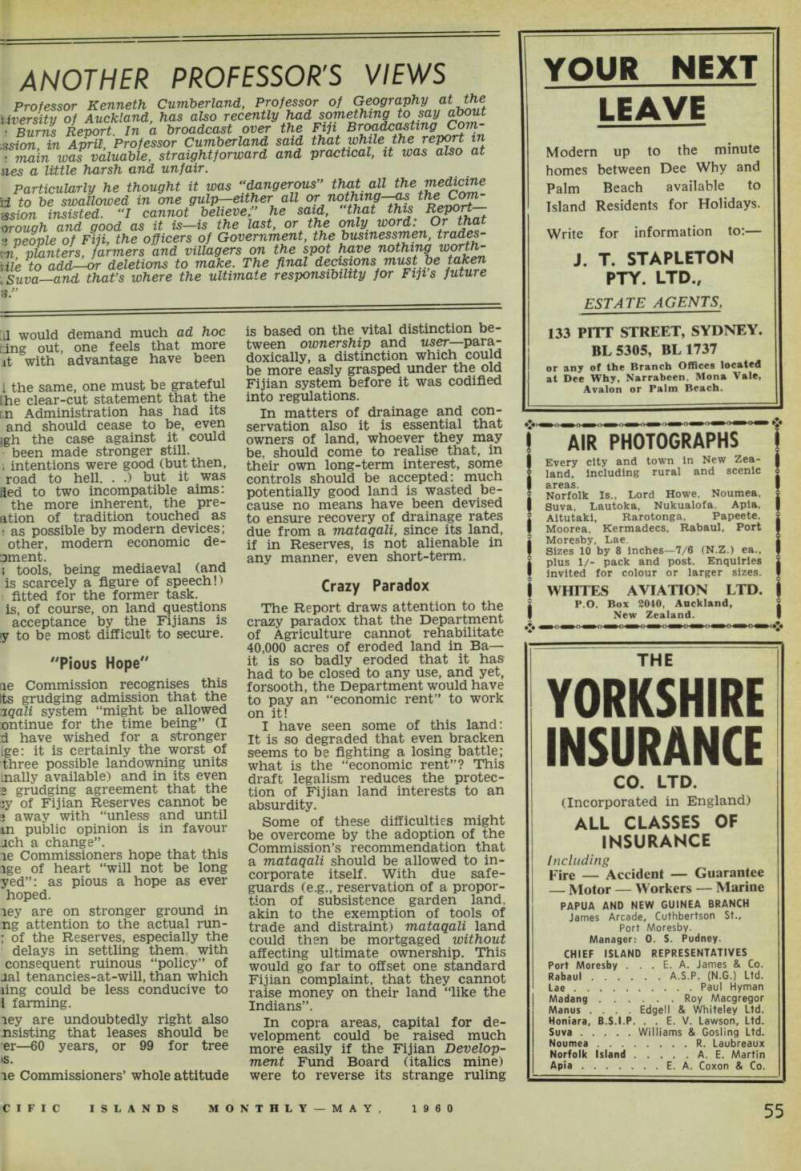
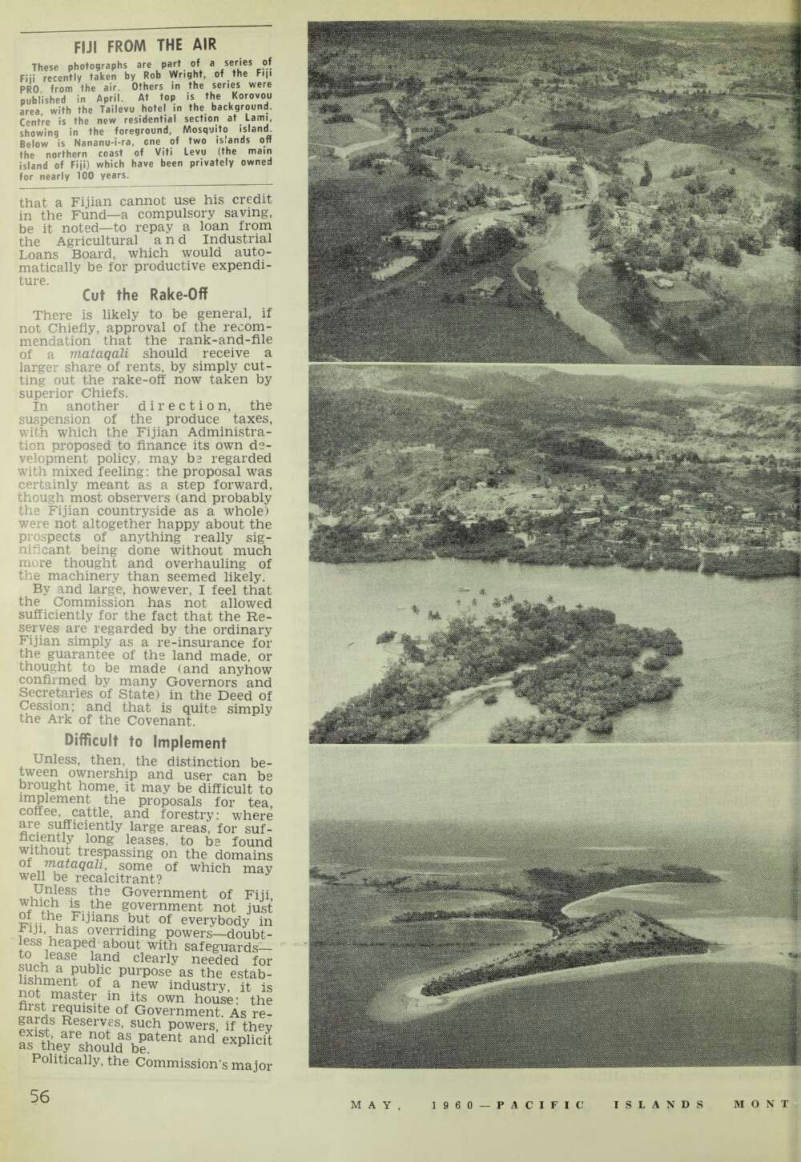
Centre is the new residential section at Lami, showing in the foreground, Mosquito island Below is Nananu-i-ra, one of two islands off the northern coast of Viti Levu (the mam island of Fiji) which have been privately owned for nearly 100 years.
mmendation for the Fijians is 3le and overdue: that three of f’ijian membsrs of Legco should Urectly elected for territorial i.ituencies. There is no reason asoever (except, perhaps, in oopinion of some self-selected irs) why Fijians should be con eed any less 1 capable of direct §g than Indians, jthink this change would be rally welcome by thoughtful nns—and there are more ghtful Fijians, not just in the <s of the “educated”, than is lily recognised. But they have given too few data to think dt, and no chance to express thinking: lacks which can be ii only by experience. )e question of a common roll did arise for the Commission; but \ time that there was some seri fiiscussion of it. The cons, from ijian point of view, are glaringly ous; but there are some pros, distribution of population is that they could not be com- Ily swamped; it may not be fble to resist such a change for ; if so, the Fijians should learn •ropes betimes.
Thorough Job
and large the Burns Corn ion has done a thorough and orehensive job: itsrecommenda resolutely acted upon, do pro some hope for a future which be easily, and not unrealistic regarded as hopeless, it that depends, once more, on • acceptance and implementa not just by Government Ord :ces and UK grants, but by solid Esustained efforts from all groups iiji. this, the Fijians themselves 1 ; a key role: they can make or and it is their own future as as that of the Colony that is ;:ake. They could easily become t they fear—a stagnant disre ted minority entrenched in their rves and their poverty.
Jit many of them are already ious to choose what seems to Lly all detached observers the forward: that of the inde lient farmers outside the com al system, the co-ops, the lit Unions. They need help and sance, more than the others; it is here that their own organ
isation, the Fijian Administration, has most conspicuously failed them.
But the Burns Riport could open new paths.
Like the Commissioners, I earnestly hope that “by becoming aware of the need of an adjustment in policy and in outlook, the peoples of Fiji may falsify these [gloomy but far too probable] projections themselves.”
I would like to add one thing: radical change will come, freely or forced, for the outside pressures are so much stronger than the potential of resistance; and if forced, so much the more pain and IOSS to Fiji and
especially the Fijians, In advocating such change, I am not speaking from an academic, doctrinaire, coldly rational stance: I have drunk far too much yaqona, in far too many villages, to be able to think of Fijians merely as ciphers in an economic sum.
But “the Fijian Way of Life” is one thing; doubtless unfortunately, yet inevitably, the Fijian people as a truly living community in the modern world is quite another. It is this latter concept which must be built up and preserved, (see next page for views of Sir Ronald Garvey.)