The Busy Kingdom
pp. 47-53 · Read in the full issue
Of Tonga
Prom Staff Writer J. P. Shortall, in Nukualofa Because Tonga has no newspapers or reporters, the world \rs little of what is going on there these days, and is apt to w the wrong conclusion that nothing noteworthy is happen in that little Kingdom. But a great many interesting develop vit projects are under way.
I are still in their infancy and ost are small, but they are, or ;ald become, important for :a Copra Board, headed by Mr. [Brown, as manager, is the is largest revenue-earning sation and provides most of :iance whereby other Govern development projects are pos te November, 1958, a lot of its :S earnings have been going :he construction of a large ieadquarters station at Havelu, or so inland near Nukualofa, present stage consists of a office block, two £7,000 copra :ouses each capable of holding tons of copra, a sack store costing over £3,000, a garage £4,000, two timber store-houses £3,500 and £2,500 respectively, ncrete block-making factory :? £3,000, a joinery shop worth a machine shop worth £2,000 ining machinery worth a r £lO,OOO, eight staff cottages from £3,500 to £5,000 each,
and a water tower and well costing
£Boo.
All these buildings should be com pleted by the end of this year, and there are plans for further ex pansion at a later date.
Board, known as the Tonga Con struction Company, was formed in
factories’ 1 wul
come under its direct control as headquarters for future public and private building projects.
In addition to its present main job at Havelu, TCC is currently also building three new schools for the Government, the first of a grotip of a dozen new schools to be built on
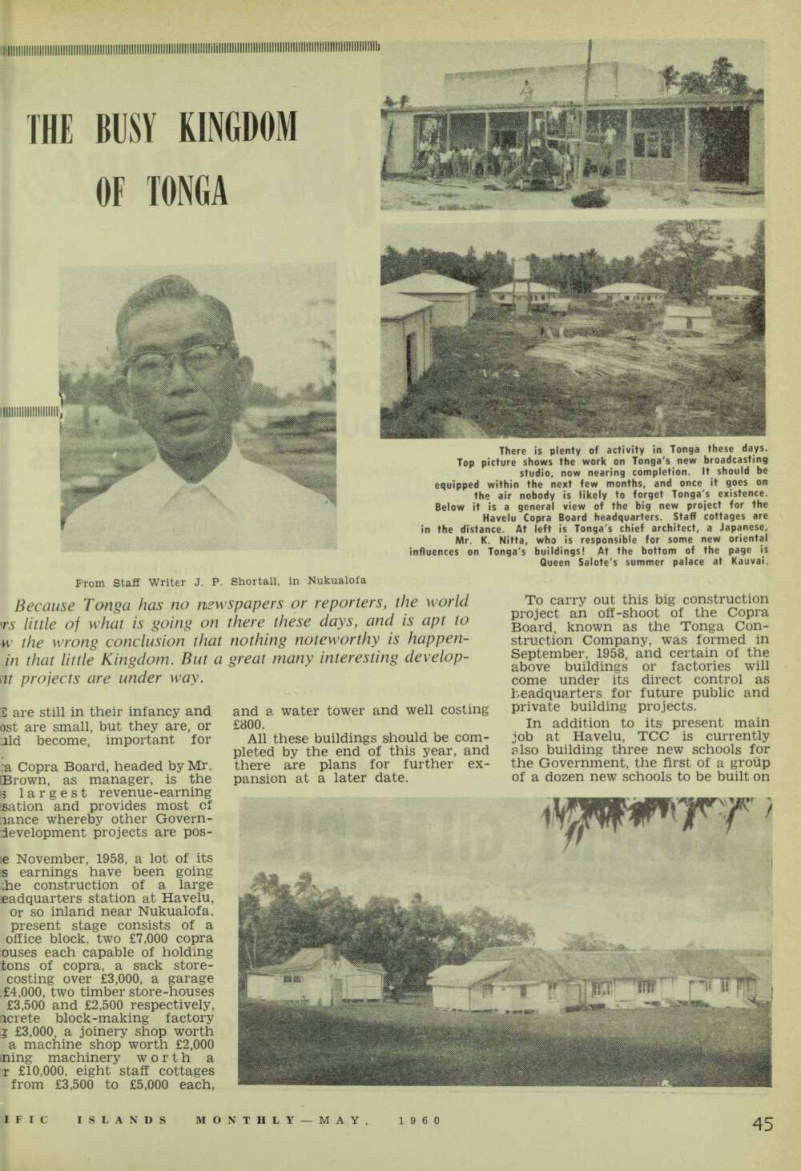
There is plenty of activity in Tonga these days.
Top picture shows the work on Tonga's new broadcasting studio, now nearing completion. It should be equipped within the next few months, and once it goes on the air nobody is likely to forget Tonga's existence.
Below it is a general view of the big new project for the Havelu Copra Board headquarters. Staff cottages are in the distance. At left is Tonga's chief architect, a Japanese, Mr. K. Nitta, who is responsible for some new oriental influences on Tonga's buildings! At the bottom of the page is Queen Salote's summer palace at Kauvai.
itapu alone in the immediate r of these will be in the Mua IMua is Tongatapu’s second c centre—and a further three Ee under way in the Kolovai :i mid-year. There are no large E 3 construction companies in so TCC has the field to it jame asi a surprise to me to ihat TCC’s chief architect is anese, Mr. K. Nitta, who does peak a word of Tongan or :h and who has distinctly Jap iideas in building construction, suggest his familiarity with ons.
Mse Influence
roof structure cf the big at Havelu is extraordinarily r e, and the sheds contain three times the amount of • that would be used for brac e roof of a similar structure i, for example. In comparison. :all strengthening seems very cottages, too, have a dis •■e style and the interior Tement varies a good deal what would be considered in design in Australia or New id. Bed-rooms are small ■e-ways very wide, some door exceptionally narrow, the le furniture beautifully made Dt mid-twentieth century, munications with Mr. Nitta, ally on technical matters, pre ixtraordinary difficulties! *e is apparently only one other in Nukualofa capable of ng Japanese, Mr. Nakao, who 7ed in Tonga for many years whose son, S. T. Nakao, is iry of Tonga Copra Board) f speaks no English, or the benefit of any Euro taff who cannot speak Tongan, who need to communicate architect Nitta, two separate *eters are required, the Tongan language is de
ficient in technical terms, the problems associated with a com plicated technical discussion be tween Mr. Nitta and, for example, Mr .H. J. Martinus, of Holland, who is supervising the Havelu job, can be better imagined than described!
One of the lessier buildings in the
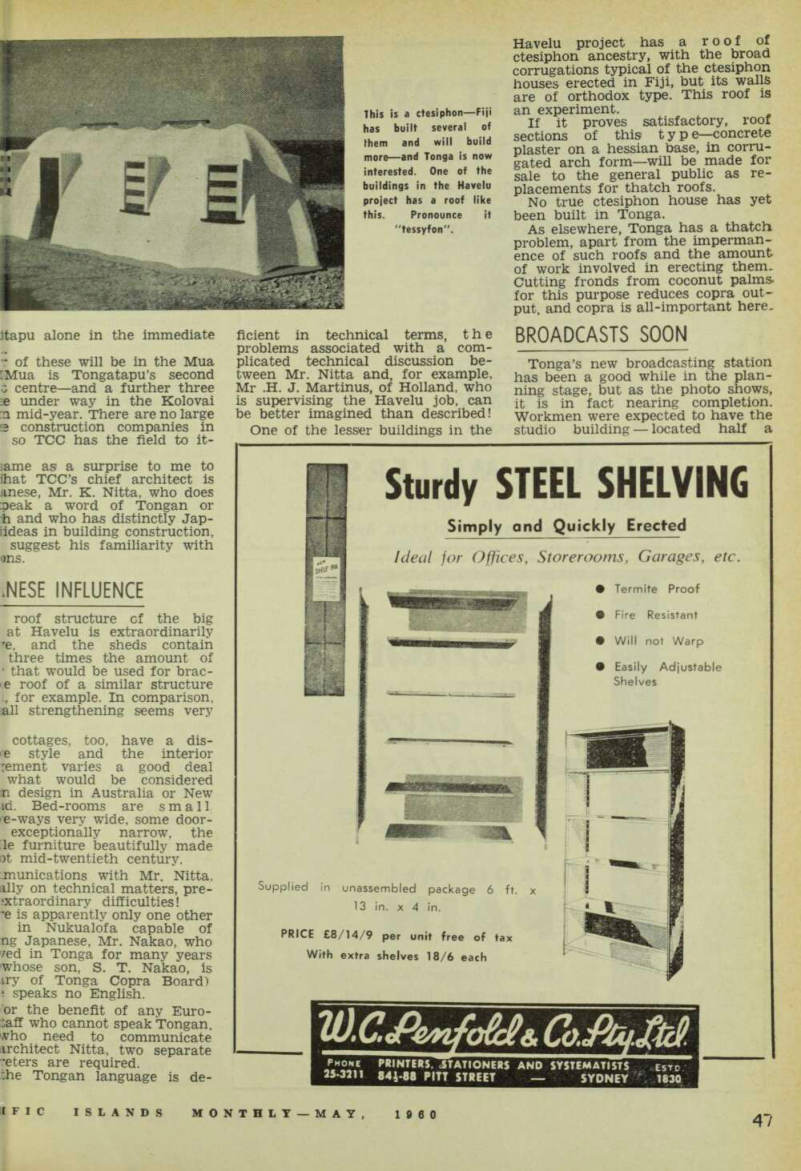
Havelu project has a roof of ctesiphon ancestry, with the broad corrugations typical of the ctesiphon houses erected in Fiji, but its walls are of orthodox type. This roof is an experiment.
If it proves satisfactory, roof sections of thisi type—concrete plaster on a hessian base, in corru gated arch form—will be made for sale to the general public as re placements for thatch roofs.
No true ctesiphon house has yet been built in Tonga.
As elsewhere, Tonga has a thatch problem, apart from the imperman ence of such roofs and the amount of work involved in erecting them.
Cutting fronds from coconut palms for this purpose reduces copra out put, and copra is all-important here.
Broadcasts Soon
Tonga’s new broadcasting station has been a good while in the plan ning stage, but as the photo shows, it is in fact nearing completion.
Workmen were expected to have the studio building located half a
This is a ctesiphon—Fiji has built several of them and will build more—and Tonga is now interested. One of the buildings in the Havelu project has a roof like this. Pronounce it "tessyfon".
mile inland just east of the Nu lofa town area—completed by* end of April and ready for thj stallation of the equipment. !
Work commenced in preparini site in March, 1959, and the b: ing was started in August.
A contract has been let for 10 k/w transmitter to Amalgan Wireless, Australia, and the e« ment should arrive within the few months.
The transmitting static] located about two miles eas Nukualofa, along the water] road.
The exact frequency has noi been settled but it will be s where between 600 kc/s and 900 in the standard broadcast l and no one is likely to f Tonga’s existence once it goe the air.
With five times the powe Suva’s main broadcast-band t: mitter it may well provide I coverage of parts of Fiji than FBC station. And that is es what Tonga is hoping.
Like the FBC service, it w; partly commercial, and Tonga i ing to be right after adver revenue from nearby territ especially from Samoa, pro from Fiji, perhaps from the ♦ and Niue.
Special programmes as vei for thisi advertising will be dir to these areas with announcer in the local languages.
The station was designed b( New Zealand Broadcasting S<l and it is likely that a New land chief engineer will be; ployed for a start.
The studio building bears inscription, BROADCAST'
Studio, Nukualofa, Toni
He Can Do Anything
At the head of Nukualofa’s; wharf is the fresh produce m which has recently undergone* modernisation and extensions refrigerated storage capacity.
Suva, produce vendors hire space for the display of their and can hire refrigerated spat storage. The ice making plant was intended to supply chippc to the tuna fishing vessel ii located here.
Presiding over the scene of a i here is Marketing Officer Dudf Blakely, who must rank as o the most versatile and talentes anywhere in the Islands-today he came to Tonga is a story self.
Mr. Blakely was in charge hibits at the Boston Musei; Science when towards the © 1952 Dr. Tom Davis and fam Rarotonga, brought their Miru to an anchorage just the road from the Museum conclusion of an eventful from Wellington, NZ.
Ideas of settling in the I
"Imai Coinage For Tonga
cbeen interrupted by the war, die interest was still there, and 53 not long before Mr. and Mrs.
I>ly made contact with the
famiiy. .
im that association, and on the c e of Dr. Davis, they decided to a look at Tonga, arriving in 1.954, where it was not long be /JMr. Blakely was appointed to resent post. nga was soon to discover, how that their new marketing ir was a man of many parts. ias certainly an artist of talent •Is and watercolours, as paint jin his home bear testimony. also proved to be a skilled jhtsman and an architect, an i.eer and a sculptor.
“ new pilot launch ’Unga was iin Auckland to his designs, and he will have a more lasting in Tonga’s history as the de ir of the new decimal coinage.
Ae New Stamps, Too
April the finishing touches being put to the models for i;oins. These display great skill Dare. om a photo of Queen Salote, Blakely first prepared sketches :i were approved by the Queen. modelling tools a sheet of jlling clay eight hundredths of ich thick and mounted on glass worked into a relief image, olaster cast of this, eight inches ameter was then made and the •ing incised round the Queen’s in profile. e lettering reads, SALOTE
Du 111 Tu’I ’Oe Otu Tonga
iich means, “Salote Tupou 111, in of all Tonga”, iis design will appear on the r and nickel coins, but the ze coins will bear the Crown of ;a encircled by ifl leaves. The ise sides will bear the denom :on, the word Tonga, and an ;ig of ifi leaves. ie denominations will be £.lO, £.025 in silver; £.Ol in nickel a fluted edge; and £OO5 and in bronze. The smallest coin thus be roughly equivalent to •thing. the Tongan decimal coinage are ready to go to the Royal „ but they will not go there the Government reaches a de ,i regarding the establishment Bank of Tonga. This matter been the subject of study by iltants and is still in the plan stage. e new decimal coinage, to re :* the existing assortment of ralian, New Zealand, and Fijian > will almost certainly appear ndent with the establishment
of the bank —unless it is decided not to establish a bank at this time, in which case the coins will probably then be issued in any case.
Mr. Blakely has also produced the design for a new 2/- stamp which will be issued next year. In salmon pink and blue it shows Tu’i Malili, the famous tortoise presented by Captain Cook and still alive today (though some doubts have been ex pressed outside Tonga as to whether this is the original tortoise), and Cook’s vessel lying offshore, with the date 1777.
As with the coins, the workman ship displayed in the stamp design is of the highest.
Beach House Again
After a period, during which Nukualofa possessed no public boarding house for visitors, the well known Government owned Beach House is again in use, and a very pleasant place it is, even if some what old-fashioned, in its cool loca tion on the waterfront road looking
out across the harbour to the reef.
Now leased by Fiji Airways, Beach House is managed by Mrs.
Bella Riechelmann. Normally, there is accommodation for nine guests but five beds are reserved by the airline for the two nights each month when the Heron from Nausori stops over. Rates are £2 per day, £lO per week, and £2B per month, and meals are reputedly excellent.
Though the air service to Tonga is currently on a non-scheduled basis, the Heron normally leaves Nausori, Fiji, on the morning of each fourth Thursday and leaves Fua’amotu, Tonga, on the return flight on the following Saturday morning.
Flying time is approximately three hours, so a businessman wishing to visit Tonga by air has a full day and a half in Nukualofa. ♦ * * Residents of Rarotonga, in the Cook Islands, who have been long badgering the Administration for a strip of tar-sealed road through the main township, would be very envious of Tongatapu’s fine network of sealed main roads.
True, the secondary roads are sometimes very secondary, and some of the main ones are a little narrow, but compared with most of Fiji, motoring here is a pleasure.
Their Roads Are Good
Being flat, and mainly coral in foundation, roadmaking is easy on this island. A great deal of rain was falling on Tongatapu in early April, but between these downpours there was time for me to make a pleasant run out to one of the less publicised sights—Queen Salote’s summer palace at Kauvai, on the shores of the inner lagoon and looking across towards the township of Mu’a.
The road down to this palace is closed when the Queen is in resid ence, but Queen Salote had left some days previously for New Zea land. The building is European style though with mainly thatched roof, but the interior decoration is pure Tongan, While on the subject of motoring,
Nukualofa has for some time been without a public boarding house for visitors but now the well-known Beach House is back in use again (right) and a very pleasant place it is.
Mr. Dudley M. Blakely, with an enlarged cast of Tonga's new decimal coinage, the design of which he has executed. Mr. Blakely has also designed some new stamps.
fia’s traffic police have just two of their Land Rovers with latest Pye VHF radio equipment iare thus able to keep in touch a central base station from <st any point on the island. ♦ ♦ ♦ olic eating houses in Nukua- Eare few and not very inviting jpearance, but perhaps the most intable is a curious little ner-house well along the ffront road towards Mafanga, n opened a few months ago and the name of Pilly India, er a cup of tea, “Pilly”—he’d Uly if there was still a “b” used ne Tongan language—told his =e of only eight Indians in mtapu, Pilly was bom in India went to Fiji many years ago, « he became a chef at the ]d Pacific. Some years later cl Salote made inquiries in Suva palace chef and Pilly was the irecommended.
Y From India
to there he possessed a tricky wisting Indian name which few ;onga could readily pronounce, )om there on he became Pilly Eat was a good job and he was treated, said Pilly, but for a who puts his heart into his [palace life wasn’t so good. Too ▼ interruptions and too many ie dropping in. 11 have breakfast ready for Her isty at eight o’clock but she It not have time to eat it until when lunch would be almost and that would have to be warm until four o’clock. You do that with good food, so a while I asked to be released.” passed Pilly India’s, Ta’ua har and the Catholic Mission, is :ier little harbour which is be ►repared as a bulk oil terminal TOss the road from the dredged our a gang of men were busy oril levelling the site where the inks will soon be erected. The has been delayed by negotia between Government and oil ►anies, and also by a steel ers’ strike in Australia, but it not be long now before the 5 go up. anwhile the oil barge Lolo m’ia, built in Auckland last lies idle. Towed by the ocean Hifofua, this barge will bring ie oil from Samoa or Fiji, ring the war the Americans had oil tanks in this area for ship ering, but they were all dis ced later. * * ♦ e of Nukualofa’s main streets jelled Railway Road. Was it in ?d that Tongatapu have a rail at some time?
A senior Tongan official explained that Nukualofa did in fact once have a railway, or anyway, a tramway.
He could not recall any Puffing Billys, in fact as far as he could remember the trucks were moved by man-power and were used for mov ing cargo only. Off-hand, he thought that the track had been pulled up in the 1920’s—and a railway was one of the things that Tonga was not planning to establish at present! * * * The mobile child welfare clinic is not peculiar to Tonga, but it was in business under a big shady tree on the side of a Nukualofa road one morning in April, with Sister Mulhern, Nurse Kesaia, and TMP Fifita busy dealing with a queue of
mothers and babies.
It was an occasion for a photo and one was taken, but—now take it easy, ladies!—l just can’t find the negative which seems to have been lost in the processing. I’ll try again, same time, same place, one of these days.
Meanwhile, apologies.
Two classrooms of a Rarotonga school, and an entire school at Manihiki, were destroyed by fire on the same day recently. Stationery supplies and the entire school library was lost in the Rarotonga fire at Arorangi school. Some furni ture was saved at the Tukou School, Manihiki, but the loss is a serious blow