Tropicalitiel
pp. 83-84 · Read in the full issue
Pacific Islands Monthly
Magazine Section
How can you define in ::ency? And can something be ilecent to one group of people ich is not indecent to another?
HAT seems to be the fine point at the back of a minor storm which broke out in Rabaul re utly over the circulation of a jendar complete with 12 pictures ipin-ups in various stages of dress • undress). rhe matter was raised by the Rev. :»sley Lutton, Chairman of the ■thodist Overseas Mission in New Rain. He said that in a country [jpled mainly by natives not yet lly civilised, the greatest care was sded in the circulation of pub led material.
Ar. Lutton said he was not bring l up the matter as a parson, but a man with a family and as a m interested in the welfare and /elopment of the native races, le told a meeting of Rabaul Town visory Council that he considered ; pictures were “downright in sent, and should be collected and rnt without delay.” The advisory mcil, which is an honorary body pointed to advise the Administra n on matters of public interest, 'erred the calendar to the Admin ration for investigation, rhe council asked the Adminis ition to decide whether the lendar came under the definition an indecent publication, and if to take remedial action.
Officials with some understand * of the legal technicalities in- Lved have since agreed that the ;tures are not indecent in any Rneable sense. In any case, they re imported and would not other se have passed strict customs •utiny.
According to a Rabaul corre-
spondent, there is a general opinion that Mr. Lutton and the council missed the point of the matter by looking at it in the light of existing law. The correspondent says some people feel it would have been better to have attacked the matter direct from the native angle by stressing the need for a more cir cumspect type of publication in a
predominantly-native country.
In expressing this opinion the critics are not, of course, detracting from the basic value of Mr. Lutton’s remarks, but are merely criticising the angle of the attack.
In fact, it is a generally-expressed feeling among the people of the Territory that the utmost care is necessary in this sort of thing. On a number of occasions there have already been public attacks on some picture theatre posters which have been spread over walls in Port Moresby and Rabaul.
Dearer With The Garbage
LATEST in the line of quaint notices which appear in Islands news-sheets is one from Tarawa.
It’s a Government notice about the private use of a couple of Govern ment vehicles. The notice says, in part: “The appointed driver for each vehicle will sign the log book for Government trips, and for pri vate runs the hirer will have to sign even though the vehicles are driven by the official driver. Charges for private use are as laid down at paragraph II of Minutes of the
Heads of Departments Conference on September 2, 1958 —namely, 1/3 per mile with a minimum of 4/6 per trip in the Land-Rover, and 1/9 per mile in the garbage truck.”
Is the higher charge to discourage father from taking the family to the movies in the garbage truck, or is it just that people cart their own garbage up there? —JPS.
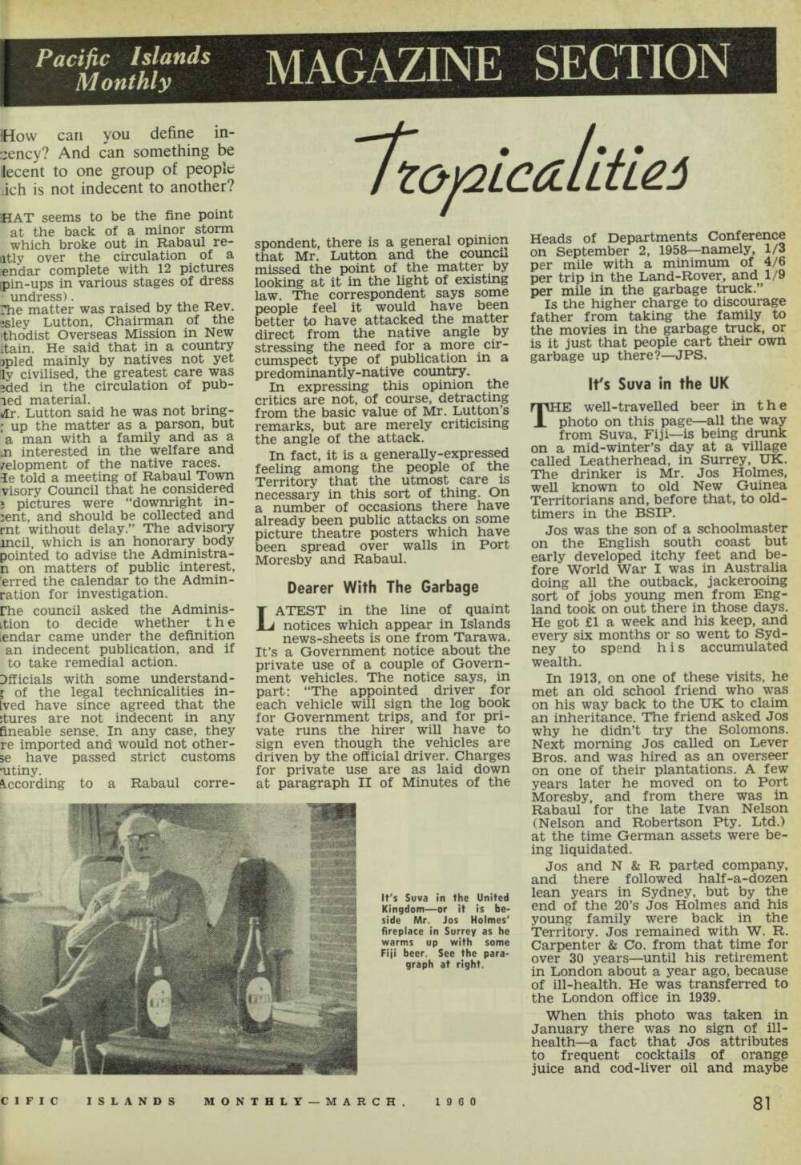
It's Suva in the UK r:E well-travelled beer in the photo on this page—all the way from Suva, Fiji—is being drunk on a mid-winter’s day at a village called Leatherhead, in Surrey, UK.
The drinker is Mr. Jos Holmes, well known to old New Guinea Territorians and, before that, to old timers in the BSIP.
Jos was the son of a schoolmaster on the English south coast but early developed itchy feet and be fore World War I was in Australia doing all the outback, jackerooing sort of jobs young men from Eng land took on out there in those days.
He got £1 a week and his keep, and every six months or so went to Syd ney to spend hi s accumulated wealth.
In 1913, on one of these visits, he met an old school friend who was on his way back to the UK to claim an inheritance. The friend asked Jos why he didn’t try the Solomons.
Next morning Jos called on Lever Bros, and was hired as an overseer on one of their plantations. A few years later he moved on to Port Moresby, and from there was In Rabaul for the late Ivan Nelson (Nelson and Robertson Pty. Ltd.) at the time German assets were be ing liquidated.
Jos and N & R parted company, and there followed half-a-dozen lean years in Sydney, but by the end of the 20’s Jos Holmes and his young family were back in the Territory. Jos remained with W. R.
Carpenter & Co. from that time for over 30 years—until his retirement in London about a year ago, because of ill-health. He was transferred to the London office in 1939.
When this photo was taken in January there was no sign of ill health—a fact that Jos attributes to frequent cocktails of orange juice and cod-liver oil and maybe
It's Suva in the United Kingdom—or it is be side Mr. Jos Holmes' fireplace in Surrey as he warms up with some Fiji beer. See the para graph at right.
«nmp nf the brew shown in the nicture He has married again since living in the UK and he and the second Mrs Holmes live in a pleasant cottage at Leatherhead, about 25 miles from London.
With the central heating raised to full pressure, the temperature is such that a good draught of Fiji (or other) beer can be enjoyed at any time. Many old Territorians find their way to this Leatherhead address.
Jos Holmes’ daughter by his first marriage is Mrs. Heather Seale, wife of District Commissioner Seale of the NG Eastern Highlands. A son Geoff was killed in the early RAF bomber raids on Germany during the last war.
Thou'll Find Out What THpv Eat I hey II rma uut wnar iney cai HOW much food do the natives of Papua-New Guinea produce every year? The question may soon be answered as a result of the Territory’s first survey of native subsistence agriculture, which begins this year.
The operation will form part of the world-wide agricultural census
which the Food and Agriculture Or ganisation of the United Nations sponsors every decade, In Papua-New Guinea, agricultural officers and field-workers of the De partment of Agriculture, Stock and Fisheries will measure, over a 12month period, the output of all native subsistence gardens, of fruit and nut trees and also of cash crops Estimates will likewise be made of the importance of game and other foods gathered from the bush, also fish.
The measurements will be made on samples chosen at random from the many thousands of gardens scattered throughout the Territory.
Statisticians will then analyse these figures and from them project the total food production of the Terri tory’s 1,832,000 native people.
Reliable estimates of total food production will help the Adminis tration in its future planning.
Rock to Home-Produced Pprnrdmnc netorumgs QUVA’s newest industry is the manufacture of disc recordings by local Fiji artists, The firm, South Seas Records
Company, has been jointly forn by well known travel agent Har Hunt and Mr. R. Thurley, until cently deputy chief engineer w me Fiji Broadcasting Service. ] Thurley, who has been in the ra and recording business for over years, will supply the techni know-how, and Mr. Hunt, with wide connections overseas as v as in Fiji, should be able to fine worthwhile export market as v as a thriving local market.
The venture should open gr opportunities for local singers a rnusica l groups and should be gc publicity for Fiji overseas.
The company will meet the creasing call for Indian music' r iji, too. Recordings of local Indi artists should have high sales /o c ® l( ? n y- Meanwhile, the fi 33.1/3rd long-play record to be p: duced of West Samoan music 1 now been issued in Apia. The d contains 14 numbers by Siaki Lab and his Samoan Islanders, and les and his Samoan Serenaders.
The record was produced by Sair Records, whose manager, Mr R Rankin, says, “We don’t claim tli< songs are the songs as Samoans sa them before the advent of Eui peans. They are Samoan songs sung today, but they will g listeners as much enjoyment as t Samoans get in singing ther Samoa Records already has standard recordings of Samo music.
Tobacco War
r.E native tobacco issue has j into the news in New Guii lately. Treasurer H. H. Re< m February denied there had b( any official, mercenary reason retaining the compulsory issue twist tobacco in native lab< rations.
He was commenting on sugg tions that the Government 1: decided to retain the tobacco iss because if it were deleted i Treasury would lose £90,000 a v on import duty.
Mr. Reeve admitted it was qr correct that the Administration 1 considered deleting the tobai issue at one stage, because medical advice that smoking \ conducive to cancer. But on “si sequent investigation” there was opinion that the smoking of tn tobacco was not nearly so injuri< as the smoking of other tobac —so it was decided to keep 1 trade twist.
“Withdrawal of the tobai issue,” added an official Administ: tion statement, “might possi defeat its object from the hea angle as many workers woi probably purchase ready-rm cigarettes or refined tobacco, havi more injurious effects than twis Have the cigarette firms s€ that?