The Highlands Have
pp. 77-81 · Read in the full issue

A Forward Look
From a Correspondent in the New Guinea Highlands.
The central Highlands of New Guinea, on green, cool plateaus at anything from 5,000 to 7,000 ft, have been in the few years since the end of the war, not so much a locale as a way of life.
BUT already the pace is changing. There are new faces and new developments everywhere.
The natives are learning what the world is all about. The settlers themselves have become organised —and although the experimenting and the pioneering is not yet over—there is a general purpose now.
Everyone seems to know better what can be done and what they should aim for.
Coffee has probably, more than anything, helped to establish this sense of purpose. Coffee plantations and new plantation homes have now been developed on what was idle land, and during 1960 in the Wahgi Valley about 600 tons of coffee will be produced—from only a small part of the total planted acreage, for much of it has yet to bear.
Administrator's Tour The Administrator of P-NG, Brigadier Cleland, with Mrs. Cleland, have just toured through the Wahgi —his first visit in two-and-a-half years. They have seen the differences and remarked on them.
Brigadier Cleland even threw some tributes to the work of the settlers, and tributes like that don’t come too often from the Administration.
“I am convinced the Wahgi settlers are doing a first-class job and deserve the fullest support of all concerned,” he said. “They, like other settlers in other parts of the Territory, are a responsible body, and seek to work amicably with the Administration. The native situation throughout the district is good, and the task ahead is economic development.”
It’s true enough, of course, and it’s good to get some support on those points. The Highlands of New Guinea will lead the Territory one day—and the time is not far off either.
The Administrator’s Highlands tour started in Goroka, where among other things he visited the Admin istration’s stud piggery.
A Showplace
This piggery is stocked with Canadian Berkshires, and has been established at the Animal Industries Centre, under the supervision of the manager, Mr. R. R. Bell, an old Territorian of more than 30 years’ residence. Purpose of the stud is to supply high-grade breeding stock to
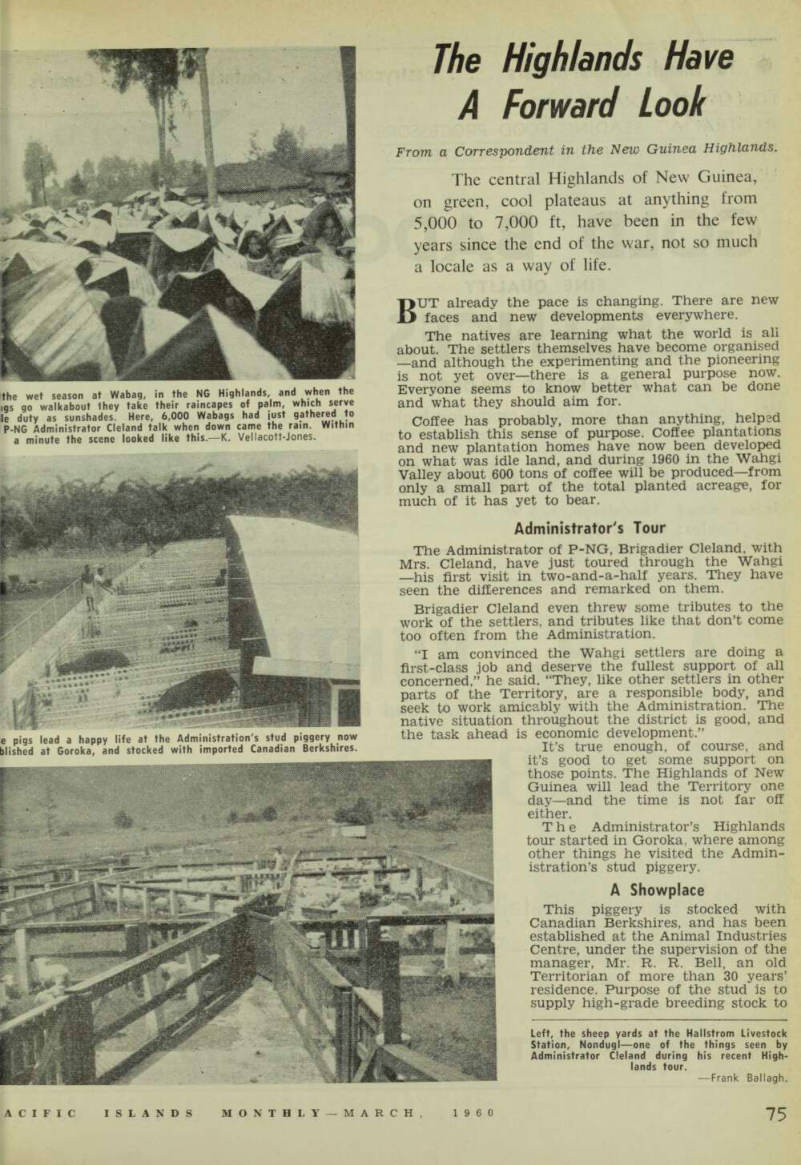
[?] the wet season at Wabag, in the NG Highlands, and when the [?]gs go walkabout Ihey take their raincapes of palm, which serve [?]le duty as sunshades. Here, 6,000 Wabags had just gathered to P-NG Administrator Cleland talk when down came the ram. Within a minute the scene looked like this. —K. Vellacott-Jones.
[?]e pigs lead a happy life at the Administration's stud piggery now blished at Goroka, and stocked with imported Canadian Berkshires.
Left, the sheep yards at the Hallstrom Livestock Station, Nondugl—one of the things seen by Administrator Cleland during his recent High lands tour. —Frank Ballagh.
European and native farmers in the Highlands, and to enable them to cross the hardy, but low-grade, village pigs with good boars.
There are first-class buildings of selected river stones, built into cement walls, and the pens have all mod. cons—a better set-up even than the pigs probably have a right to expect. With the present stud the piggery will have an annual output of 240 pigs.
Although the piggery was de signed as a practical venture and not as a show place, it certainly is a show place and will be even better soon, thanks to the work of Mr. Bell.
A well known Territory businessman who recently visited the stud re marked that if the Government ever put the place up for sale he would make sure he got in the first bid.
Also at Goroka, and run by pri vate enterprise, is a brickyard turn ing out the Territory’s only baked clay bricks. Cement bricks are be ing used in several places in the Territory.
Goroka Bricks The Goroka clay deposits are be ing operated by New Guinea Brick & Pottery Ltd., with Mr. E. J. Gane the managing director. The works were started about two years ago experimentally, and will soon be able to turn out about 10,000 bricks a day. At present they produce 1,500 bricks a day.
Mr, Gane, who in February went to Melbourne to show CSIRO officers samples of his bricks, considers that the local clay could also be used for the manufacture of roofing tiles and agricultural drain pipes. He is investigating machinery costs for this work during his Australian visit.
The Goroka brick industry has attracted the attention of the natives, some of whom have already decided to build brick houses. There is a steady rise in cash income among the natives and it’s natural they will be wanting permanent homes. The cost of building a brick house in the Goroka area from locally made bricks is only slightly higher than it is for timber.
Missions at Work From Goroka, Brig. Cleland went on to Nondugl and looked at some cattle. He also opened the Wahgi Valley Club at Minj. He also met a vast number of Wahgi natives who came for miles by foot and by bicycle to hear him talk, and to talk to him. Along the trail, at Minj, Banz and Mt. Hagen, he interviewed members of Farmers & Settlers’ As sociations —and there was some plain speaking there.
He visited many Christian Missions in the Highlands, includ ing several in the Lai Valley towards Wabag—which must be about the most heavily populated Mission area in the South Pacific. By aircraft
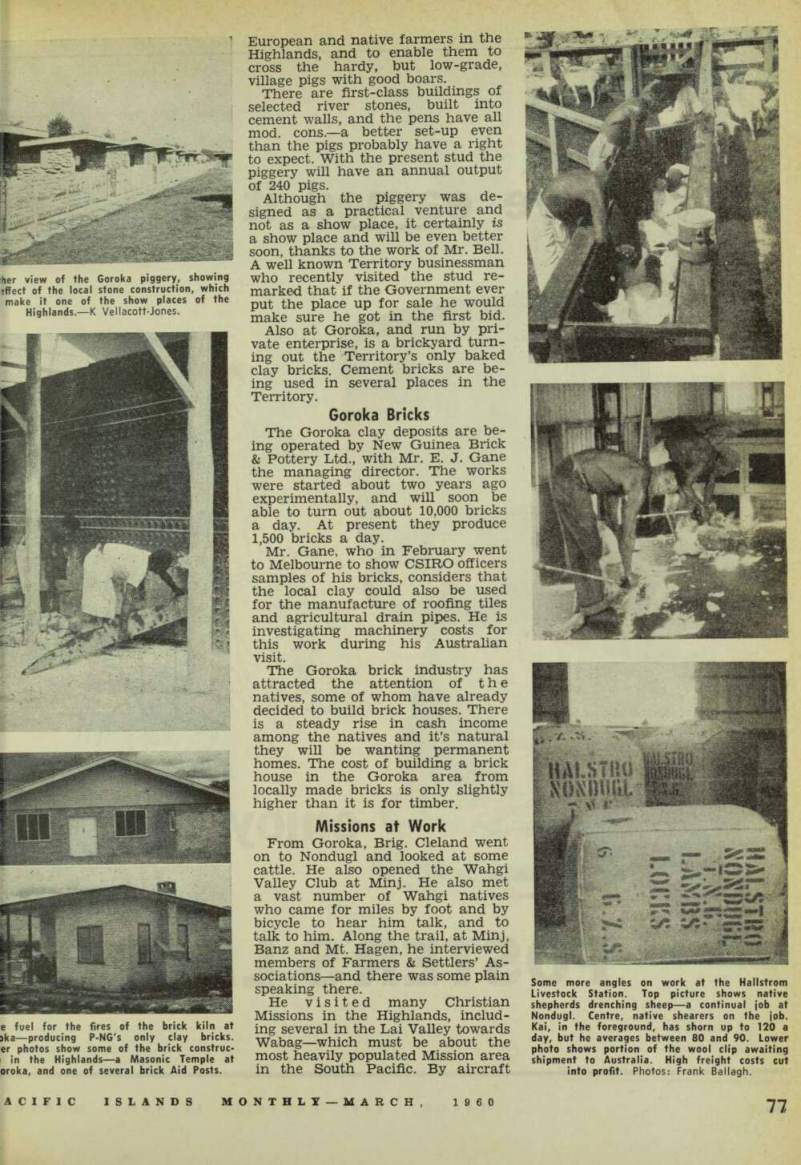
[?]her view of the Goroka piggery, showing [?]ffect of the local stone construction, which make it one of the show places of the Highlands.—K Vellacott-Jones.
[?]e fuel for the fires of the brick kiln at [?]ka —producing P-NG's only clay bricks, [?]er photos show some of the brick construc in the Highlands—a Masonic Temple at [?]oroka, and one of several brick Aid Posts.
Some more angles on work at the Hallstrom Livestock Station. Top picture shows native shepherds drenching sheep—a continual job at Nondugl. Centre, native shearers on the job.
Kai, in the foreground, has shorn up to 120 a day, but he averages between 80 and 90. Lower photo shows portion of the wool clip awaiting shipment to Australia. High freight costs cut into profit. Photos: Frank Ballagh.
Dng the valley you pass over one ission station after another.
An Australia Day Sports meet g, held at Wabag on February 1, is attended by the Lai Valley immunity Government and ission people from Wabag, Laiagam id Wapenamanda. There were lout 75 Europeans playing golf, nnis, badminton and volley ball great many of them Americans.
For the opening of the Wahgi alley Club at Minj more than 150 ;ople turned up, from as far afield i Lae and Madang. Among the ae visitors were Mr. Des Ashton, 3ting Mor o be District Com issioner, and Mrs, Ashton. Mr. shton is club patron—when he was DO at Minj he made the first step wards building the golf course ad tennis courts, and from that art the present club has grown.
The clubhouse includes children’s >oms, with bunks, kitchen, bar and
verandah—it overlooks the golf course and has a magnificent view of the Wahgi Valley. The building was done for the most part by voluntary labour. Club members bought logs from local natives, and then did their own saw-milling.
A striking feature of the interior decorations for the opening ceremony was a 28-foot long mural showing a tropical beach scene, done by Miss Penny Pile—l B-year-old daughter of Mr. and Mrs. B. Pile, of the Mintal coffee plantation, near Minj. She was assisted by Mrs. V.
Nisbet.
First Since 1953 For Mrs. Cleland this was her first visit to the Wahgi Valley since 1953 when the entire European popula tion, she recalled, was 22 people.
There were only three permanent houses in Mt. Hagen.
Mrs. Cleland said, after she got back to Port Moresby, that she was enormously impressed not only with the progress but by the young wives of the valley. “They are charming people pioneering with their husbands, helping to build their own grass houses and living in them cheerfully until something better came along,” she said. “Each of them seemed to have a bevy of young children. None of them was daunted by the thought that it might yet be some years before their coffee brought in adequate income”.
No, the Wahgi Valley is not daunted. It has a forward look these days.
[?]e of the Wahgi Valley settlers (above) after [?]luncheon given for the Administrator and [?].Cleland by the Wahgi Valley Farmers and [?]tiers Association, at the home of Mr. Peter [?]beck, near Banz. Brigadier Cleland, wearing dark tie, is on the right, next to Mr. S. M. [?]ley, Acting Western District Commissioner.
This is part of the crowd of 14,000 natives who turned up for a meeting with the Administrator at Mt. Hagen. The airstrip was black with figures.
[?] the Church of the Nazarene Mission, Kudgip, [?]e Rev. Condor greets the Administrator and [?]rs. Cleland. All the buildings at the Mission are of European materials.
Photos this page: K. VeMacott-Jones.