The Men Who Made
pp. 31-33 · Read in the full issue
Fiji's Long-Awaited Blueprint The Men Who Made The Burns Report
By a Staff Reporter
The lady was in difficulties. Her evening dress zipper, at 5 back, had become unfastened and her shawl was entangled th it. With every tug of the wrap, trying to unsnarl it as she wed to join a party of important guests at a hotel in Suva, > zipper slid further down much to her embarrassment.
7ELL-GROOMED, silver-haired
ientleman of this pre-dinner xoup rose from the bamboo ie when he saw her plight, iyed the offending fastener with a few deft movements, itly released the shawl, zipped gown, and again calmly sat beside Lady Burns. Sir Alan saved the situation!
Suva businessman, watching as ;ood in the Suva hotel’s foyer cool August evening, remarked genuine feeling: “I certainly he can fix Fiji’s troubles as y as that!” small incident, but the com was characteristic of the way / Fiji people were pinning their on Sir Alan Burns and his colleagues, Professor A. T. ock and Mr. T. Y. Watson, then ji as members of a Commission ;port on Fiji’s inter-racial and cmic position and future de >ment.
Mooted First in 1952 painstaking personal research the past, shrewd and intelligent rvation of the present, and ing willing ears to the ideas of tnd sundry for the future are criteria, then Fiji’s hopes should
not be dashed when the Burns Com mission Report is released in late March. ..
Although Fiji Legislative Council transmitted to Whitehall a formal resolution for a Commission of In quiry as far back as 1952, a Com mission was not appointed by the Colonial Office until August, 1958.
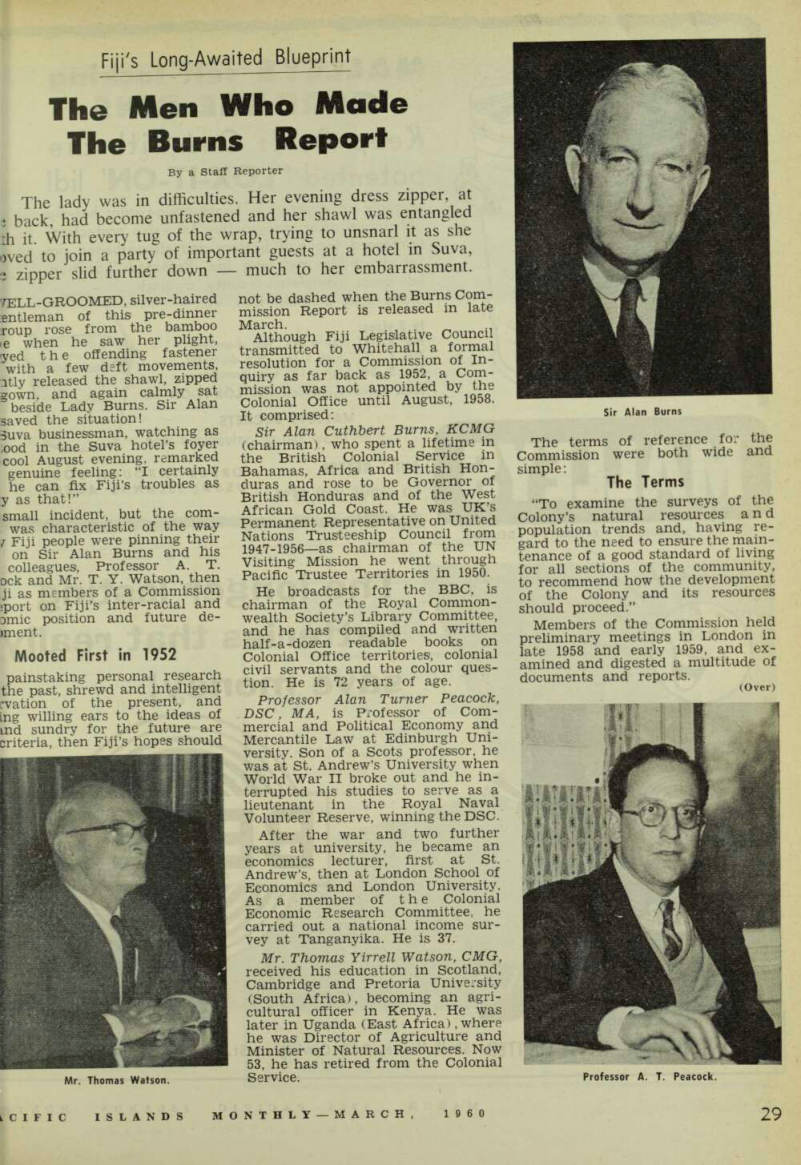
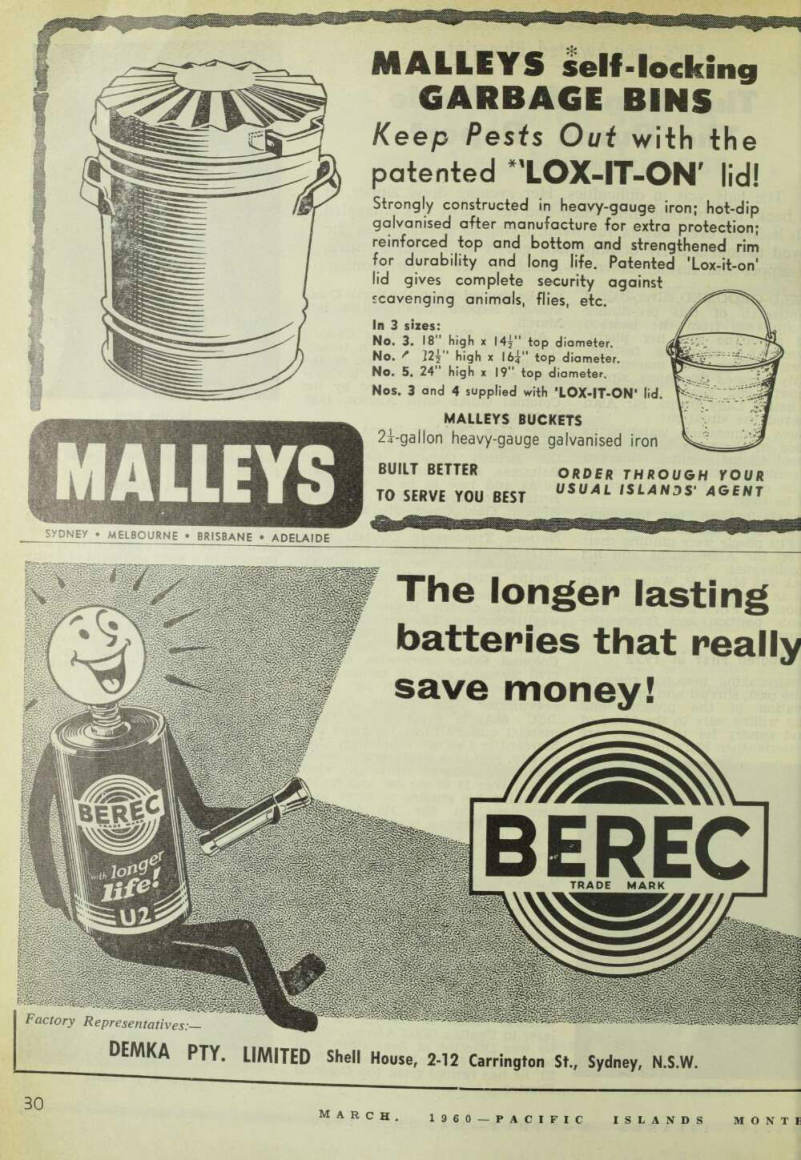
It comprised: Sir Alan Cuthbert Burns, KCMG (chairman) , who spent a lifetime in the British Colonial Service in Bahamas, Africa and British Hon duras and rose to be Governor of British Honduras and of the West African Gold Coast. He was UK’s Permanent Representative on United Nations Trusteeship Council from 1947-1956—as chairman of the UN Visiting Mission he went through Pacific Trustee Territories in 1950.
He broadcasts for the BBC, is chairman of the Royal Common wealth Society’s Library Committee, and he has compiled and written half-a-dozen readable books on Colonial Office territories, colonial civil servants and the colour ques tion. He is 72 years of age.
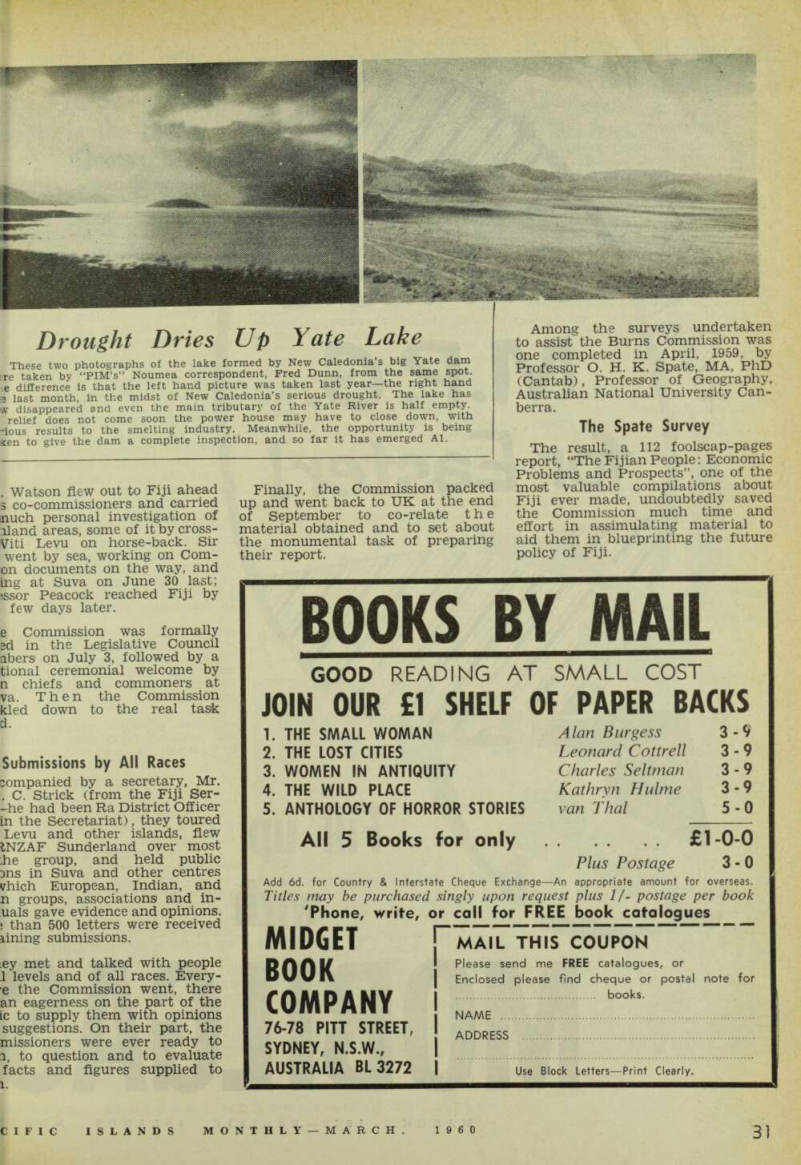
Professor Alan Turner Peacock, DSC, MA, is Professor of Com mercial and Political Economy and Mercantile Law at Edinburgh Uni versity. Son of a Scots professor, he was at St. Andrew’s University when World War II broke out and he in terrupted his studies to serve as a lieutenant in the Royal Naval Volunteer Reserve, winning the DSC.
After the war and two further years at university, he became an economics lecturer, first at St.
Andrew’s, then at London School of Economics and London University.
As a member of the Colonial Economic Research Committee, he carried out a national income sur vey at Tanganyika. He is 37.
Mr. Thomas Yirrell Watson, CMG, received his education in Scotland, Cambridge and Pretoria University (South Africa), becoming an agri cultural officer in Kenya. He was later in Uganda (East Africa), where he was Director of Agriculture and Minister of Natural Resources. Now 53, he has retired from the Colonial Service.
The terms of reference for the Commission were both wide and simple: The Terms “To examine the surveys of the Colony’s natural resources and population trends and, having re gard to the need to ensure the main tenance of a good standard of living for all sections of the community, to recommend how the development of the Colony and its resources should proceed.”
Members of the Commission held preliminary meetings in London in late 1958 and early 1959, and ex amined and digested a multitude of documents and reports. (Over)
Mr. Thomas Watson.
Sir Alan Burns
Professor A. T. Peacock.
. Watson flew out to Fiji ahead s co-commissioners and carried much personal investigation of iland areas, some of it by cross- Viti Levu on horse-back. Sir went by sea, working on Com on documents on the way, and ing at Suva on June 30 last; >ssor Peacock reached Fiji by few days later. e Commission was formally sd in the Legislative Council fibers on July 3, followed by a tional ceremonial welcome by n chiefs and commoners at va. Then the Commission kled down to the real task d.
Submissions by All Races
companied by a secretary, Mr. . C. Strick (from the Fiji Ser -he had been Ra District Officer in the Secretariat), they toured Levu and other islands, flew INZAF Sunderland over most ;he group, and held public 3ns in Suva and other centres vhich European, Indian, and n groups, associations and in uals gave evidence and opinions. * than 500 letters were received lining submissions. ey met and talked with people .1 levels and of all races. Every e the Commission went, there an eagerness on the part of the Lc to supply them with opinions suggestions. On their part, the missioners were ever ready to i, to question and to evaluate facts and figures supplied to i.
Finally, the Commission packed up and went back to UK at the end of September to co-relate the material obtained and to set about the monumental task of preparing their report,
Among the surveys undertaken to assist the Burns Commission was one completed in April, 1959, by Professor O. H. K. Spate, MA, PhD (Cantab), Professor of Geography, Australian National University Can berra.
The Spate Survey
The result, a 112 foolscap-pages report, “The Fijian People: Economic Problems and Prospects”, one of the most valuable compilations about Fiji ever made, undoubtedly saved the Commission much time and effort in assimulating material to aid them in blueprinting the future policy of Fiji.